


Shopping cart abandonment rate is a fancy term for a simple, painful problem: it’s the percentage of shoppers who put items in their cart but bail before paying you. Think of it as the ultimate measure of lost sales and a huge red flag pointing to friction in your customer’s journey.
Understanding Shopping Cart Abandonment Rate
Picture a customer in a real-world store. They’ve loaded up their basket, walked all the way to the register… and then just left it there and walked out. That’s exactly what shopping cart abandonment rate tracks for your online store.
This isn’t just some number to glance at in a report. It’s one of the most vital health indicators for your business, showing you precisely where your hard-earned revenue is slipping through the cracks. A high rate is a clear signal that something is wrong—maybe it’s your checkout process, unexpected costs, or a simple lack of trust.
Calculating Your Abandonment Rate
Figuring out this metric is thankfully pretty simple. You just need to compare how many people created a cart versus how many actually finished the purchase. The formula gives you a clean percentage of how many potential sales you lost at the finish line.
Formula: (Number of Completed Purchases ÷ Number of Carts Created) x 100 = Your Cart Conversion Rate. Then, 100% – Your Cart Conversion Rate = Your Shopping Cart Abandonment Rate.
Getting a handle on this calculation is your first real step toward diagnosing any problems. For a more detailed breakdown, check out our guide on how to calculate your cart abandonment rate.
To make it even clearer, here’s a quick summary of what this metric is all about.
Cart Abandonment Rate At a Glance
| Concept | Explanation |
|---|---|
| Definition | The percentage of online shoppers who add items to their cart but leave the site without completing the purchase. |
| Formula | 100% - ((Number of Completed Purchases ÷ Number of Carts Created) x 100) |
| What It Measures | Lost sales opportunities and potential friction points in the checkout process. |
| Why It’s Important | Directly impacts revenue, customer experience, and overall conversion rates. A high rate signals underlying issues that need to be fixed. |
| Average Industry Rate | Around 70.19%, meaning roughly 7 out of every 10 shoppers abandon their carts. |
| Primary Goal for Stores | To understand the “why” behind the abandonment and implement strategies (like SMS recovery, UX improvements) to lower the rate and recapture lost revenue. |
This table boils it down, but the real power comes from understanding the story these numbers tell about your store’s performance.
Why This Metric Matters So Much
This isn’t just a passive statistic; it’s an active alarm bell for your store’s health. The global average shopping cart abandonment rate is a massive 70.19%. What’s even more telling is that this number has been climbing for years, up from 59.8% back in 2006.
This trend shows just how tough it’s getting to turn a casual browser into a paying customer. You can find more details on these cart abandonment statistics on VWO.com.
When your rate is high, it means the vast majority of people who were interested enough to add something to their cart are leaving at the very last moment. By focusing on bringing this number down, you can unlock some serious growth.
- Increase Revenue: Even a tiny improvement can lead to a huge jump in sales. We’re talking about recovering money that was almost yours.
- Improve User Experience: Finding out why people are leaving helps you fix frustrating parts of your website that you might not even know about.
- Boost Conversion Rates: A smoother, more trustworthy checkout process doesn’t just reduce abandonment—it naturally leads to more completed orders overall.
Why Shoppers Really Abandon Their Carts
Figuring out your shopping cart abandonment rate is a good start, but the real magic happens when you understand why a customer who was ready to buy suddenly walks away. The decision to ditch a cart isn’t just a random click; it’s almost always a gut reaction to friction, surprise, or doubt right at the finish line.
Think about it: your customer has already mentally bought the item. They’re picturing it in their home. Then, boom—they hit an unexpected roadblock at the last second. This completely shatters their buying momentum and is the root cause of nearly all abandoned carts. To get to the bottom of this, we need to step into our customers’ shoes.
These moments of friction usually boil down to three major pain points that kill a customer’s excitement and drive to buy.
The Pain of Unexpected Costs
This is the number one villain in the cart abandonment story. A customer sees a price on the product page and agrees to it in their mind, only to get hit with “sticker shock” at checkout when shipping, taxes, and other fees pile on. It feels like a classic bait-and-switch, and it instantly torches the trust you’ve built.
Globally, this is a trillion-dollar problem, and those surprise costs are the main culprit. In fact, a staggering 48% of shoppers say extra charges like taxes are why they leave, while 41% bail because of high delivery fees. You can dig into more of these stats over at Analyzify.com.
Imagine a customer finds a pair of sneakers for $80 and heads to checkout, feeling good about the deal. Suddenly, the total leaps to $105 after shipping and taxes are added. The value they perceived is gone, and they abandon the cart feeling tricked.
It’s not just about the money. It’s about the broken promise. The price they mentally agreed to is no longer the price on the screen, creating a powerful psychological barrier that stops the sale cold.
The Frustration of a Clunky Process
Time and effort are valuable currencies for any online shopper. If your checkout process is long, confusing, or asks for their life story, it just creates frustration. Forcing someone to create an account or re-enter their shipping info is the digital equivalent of making them wait in a ridiculously long line at a real-world store.
Some of the most common process-related headaches include:
- Forced Account Creation: Nobody wants a long-term commitment for a one-time purchase. Let them check out as a guest.
- Complex Forms: Asking for too much information or spreading the checkout over endless pages just adds friction.
- Website Errors: A slow-loading page or a technical glitch is a surefire way to lose a sale instantly.
The Doubt from a Lack of Trust
At the end of the day, no one is going to type in their credit card details if they don’t feel 100% secure. A lack of trust signals—or worse, the presence of red flags—can make even the most eager buyer hesitate. This doubt often creeps in when a site looks unprofessional, is missing security badges, or has vague policies.
If a customer can’t easily find your return policy, shipping timelines, or privacy measures, you’re asking them to take a leap of faith. Most won’t. You need to build trust both visually and with clear information throughout the entire shopping journey to reassure them that their purchase is safe and their decision is a smart one. For a deeper dive, check out our post on the psychology behind what drives customers away.
How Industry and Device Impact Your Numbers
Your shopping cart abandonment rate isn’t a static number; it’s heavily influenced by the industry you’re in and the devices your customers use to shop. Getting a handle on this context is a huge deal. Why? Because what looks like a scary-high rate in one sector might be perfectly average in another. It helps you set realistic goals and figure out if your checkout process is actually healthy.
Think of it this way: someone browsing for a new luxury car is in a completely different headspace than someone ordering their weekly groceries. The car buyer is deep in research mode, comparing models and prices, making them far more likely to add something to a cart and then walk away. The grocery shopper? They’re usually on a mission, making a routine purchase. This same logic plays out across all of eCommerce.
Industry Benchmarks and Expectations
The kinds of products you sell set a natural baseline for your shopping cart abandonment rate. Industries with big-ticket items or a long decision-making process—like luxury goods or furniture—almost always have higher abandonment rates. It just comes with the territory.
To give you a clearer picture, here’s a look at how different industries stack up:
Average Cart Abandonment Rates by Industry
We’ve gathered some typical abandonment rates from various eCommerce sectors. Use these numbers as a yardstick to see how you compare against others in your field.
| Industry | Average Abandonment Rate (%) |
|---|---|
| Fashion & Apparel | 76% |
| Home & Furniture | 78% |
| Food & Beverage | 58% |
As you can see, the differences are significant. Fashion shoppers often use their carts like a virtual dressing room, while furniture buyers hesitate over the high price tags. Meanwhile, food and beverage purchases are often need-based, leading to fewer abandoned carts. This is exactly why you need to measure your performance against your industry’s average, not some generic global number.
The infographic below breaks down the three core reasons shoppers bail, no matter the industry.
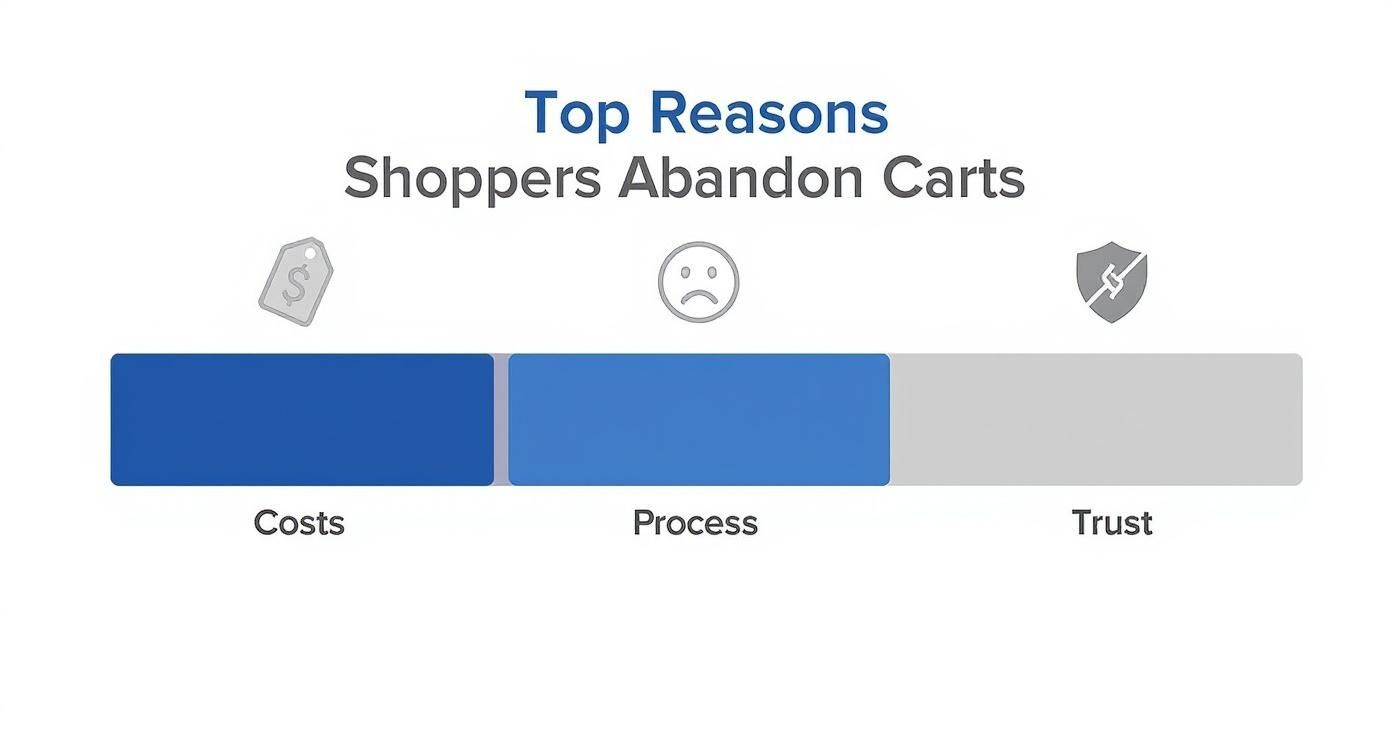
Surprise costs, a clunky process, and a lack of trust—these are the universal deal-breakers that drive people away right at the finish line.
The Major Impact of Mobile Devices
Today, the device a customer is using might just be the single biggest factor in whether they complete their purchase. Mobile is fantastic for browsing, but it’s notoriously frustrating for actually buying something. The result? Sky-high abandonment rates.
When you break down the numbers, mobile device cart abandonment can soar as high as 86%. That’s a huge jump from desktop rates, which hover closer to 73%.
So, why the massive gap? It’s a mix of things. Tiny screens make filling out forms a pain, Wi-Fi can be spotty, and many shoppers still feel a bit uneasy about security on their phones.
For a deeper dive, check out our guide on why customers abandon their carts on mobile devices. Optimizing your mobile checkout isn’t just a “nice-to-have” anymore; it’s absolutely critical if you want to capture a massive slice of your potential sales.
Proven Strategies to Prevent Cart Abandonment
The best way to fix your abandonment rate? Stop shoppers from leaving in the first place.
Instead of chasing down lost sales, the real win comes from building a checkout experience so smooth and trustworthy that customers sail right through it. It’s all about shifting your focus from recovery to prevention, removing friction, and building confidence when it matters most.
Think about it: you can proactively guide an eager buyer across the finish line by tackling the big three deal-breakers—surprise costs, a clunky process, and a lack of trust—before they even become issues. Getting this right can deliver a massive return.
Eliminate Sticker Shock with Cost Transparency
The single biggest reason people ditch their carts is a nasty surprise at the end: unexpected costs. A customer sees one price on the product page, but by the time shipping, taxes, and other fees get tacked on, the total looks completely different. This kills trust instantly and is why 48% of shoppers walk away.
The fix is simple: be radically transparent about all costs, right from the start.
- Add a Shipping Calculator: Let people estimate shipping costs on the product or cart page. No guessing, no surprises.
- Show the Full Price Early: Make sure your cart summary includes taxes and any other fees. The number they see should be the number they pay.
Being honest about the total cost builds immediate trust. It shows you respect your customer’s budget and turns a potential point of friction into a moment of confidence.
Simplify the Path to Purchase
Every extra step, every unnecessary form field, every required click—it’s another chance for a customer to get frustrated and leave. A long, complicated checkout is a massive conversion killer, and forcing someone to create an account is often the final straw.
The goal is to make buying from you feel effortless.
The ideal checkout is invisible. It should feel so intuitive and fast that the customer barely notices they’re completing a process. Friction is the enemy of conversion.
To get there, streamline everything. Offer a guest checkout option so new buyers don’t feel forced into a commitment. You can always invite them to create an account on the thank-you page after the sale is made. Also, take a hard look at your forms and cut out anything that isn’t absolutely essential.
If you want to dive deeper, we have a complete guide on how to optimize your checkout process to reduce cart abandonment.
Build Unshakeable Trust and Security
Nobody is going to type their credit card number into a site that looks sketchy. Building confidence is non-negotiable, and you do it with clear visual cues and reassuring policies. Your checkout page should feel like a secure vault for their sensitive information.
Here’s how to build that crucial trust:
- Display Security Badges: Show off logos from trusted names like Visa, Mastercard, and PayPal, along with SSL security seals. These are instant trust signals.
- Showcase Social Proof: A few star ratings or a short customer testimonial near the “buy” button goes a long way in reassuring shoppers that others have had a great experience.
- Make Policies Clear: Your return policy and shipping info should be dead simple to find and understand. Don’t let lingering doubts kill the sale.
For a comprehensive resource on implementing various tactics to combat this issue, exploring effective proven strategies to reduce cart abandonment can provide additional valuable insights.
Recovering Lost Sales with Email and SMS
Trying to prevent every single abandoned cart is a losing battle. No matter how perfect your checkout is, some shoppers will always slip through the cracks. But here’s the good news: an abandoned cart isn’t a lost sale. It’s a warm lead.
Think about it. These people were interested enough to browse your products and add something to their cart. Life just got in the way. A gentle, well-timed reminder is often all it takes to bring them right back.
This is where recovery campaigns become your secret weapon. By setting up automated email and SMS messages, you can re-engage these shoppers, clear up any doubts they had, and guide them back to finish what they started. It’s a surprisingly simple way to turn a near-miss into a definite win.
Crafting an Effective Email Recovery Sequence
Email has been the go-to tool for cart recovery for years, and for good reason. It gives you the space to remind customers what they left behind, highlight the benefits of their chosen products, and even toss in a small incentive to seal the deal. The proof is in the numbers: a solid 45% of all cart abandonment emails are opened. People are clearly listening.
A great email strategy isn’t about sending one message and hoping for the best. It’s a carefully timed sequence.
- Email 1 (Within 1 hour): This first message should be a simple, helpful nudge. You’re trying to catch someone who got distracted by a phone call or ran into a minor website glitch. Keep the tone light and friendly, something like, “Did you forget something?”
- Email 2 (After 24 hours): If the first email didn’t do the trick, it’s time to build a little urgency. You could mention the product’s popularity or hint that stock is running low. Social proof works wonders here.
- Email 3 (After 3-5 days): This is your final shot. It’s the perfect time to offer a small discount—think 10% off or free shipping—to encourage them to act now before the items are gone for good.
The whole point is to be helpful, not annoying. Each email needs to provide some value, whether it’s a simple reminder, a link to your support team, or a compelling reason to buy now. Your job is to gently guide them back, not shove them toward the checkout.
Leveraging SMS for Immediate Impact
While email is a reliable workhorse, SMS is the undisputed champion of modern cart recovery. Text messages have a mind-blowing open rate, often hitting as high as 99%, and most are read within just a few minutes. That kind of speed cuts through all the digital noise and gets your message seen instantly.
Because SMS feels more personal, your approach needs to be short and sweet. A killer recovery text has three things: a friendly reminder, a direct link back to their pre-filled cart, and a super clear call to action.
For instance: “Hey [Name]! Your items at [Store Name] are waiting. Don’t miss out! Complete your order here: [Link]”
This direct approach can trigger incredibly fast conversions. But the real magic happens when you combine both channels. We break down the data in our article comparing abandoned cart email vs. SMS statistics. Using both email and SMS in tandem creates a powerful recovery net that catches customers wherever they are, turning lost chances into loyal shoppers.
Your Action Plan to Reclaim Lost Revenue
So, you’ve got the data. Now it’s time to turn that frustrating cart abandonment number into a serious growth opportunity. Think of it this way: an abandoned cart isn’t a “no.” It’s a “not right now.” These are warm leads who just need a little nudge to get back on track.
The trick is to move from knowing what’s happening to taking action. First things first, you need a baseline. After all, you can’t improve what you don’t measure.
Once you have your number, it’s time to play detective. Why are people leaving? Is it a surprise shipping cost that pops up at the last second? A checkout process that feels like filling out tax forms? Or maybe your site just doesn’t feel secure enough to hand over credit card details.
When you’ve pinpointed the friction points, you can build a solid action plan. This plan needs to attack the problem from two angles: prevention and recovery.
Your Store Audit Checklist
Use this quick checklist to run through your store and figure out where to focus your efforts for the biggest wins.
- Prevention First:
- Are all costs transparent? Nobody likes a last-minute surprise. Show your shipping fees, taxes, and any other costs right from the start.
- Is checkout effortless? Offer a guest checkout option. Every extra field you ask someone to fill out is another reason for them to leave. Keep it simple.
- Do you build trust? Make sure your security badges and customer reviews are front and center, especially on the checkout page.
- Active Recovery:
- Is your email sequence automated? Set up a series of emails to remind shoppers about what they left behind. A little incentive never hurts, either.
- Are you leveraging SMS? Text messages get opened almost instantly. Implementing SMS reminders is one of the fastest ways to grab a customer’s attention and bring them back.
Got Questions? We’ve Got Answers.
Even with the best game plan, a few questions always pop up when you’re trying to nail down your cart abandonment strategy. Let’s tackle some of the most common ones so you can get a clearer picture of your goals and tactics.
What Is a Good Shopping Cart Abandonment Rate?
There’s no single magic number here. A “good” rate is really just one that’s consistently better than your industry’s average. For most online stores, getting your abandonment rate below 60% is a fantastic place to start.
But context is everything. A high-end furniture shop might be perfectly fine with a 75% rate, while a grocery delivery service needs to aim way, way lower. The real key is to see how you stack up against your direct competitors and focus on chipping away at your own number, not chasing some impossible ideal.
The goal isn’t perfection; it’s progress. Aim to lower your abandonment rate bit by bit, month after month. You do that by finding and fixing the little friction points that are unique to your store.
How Often Should I Send Abandonment Reminders?
Timing is everything. You want to be effective without driving your customers crazy. A short sequence of messages spread out over a few days is usually the sweet spot.
Here’s a proven flow:
- First Reminder (1 Hour): Send a quick, gentle SMS or email. This catches the people who just got distracted by the doorbell or a phone call.
- Second Reminder (24 Hours): Follow up a day later. You can use this one to create a little urgency or remind them why they loved the product in the first place.
- Final Reminder (3-5 Days): This is your last shot. Tossing in a small incentive, like a 10% discount, often does the trick to seal the deal.
This spaced-out approach keeps you top-of-mind without flooding their inbox, giving you the best chance to win back the sale.
Can You Eliminate Cart Abandonment Completely?
In a word: no. Trying to get to a zero-percent abandonment rate is like trying to catch smoke. Shoppers will always browse, compare prices, or just use their cart as a wishlist. Life happens.
The focus should never be on hitting 0%. Instead, think of every single percentage point you shave off as a huge win. Knocking your rate down from 80% to 70% is a massive achievement that puts real money back into your business and makes for a much smoother customer journey.
Turn those almost-sales into actual profit. CartBoss uses automated SMS to recover lost sales and boost your revenue, all on autopilot. Start reclaiming your lost sales today.