


Let’s be blunt: the current global average cart abandonment rate is a staggering 70.19%.
Think about that for a second. For every ten shoppers who take the time to add products to their online cart, seven will walk away without ever buying. That’s a huge number, and it represents a massive pile of potential revenue just sitting there, waiting to be reclaimed.
Decoding the Average Cart Abandonment Rate
The best way to think about the cart abandonment rate is as a story of missed connections. It’s the digital version of a customer filling their physical shopping cart to the brim, pushing it all the way to the checkout line, and then just leaving it there. It’s one of the most vital health metrics for any eCommerce store because it shines a light on friction points in your customer’s journey.
This isn’t just some passive statistic you glance at once a month; it’s an active signal coming directly from your audience. A high rate is almost always a sign of a hidden problem—maybe it’s unexpected shipping costs, a clunky checkout process, or a simple lack of trust. Getting a handle on this number is the first step to figuring out what’s wrong and turning those “almost” sales into definite orders.
The Rising Tide of Abandoned Carts
While cart abandonment has always been a challenge for online stores, it’s become much more pressing. The global average has been climbing for years, and in 2024, it finally crossed a major threshold: 70.19% of all online shopping carts are abandoned before the purchase is complete.
This isn’t a small jump. It’s the peak of a decade-long upward trend. The rate has crept up from 68.07% in 2014 to 69.99% in 2022 before hitting today’s high. The financial cost is almost hard to believe, with an estimated $260 billion in recoverable lost orders worldwide every year. If you want to dive deeper into the numbers, you can explore the latest cart abandonment research.
This steady climb tells us something important about how online shoppers have changed. Today’s customers are smarter, have much higher expectations, and have zero patience for a bad user experience.
Cart abandonment isn’t just a lost sale—it’s a symptom of a deeper issue in the customer experience. Each abandoned cart is a piece of feedback telling you something needs to improve.
To really see this trend in action, let’s look at how the rate has evolved over the past ten years.
A Decade of Global Cart Abandonment Rates
This table illustrates the steady rise in average cart abandonment rates over the last ten years, underscoring the growing challenge for online retailers.
| Year | Average Cart Abandonment Rate |
|---|---|
| 2014 | 68.07% |
| 2016 | 69.23% |
| 2018 | 69.57% |
| 2020 | 69.80% |
| 2022 | 69.99% |
| 2024 | 70.19% |
The data paints a very clear picture. As eCommerce continues to boom, the hurdles to actually converting a visitor into a customer are also getting higher. The good news is, you can fight back. In the next sections, we’ll dig into why this is happening and give you some real, data-backed strategies to turn this trend around for your store.
Why Your Customers Abandon Their Carts
To really bring down your average cart abandonment rate, you have to get inside your customer’s head. Figuring out the “why” behind that final click away from your store is everything. It’s almost never one big, dramatic reason. More often, it’s a bunch of small frustrations piling up until the shopper just gives up.
Let’s go beyond a simple checklist and look at the real psychology behind cart abandonment. I see three common scenarios pop up again and again, and every e-commerce owner needs to recognize them. These stories show the core friction points that can turn an excited buyer into just another lost sale.
The Pain of Sticker Shock
Picture this: a customer is genuinely excited. They’ve found the perfect product on your site, and the price looks great. They eagerly add it to their cart, head to the checkout, and then… bam. The final price is suddenly 30% higher than they thought. This is sticker shock, and it’s one of the quickest ways to lose a customer.
Unexpected costs are the undisputed king of cart abandonment. These last-minute surprises completely shatter the trust you just spent time building. The usual suspects are:
- High Shipping Costs: The shipping fee is way more than they expected, sometimes nearly as much as the product itself.
- Taxes and Fees: Mandatory taxes or odd handling fees that only show up on the very last screen feel like a bait-and-switch.
The moment a customer feels ambushed by hidden costs, their excitement flips to frustration. Being transparent with your pricing isn’t just nice—it’s a powerful conversion tool.
This feeling of being blindsided is a huge deal. One study showed that high, unexpected shipping costs are why 41% of global shoppers ditch their carts. With mobile cart abandonment rates pushing past 80%, a clear, upfront pricing structure is absolutely non-negotiable.
The Friction of Checkout Headaches
Now, imagine a different shopper. They’re ready to buy, credit card in hand. They start your checkout process, only to be hit with a wall of text—a long, confusing form. Worse, you’re forcing them to create an account, dream up a password, and verify their email before they can even give you their money. This is a classic checkout headache.
Every single extra step you add to your checkout is another chance for a customer to walk away. Today’s shoppers are all about speed and convenience.
Common checkout headaches include:
- Forced Account Creation: Making someone sign up before they can buy is a massive roadblock. Most people don’t want to create yet another account for a single purchase.
- Long and Confusing Forms: Asking for a bunch of unnecessary information or using a poorly designed form can easily overwhelm someone.
- Website Errors or Slowness: A technical glitch, a page that takes forever to load, or a button that doesn’t work will kill a sale on the spot and make your brand look unprofessional.
For a deeper look at what drives people away, check out our guide on the top reasons customers abandon their carts.
The Doubts of Last-Minute Hesitation
Finally, think about a more cautious shopper. They’ve added an item to their cart, but they aren’t 100% convinced. They’re looking for a little reassurance—a sign that they’re making the right choice. Instead, they find a vague return policy, zero customer reviews, and no trust badges on the payment page. This is last-minute doubt.
This stage is all about building trust and confidence. If a customer feels even a little bit uncertain about your business or the product, they’ll often tell themselves they’ll “save it for later,” which usually means they’re gone for good. Sometimes this isn’t just a checkout problem; a high website bounce rate can also signal user experience issues that cause people to leave early. Getting a handle on your site’s overall engagement is crucial, and you can learn more by exploring resources on understanding and lowering bounce rates. Tackling these doubts head-on can make a huge difference in your abandonment rate.
What’s a Good Cart Abandonment Rate, Anyway? Industry Benchmarks
So, you’ve calculated your average cart abandonment rate. Now for the big question: is that number a red flag signaling a major problem, or is it just the cost of doing business in your market?
Knowing where you stand means looking beyond the global average. You need context. The reasons customers ditch their carts change wildly from one industry to the next, driven by completely different buying habits, product types, and price points.
Think of it this way: without industry benchmarks, you’re flying blind. You could be chasing an impossibly low rate that’s unheard of in your sector, or worse, ignoring a leaky checkout process that’s costing you serious money because you assume your rate is “normal.”
The Story Behind the Numbers
Behind the headline stats, there’s a much more interesting story. For example, the fashion and clothing world sees a 68.3% abandonment rate. But that’s nothing compared to luxury and jewelry, which hits a staggering 82.28% as of June 2024—the highest of any category.
At the other end of the spectrum, pet care and veterinary services have the lowest rate by a long shot, at just 51.03%. Digging into more cart abandonment statistics can show you how these trends shift over time.
This infographic shows some of the usual suspects behind why shoppers leave, no matter what you’re selling.
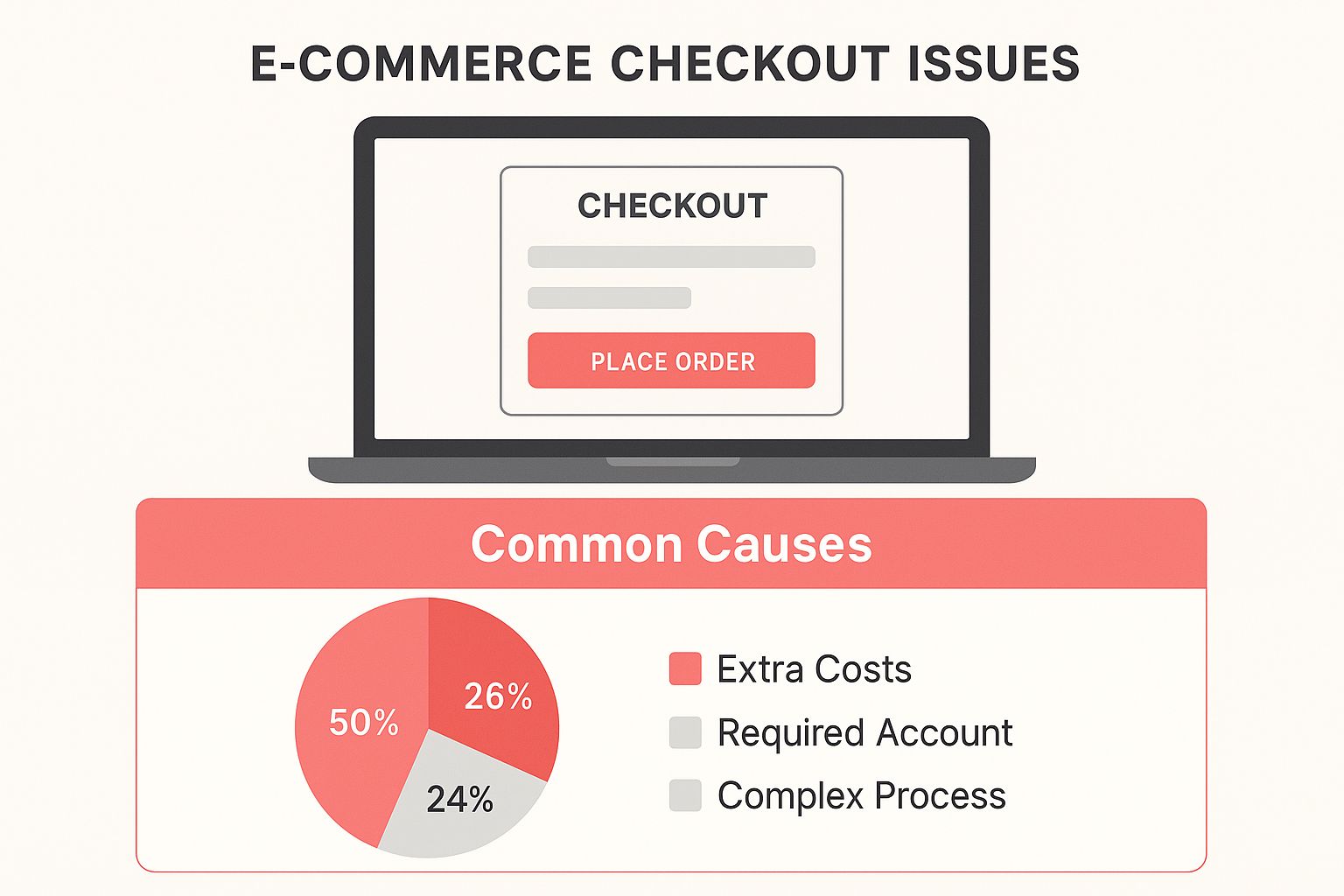
As you can see, things like surprise shipping costs and complicated checkout forms are universal headaches. But how these problems affect shoppers really depends on what they’re trying to buy.
High-Ticket “Wants” vs. Everyday “Needs”
The huge gap in abandonment rates often boils down to one simple thing: the customer’s mindset. Are they making a considered, high-value purchase that requires a lot of thought, or are they grabbing a routine necessity?
This difference explains almost everything.
- Luxury & Fashion (High Abandonment): In these sectors, the shopping cart isn’t just a checkout tool; it’s a wishlist, a mood board, a calculator. Shoppers add items to see the total, compare different combinations, and sleep on a big decision. This naturally leads to a higher abandonment rate because the sales cycle is just plain longer.
- Pet Care & Groceries (Low Abandonment): On the flip side, industries like pet care run on repeat, needs-based buys. When a customer runs out of dog food, they aren’t comparison shopping for weeks. The decision is already made. The checkout is just a final step, not part of the research.
A high cart abandonment rate isn’t always a catastrophe. For a luxury brand, it’s a normal part of how customers make decisions. The real trick is learning to tell the difference between a casual browser and a serious buyer who just needs a nudge.
Average Cart Abandonment Rates by Industry
Once you understand why these rates are so different, you can build smarter recovery strategies. A luxury brand shouldn’t use the same tactics as a pet food store.
Here’s a look at what influences the numbers in a few key sectors.
| Industry | Average Abandonment Rate |
|---|---|
| Luxury & Jewelry | 82.28% |
| Fashion & Apparel | 68.30% |
| Home & Furniture | 66.40% |
| Beauty & Cosmetics | 64.90% |
| Pet Care & Vets | 51.03% |
This data makes it clear that a one-size-fits-all approach to cart recovery is doomed to fail. A luxury retailer might focus on VIP retargeting for high-value carts, while a fashion store should probably scream about its easy, free returns.
Knowing your industry’s standard is the first step toward smart, targeted improvements that actually work.
Proven Strategies to Reduce Cart Abandonment
Knowing why customers walk away is the first step. But turning that knowledge into real, actionable changes is how you actually make more money. A high average cart abandonment rate isn’t a life sentence for your store; it’s a sign that there are specific, fixable friction points in your sales process.
Let’s break down the playbook for turning those almost-sales back into completed orders. Each of these strategies directly tackles the biggest reasons people leave—sticker shock, checkout hassles, and last-minute doubt.
Eliminate Sticker Shock with Total Transparency
There’s no faster way to kill a sale than with a surprise cost. When a customer gets all the way to the final step and suddenly sees a high shipping fee or unexpected tax, they don’t just get annoyed. They feel tricked. The fix? Be completely transparent from the get-go.
Don’t hide shipping costs until the payment page. Show them right there on the product page or in a banner across the top of your site. Even better, offer a free shipping threshold. A simple message like “Free shipping on all orders over $75!” does more than just present a deal. It turns the checkout into a mini-game, encouraging shoppers to add just one more thing to hit that magic number. You’ve just flipped a negative (paying for shipping) into a positive incentive.
A customer who knows the total cost upfront is far more likely to complete their purchase. Transparency builds the trust necessary to prevent the 48% of global shoppers who abandon carts due to extra costs at checkout from leaving your site.
When you’re upfront, you show respect for your customer’s wallet and eliminate the single biggest reason people bail on their carts.
Fix Checkout Headaches by Streamlining the Process
A clunky, complicated checkout is an obstacle course nobody signed up to run. Every extra field they have to fill out, every mandatory account creation, is another chance for them to lose patience and leave. Your goal should be to make buying from you feel completely effortless.
Start with a guest checkout option. Forcing people to create an account is a massive hurdle, and 26% of shoppers say it’s why they’ve abandoned a purchase. You can always ask them to create an account after the sale is done, on the confirmation page.
Next, simplify the payment process itself. Payment options are a critical factor. Studies show 48% of business buyers will abandon their cart if there aren’t enough payment methods available. Similarly, discount codes play a big role; half of all shoppers will leave if a promo code doesn’t work.
Here are some quick wins you can implement today:
- One-Click Payments: Add express payment options like Shop Pay, Google Pay, or PayPal. These tools save a customer’s info, letting them check out in seconds.
- Minimal Form Fields: Be ruthless. Only ask for what is absolutely essential to ship the order. Do you really need their birthday and a second phone number? Probably not.
- Clear Progress Indicators: Show people where they are in the process (e.g., “Step 1 of 3”). It manages their expectations and makes the whole thing feel less like a chore.
For more in-depth techniques, you can also read our guide on how to reduce cart abandonment with proven strategies.
Overcome Last-Minute Doubts with Trust and Reassurance
Even with a perfectly smooth checkout, a customer can still hesitate right before clicking that final button. This is where you need to build a fortress of trust around your “Complete Purchase” button. Your job is to squash any last-second anxieties that might give them pause.
Social proof and trust signals are your best friends here. Placing them strategically can make all the difference.
- Trust Badges: Display security logos (like SSL certificates) and icons of accepted payment methods (Visa, Mastercard, PayPal) right on the checkout page. This instantly tells customers their financial info is secure.
- Customer Reviews & Testimonials: A few positive reviews or a star rating visible during checkout can be the final nudge a hesitant buyer needs to feel confident.
- Crystal-Clear Return Policy: Make your return policy incredibly easy to find and understand. A generous, no-fuss policy removes the risk for the customer, making it far easier for them to commit.
Beyond these specific fixes, looking at the bigger picture and optimizing your entire e-commerce funnel will also lower abandonment rates. You can explore a variety of advanced techniques and strategies to improve your website’s conversion rate. When you combine these big-picture improvements with targeted checkout fixes, you create a powerful system for turning more visitors into happy, paying customers.
Recovering Lost Sales with High-Impact SMS
Email sequences have long been the go-to for cart recovery, but let’s be honest: inboxes are a battlefield. If you want to cut through the noise, there’s another channel that works with incredible efficiency: SMS.
While an email can sit unread for hours—or even days—a text message is almost impossible to ignore. It gives you a direct, personal line to your customer right when their desire to buy is still fresh.
Think about it from your customer’s point of view. An email can feel a bit corporate and easily gets buried. A text, on the other hand, feels immediate and conversational. This is exactly why SMS open rates are so ridiculously high, often hitting over 98%. It’s a powerful way to re-engage shoppers who were just a click away from completing their purchase.
The Golden Hour for SMS Recovery
With SMS, timing is everything. Send a text too soon, and it can feel a little pushy. Wait too long, and their interest completely evaporates.
We’ve found the sweet spot is what we call the “golden hour”—usually between 30 to 60 minutes after they’ve left their cart.
In this window, the customer is likely still online or just stepped away for a moment. The product is fresh in their mind, and a friendly, helpful nudge is often all it takes to bring them back. It’s the perfect balance of being prompt without being intrusive.
An effective SMS recovery campaign isn’t about being pushy; it’s about being helpful. Frame your message as a customer service touchpoint, offering assistance rather than just demanding a sale.
A well-timed text can feel less like marketing and more like a helpful reminder, especially if they got distracted or ran into a technical snag. If you want to explore more recovery tactics, we have a whole guide on how to effectively recover abandoned carts.
Crafting the Perfect Recovery Message
Your message needs to be short, valuable, and get straight to the point. Unlike email, you don’t have room for fluff. Every single word counts. A great recovery SMS needs three things:
- A Friendly Opener: Start with a gentle reminder that they left something behind. Always mention your store name so they know who it’s from.
- A Clear Incentive: Give them a reason to come back now. This could be a small discount, a free shipping code, or just a simple reminder of the great product they were looking at.
- A Direct Link to Their Cart: This is non-negotiable. The link must take them straight back to their pre-filled cart. No friction, no extra steps.
This simple, automated approach makes it a low-effort, high-reward system. You set the rules once, and platforms like CartBoss work in the background to bring back sales you would have otherwise lost for good. This hands-off approach turns one of e-commerce’s biggest headaches into a reliable source of reclaimed revenue.
Using Email Remarketing to Win Back Customers
While fast-acting SMS messages are your best bet for immediate cart recovery, a smart email remarketing sequence is your strategic follow-up. Think of it as your second line of defense. It gives you the space to have a deeper conversation with shoppers who might need a little more convincing before they commit.
The key here isn’t to blast them with sales pitches. Instead, you want to create a series of helpful, well-timed messages that feel more like great customer service. When you get this right, you don’t just lower your average cart abandonment rate—you show customers you’re committed to their experience. You’re turning a moment of hesitation into a chance to build a real, lasting relationship.
The Anatomy of a Winning Email Sequence
A powerful email recovery strategy doesn’t just spam a customer’s inbox. It follows a logical timeline that respects their thought process, giving them multiple chances to come back without feeling pressured. A three-part sequence is a tried-and-true model that works wonders.
And the data backs this up. Cart recovery emails see impressive open rates of 39.07% and click-through rates of 23.33%. What’s really interesting is that retailers see a huge lift in revenue when they send a series of emails instead of just one. You can explore more about these promising email recovery stats to see just how much a good sequence can impact your sales.
So, what does a successful sequence look like? It usually breaks down like this:
- Email 1: The Gentle Reminder (After 1 Hour)
This first email is just a friendly nudge. Keep it light and helpful. The goal is to ask if they ran into a problem or simply got sidetracked. Your tone is everything—imagine a helpful store associate asking, “Did you need any help with that?” - Email 2: The Value-Add (After 24 Hours)
If the first reminder didn’t do the trick, it’s time to sweeten the deal. The second email is the perfect spot to introduce a small incentive to tackle any price hesitation. A simple offer like 10% off or free shipping shows you value their business and are willing to meet them halfway. - Email 3: The Final Follow-Up (After 3 Days)
This last email is all about creating a little friendly urgency. Remind them that their cart—and any special offer you included—is about to expire. Frame it as their last chance to grab the products they showed interest in, gently reminding them of what they’ll miss out on.
By crafting each message with a specific goal—from gentle reminder to value-add to final nudge—you transform a simple abandoned cart into a multi-stage conversation that guides the customer back to purchase.
This layered approach respects the customer’s time while strategically tackling the most common reasons for abandonment, like unexpected costs or just plain forgetfulness. By turning a potentially lost sale into a positive interaction, you’re doing more than just recovering revenue. You’re building the kind of loyalty that keeps customers coming back.
Got Questions? We’ve Got Answers
Even with a solid plan, a few questions always pop up when you’re in the trenches. Let’s tackle some of the most common ones I hear from store owners, moving you from theory to confident action.
What’s a “Good” Cart Abandonment Rate, Really?
Honestly, there’s no single magic number. A “good” rate is completely relative to your industry. A store selling high-end, luxury goods might see abandonment rates north of 80% because shoppers are doing more research, while a pet food supplier could easily sit closer to 50%.
Instead of getting hung up on a universal benchmark, you should be obsessed with your own data. The best way to think about it is:
- First, figure out what your current average rate is.
- Next, roll out targeted changes to fix the leaks.
- Then, aim to chip away at that number, month after month.
A “good” rate for your store is one that’s consistently getting smaller. That’s the real win.
How Quickly Can I See Results from New Strategies?
The impact of your changes can vary quite a bit. Some fixes deliver results almost instantly. For example, adding a guest checkout option or integrating express payments like Apple Pay can boost conversions overnight. Shoppers who were on the verge of giving up due to a clunky process will suddenly have a reason to finish their purchase.
On the other hand, strategies that build trust—like adding customer reviews or making your return policy crystal clear—take more time to bear fruit. These changes build shopper confidence gradually, slowly but surely improving your conversion rate as more people feel secure buying from you.
How Can I Optimize My Checkout for Mobile Users?
This isn’t just a nice-to-have; it’s critical. Abandonment rates on mobile are always higher because small screens can make checkouts feel like a chore. The key is to make the process ridiculously simple. We have a complete guide on how to optimize the checkout process that dives deep into the details.
But if you want the highlights, focus on these key actions:
- Use a responsive design that looks great on any screen, no pinching or zooming required.
- Keep your forms short. Only ask for what is absolutely essential to complete the order.
- Integrate mobile-native payment options like Apple Pay or Google Pay.
- Make sure your buttons are big, bold, and easy to tap with a thumb.
Your goal is to make buying from a phone feel just as effortless and intuitive as it does on a desktop.
Ready to turn those abandoned carts into your biggest revenue source? CartBoss uses the power of automated SMS to re-engage shoppers and recover lost sales on autopilot. Start your free trial and see how much you can recover.