



Optimizing your sales funnel is just a fancy way of saying you’re plugging the holes where money is leaking out. It’s about taking a hard look at the entire journey a customer takes—from the moment they first hear about you to when they finally click “buy”—and smoothing out all the bumps that make them leave.
The goal? Turn that leaky bucket into a streamlined path that guides more browsers into becoming buyers, boosting your revenue every step of the way.
Diagnosing Your Leaky Ecommerce Sales Funnel
Every online store has a sales funnel, whether you’ve intentionally designed it or not. The problem is, most are silently leaking profits. This “leaky bucket” issue is incredibly common, and figuring out where the leaks are is the first real step to fixing anything.
Think of the customer journey in its simplest terms: people become aware of you, they get interested in what you’re selling, and then (hopefully) they take action and buy.
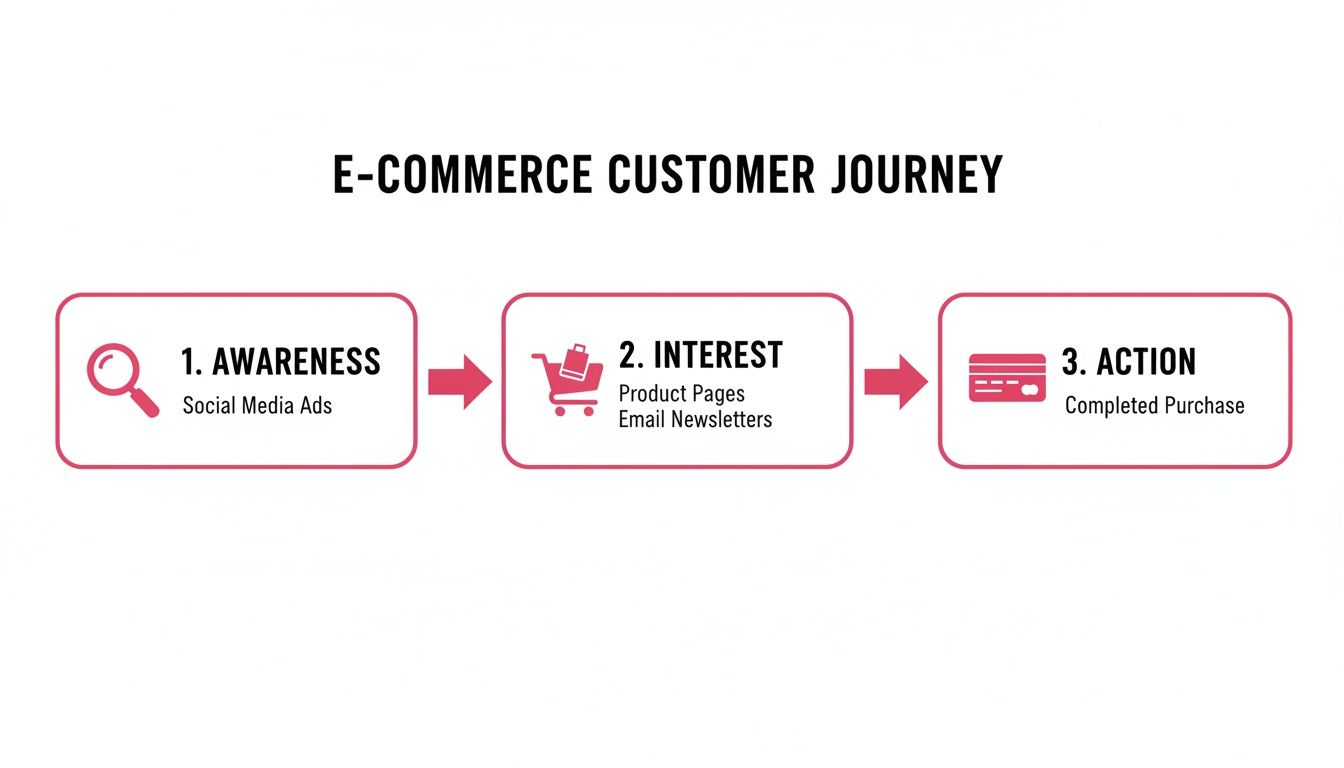
This flow from awareness to action is your funnel. Each transition is a point where you can lose someone. Your job is to map out your store’s specific journey and use your analytics to find the biggest drains. This isn’t about guesswork; it’s about digging into the data.
Mapping the Customer Journey
Before you can fix anything, you have to know exactly what path your customers are taking. Start from the very beginning. Trace their steps from the initial touchpoint—maybe a Facebook ad or a Google search—all the way through to a completed purchase on your site.
As you map this out, ask yourself a few key questions:
- Awareness: How are people finding us in the first place? Is it paid ads, organic search, a shoutout from an influencer?
- Interest: Once they land on the site, where do they go? Do they head straight for product pages, browse categories, or read a blog post?
- Desire: What actions show they’re serious about buying? Adding an item to the cart is the big one, but creating a wishlist counts, too.
- Action: What’s happening during the checkout flow? Where do they pause, get confused, or just give up?
Answering these gives you a clear blueprint of your funnel and how it’s actually performing, not just how you think it’s performing.
Identifying the Biggest Drop-Off Points
With your journey mapped, it’s time to dive into your analytics and find the leaks. The numbers don’t lie. One of the most notorious drop-off points happens right before the finish line. Globally, cart abandonment rates are sitting around a staggering 70%. Think about that: for every 10 shoppers who add your products to their cart, seven of them walk away.
Here’s a quick way to spot the most common leaks in your own funnel.
Common Funnel Leaks and Their Symptoms
| Funnel Stage | Symptom (Metric to Watch) | Potential Cause |
|---|---|---|
| Product Pages | High bounce rate, low ‘Add to Cart’ rate | Poor product images, unclear description, missing reviews, confusing CTA |
| Cart Page | High cart abandonment (before checkout starts) | Surprise shipping costs, no guest checkout, confusing layout, promo code box is too prominent |
| Checkout Process | High drop-off between checkout steps | Too many form fields, no progress bar, limited payment options, security concerns |
| Payment Step | Abandonment after entering payment info | Payment gateway errors, declined cards, lack of trust seals or SSL certificate |
This table should give you a starting point. By looking at the symptoms in your analytics, you can quickly narrow down the likely cause.
A leaky funnel isn’t just a marketing problem; it’s a direct drain on your profits. Identifying the single biggest point of friction—whether it’s a confusing product page or a clunky checkout—and fixing it can have an outsized impact on your bottom line.
To get concrete numbers, head to your analytics platform. You can see the drop-off rate between each key page in your funnel. A thorough abandoned cart analysis is the best way to understand this behavior.
Maybe you find that tons of people add to their cart but never even start the checkout. That points to a problem on the cart page itself. Or perhaps the drop-off is massive between entering payment details and completing the order. That could signal an issue with your payment processor or a lack of trust signals.
To get a better sense of how different funnels are structured, check out these 7 Practical Digital Sales Funnel Examples. Seeing how others do it can spark ideas and help you spot obvious gaps in your own setup, setting the stage for smart, targeted optimizations that actually move the needle.
Attracting High-Intent Traffic to Your Funnel
An optimized funnel is completely useless if the wrong people are entering it. A common trap I see brands fall into is chasing sheer volume—more clicks, more impressions, more everything. But success in ecommerce sales funnel optimization starts way before that. It’s all about attracting high-intent shoppers: people who are already looking for what you sell, not just browsing aimlessly.
This means you have to stop obsessing over vanity metrics. A thousand visitors who couldn’t care less about your products will always lose to ten visitors who are ready to pull out their credit cards. The real goal is to fill the top of your funnel with genuine potential customers.

To pull this off, your acquisition strategy needs to be surgical. It all begins with a crystal-clear picture of your ideal customer. Who are they? What problems are they trying to solve? Where do they hang out online? Get this right, and everything from your ad targeting to your content strategy will fall into place.
Refining Your Audience Segmentation
Generic targeting is the fastest way to burn through your ad spend. If you want high-intent traffic, you need to get granular with audience segmentation on platforms like Facebook and Google. Forget broad, interest-based targeting; it’s time to focus on behaviors that scream “I’m ready to buy.”
Here are a few ways to sharpen your aim:
- Lookalike Audiences: Don’t just build lookalikes from your entire customer list. Instead, create them from your highest-value customers—the repeat buyers, the ones with the biggest average order value. This tells the ad platform to find more people like your best customers, not just any customer.
- Behavioral Targeting: Zero in on users who have recently taken actions that show intent. This could be anything from visiting specific product pages on your site to engaging with a competitor’s ads or searching for keywords that suggest they’re deep in the research phase.
- Custom Intent Audiences (Google): Go beyond broad keywords. Build audiences around long-tail search terms that show someone is much further down the buying journey. Think “best leather dog collar for large dogs” instead of just “dog collars.”
When you narrow your focus like this, you ensure every dollar is spent reaching users who are far more likely to convert. You’re essentially pre-qualifying traffic before it even lands on your site.
Creating a Seamless Ad-to-Landing-Page Experience
Okay, so you’ve nailed your targeting and earned a high-intent click. The journey is just beginning. The handoff from your ad to your landing page has to be absolutely seamless. Any disconnect—in the message, the offer, or the design—creates instant friction and sends your bounce rate soaring. That valuable click? Wasted.
This concept is all about message match.
Your ad makes a promise. Your landing page needs to deliver on that promise instantly. If someone clicks an ad for “50% off running shoes,” they’d better land on a page filled with discounted running shoes, not your generic homepage.
This alignment is crucial for building immediate trust. It tells the visitor they’re in the right place. The headline on your landing page should echo your ad copy. The imagery should be consistent. Every single element needs to work together to reinforce the value that got them to click in the first place.
Leveraging Content to Build Trust
Paid ads are great, but organic traffic is often your highest-converting channel. A powerful way to attract qualified visitors is by creating content that answers their questions before they even think to buy. This is where a smart SEO strategy comes into play. You can get a deeper dive into this by checking out these ecommerce SEO best practices.
Just think about the questions your ideal customers are typing into Google:
- “How do I choose the right [product type]?”
- “[Product A] vs. [Product B] comparison”
- “Is [product feature] worth it?”
By creating blog posts, buying guides, or video tutorials that tackle these specific queries, you position your brand as a helpful expert, not just a seller. You attract users with a real problem, build trust by giving them a real solution, and can then naturally guide them toward your products. It’s a content-driven approach that fills your funnel with educated, engaged prospects who already see you as a credible authority.
Turning Browsers into Buyers with CRO
Getting high-intent traffic to your site is only half the battle. Now comes the real work: turning those casual browsers into actual buyers. This is where you roll up your sleeves and dive into Conversion Rate Optimization (CRO), the art and science of tweaking your website experience to get more visitors to take action.
This isn’t about smoke and mirrors or flashy design tricks. It’s about methodically building trust, removing friction, and making a powerful case for your products. Your product and category pages are your digital showroom—it’s where the magic happens and buying decisions are made. Let’s get them dialed in.
Writing Product Descriptions That Truly Sell
So many stores drop the ball with product descriptions that read like a boring spec sheet. Sure, the technical details matter to some, but features alone don’t sell. A great description connects those features to real-world benefits that solve a customer’s problem.
Don’t just say “10,000 mAh battery.” Instead, frame it as “all-day power for your busiest days, so you’re never hunting for an outlet.” See the difference? That subtle shift changes the focus from what the product is to what the product does for your customer.
Here’s a simple framework I use that just works:
- The Hook: Kick things off with a sentence that grabs attention by hitting on a specific pain point.
- The Benefits: Use a clean, scannable bulleted list to highlight 3-5 key benefits. Always focus on the outcome.
- The Features: Now you can drop in the technical specs for the detail-oriented shoppers.
- The Proof: Wrap it up with a punchy testimonial or a snippet from a glowing review.
The Power of Visuals and Social Proof
Online, your customers can’t touch, feel, or try on your products. Your photos and videos have to do all the heavy lifting. Grainy, low-quality images are an instant credibility killer, while professional, crisp visuals build confidence right away.
Show your product from every conceivable angle. Show it in context. If it’s a dress, feature it on different body types. If it’s a couch, show it in a lived-in room. A quick video of the product in action can be ridiculously persuasive, knocking down objections before they even pop into a customer’s head. Some brands are even leaning into tech that offers try before you buy features to bridge that physical gap, which can be a game-changer for reducing purchase anxiety.
Beyond your own assets, nothing builds trust faster than hearing from other happy customers. We all know the stats—over 90% of consumers check reviews before buying. This makes customer reviews, star ratings, and user-generated content (UGC) completely non-negotiable for serious ecommerce sales funnel optimization.
A five-star rating from a total stranger is often more powerful than the most perfectly polished marketing copy you could ever write. It’s an unbiased seal of approval that makes new buyers feel safe handing over their credit card info.
Even better? Encourage customers to upload photos with their reviews. Seeing real people enjoying your products is one of the most authentic and effective conversion drivers you have.
Personalizing the Shopping Experience
A one-size-fits-all website feels cold and impersonal. The secret to making visitors feel seen is personalization. By using data from their browsing behavior, you can create an experience that feels like it was built just for them.
You don’t need a massive tech stack to get started. These simple tactics are incredibly effective:
| Personalization Tactic | How It Works | Why It Boosts Conversions |
|---|---|---|
| Recently Viewed Items | A simple section that shows products a visitor just looked at. | It’s a helpful breadcrumb trail, making it easy for them to pick up where they left off without having to search again. |
| Dynamic Recommendations | “Customers who bought this also bought…” or “You might also like…” prompts. | This is your digital upsell. It drives product discovery and is a proven way to increase Average Order Value (AOV). |
| Geo-Targeted Content | Automatically showing the right currency, language, or shipping info based on location. | This instantly removes confusion and makes international shoppers feel right at home. |
These strategies make shoppers feel like you “get” them, gently guiding them from just looking to actually buying. Each one of these CRO tactics builds crucial momentum. For a deeper dive, check out this ultimate guide to ecommerce conversion rate optimization. By turning your product pages into high-trust, benefit-driven, and personalized experiences, you create a powerful engine for turning casual browsers into loyal buyers.
Plugging Leaks at the Bottom of the Funnel
You’ve done all the hard work. You got a visitor to your store, they fell in love with a product, and they added it to their cart. This is the moment of truth. Yet, this is precisely where so many e-commerce stores bleed money without even realizing it. The cart and checkout pages are the final hurdles, and even the smallest amount of friction can make a sale fall apart.
Think about it from the shopper’s perspective. They’re ready to hand over their credit card details, but suddenly they’re hit with a surprise shipping cost. Or they’re forced to create an account. Or the form is just clunky and confusing. All that trust you built up? Gone in an instant. Fixing these final steps isn’t just a minor tweak; it’s one of the highest-impact things you can do for your store’s bottom line.
This is the final push—turning that interested browser into a paying customer by making the last step as easy and trustworthy as possible.
Crafting a High-Converting Checkout Experience
The best checkout experiences are the ones customers don’t even think about. It should feel so seamless and intuitive that they just glide right through it. If there’s one killer mistake I see stores make over and over, it’s forcing account creation. The data is clear: nearly 40% of shoppers will ditch a purchase if you make them create an account. That’s a massive, self-inflicted wound.
The fix is incredibly simple: always, always offer a guest checkout option. Make it the default, the biggest button on the page. You can always invite them to create an account after the purchase is complete, on the thank you page. Don’t put that barrier between you and the sale.
Beyond that, a few other elements are absolutely non-negotiable for a checkout that actually converts:
- Show Them the Finish Line: Use a visible progress bar (e.g., Shipping > Payment > Confirm). People like to know where they are in a process; it reduces anxiety and keeps them moving forward.
- Keep It Lean: Only ask for the information you absolutely need to fulfill the order. Every single extra field you add is another chance for someone to get frustrated and leave.
- More Ways to Pay: Don’t stop at just Visa and Mastercard. Integrating digital wallets like Apple Pay, Google Pay, and PayPal is a game-changer. They make paying on mobile a one-click affair.
- Build Last-Minute Trust: Plaster your checkout page with security badges. Seeing logos for SSL certificates and familiar payment providers reassures customers that their sensitive data is safe with you.
Nailing these fundamentals will solve the vast majority of checkout abandonment issues. If you want to dive even deeper, our complete ecommerce checkout optimization guide is packed with more advanced strategies.
The Ultimate Tool for Cart Recovery: SMS
No matter how perfect you make your checkout, people will still abandon carts. A baby cries, the dog needs to go out, a meeting reminder pops up—life happens. This is where your recovery strategy kicks in, and nothing is more effective right now than SMS. Email is still important, but let’s be honest, inboxes are crowded and open rates are dropping. SMS is direct, personal, and immediate.
The numbers don’t lie. SMS messages have an almost unbelievable 99% open rate, and most are read within minutes. No other channel even comes close to that level of engagement.
This immediacy is the secret weapon for cart recovery. You can tap a customer on the shoulder while the desire to buy is still fresh, gently guiding them back to their cart before they forget about you or, worse, buy from a competitor.
Building Your Automated SMS Recovery Workflow
You might think setting up an automated SMS flow is complicated, but with the right tools, it’s surprisingly straightforward. The goal is a short sequence of messages that feels like a helpful reminder, not a pushy sales pitch. A few well-timed texts can mean the difference between a lost sale and a loyal customer.
Here’s a simple, battle-tested framework you can set up today:
- The First Reminder (Send 30-60 Minutes Post-Abandonment): This is the magic window. The shopper probably just got distracted. A simple, friendly text saying, “Hey, looks like you left something behind!” is often all it takes. Make sure to include a direct link that takes them right back to their pre-filled cart.
- The Gentle Nudge (Send 24 Hours Later): If they didn’t bite on the first message, a follow-up a day later works wonders. This is the perfect time to add a little urgency. A small incentive, like a free shipping code or a tiny discount that expires soon, can be very persuasive.
- The Final Offer (Send 48-72 Hours Later): This is your last shot. For high-value carts, consider a slightly more generous offer. Frame it as their final chance to grab their items before they go back into stock.
Automating this process is what turns it from a chore into a reliable revenue machine. Platforms like CartBoss are designed to do all the heavy lifting for you. It automatically detects abandoned carts, sends your pre-written (and pre-translated) messages at the perfect intervals, and can even generate unique discount codes on the fly. It transforms a major revenue leak into a hands-off system that consistently brings lost sales back to life.
Building a Retention Loop for Long-Term Growth
Think a successful sale is the end of your funnel? Think again. It’s actually the beginning of a new, even more profitable loop. The smartest ecommerce sales funnel optimization strategies don’t stop at the first purchase. The real, sustainable growth comes from turning that one-time buyer into a repeat customer—and eventually, a loyal brand advocate.
This is the shift that separates the good stores from the great ones. It’s all about maximizing Customer Lifetime Value (CLV), which is the total amount you can expect to earn from a single customer. When you build a thoughtful post-purchase experience, you create a growth engine that fuels itself.
That period right after a customer buys something is a golden opportunity. They’re excited about their order, and your brand is fresh in their mind. Now is the perfect time to reinforce their great decision and set the stage for the next sale.
Crafting Post-Purchase Sequences That Build Loyalty
Your post-purchase communication needs to be more than just a receipt. See it as a chance to welcome your new customer and make them feel like part of the club. A well-designed email and SMS sequence can hit several important goals at once.
Imagine an automated flow like this:
- Order Confirmation: This is your first touchpoint after the sale. Go beyond the boring details. Add a warm thank you, be crystal clear about shipping times, and maybe even link to a guide on how to get the most out of their new product.
- Shipping Notification: Keep the excitement going by letting them know their order is on its way. A simple, proactive update cuts down on those “where is my order?” support tickets and keeps the good vibes flowing.
- Delivery Confirmation & First Use: As soon as the package lands, ping them with a message. Ask if everything arrived safely. This is a brilliant time to offer setup tips or link to a quick video tutorial.
These simple, automated touchpoints prove you care about the customer’s experience, not just their wallet. It builds trust and makes them much more likely to engage with you again.
Turning Happy Customers into Powerful Social Proof
Once you’ve given your customer enough time to actually use and love their purchase, it’s time for the ask: a review. Social proof is a massive conversion driver, and your happiest customers are your best source for it.
A study found that products with at least five reviews have a 270% higher conversion rate than those with zero. Your post-purchase funnel is the most reliable way to generate this gold.
Send a polite, automated email or SMS about a week or two after delivery. Make it ridiculously easy for them to leave feedback. Don’t just ask for a review; frame it as them helping other shoppers make a smart choice, just like they did.
Segmenting for Smarter, More Relevant Marketing
Not all customers are the same, so why would you market to them that way? As you collect data, start segmenting your customer list to send offers that actually feel relevant. Blasting the same message to everyone is a huge missed opportunity.
Here are a few powerful segments to get you started:
- VIP Customers: These are your ride-or-dies—the ones who buy often and spend the most. Reward them. Give them exclusive early access to new drops, special discounts, or a spot in a loyalty program.
- One-Time Buyers: Create a specific campaign just to get them to make that second purchase. A juicy discount on a related product can be just the nudge they need.
- Product-Specific Segments: Customers who bought a particular item are prime candidates for cross-sells. Someone bought a coffee machine? They’re the perfect audience for a campaign about your new premium coffee beans.
This targeted approach makes your marketing feel personal and helpful instead of generic and spammy. By understanding who your customers are and what they’ve bought, you can create a retention loop that sends your CLV through the roof. For a deeper dive, there are plenty of proven customer retention strategies to explore that can help build lasting loyalty.
Common Questions About Funnel Optimization
Let’s dig into some of the questions that always come up when we talk about optimizing an e-commerce sales funnel. These are the practical, real-world queries we hear from store owners who are ready to put these strategies into action.
How Soon Should I Send an Abandoned Cart Text?
Timing is everything. From what we’ve seen, the sweet spot is sending the first SMS within 30-60 minutes after a customer leaves their cart. At this point, the desire to buy is still fresh, and they probably just got sidetracked by something else.
If that first text doesn’t bring them back, a second reminder about 24 hours later can work wonders. This one often performs best with a little nudge—think a free shipping code or a small, time-sensitive discount to create some urgency. Wait too much longer, and you risk them having already bought from a competitor or forgotten about you completely.
The goal of an abandoned cart SMS isn’t to be pushy; it’s to be a helpful reminder. A friendly nudge sent at the right time feels like good customer service and can recover a significant amount of otherwise lost revenue.
What’s a Good Conversion Rate for an Ecommerce Store?
This is the million-dollar question, and honestly, there’s no single magic number. While you’ll see the global average conversion rate for e-commerce floating around 2.5% to 3%, a “good” rate really depends on what you sell and at what price point.
- Food & Beverage: These stores often see higher rates, sometimes pushing past 5%.
- Luxury Goods: It’s a different story here. Rates can be closer to 1% because it’s a much bigger buying decision.
Instead of getting hung up on a universal benchmark, focus on two things: your industry’s average and, more importantly, your own progress. Even a small 0.5% lift in your store’s conversion rate can translate into a massive revenue boost over the year.
Can I Use Both Email and SMS for Cart Recovery?
Not only can you, but you absolutely should! Using multiple channels is one of the smartest recovery strategies out there. It lets you play to the strengths of both platforms to get the best possible recovery rate.
You can set up a simple automated flow that does the heavy lifting. For instance, an email could go out one hour after abandonment, followed by an SMS a few hours later if the cart is still sitting there. This approach uses email for more detailed content and SMS for its incredible immediacy and almost guaranteed open rates.
Ready to plug the biggest leak in your sales funnel? With CartBoss, you can automate your SMS cart recovery, win back lost sales, and watch your revenue grow—all on autopilot. Start recovering sales today.