


In a world of fleeting interactions, a well-crafted follow-up letter can be your most powerful tool. It’s the difference between being remembered and being forgotten, whether you’re securing a job, closing a sale, or building a professional network. A thoughtful follow-up demonstrates professionalism, reinforces your key messages, and keeps the conversation moving forward. It’s a strategic move that shows you’re invested, detail-oriented, and genuinely engaged.
Understanding why a great follow-up letter matters is crucial, as these communications are vital components of any successful effective content marketing strategy. They nurture leads and build relationships long after the initial contact.
This guide goes beyond generic templates by offering a deep strategic analysis for several crucial scenarios. We will break down proven examples of follow up letters, providing actionable takeaways and replicable methods to help you craft communications that don’t just get read-they get results. From post-interview thank-yous to networking follow-ups, you’ll learn to transform this simple courtesy into a significant strategic asset. Prepare to master the art of the follow-up.
1. Post-Interview Thank You Letter
The post-interview thank you letter is a critical, yet often overlooked, component of a successful job search strategy. Sent within 24 hours of an interview, this communication serves as a powerful tool to express gratitude, reiterate your enthusiasm for the role, and strategically reinforce why you are the ideal candidate. It’s your final opportunity to solidify a positive impression and keep your name at the top of the hiring manager’s list.

More than just a formality, a well-crafted thank you note is a strategic move. It demonstrates professionalism, attention to detail, and genuine interest. By referencing specific points from your conversation, you prove you were an engaged and attentive listener, transforming a generic follow-up into a meaningful, personalized interaction.
Strategic Breakdown
Effective examples of follow up letters after an interview go beyond a simple “thank you for your time.” They connect your skills directly to the company’s needs as discussed during the meeting.
- For a technical role: You might mention a specific challenge discussed, like, “I particularly enjoyed our conversation about optimizing the database query for the user analytics dashboard. It reminded me of a similar project where I successfully reduced latency by 30% using caching strategies.” This reinforces your technical prowess.
- For a marketing role: Reference a recent campaign. “Following our discussion about the ‘Summer Splash’ campaign, I had an idea for a user-generated content contest on Instagram that could amplify its reach and engagement.” This shows proactive, innovative thinking.
- To address concerns: If an interviewer questioned your experience, you can subtly counter it. “Thank you for discussing the team leadership aspect of the role. While my direct management experience is developing, I successfully mentored two junior developers on the X project, which strengthened my coaching and communication skills.”
Key Insight: The goal is not just to say thank you, but to add value. A strategic follow-up continues the conversation and provides a new, positive data point for the hiring team to consider.
Actionable Takeaways
- Timing is Everything: Send your email within 24 hours. This ensures the interview is still fresh in everyone’s mind and conveys your eagerness.
- Personalize Each Letter: If you interviewed with multiple people, send a unique, individualized letter to each one. Reference a specific topic you discussed with them personally.
- Proofread Meticulously: A typo or grammatical error can undermine your message of professionalism and attention to detail. Read it aloud or use a tool to check it.
- Keep It Concise: Respect the hiring manager’s time. A few focused paragraphs are more effective than a long, rambling letter. Aim for under 200 words.
2. Sales Follow-Up Letter
The sales follow-up letter is a strategic communication sent to a prospect after an initial meeting, product demo, or inquiry. Far from being a simple check-in, its purpose is to maintain momentum, build trust, and guide the prospect toward a purchasing decision. This type of follow-up addresses lingering questions, reinforces the value proposition, and keeps your solution top-of-mind in a crowded market.

A powerful sales follow-up transitions the conversation from a general discussion to a tailored solution. By referencing specific pain points and goals shared by the prospect, it demonstrates that you were listening intently and are invested in their success. This personalized approach is a cornerstone of modern sales methodologies, from Dale Carnegie’s relationship-building principles to HubSpot’s inbound framework.
Strategic Breakdown
Effective examples of follow up letters in a sales context are always value-driven, not pushy. They provide new information or resources that help the prospect make an informed decision, positioning you as a helpful advisor rather than just a vendor.
- For B2B software: After a product demo, you could send a summary of key features discussed and attach a customized ROI calculation. “Based on our conversation about your team’s current 10-hour weekly manual reporting, our tool’s automation feature could save you approximately 40 hours per month, translating to a potential $2,000 in monthly productivity gains.”
- For a real estate agent: Follow up a property showing with a comparative market analysis. “As promised, here is a report on three similar properties that have sold in the neighborhood in the last 60 days. This should give you a clearer picture of the value proposition for the home we viewed on Elm Street.”
- For an insurance broker: Address specific concerns raised during the initial call. “You mentioned your concern about coverage for specialized equipment. I’ve attached a one-sheet detailing our ‘Artisan Contractor’ policy add-on, which is designed specifically for the risks we discussed.”
Key Insight: The best sales follow-up feels like a consultation. It provides clarity and tangible data that directly ties your product or service to the prospect’s specific challenges and goals.
Actionable Takeaways
- Reference Pain Points: Start your letter by referencing a specific challenge the prospect mentioned. This immediately shows you understand their needs.
- Provide Social Proof: Include a relevant case study, a powerful testimonial, or a link to a review from a similar company to build credibility and trust.
- Set a Clear Next Step: Don’t leave the conversation open-ended. Suggest a specific next action, like “Are you free for a 15-minute call next Tuesday to discuss the ROI report?”
- Leverage Multiple Channels: While email is standard, supplementing it with other touchpoints can be powerful. For a more immediate and personal connection, discover how to use proven sales text message examples to drive results.
3. Customer Service Resolution Follow-Up
A customer service resolution follow-up is a proactive communication sent after your team has resolved a customer’s complaint or service issue. This letter or email is crucial for turning a potentially negative experience into a positive one. It confirms the problem is fixed, shows you care beyond the initial transaction, and reinforces your company’s commitment to customer satisfaction.
More than just a confirmation, these examples of follow up letters serve a strategic purpose. They close the feedback loop, prevent customer churn, and can even generate positive word-of-mouth. By showing you’ve taken their issue seriously and are checking in to ensure their satisfaction, you transform a service failure into a demonstration of excellent customer care.
Strategic Breakdown
An effective follow-up after a service issue demonstrates empathy and ownership. It should be specific to the customer’s problem and transparent about the solution provided.
- For an e-commerce store: After a customer reports a damaged item, the follow-up could state, “We’ve confirmed that your replacement for the ‘Ceramic Coffee Mug’ (Order #12345) shipped today via express post. We have also added extra protective packaging to ensure it arrives in perfect condition.” This shows concrete action.
- For a hotel chain: Following a complaint about a noisy room, the letter might say, “We sincerely apologize again for the disturbance you experienced. We have since relocated you to a room on our designated quiet floor and have issued a credit for one night’s stay to your account.” This validates their complaint and offers compensation.
- For a SaaS company: After a user reports a software bug, the follow-up could read, “Our engineering team has deployed a patch that resolves the dashboard loading issue you reported. Thank you for helping us identify and fix this; your feedback is invaluable.” This frames the customer as a helpful partner.
Key Insight: The goal is to make the customer feel heard, valued, and confident in the resolution. A specific, solution-oriented follow-up rebuilds trust that may have been lost during the initial problem.
Actionable Takeaways
- Act Promptly: Send the follow-up within 24-48 hours of the confirmed resolution. This timing shows that their satisfaction remains a top priority.
- Be Specific: Reference the exact issue and the specific steps taken to resolve it. This personalization proves you are not sending a generic, automated response.
- Request Feedback: Ask for their opinion on how the resolution process was handled. This provides valuable insights for improving your customer service protocols. To learn more about effective communication strategies, explore how to follow-up with customers on cartboss.io.
- Provide a Direct Contact: Offer a direct line or email address to a specific person in case they have further questions, preventing them from having to start over in a general support queue.
4. Networking Event Follow-Up Letter
A networking event follow-up letter transforms a brief, casual encounter at a conference or industry event into a tangible professional relationship. This communication, sent shortly after meeting someone, serves to solidify the connection, remind them of your conversation, and propose a clear next step. It’s the bridge between a simple handshake and a meaningful business connection, a critical step popularized by networking philosophies like those of Keith Ferrazzi.
More than just a courtesy, this type of follow-up is a strategic tool for building your professional circle. By referencing a specific detail from your conversation, you demonstrate that you were genuinely engaged and aren’t just sending a mass email. This personal touch is what elevates your message from forgettable spam to a welcome outreach, paving the way for future collaboration or opportunities.
Strategic Breakdown
Effective examples of follow up letters after networking are tailored and purpose-driven. They move beyond a generic “it was nice to meet you” to provide value and a reason to continue the dialogue.
- For a potential client: After meeting at a marketing conference, you could say, “I really enjoyed our discussion about the challenges of SMS-based customer engagement. I’m attaching a short case study on how we helped a similar company boost their repeat purchase rate by 25%.” This offers immediate value and showcases your expertise. You can get more insights on SMS marketing strategies on CartBoss.io to further enrich your conversation.
- For a potential investor: Following a startup pitch event, an email might state, “Thank you for your time after my presentation. You raised an excellent point about our go-to-market strategy. I’ve attached a one-page summary that further details our phased roll-out plan, which directly addresses your question.”
- For a career contact: When following up with a hiring manager from a career fair, write, “It was great learning about the new data analytics team at [Company Name]. As we discussed, my experience in Python and SQL aligns directly with the skills you’re seeking for the new roles.”
Key Insight: The primary goal is to make it easy for the recipient to remember you and understand why you are reaching out. Anchor your message to a shared moment or topic to instantly re-establish context.
Actionable Takeaways
- Act Promptly: Send your follow-up within 48-72 hours. This ensures the interaction is still fresh in their mind, maximizing your impact.
- Jog Their Memory: Always mention the event name and a specific detail from your conversation. For example, “We met at the Tech Summit on Thursday near the coffee station and talked about AI ethics.”
- Propose a Clear Next Step: Don’t leave the conversation open-ended. Suggest a concrete action, like “Would you be open to a brief 15-minute call next week to explore this further?”
- Connect on LinkedIn: Send a personalized LinkedIn connection request along with your email. This provides another professional touchpoint to maintain the relationship.
5. Project Status Update Follow-Up
The project status update is a systematic communication sent to stakeholders, clients, or team members to maintain alignment and transparency. This follow-up provides a clear overview of project progress, milestones achieved, current budget status, and any challenges encountered. It is an indispensable tool for managing expectations, fostering trust, and ensuring all parties remain informed and confident in the project’s direction.
This infographic outlines the core components of an effective project status update, creating a clear and repeatable process.
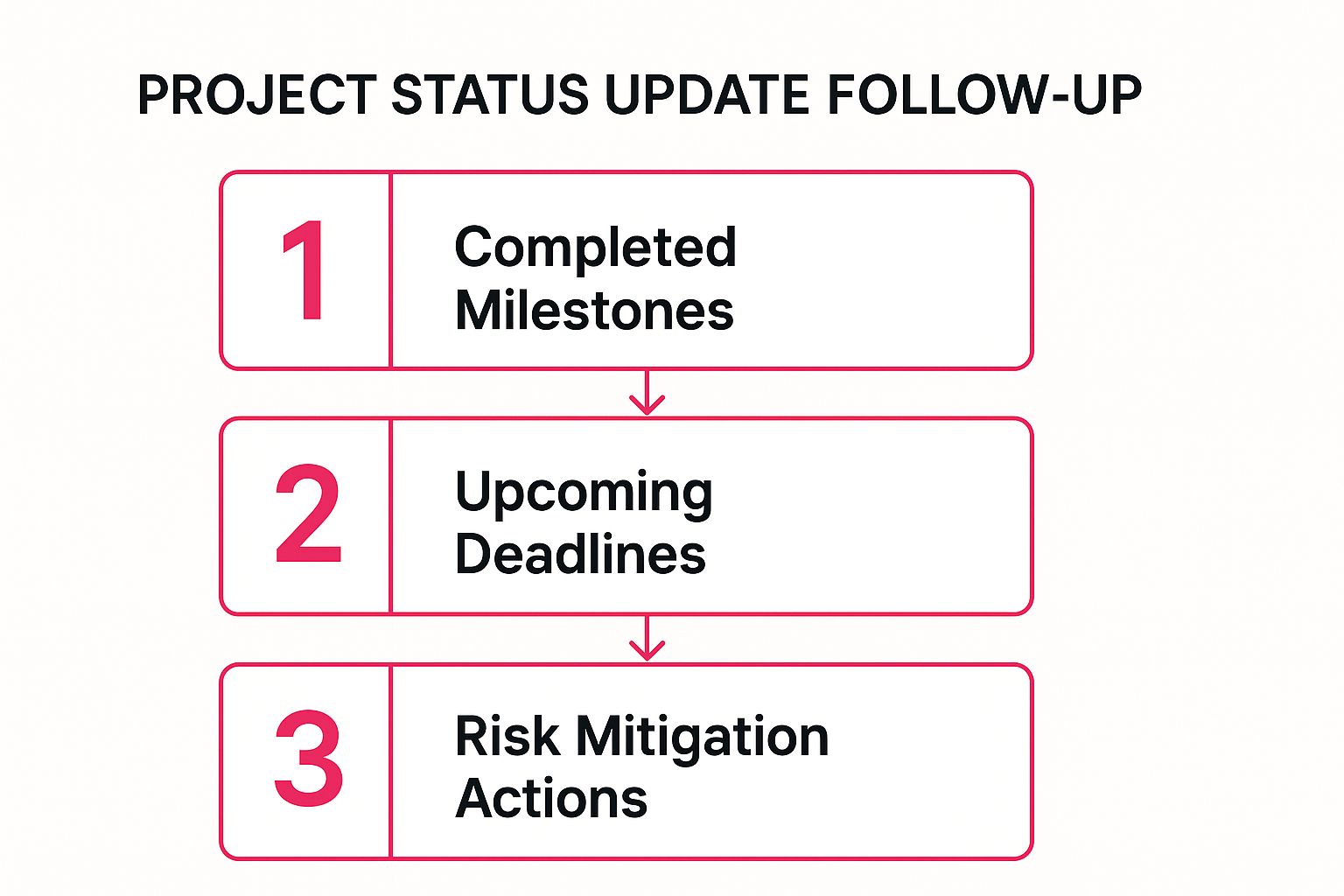
This logical flow ensures you first report on accomplishments, then set future expectations, and finally address potential issues with proactive solutions.
More than a simple report, this type of follow-up is a key part of your overall customer engagement strategy template. A well-structured update demonstrates accountability, proactive problem-solving, and a commitment to shared success, preventing misunderstandings and keeping momentum strong.
Strategic Breakdown
Effective examples of follow up letters for projects avoid data dumps. They tell a story about the project’s journey, tailored to the audience’s specific interests and level of involvement.
- For a client: Focus on progress against key deliverables and budget. “This week, we completed the user authentication module (Milestone 3) and are currently 5% under budget. We are on track to begin the payment gateway integration next Monday.”
- For an executive stakeholder: Highlight alignment with business goals. “The completion of Phase 1 directly supports our Q3 goal of improving user retention. Early metrics from the beta test show a 10% increase in session duration, indicating strong progress.”
- For an internal team: Detail specific tasks, dependencies, and roadblocks. “The front-end team has pushed the final UI components. However, we are blocked by the API endpoint for user profiles. The backend team is prioritizing this, with an ETA of Wednesday.”
Key Insight: Transparency is paramount. Always be upfront about challenges, but frame them with a clear, solution-oriented action plan. This builds credibility and shows you are in control of the situation.
Actionable Takeaways
- Establish a Cadence: Set a regular schedule for updates (e.g., weekly, bi-weekly) from the project’s start. Consistency builds trust and makes the information expected.
- Tailor the Detail: A CEO needs a high-level summary, while a lead developer needs technical specifics. Adjust the level of detail for each audience.
- Use Visuals for Data: For complex information like budget allocation or timeline tracking, use simple charts or graphs to make the data digestible at a glance.
- Be Accountable: Always include specific dates, metrics, and responsible parties. This turns a passive update into an active management tool.
6. Payment Reminder Follow-Up Letter
The payment reminder follow-up is a crucial communication tool for maintaining healthy cash flow while preserving client relationships. Sent to customers with overdue invoices, this letter serves to gently prompt payment without causing offense. It’s a necessary, methodical process that escalates in tone and formality over time, ensuring you get paid while acting professionally and reasonably.
More than just a demand for money, a well-structured payment reminder demonstrates organization and respect for the business relationship. By starting with a polite nudge and offering solutions like payment plans, you show empathy and a willingness to work with clients, which can turn a potentially negative interaction into a positive one that builds long-term loyalty.
Strategic Breakdown
Effective examples of follow up letters for payment collection are not one-size-fits-all. They must be tailored to the specific situation, including how overdue the payment is and your relationship with the client.
- For a recent overdue invoice (1-2 weeks): A freelance designer might send a gentle reminder: “Hi [Client Name], this is a friendly follow-up on invoice #123 for the website project, which was due last week. Please let me know if you’ve had a chance to look at it. I’ve attached a copy for your convenience.”
- For a significantly overdue invoice (30-60 days): A business could take a firmer tone and offer solutions: “Following up on invoice #456, which is now 60 days past due. We understand that things can get overlooked. If you are experiencing difficulties, we are open to discussing a payment plan that works for you.”
- For a final notice: A service provider might state clear consequences: “This is the final notice for invoice #789, which is now 90 days overdue. If payment is not received by [Date], we will have no alternative but to refer this matter to our collections agency.”
Key Insight: The strategy is escalation. Each follow-up should become slightly more firm, clearly state the facts (invoice number, amount, due date), and guide the client toward a resolution, documenting every step of the process.
Actionable Takeaways
- Start Gently: Your first reminder should be polite and assume the missed payment was an oversight. A simple, friendly email is often all that’s needed.
- Gradually Increase Firmness: If initial reminders are ignored, your tone should become more direct in subsequent communications. Clearly state the number of days the invoice is overdue.
- Always Include the Invoice: Attach a copy of the original invoice to every reminder. This eliminates any confusion and makes it easy for the client to process the payment.
- Offer Solutions: For good clients who are late, offering a payment plan can help them manage their finances and help you secure the payment. It’s also helpful to have a broad knowledge of understanding payment methods to facilitate this process.
- Document Everything: Keep a clear record of every reminder sent, including dates and content. This documentation is vital if you need to take legal action later.
7. Meeting Follow-Up Letter
A meeting follow-up letter, often sent as an email, is a professional communication that transforms verbal discussions into a documented record. Sent after business meetings, this correspondence summarizes key discussion points, outlines decisions made, and clearly assigns action items with deadlines. It serves as an essential tool for ensuring alignment, maintaining momentum, and fostering accountability among all participants.
More than just formal minutes, a well-structured follow-up acts as a project’s North Star. It eliminates ambiguity, prevents tasks from falling through the cracks, and provides a clear reference point for future discussions. By creating a shared understanding of outcomes, these examples of follow up letters ensure that the time invested in the meeting translates directly into productive action.
Strategic Breakdown
An effective meeting follow-up moves beyond a simple summary. It is a strategic tool for project management and relationship building, ensuring every participant leaves with the same understanding and a clear path forward.
- For a client project meeting: A project manager could summarize, “As discussed, we will proceed with Option B for the homepage redesign. Action Item: Our design team (John) will deliver initial wireframes by Friday, EOD. Action Item: The client team (Susan) will provide brand assets by Wednesday.” This clarifies deliverables and responsibilities.
- For an internal strategy session: A department head might document, “We have decided to pivot our Q4 marketing focus toward video content. Action Item: Maria will research video production vendors and present options by 10/15. Action Item: Ben will analyze competitor video strategies and report findings by 10/18.” This solidifies strategic direction.
- For a performance review: An HR manager can follow up to formalize a conversation. “Thank you for the productive discussion about your Q3 goals. We agreed on a focus area of improving client presentation skills. Action Item: You will enroll in the public speaking workshop by the end of the month.”
Key Insight: The purpose is to create an undeniable source of truth. By clearly outlining decisions, assigning ownership, and setting deadlines, you remove the risk of misinterpretation and drive accountability.
Actionable Takeaways
- Act Promptly: Send the follow-up within 24-48 hours. This ensures details are fresh for everyone and capitalizes on the meeting’s momentum. While post-meeting follow-ups are crucial, preventing no-shows is equally important. To learn more about how to proactively manage attendance, explore these appointment reminder text message templates to reduce no-shows.
- Structure for Clarity: Use headings like “Decisions Made,” “Action Items,” and “Next Steps.” Utilize bullet points and bold text to make the email easily scannable for busy professionals.
- Assign Ownership: Every action item must have a specific person’s name and a clear deadline attached. Vague assignments like “the team will look into it” lead to inaction.
- Invite Collaboration: End the letter by asking participants to review the summary and reply with any corrections or additions. This ensures buy-in and accuracy.
7 Types of Follow-Up Letters Compared
| Follow-Up Type | 🔄 Implementation Complexity | 💡 Resource Requirements | 📊 Expected Outcomes | 💡 Ideal Use Cases | ⭐ Key Advantages |
|---|---|---|---|---|---|
| Post-Interview Thank You Letter | Low – simple, personalized letter | Minimal – basic writing skills | Positive impression, reinforces interest | After job interviews to express gratitude | Demonstrates professionalism, shows interest |
| Sales Follow-Up Letter | Medium – requires personalization | Moderate – research and data | Maintains engagement, overcomes objections | After sales meetings or presentations | Builds trust, accelerates decision-making |
| Customer Service Resolution | Medium – requires case-specific details | Moderate – time per case | Increased satisfaction, issue closure | After resolving customer complaints | Enhances retention, shows accountability |
| Networking Event Follow-Up Letter | Medium – personalized with specific refs | Moderate – recalling meeting details | Builds connections, potential collaborations | After networking events or conferences | Grows network, opens referral opportunities |
| Project Status Update Follow-Up | High – detailed, regular updates | High – data gathering and reporting | Transparency, stakeholder confidence | For project teams and stakeholders | Manages expectations, identifies issues early |
| Payment Reminder Follow-Up Letter | Low to Medium – straightforward but firm | Moderate – tracking and escalation | Improved payment collection | For overdue invoices and payment collections | Improves cash flow, maintains professionalism |
| Meeting Follow-Up Letter | Medium to High – detailed summaries | Moderate – note-taking and formatting | Clear understanding, accountability | After business meetings | Ensures clarity, documents decisions |
From Templates to Triumphs: Your Next Steps in Follow-Up Mastery
Throughout this guide, we’ve dissected a wide array of examples of follow up letters, moving far beyond generic templates. From the post-interview thank you that secures a job offer to the sales follow-up that closes a critical deal, and the customer service message that rebuilds trust, a clear pattern emerges. The most effective follow-ups are not mere formalities; they are strategic communication tools built on three core pillars: personalization, timeliness, and value.
A generic, delayed message is easily ignored. A thoughtful, prompt message that offers something of value, whether it’s a helpful resource, a reiterated key point from a conversation, or a clear solution to a problem, demands attention and drives action. This principle holds true across every scenario we’ve covered, from networking events to project updates.
Turning Insight into Instinct
The true power of these examples lies not in copying them word-for-word, but in internalizing the strategic DNA behind them. Your goal is to move from consciously constructing a follow-up to instinctively knowing how to connect, add value, and guide the conversation forward. To achieve this, focus on these actionable next steps:
- Deconstruct Before You Construct: Don’t just look at a template and fill in the blanks. Analyze why it works. Identify the hook, the value proposition, and the call to action. Understanding the underlying structure is more important than memorizing the exact phrasing.
- Create Your “Value” Snippet Library: For your specific role or industry, what constitutes value? Is it a link to a relevant case study, an introduction to a helpful contact, a summary of meeting action items, or a discount code? Start collecting these “value-adds” so you can easily deploy them in your follow-ups.
- Embrace Automation for Scalability: For professionals in marketing or e-commerce, manually following up with every lead or customer is impossible. The principles of timely, personalized follow-ups are the bedrock of modern marketing automation. For those looking to integrate their follow-up strategies into broader digital campaigns, exploring effective email marketing strategies for driving growth can provide valuable insights into building comprehensive customer journeys.
Mastering the art of the follow-up is an investment in your professional relationships and business outcomes. It’s the skill that turns a promising conversation into a partnership, a passive lead into a loyal customer, and a simple interaction into a lasting positive impression. By applying these strategic principles consistently, you are not just sending better messages; you are building a reputation as a proactive, thoughtful, and effective communicator.
Ready to automate the most crucial follow-up in e-commerce? CartBoss applies these same principles of timely, personalized communication to automatically recover abandoned shopping carts using high-engagement SMS messages. Stop losing sales and start turning missed opportunities into revenue by visiting CartBoss to see how powerful automated follow-ups can be.