


The Great Debate: Text Messages vs. Emails
Choosing between SMS marketing and email marketing can be tough. This listicle clarifies 7 key differences, helping you maximize your marketing ROI. We’ll cover strategies from segmented SMS campaigns and automated email sequences to SMS short codes and interactive emails. Learn whether SMS marketing, email marketing, or a combination of both is best for your e-commerce business in 2025. Understand how to leverage each channel for customer retention, loyalty programs, and even newsletter monetization. This comparison of SMS marketing vs email marketing empowers you to optimize your marketing spend and reach your target audience effectively.
1. Segmented SMS Campaigns
In the ongoing debate of SMS marketing vs email marketing, segmented SMS campaigns emerge as a powerful tool for boosting engagement and conversions. Segmented SMS marketing involves dividing your audience into specific groups based on demographics, behavior, purchase history, or preferences. This allows you to deliver highly targeted text messages, ensuring recipients receive content relevant to their specific needs and interests, ultimately driving better results than generic mass texting. This personalized approach significantly elevates the customer experience while simultaneously optimizing your marketing spend.
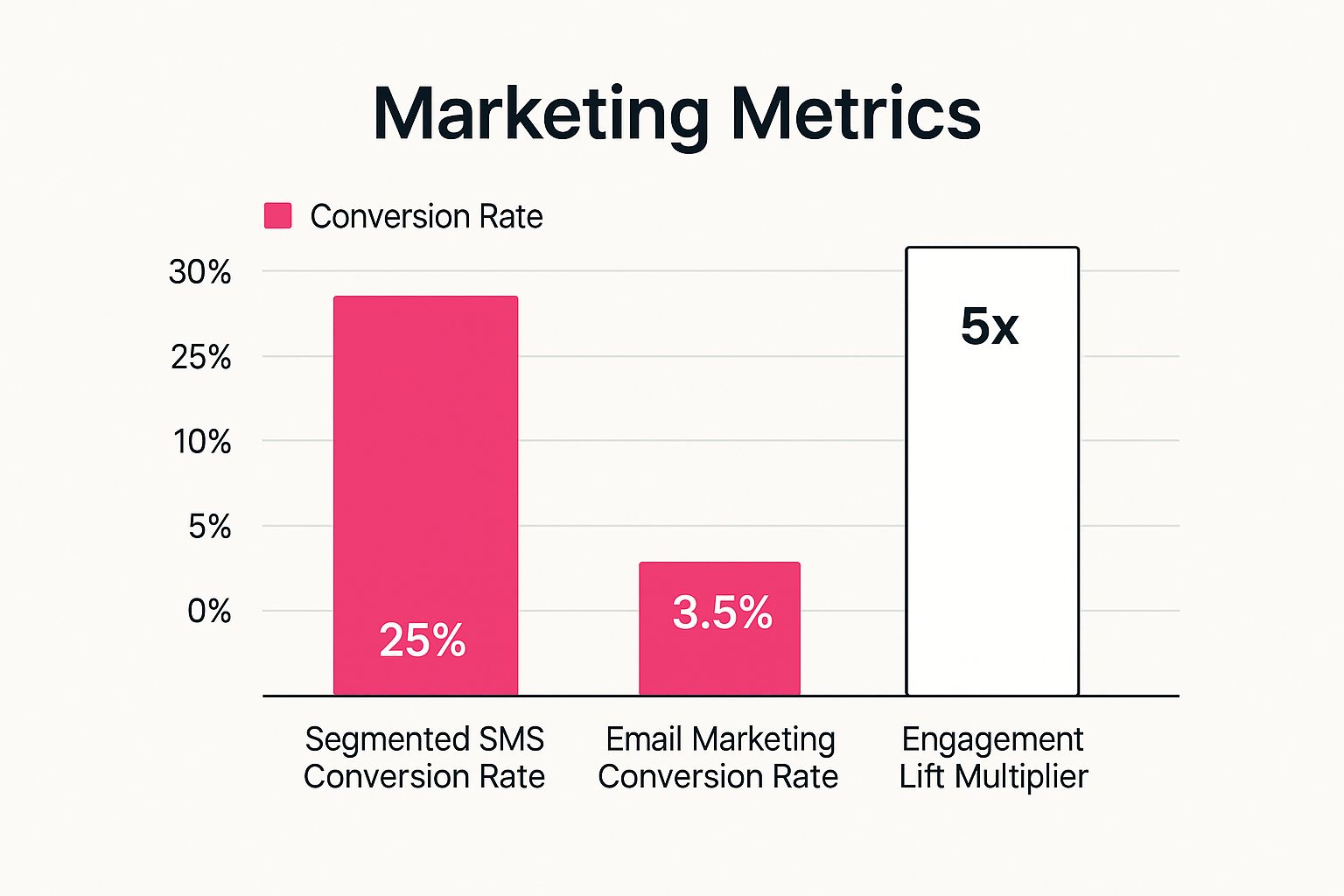
The infographic above visualizes the impact of segmented SMS campaigns on key performance indicators. The bar chart clearly demonstrates the lift achieved through segmentation, with engagement rates soaring 4-6x higher and conversion rates improving by up to 200% compared to unsegmented campaigns. It also showcases a decrease in opt-out rates, highlighting the importance of relevant content in customer retention.
Features of segmented SMS campaigns include precise audience targeting based on multiple data points, personalized message content for each segment, automated delivery based on segment criteria, and real-time performance tracking by segment. These features provide businesses with granular control over their SMS marketing efforts, allowing for highly effective and data-driven campaigns. For example, Sephora’s Beauty Insider program segments SMS recipients by purchase history and sends personalized product recommendations. Similarly, Starbucks uses segmentation to send different promotional offers based on customer visit frequency, and Domino’s Pizza segments users by location and past orders to deliver relevant local promotions. These examples demonstrate how leveraging customer data can enhance the impact of SMS marketing.
When comparing SMS marketing vs email marketing, the immediacy and higher open rates of SMS make it ideal for time-sensitive promotions, flash sales, and important updates. Segmented SMS campaigns take this a step further by tailoring those messages for maximum impact. The benefits are clear: higher engagement rates (typically 4-6x higher than unsegmented campaigns), improved conversion rates (up to 200% better than mass texting), reduced opt-out rates by delivering relevant content, and an enhanced customer experience through personalization. Learn more about Segmented SMS Campaigns to delve deeper into effective segmentation techniques.
However, implementing segmented SMS campaigns also comes with its challenges. It requires robust customer data collection and management, and can be more complex to set up and manage than basic mass SMS. It may also require specialized SMS marketing platforms like Attentive Mobile, Tatango, or EZ Texting, and can be time-consuming to create multiple message variations.
To get started with segmented SMS campaigns, begin with 3-5 key segments before expanding to more granular targeting. Test different message variations for each segment to optimize performance, and include segment-specific calls-to-action (CTAs) that address unique pain points. Regularly cleaning and updating segment data ensures accuracy and maintains the effectiveness of your campaigns. This meticulous approach allows you to fully leverage the power of personalization within your SMS strategy, significantly impacting your bottom line. This makes segmented SMS campaigns a crucial element to consider when evaluating SMS marketing vs email marketing for your e-commerce business.
2. Automated Email Sequences
When comparing SMS marketing vs email marketing, automated email sequences stand out as a powerful tool in the email marketer’s arsenal, offering a level of personalized communication and engagement that SMS, with its character limits, often struggles to match. These sequences, also known as drip campaigns, are pre-planned series of emails automatically sent to subscribers based on specific triggers or timed intervals. They nurture leads through the sales funnel, delivering targeted content at each stage to build trust and guide them towards conversion. This approach allows for a more strategic and personalized communication strategy compared to simple, one-off email blasts.
Automated email sequences work by pre-defining a series of emails and the triggers that initiate their sending. These triggers can be user actions, such as signing up for a newsletter or abandoning a shopping cart, or time-based intervals, like sending a welcome email immediately after signup followed by a product showcase a few days later. The system automatically sends the emails based on these predefined parameters. Features such as behavior-triggered delivery, sequential messaging, dynamic content adaptation, predetermined timing intervals, and branching logic based on user engagement empower businesses to create truly personalized experiences.
For instance, Airbnb leverages post-booking email sequences to guide guests through the check-in process and provide essential information about their stay. Grammarly uses a free-to-premium user conversion sequence, strategically highlighting the benefits of their advanced features. HubSpot, a marketing automation giant, utilizes lead nurturing sequences tailored to different buyer personas, ensuring relevant content delivery. These examples showcase how automated sequences can be implemented across various business models to achieve specific marketing objectives.
Pros:
- Automation & Reduced Manual Work: Significantly reduces the manual effort required for repetitive email tasks.
- Consistent Engagement: Creates consistent touchpoints throughout the customer journey, fostering stronger relationships.
- High ROI: Delivers a higher return on investment compared to one-off campaigns, averaging 320% higher.
- Scalability: Easily scalable to accommodate large subscriber bases.
- Valuable Insights: Provides valuable behavioral insights through tracking, allowing for data-driven optimization.
Cons:
- Upfront Planning: Requires substantial upfront planning and content creation.
- Potential Impersonality: Can feel impersonal if not properly personalized.
- Technical Complexity: Technical setup can be complex, especially for sophisticated sequences with advanced branching logic.
- Ongoing Maintenance: Needs regular maintenance and optimization to ensure effectiveness.
Actionable Tips for Creating Effective Email Sequences:
- Map Your Flow: Plan the entire sequence flow before writing any emails.
- Clear CTAs: Include clear, single-focused calls-to-action in each email.
- Strategic Timing: Space out emails appropriately to avoid overwhelming recipients.
- Segmentation: Create different sequences for different segments of your audience.
- Regular Optimization: Regularly test and optimize your sequences to improve open rates and click-through rates.
Learn more about Automated Email Sequences for further insights into optimizing your email marketing strategy.
Automated email sequences deserve a prominent place in any “SMS marketing vs email marketing” comparison because they offer a depth of personalization and engagement that SMS, despite its immediacy, struggles to achieve. While SMS excels at short, time-sensitive messages, email allows for richer content, detailed storytelling, and the development of complex nurturing campaigns, particularly beneficial for e-commerce businesses, marketing professionals, and online retailers targeting high cart abandonment rates and customer retention. Platforms like Mailchimp, ActiveCampaign, and ConvertKit have popularized this approach, providing user-friendly tools to create and manage sophisticated automated email sequences. This automated, personalized approach is crucial for small to medium-sized businesses, Shopify and WooCommerce store owners, and agencies managing multiple e-commerce clients, particularly when operating in multiple languages or aiming to optimize marketing spend within a competitive online landscape. By leveraging automated email sequences, businesses can cultivate deeper relationships with their audience and drive conversions more effectively than with standalone email blasts or SMS alone.
3. SMS Short Code Campaigns
In the ongoing debate of SMS marketing vs email marketing, SMS short code campaigns offer a powerful tool for reaching a broad audience quickly and effectively. This method utilizes memorable 5-6 digit numbers (short codes) instead of standard 10-digit phone numbers, enabling two-way text messaging between businesses and their customers. This approach is particularly well-suited for high-volume, time-sensitive promotions, contests, polls, and opt-in campaigns where brand recognition and easy recall are critical. For e-commerce businesses, marketing professionals, and online retailers, particularly those with high cart abandonment rates or operating across multiple languages, short codes provide a unique avenue for engaging customers and driving conversions.
How SMS Short Codes Work:
Customers text a keyword to the designated short code to opt in or participate. The short code facilitates higher throughput (100+ messages per second) and supports keywords that trigger automated responses. This allows businesses to manage large-scale interactions seamlessly. The system is built-in with compliance features for telecom regulations, ensuring your campaigns adhere to industry standards. Moreover, short codes boast enhanced deliverability rates (98%+), significantly reducing the risk of messages being lost or filtered as spam.
Features and Benefits:
- Memorable 5-6 digit numbers: Easy for customers to remember and use.
- High Throughput: Handles large volumes of messages simultaneously.
- Keyword Support: Automates responses and segments audiences.
- Regulatory Compliance: Built-in features ensure adherence to telecom rules.
- High Deliverability: Ensures messages reach their intended recipients.
Pros:
- Higher Engagement: Boasts 25-30% higher response rates than long-code SMS.
- Ideal for Mass Marketing: Perfect for time-sensitive offers and large-scale promotions.
- Interactive Two-Way Communication: Enables personalized conversations at scale.
- Strong Brand Recognition: Short codes reinforce brand identity.
- Reduced Spam Filtering: Less likely to be flagged as spam compared to long codes.
Cons:
- Cost: Leasing a short code can be expensive ($500-$1,000+ monthly).
- Acquisition Time: The approval process can take 8-12 weeks.
- Limited Availability: Requires early reservation due to limited numbers.
- Less Personal: Can feel less personal than communication from a standard long code.
Examples of Successful Implementation:
- Coca-Cola: Used short code 2653 (COKE) for their “Share a Coke” contest.
- American Idol: Pioneered voting via short code with their 5701 number.
- Starbucks: Uses short code 873283 (SBUCKS) for their rewards program. These examples demonstrate the versatility of short codes across various marketing objectives, from contests and voting to loyalty programs.
Actionable Tips for Using Short Codes:
- Keyword Selection: Choose keywords that are simple, memorable, and relevant to your brand.
- Value Proposition: Clearly communicate the value users receive by opting in.
- Immediate Response System: Ensure prompt replies to all incoming texts.
- Throughput Testing: Test capacity before launching major campaigns.
- Opt-Out Instructions: Always include clear opt-out instructions in every message.
Why Short Codes Deserve a Place in SMS Marketing vs Email Marketing Discussions:
While email marketing remains a valuable tool, SMS short code campaigns fill a specific niche. They excel in scenarios requiring immediate interaction, high engagement, and broad reach. This makes them a crucial component of any comprehensive marketing strategy, especially for e-commerce businesses aiming to optimize their marketing spend and improve customer retention. The high deliverability and cut-through capability make them particularly valuable for time-sensitive promotions and reaching customers who may be less responsive to email. For Shopify and WooCommerce store owners, agencies managing multiple e-commerce clients, and businesses focused on customer retention, short codes offer a compelling method for driving engagement and achieving marketing objectives. Platforms like Twilio, SlickText, and SimpleTexting have popularized and streamlined access to this technology, making it more accessible than ever.
4. Interactive Email Marketing
In the ongoing debate of SMS marketing vs email marketing, interactive email marketing emerges as a powerful contender for engagement and conversion. It elevates email campaigns beyond static content by incorporating dynamic, clickable elements directly within the email itself. This allows recipients to interact with your message without ever leaving their inbox, transforming passive consumption into an engaging, almost app-like experience. Think polls, surveys, image carousels, accordions, even add-to-cart functionality – all within the email.
Interactive email features like clickable image carousels showcasing product galleries, embedded forms for surveys and feedback, interactive quizzes and polls for engagement, and accordion menus for streamlined content organization can significantly enhance the customer journey. Animated buttons and compelling calls-to-action further encourage immediate interaction. These features translate into tangible benefits, such as increasing engagement by up to 300% compared to static emails, reducing friction in the purchasing process by allowing in-email purchases, and providing valuable first-party data through user interactions. This creates more memorable brand experiences and increases the time users spend engaging with your email content, typically 2-3 times longer than standard emails.
For example, Burberry uses interactive product carousels to showcase their latest seasonal collections directly within emails, enabling customers to browse and click through to purchase without leaving their inbox. Netflix uses an in-email rating system for recently watched content, gathering valuable feedback while keeping users engaged. Sephora incorporates interactive shade-finder tools within promotional emails, allowing customers to find their perfect makeup match without navigating to the website. These examples demonstrate how interactive email can create a more personalized and engaging experience, driving conversions and fostering customer loyalty.
While the benefits are compelling, there are some challenges. Technical implementation can be complex, and not all interactive elements are supported across every email client. This necessitates thorough testing across various devices and platforms to ensure a consistent user experience. Interactive emails can also have larger file sizes, potentially increasing load times. Finally, production costs are typically higher than standard emails. However, the significant increase in engagement and conversions often outweighs these challenges, making interactive email a worthwhile investment, especially for e-commerce businesses.
To get started with interactive email marketing, always include fallback content for email clients that don’t support interactivity, ensuring everyone receives a readable message. Start with simpler interactive elements like polls and quizzes before implementing complex features like add-to-cart functionality. Explore technologies like AMP for Email to unlock advanced interactive capabilities. Rigorous testing across major email clients is crucial before sending to your full list. Finally, focus your interactive elements on features that directly drive your business objectives, whether it’s increasing sales, gathering customer feedback, or boosting brand engagement. Platforms like Mailchimp and Stripo offer built-in interactive email builders, while specialized solutions like Zembula and Google’s AMP for Email provide more advanced options. Learn more about Interactive Email Marketing and discover how it can elevate your email marketing strategy in the context of SMS marketing vs email marketing. By strategically leveraging interactive elements, you can transform your emails from passive messages into dynamic, engaging experiences that drive results.
5. Conversational SMS Marketing
In the ongoing debate of SMS marketing vs email marketing, conversational SMS marketing emerges as a powerful contender, offering a highly engaging and personalized approach. This method leverages AI-powered chatbots and live agent integration to create two-way text message dialogues that simulate human conversation. It transforms traditional one-way SMS broadcasts into dynamic interactions, enabling businesses to answer questions, provide recommendations, troubleshoot issues, and guide customers through purchasing decisions in real-time. This personalized engagement makes it particularly relevant in the SMS marketing vs email marketing discussion, as it offers a level of immediacy and interactivity that email often struggles to match.
Conversational SMS marketing is powered by several key features:
- Natural Language Processing (NLP): Allows chatbots to understand and interpret human language.
- Contextual Response Generation: Ensures relevant and appropriate replies based on the conversation history.
- Seamless Handoff between AI and Human Agents: Facilitates smooth transitions for complex inquiries requiring human intervention.
- Personalized Recommendation Engines: Offers tailored product suggestions based on customer preferences and past behavior.
- Conversation History Tracking: Maintains a record of interactions for personalized future engagements.
- Omnichannel Integration: Connects with other customer service platforms for a unified customer experience.
This approach offers significant advantages in the SMS marketing vs email marketing landscape:
Pros:
- Creates personalized, 1:1 customer experiences at scale: Fosters deeper customer relationships.
- Resolves customer inquiries instantly (average 3-minute resolution): Provides immediate support and gratification.
- Significantly higher engagement than one-way SMS (75% vs 25% response rate): Drives better results and ROI.
- Builds stronger emotional connections with customers: Increases brand loyalty and advocacy.
- Collects valuable conversational data for marketing insights: Informs future marketing strategies.
However, it’s crucial to acknowledge the potential drawbacks:
Cons:
- Requires sophisticated AI and integration technologies: Can involve a steeper learning curve.
- Higher implementation costs than traditional SMS: Demands investment in technology and resources.
- May need human oversight for complex inquiries: Requires trained personnel to manage escalations.
- Potential for AI misinterpretation of customer intent: Necessitates ongoing monitoring and refinement.
- More resource-intensive to maintain than broadcast SMS: Requires continuous optimization and updates.
Several brands have successfully implemented conversational SMS marketing:
- Sephora’s Beauty Bot: Provides personalized product recommendations via text.
- Bank of America’s Erica SMS assistant: Handles account inquiries and transactions.
- H&M’s conversational shopping assistant: Helps customers find products quickly and efficiently.
To effectively utilize conversational SMS marketing, consider these tips:
- Start with commonly asked questions when building your conversational flows: Address the most frequent customer inquiries first.
- Establish clear handoff protocols between AI and human agents: Ensure seamless transitions for complex issues.
- Use conversational data to continuously improve response accuracy: Refine your AI models based on customer interactions.
- Maintain consistent brand voice across automated and human responses: Preserve brand identity and create a cohesive experience.
- Set clear expectations about response times and service hours: Manage customer expectations effectively.
Conversational SMS marketing deserves its place in the SMS marketing vs email marketing discussion because it bridges the gap between personalized service and scalable outreach. By facilitating real-time, two-way communication, it empowers businesses to build stronger customer relationships, resolve issues quickly, and ultimately drive conversions. For e-commerce businesses, marketing professionals, and online retailers, especially those dealing with high cart abandonment rates or operating across multiple languages, conversational SMS offers a compelling alternative to traditional methods. Learn more about Conversational SMS Marketing This approach aligns perfectly with the needs of Shopify and WooCommerce store owners, as well as agencies managing multiple e-commerce clients, seeking to optimize marketing spend and enhance customer retention. By focusing on real-time engagement, conversational SMS provides a unique edge in the competitive landscape of online marketing.
6. Email Newsletter Monetization
When comparing SMS marketing vs email marketing, a key differentiator emerges in the realm of monetization. While SMS marketing excels at driving immediate actions and conversions, email marketing offers a unique opportunity to build a revenue-generating asset through newsletter monetization. This transforms email from a pure customer acquisition channel into a direct source of income.
Email newsletter monetization involves creating valuable, specialized content delivered via email and then leveraging that audience to generate revenue. This can be achieved through several avenues:
Features and Monetization Methods:
- Sponsored Content Placements and Dedicated Sends: Partnering with relevant brands to feature their products or services within your newsletter, either as integrated content or dedicated email blasts.
- Tiered Subscription Models (Free vs. Premium Content): Offering a free newsletter with valuable content while also providing a premium subscription tier with exclusive content, features, or community access.
- Affiliate Product Recommendations: Integrating affiliate links within your newsletter content, earning a commission on sales generated through those links.
- Native Advertising Integrations: Seamlessly weaving advertisements into the newsletter content in a way that feels natural and non-intrusive.
- Exclusive Member-Only Content: Providing subscribers with access to exclusive content, discounts, or early access to products/services.
- Cross-promotion with Complementary Brands: Partnering with non-competing businesses to cross-promote each other’s products or services to respective audiences.
Pros:
- Creates Direct Revenue: Transforms your email marketing efforts into a profit center.
- Builds Valuable First-Party Audience Data: Collects valuable data about your subscribers’ preferences and behaviors.
- Higher Profit Margins: Often offers better returns than traditional advertising.
- Strengthens Audience Relationships: Provides valuable content that fosters loyalty and engagement.
- Less Susceptible to Platform Algorithm Changes: Unlike social media, you own your email list and control the delivery of your content.
Cons:
- Requires Consistent High-Quality Content Creation: Maintaining a successful newsletter demands a commitment to producing valuable content regularly.
- Monetization Potential Depends on List Size and Engagement: A larger, engaged audience translates to greater monetization opportunities.
- Risk of Audience Fatigue with Excessive Promotions: Overly promotional content can lead to unsubscribes.
- Needs Careful Balance Between Editorial and Commercial Content: Maintaining a balance between valuable content and promotional material is crucial for long-term success.
- Potential for Subscriber Churn if Value Proposition Weakens: If the newsletter’s value diminishes, subscribers may lose interest and unsubscribe.
Examples of Successful Implementation:
- Morning Brew: This popular business newsletter generates $20M+ in annual revenue through sponsored content and other monetization strategies.
- The Hustle: This daily business newsletter, acquired by HubSpot for $27M, demonstrates the potential for substantial returns.
- The Skimm: This daily news digest leverages multiple revenue streams, including sponsorships and affiliate marketing.
Tips for Effective Email Newsletter Monetization:
- Focus on Building a Highly Engaged, Niche Audience Before Monetization: A dedicated audience is crucial for successful monetization efforts.
- Maintain Clear Separation Between Editorial and Sponsored Content: Transparency builds trust with your audience.
- Test Different Ad Formats to Find What Resonates with Your Audience: Experimentation helps identify the most effective monetization strategies.
- Create a Media Kit with Subscriber Demographics for Potential Sponsors: Provide sponsors with valuable data to attract partnerships.
- Consider Launching with Weekly Frequency Before Scaling to Daily Sends: Starting with a less frequent schedule allows you to refine your content and strategy.
Popularized By: Substack (newsletter platform), Ben Thompson (Stratechery), Ann Handley (MarketingProfs), Sam Parr and Shaan Puri (The Hustle)
Email newsletter monetization deserves its place in the SMS marketing vs email marketing discussion because it highlights a crucial difference in their revenue-generating capabilities. While SMS is powerful for driving immediate sales, email newsletters, when strategically monetized, can become a sustainable and significant revenue stream, making it an attractive option for e-commerce businesses, marketing professionals, and online retailers looking to diversify their income. This approach is particularly relevant for those focused on building a loyal audience and creating valuable content, as it allows them to leverage their email list as a direct revenue-generating asset rather than just a communication channel.
7. SMS Loyalty Programs
SMS loyalty programs represent a powerful way to boost customer retention and engagement, offering a compelling alternative or complement to traditional email marketing strategies in the “sms marketing vs email marketing” debate. These programs leverage the immediacy and high open rates of text messaging to create, manage, and enhance customer loyalty initiatives. They use text messages to enroll members, track points or rewards, deliver personalized offers, provide real-time balance updates, and facilitate redemption—all through the convenience of a customer’s mobile device. This direct and personal approach allows businesses to foster stronger relationships with their customers, ultimately driving repeat purchases and increasing customer lifetime value.

Features like text-to-join enrollment processes simplify sign-up, while digital loyalty card integration eliminates the need for physical cards. Automated point balance notifications and location-based reward triggers add a layer of personalization and convenience. Further enhancing the customer experience are automated birthday and anniversary rewards and the ability to deliver and redeem mobile coupons directly through text. Two-way messaging functionality also enables customers to easily inquire about their rewards.
This approach holds several key advantages in the sms marketing vs email marketing comparison. SMS loyalty programs boast significantly higher participation rates (40-60% higher) than traditional loyalty programs and benefit from the near-instant delivery of time-sensitive offers, with a 98% read rate within minutes. They also offer lower implementation costs than custom loyalty apps and drive significantly higher redemption rates for SMS coupons (10x email coupon redemption). Crucially, these programs generate valuable first-party customer data and drive repeat purchase frequency, typically increasing it by 25-35% on average. For e-commerce businesses, marketing professionals, and online retailers – especially those with high cart abandonment rates or operating small to medium-sized stores on platforms like Shopify and WooCommerce – the data-driven insights and personalized engagement offered by SMS loyalty programs are invaluable.
However, it’s important to be mindful of the limitations. Message frequency must be carefully managed to avoid customer fatigue, and character count restrictions can make conveying complex program details challenging. Strict compliance with SMS regulations is essential, and visual branding opportunities are more limited compared to dedicated apps. Finally, adoption rates might be lower among older demographics.
Successful examples of SMS loyalty programs include Chipotle’s text notifications that drive same-day visits, DSW’s VIP text club with exclusive member-only offers, and Kiehl’s tiered rewards system implemented through text messaging. These brands effectively utilize SMS to engage their customers and incentivize repeat business.
To maximize the effectiveness of your SMS loyalty program, consider these tips: Create a simple keyword for program enrollment (e.g., TEXT ‘JOIN’ to 12345). Send a welcome sequence explaining program benefits immediately after signup and maintain a consistent messaging cadence (typically 4-6 messages monthly). Personalize messages with customer names and point balances. Create special VIP text events for high-value customers, and always include clear redemption instructions with offers. Learn more about SMS Loyalty Programs for detailed guidance.
Platforms like Yotpo (loyalty and SMS marketing platform), Textedly (business texting service), and Belly (digital loyalty platform) have popularized and streamlined the implementation of SMS loyalty programs. By considering the pros and cons and following best practices, businesses can leverage the power of SMS to build stronger customer relationships and drive significant growth.
7-Strategy SMS vs Email Comparison
| Strategy | Implementation Complexity 🔄 | Resource Requirements 💡 | Expected Outcomes 📊 | Ideal Use Cases 💡 | Key Advantages ⭐ |
|---|---|---|---|---|---|
| Segmented SMS Campaigns | Moderate to High; requires customer data & multiple variants | Robust data management and specialized SMS platforms | 20-30% conversion rates; 4-6x higher engagement | Targeted promotions; personalized customer communication | Higher conversions; reduced opt-outs; real-time tracking |
| Automated Email Sequences | High; upfront planning and technical setup | Significant content creation and marketing automation tools | 70.5% higher open rates; 152% higher click rates | Lead nurturing; onboarding; timed user journeys | Scalable automation; consistent touchpoints; high ROI |
| SMS Short Code Campaigns | Moderate; approval process lengthy and costly | Leasing short codes is expensive; compliance needed | 25-30% higher response rates; ideal for urgent, mass offers | Flash sales; contests; large-scale opt-in campaigns | Memorable codes; high throughput; strong brand recognition |
| Interactive Email Marketing | High; technical and design complexity | Advanced email design tools and testing resources | 2-3x higher conversions; click-to-open rates >70% | Engagement-driven campaigns; product showcases | High engagement; data collection; reduces conversion friction |
| Conversational SMS Marketing | Very High; AI integration and maintenance required | Sophisticated AI, integration tech, and human oversight | 75% response rate; 89% customer satisfaction | Customer support; real-time recommendations; interactive sales | Personalized 1:1 engagement; instant resolution; strong loyalty |
| Email Newsletter Monetization | Moderate to High; consistent content and strategy required | Ongoing high-quality content creation and audience management | Revenue $1-$5 per subscriber monthly; premium $10+ subs | Niche audience monetization; sponsored content | Generates direct revenue; strong audience relationships |
| SMS Loyalty Programs | Moderate; compliance and messaging cadence critical | Platform for SMS loyalty management and customer data | 40% higher retention; 25% increased order value | Customer retention and repeat purchase programs | High participation; instant offer delivery; valuable data |
Choosing the Right Path: SMS, Email, or Both?
In the dynamic landscape of digital marketing, choosing between SMS marketing and email marketing isn’t always an either/or scenario. As we’ve explored, SMS excels in capturing immediate attention with concise, time-sensitive offers and fostering direct customer interaction through conversational SMS marketing and loyalty programs. Think segmented SMS campaigns for flash sales and short code campaigns for quick opt-ins. Conversely, email marketing empowers you to deliver rich, detailed content like interactive newsletters, nurture long-term relationships through automated email sequences, and guide customers through complex conversions. Each method offers unique strengths, from email newsletter monetization to building SMS loyalty programs.
The key takeaway from understanding “sms marketing vs email marketing” is recognizing their complementary nature. By strategically integrating both channels, you can maximize your reach and create a truly impactful marketing strategy. For businesses looking to streamline their marketing efforts across multiple channels, integrating social media can be highly effective. Utilizing social media scheduling tools can help manage both email and SMS campaigns alongside other digital marketing activities. Mastering these approaches allows you to connect with your audience on their preferred platforms, deliver personalized experiences, and ultimately drive significant business growth.
The future of marketing lies in creating seamless, integrated experiences. Embrace the power of both SMS and email to achieve unparalleled results and propel your business forward. Ready to harness the combined power of SMS and email to recover lost revenue and boost customer engagement? Explore CartBoss and discover how this powerful platform can seamlessly integrate both strategies, turning abandoned carts into profit and optimizing your marketing ROI.