


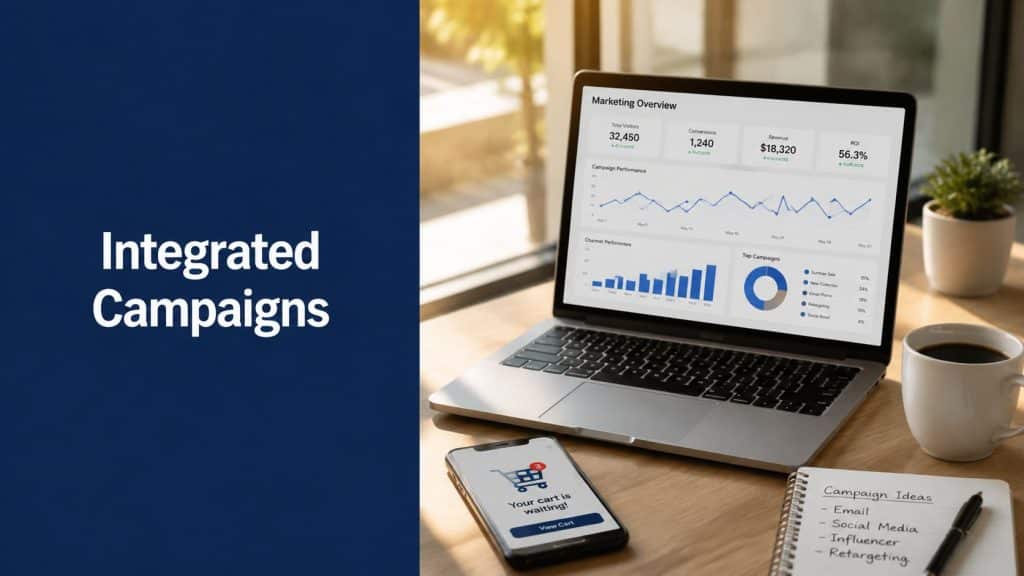
Most e-commerce brands don’t have a traffic problem. They have a coordination problem.
When campaigns run separately across email, paid social, SMS, search, and onsite messaging, each channel works harder than it should. The message shifts, timing slips, attribution gets messy, and buyers get a fragmented experience. That usually shows up as more abandoned carts, weaker conversion paths, and spend that’s difficult to justify.
The case for integration is strong. Campaigns launched across four or more channels can outperform single- or dual-channel campaigns by 300%, according to Klaviyo’s integrated marketing campaign guide. For e-commerce teams, that’s the difference between “we sent some emails and ran some ads” and “we built a system that moved shoppers toward checkout.”
Integrated marketing campaigns aren’t about posting the same creative everywhere. They’re about building one revenue path across channels, with each touchpoint doing a specific job.
Why Integrated Campaigns Are a Must for E-commerce Growth
Siloed marketing is expensive because customers don’t shop in silos.
A shopper might discover a product through Instagram, click a retargeting ad later, subscribe to email for a discount, leave the cart, then come back after a reminder on mobile. If those touchpoints aren’t aligned, the brand feels inconsistent and the journey adds friction right when intent is building.
What integration looks like in practice
In e-commerce, integrated marketing campaigns mean:
- One campaign objective tied to revenue, opt-ins, or recovery
- One core message adapted to each channel’s format
- One timing plan so reminders and promotions don’t collide
- One measurement view across the journey, not just by platform
That sounds obvious, but many stores still run email in one tool, ads in another, SMS as a separate tactic, and onsite messaging as an afterthought. The result is duplicated effort and mixed signals.
A practical omnichannel setup doesn’t require complexity for its own sake. It requires consistency. If you need a useful primer on how that differs from channel-by-channel promotion, this guide to omnichannel strategy is a strong companion read.
Practical rule: If a customer sees your ad, visits your store, joins your list, and abandons a cart, they should feel like one brand is talking to them, not four disconnected systems.
Why e-commerce brands feel the pain faster
Retail moves quickly. Promotions expire, products go out of stock, purchase intent cools fast, and margin disappears when teams overuse discounts to compensate for poor coordination.
Integrated campaigns reduce that waste because each channel has a role. Paid media creates demand. Email nurtures and educates. SMS handles urgency and recovery. Onsite messaging closes gaps at the point of decision. When those pieces support each other, the store captures more of the demand it already paid to acquire.
This is why integration has shifted from a branding idea to a growth discipline. In e-commerce, the customer journey is already multichannel. Your campaign structure needs to match it.
Foundations of a Winning Integrated Campaign
Strong campaigns usually look simple from the outside. Under the hood, they’re built on sharp planning.
The biggest campaign mistakes are predictable. The most common failure modes in marketing campaigns are ignoring audience segmentation, using inconsistent messaging across channels, and making decisions without data, according to Convert More’s breakdown of integrated campaign pitfalls.

Start with one measurable objective
Most underperforming campaigns try to do too much at once.
If you’re launching a spring collection, decide whether the primary goal is first-purchase conversion, repeat purchase, abandoned-cart recovery, or subscriber growth. You can support more than one outcome, but only one should lead. Otherwise, teams create mixed creative, mixed offers, and mixed reporting.
Good campaign objectives for e-commerce are specific enough to guide decisions:
- Recover abandoned carts
- Increase repeat purchase from recent buyers
- Grow qualified SMS or email opt-ins
- Move slow inventory without eroding brand value
Once that objective is fixed, every channel gets a job tied to it.
Segment before you write anything
Segmentation changes both message quality and timing. New visitors need reassurance. Returning shoppers need momentum. Cart abandoners need a friction-reducing nudge. VIP customers may respond better to access and convenience than discounts.
A useful segmentation workflow often includes:
- Behavioral segments based on browse, cart, purchase, and inactivity events
- Lifecycle segments such as first-time visitor, subscriber, customer, repeat customer
- Offer sensitivity segments for shoppers who only convert with incentives versus those who buy at full price
- Market segments by language, region, and compliance requirements
If you want a practical framework for building these groups, CartBoss has a useful guide to customer segmentation techniques.
Teams don’t need more messages. They need fewer messages that match the buyer’s situation.
For a broader strategic view, this article on winning multi-channel campaigns is worth reading because it reinforces the planning discipline that keeps channel execution coherent.
Set KPIs that reflect buying behavior
Don’t let platform metrics drive the campaign. Your KPIs should reflect the business action you want.
Track metrics such as:
- Recovered revenue for cart recovery flows
- Conversion rate by segment
- Revenue per send for lifecycle messages
- Return traffic to checkout
- Assisted conversions across channels
Vanity metrics still have diagnostic value, but they shouldn’t decide budget on their own. A campaign with lower visible engagement can still be more profitable if it moves high-intent shoppers back to checkout.
Selecting Your E-commerce Channel Mix
Channel selection isn’t about being everywhere. It’s about assigning each channel a role in the buying journey.
That matters because integrated marketing doesn’t just improve brand consistency. It’s also tied to performance. Studies from the Association of National Advertisers show that integrated marketing can deliver 18% higher sales and a 16% boost in profitability compared to siloed marketing efforts, as cited in Strikingly’s overview of integrated marketing.
The channels that usually matter most
For most e-commerce brands, the core mix comes down to email, SMS, paid social, and content or SEO. Search and onsite messaging also matter, but those first four tend to shape most campaign orchestration.
Here’s the practical breakdown.
| Channel | Primary Role | Best For | Key Metric |
|---|---|---|---|
| Nurture and educate | Product launches, post-purchase, cart reminders, promotions | Revenue per send | |
| SMS | Create urgency and remove friction | Cart recovery, flash offers, time-sensitive reminders | Recovered revenue |
| Paid Social | Generate demand and re-engage visitors | Prospecting, retargeting, offer awareness | Assisted conversions |
| Content and SEO | Capture intent and build trust | Product education, category discovery, long-tail acquisition | Conversion from organic sessions |
What each channel should actually do
Email handles depth. It gives you room for product details, objections, social proof, bundles, and post-purchase follow-up. It’s flexible, but it can also become cluttered if every campaign asks email to do all the work.
SMS works best when speed matters. It’s not the place for long explanations. It’s the place for reminders, urgency, direct calls to action, and checkout recovery. In abandoned-cart campaigns, SMS often performs best when it follows behavior instead of broadcast calendars.
Paid social is strong at interruption and re-entry. It gets products in front of new audiences and brings warm visitors back. But on its own, it rarely closes every sale. It works better when it hands traffic into email capture, product page engagement, or cart flows.
Content and SEO support the rest of the stack. They answer questions, rank for intent-based searches, and reduce the trust gap before a purchase.
A useful reference if you’re weighing direct-response channels side by side is this comparison of email marketing vs SMS marketing.
A realistic channel mix for most stores
Most stores don’t need more channels. They need clearer handoffs.
A practical sequence often looks like this:
- Paid social introduces the product or offer
- Onsite capture collects email or phone consent
- Email continues consideration with product and offer context
- SMS handles cart recovery or time-sensitive follow-up
- Retargeting keeps the product visible if the shopper delays
Use SMS where hesitation is costly. Use email where explanation matters.
If you sell on marketplaces as well as your own store, your channel mix may need to reflect that buyer behavior too. This comparison of Amazon vs Walmart vs Target is useful when marketplace strategy affects how much demand you need to create and recover on your owned channels.
Crafting Cohesive Messaging and Creative
A campaign falls apart when every channel says something slightly different.
Customers notice when the ad promises one thing, the email frames a different benefit, and the SMS pushes a separate offer. That inconsistency doesn’t just weaken performance. It creates doubt, especially late in the journey when buyers are deciding whether to trust the checkout.

Build a master message first
Before writing channel copy, define one campaign message with four parts:
-
Core promise
What’s the primary value to the customer? -
Support point
Why should they believe it? -
Offer logic
Is there a discount, incentive, or urgency trigger? -
Primary action
What should they do next?
Here’s a simple example for a seasonal campaign:
- Core promise: Refresh your spring wardrobe with versatile essentials
- Support point: New arrivals designed for everyday wear
- Offer logic: Limited-time launch offer
- Primary action: Shop the collection now
That’s the campaign spine. Every channel should express the same idea in a format that fits the medium.
Adapt the message without breaking it
The message should stay consistent. The execution should change.
For the same spring campaign:
- Email can expand on styling, product benefits, and collection highlights
- Paid social should focus on visual appeal and a quick hook
- SMS should stay short, urgent, and action-led
- Onsite banners should reinforce the same offer the visitor saw before clicking
Example adaptation:
- Email subject line: Spring essentials are here
- Paid social hook: New season. Easy upgrades.
- SMS copy: Your spring picks are waiting. Shop now before the offer ends.
- Onsite banner: Spring collection live. Limited-time offer available.
Notice what stays stable. The theme, the offer logic, and the call to action remain aligned.
Keep localization operational, not cosmetic
Many brands underestimate how hard it is to keep campaigns aligned across markets. A major challenge for global e-commerce brands is keeping messages aligned when translating copy, adapting offers, and respecting compliance rules across different markets like the EU and US, as discussed in Mural’s guide to integrated campaigns.
That means localization needs rules, not just translation.
Use a checklist like this:
- Translate intent, not just words
- Review urgency language by market
- Adapt offer framing where discount norms differ
- Confirm consent language and send rules
- Keep visual identity constant across languages
If one region gets a softer value-led message and another gets hard urgency, that can work. If the offer, brand tone, and buyer expectation stop matching, the campaign starts to drift.
Creative consistency matters just as much. Keep the same visual system, product hierarchy, and CTA structure across touchpoints so the customer immediately recognizes the campaign wherever they see it.
Building Your Automated Campaign Workflow
Stores usually lose cart revenue for predictable reasons. The reminder goes out too late, every channel says the same thing, or SMS gets treated like a copy of email instead of the fastest path back to checkout.
For e-commerce, the cleanest automation workflow starts with abandoned carts because intent is already established. The customer found products, added them to cart, and showed buying behavior. The job now is to recover that demand without creating friction or overlap.

Build around the trigger, not the calendar
Good automation follows shopper behavior. It does not wait for the next scheduled campaign slot.
For cart recovery, start with the abandonment event, then assign each channel a clear job:
-
Short delay after abandonment
Wait long enough to avoid interrupting shoppers who are still comparing options or fixing payment details. -
First email reminder
Rebuild context. Show the product, cart contents, price, and a direct path back to checkout. -
SMS follow-up
Send a brief checkout-focused message once the initial intent starts cooling. SMS works well here because it gets seen quickly and removes steps. -
Final recovery touch
Use email or retargeting to answer objections, reinforce trust, or introduce an incentive if margin supports it.
That division of labor matters. Email handles explanation. SMS handles speed. Retargeting keeps the product visible for shoppers who need more time.
If your team is still mapping triggers, delays, and recovery logic, this guide to marketing automation for e-commerce is a useful reference.
A practical abandoned-cart sequence
A workable sequence for many e-commerce brands looks like this:
-
Email at 30 to 60 minutes
Keep the message simple. Remind the shopper what they left behind and link straight back to their cart. -
SMS at 2 to 4 hours
Keep it tighter than email. The goal is not persuasion through long copy. The goal is to get the click and recover the order before intent drops. -
Final email at 20 to 24 hours
Add one objection-breaker only. That could be shipping clarity, returns reassurance, review proof, or a modest offer.
This is also where channel trade-offs show up. Sending SMS too early can feel intrusive. Sending it too late turns a high-intent recovery touch into a low-intent reactivation attempt. In practice, I see the strongest performance when SMS sits after the first email, not before it, because the customer already has product context and only needs a fast route back to checkout.
CartBoss fits this part of the stack by handling automated abandoned-cart SMS with localized templates, analytics, and checkout-focused recovery flows.
Brands that want to improve conversion before adding more traffic should also spend time understanding CRO. A stronger cart recovery flow performs better when the checkout experience itself is clear and low-friction.
Here’s a simple template set you can adapt:
Email reminder
Subject: You left something in your cart
Body: Your items are still waiting. Return to checkout and finish your order while they’re still available.
SMS reminder
Message: You left items in your cart. Complete your order here: [checkout link]
Final email
Subject: Still thinking it over?
Body: Your cart is still saved. Return now and complete your purchase in a few clicks.
Keep automation compliant and useful
Revenue recovery only works if the flow stays trustworthy.
Use this checklist:
- Respect consent status before sending SMS
- Use urgency only when it is real
- Cap frequency so reminders stay helpful
- Match offers across channels so the shopper does not see conflicting incentives
- Test checkout links every time the flow changes
- Exclude converted customers fast so nobody gets a recovery message after purchase
A short walkthrough can help if your team is building these flows for the first time:
Automation should reduce steps between intent and purchase. Every message in the workflow should make returning to checkout faster and easier.
Measuring Campaign Performance and Driving ROI
If you can’t measure the campaign across channels, you can’t improve it with confidence.
Many integrated marketing campaigns stall when teams launch across email, SMS, paid media, and onsite channels, but reporting stays fragmented. That’s a real problem because only 26% of marketers believe their analytics tools are well-integrated, according to the University of West Alabama’s integrated marketing campaign guide.

Measure business outcomes first
Start with metrics tied to buying behavior, not channel vanity.
The most useful campaign-level metrics are usually:
- Campaign-driven revenue
- Recovered cart revenue
- Customer acquisition cost
- Return on ad spend
- Conversion rate by audience segment
These tell you whether the campaign generated profitable action. Opens, clicks, and engagement still matter, but mostly as diagnostic signals.
If your team needs a clearer framework for what to track and how to interpret it, this guide on how to measure marketing campaign success is a practical starting point.
Use a simple attribution model and stick to it
Attribution gets messy when every platform claims the sale.
You don’t need a perfect model to make better decisions. You need a consistent one. For many stores, that means choosing one of these approaches:
| Attribution approach | Best use |
|---|---|
| Last-touch | Fast operational reporting when the final conversion step matters most |
| First-touch | Top-of-funnel analysis for acquisition campaigns |
| Linear | Shared credit across touchpoints when multiple channels influence the sale |
In privacy-first environments, channel reporting will never be completely clean. That’s why many teams now rely more on first-party data, conversion events, and controlled testing than on platform-reported engagement alone.
A strong supporting discipline here is conversion rate optimization. If your traffic is already in place, improving the path to purchase often has outsized impact. This explainer on understanding CRO is useful if your team needs to connect campaign traffic with onsite conversion work.
Prove the value of SMS inside the larger system
The mistake is measuring SMS as if it exists alone.
In an integrated campaign, SMS often works as a recovery or acceleration channel. It may not create the initial demand. It closes high-intent gaps. To measure that properly, look at:
- Return visits to checkout after message send
- Recovered purchases tied to the cart event
- Performance by segment and send timing
- Revenue influence when SMS supports email and retargeting
That gives you a more honest picture of contribution. Not every channel should be judged by the same standard. Email can nurture. Paid social can re-engage. SMS can convert hesitation into action. The campaign wins when those roles work together and the reporting reflects that.
If your store is already running email and paid media but still losing buyers at checkout, CartBoss can fill the recovery gap with automated SMS flows built for abandoned carts, localized messaging, and revenue tracking that’s easier to connect to campaign performance.