


With a staggering 98% open rate, SMS marketing is a crucial channel for direct customer engagement and a powerful tool for driving conversions. However, simply sending messages isn’t enough to guarantee success. The difference between a campaign that boosts sales and one that gets ignored lies in a well-defined strategy. This guide dives deep into the essential best practices for SMS marketing, providing actionable insights to elevate your campaigns from simple texts to powerful revenue drivers.
You will learn how to build a compliant and highly engaged subscriber list, craft personalized messages that resonate, and optimize your timing for maximum impact. From navigating complex compliance laws to mastering the art of segmentation and automation, these proven strategies will help you build trust, foster loyalty, and significantly boost your ROI. We will explore how to implement these tactics effectively, particularly in high-impact areas like abandoned cart recovery, turning lost opportunities into consistent profit.
While these tips focus on texting, remember that SMS is most effective as part of a larger, integrated strategy. For a broader perspective on optimizing your overall online presence and maximizing your returns, consider these essential digital marketing best practices. Now, let’s explore the specific techniques that will transform your text message marketing efforts.
1. Obtain Explicit Consent and Maintain Compliance
The absolute foundation of any successful SMS marketing strategy is obtaining explicit, unambiguous consent from every single subscriber. Unlike email, where implied consent can sometimes be acceptable, SMS operates under much stricter regulations. Sending messages to individuals who have not clearly opted in is not just a poor practice; it’s a direct violation of laws like the Telephone Consumer Protection Act (TCPA) in the U.S. and GDPR in Europe, which can lead to severe financial penalties.
This process, often called “express written consent,” means a user must take a clear, affirmative action to subscribe, such as ticking a non-pre-filled checkbox at checkout or texting a specific keyword to your short code. Building your list this way ensures you are contacting a highly engaged audience that genuinely wants to hear from you, which dramatically increases open rates and conversion potential. It also establishes trust from the very first interaction.
How to Implement It
A great example is Sephora’s Beauty Insider program, which requires customers to check a specific box and then confirm their subscription via a follow-up text. Similarly, CVS Pharmacy uses a double opt-in where customers text a keyword (e.g., “JOIN”) and then must reply “YES” to a confirmation text, creating a clear and verifiable consent record.
Actionable Tips for Compliance
- Use Double Opt-Ins: Always require users to confirm their subscription by replying to an initial text message. This creates an undeniable record of consent.
- Maintain Meticulous Records: Keep detailed documentation of who consented, when, and through what method. It’s crucial to hold these records for at least four years.
- Simplify Opt-Outs: Make unsubscribing as easy as subscribing. Standard “STOP” language should be honored instantly and automatically.
- Provide Clear Terms: Your initial opt-in prompt should always include a link to your terms and conditions and privacy policy.
Key Insight: Compliance isn’t just about avoiding fines; it’s about building a high-quality, engaged subscriber list. A smaller list of willing participants will always outperform a larger, unconsented list. To dive deeper into the legal nuances, you can find a comprehensive guide on achieving express written consent for business compliance.
2. Personalize Messages with Relevant Customer Data
Moving beyond generic broadcasts, personalization is where SMS marketing transforms from a simple notification tool into a powerful revenue driver. This practice involves using customer data to create tailored, relevant messages that speak directly to individual recipients. It goes far beyond just using a customer’s first name; it leverages purchase history, browsing behavior, and lifecycle stage to deliver messages that feel less like a mass advertisement and more like a one-on-one conversation.

Effective personalization makes customers feel seen and understood, which is a cornerstone of modern customer relationships. By sending an SMS that reflects a user’s known interests, like a special offer on a product they recently viewed, you demonstrate that your brand is paying attention. This targeted approach is a key component of the best practices in SMS marketing, as it dramatically boosts engagement and conversion rates compared to one-size-fits-all campaigns.
How to Implement It
Starbucks excels at this by sending personalized reward reminders that mention a customer’s favorite drink and their current star balance. Similarly, Amazon uses purchase history to send highly relevant product recommendation texts. A powerful use case is Spotify, which alerts users via text when an artist they frequently listen to announces a concert in their city, creating an immediate and valuable connection.
Actionable Tips for Personalization
- Start Simple, Then Scale: Begin with basic personalization like using the recipient’s first name and gradually add more sophisticated data points like purchase history or location.
- Segment Your Audience: Divide your subscriber list into meaningful groups based on behavior, demographics, or purchase frequency. Aim for at least 5-7 distinct segments.
- Use Merge Tags Carefully: Always test your dynamic fields (like
[FirstName]) before sending a campaign to your full list to avoid embarrassing errors. - Combine Data Sources: Integrate data from your CRM, e-commerce platform, and website analytics to build rich, comprehensive customer profiles for deeper personalization.
Key Insight: Personalization isn’t just a tactic; it’s a strategy to build loyalty. A message that acknowledges a customer’s past interactions with your brand will always outperform a generic blast. To see how top brands achieve this, you can explore some of the most effective personalized marketing examples.
3. Keep Messages Concise and Action-Oriented
The inherent power of SMS marketing lies in its immediacy and brevity. With a strict character limit of 160 characters per message, there is no room for fluff. Every word must serve a purpose. This best practice centers on crafting direct, value-driven messages that get straight to the point and guide the user toward a single, clear action. Respecting the recipient’s time is paramount in this intimate channel.
Unlike email, where users might scan longer content, an SMS message must deliver its entire value proposition in a single glance. A message that is too long, confusing, or lacks a clear purpose will be ignored or, worse, result in an opt-out. Mastering concise, action-oriented copy is a fundamental skill for effective SMS marketing, ensuring your messages are read, understood, and acted upon instantly.
How to Implement It
Consider how major brands use this principle. Target often sends messages like, “Hi Sarah! 20% off your cart ends tonight. Finish checkout: [link] Reply STOP to opt out.” This message immediately identifies the recipient, states the value (20% off), creates urgency (ends tonight), and provides a clear call-to-action (finish checkout). Similarly, Pizza Hut’s “FLASH SALE! 🍕 Large pizza $9.99 today only. Order now: [link]” is a masterclass in brevity, delivering the offer and CTA in just a few words.
Actionable Tips for Impact
- Lead with Value: Place your core offer, like “20% Off” or “Free Shipping,” in the first few words to grab attention immediately.
- Use Strong Action Verbs: Start your call-to-action with powerful verbs such as “Shop,” “Claim,” “Get,” or “Redeem” to prompt an immediate response.
- Incorporate Urgency: Use time-sensitive language like “ends tonight,” “today only,” or “now” to encourage quick action and combat procrastination.
- Shorten Your Links: Always use a URL shortener provided by your SMS platform or a service like Bitly to save valuable character space and track clicks.
Key Insight: The goal of an SMS isn’t to tell the whole story; it’s to create enough interest to drive a click. Think of your message as a powerful headline with a single, compelling CTA. By focusing on one action, you eliminate decision fatigue and make it incredibly easy for the user to convert.
4. Timing and Frequency Optimization
One of the most critical best practices in SMS marketing is sending messages at the right time and with the right frequency. Unlike email, which can sit in an inbox for days, texts are immediate and demand instant attention. Strategic timing ensures your message arrives when recipients are most receptive, while proper frequency management prevents subscriber fatigue and high opt-out rates.
This balance involves understanding your audience’s daily routines, time zones, and overall engagement patterns. Sending a message at the perfect moment can be the difference between a conversion and an unsubscribe. Over-messaging can quickly make your brand feel intrusive, eroding the trust you worked hard to build. The goal is to remain a welcome presence, not an annoying interruption.
How to Implement It
Successful brands align their SMS sends with customer behavior. For instance, Chipotle strategically sends lunch special alerts between 10:30 AM and 11:30 AM on weekdays, capturing customers as they plan their midday meal. Similarly, an e-commerce brand might send an abandoned cart reminder one hour after abandonment to catch the user with high purchase intent, followed by another at 24 hours.
Actionable Tips for Optimization
- Respect Quiet Hours: Never send promotional messages before 9 AM or after 9 PM in the recipient’s local time zone. This is a legal requirement in many areas and a common courtesy everywhere.
- Analyze Engagement Data: Dive into your campaign analytics to identify peak open and click-through times for your specific audience. Tuesdays and Thursdays often perform well for general B2C offers.
- Set a Sensible Cadence: Limit promotional texts to 2-4 per month. Transactional messages like order confirmations can be sent as needed, but promotional sends should be spaced at least 3-5 days apart.
- Monitor Opt-Out Rates: A spike in unsubscribes after a campaign is a clear sign you are sending too frequently or at the wrong time. Adjust your strategy accordingly.
Key Insight: Timing is not a one-size-fits-all strategy; it’s a dynamic process of listening to your audience. The data will tell you when they want to hear from you. For a deeper analysis, explore this detailed guide on the best time to send SMS marketing.
5. Integrate SMS with Omnichannel Marketing Strategy
SMS marketing is a powerful tool, but it achieves maximum effectiveness when integrated with your other marketing channels, not when it operates in isolation. This omnichannel approach involves coordinating SMS campaigns with email, social media, and in-app notifications to create a seamless, cohesive customer journey. By doing so, you ensure consistent messaging and leverage the unique strengths of each platform, with SMS serving as the ideal channel for high-urgency, high-visibility alerts.
This integration allows channels to complement one another. For example, a detailed product launch announcement sent via email can be supported by a concise SMS reminder about an exclusive early access window. To truly maximize the impact of your SMS campaigns, it’s crucial to understand how they fit into a broader omnichannel marketing approach. For a deeper dive into this concept, you can explore resources on understanding omnichannel marketing. This synergy prevents channel fatigue and delivers the right message at the right time, on the right platform.
How to Implement It
A prime example is how airlines manage communication. They send a detailed email itinerary upon booking, then follow up with an SMS containing a boarding pass link and gate change alerts 24 hours before the flight, and finally use app notifications for real-time delay updates. Similarly, Target sends weekly email circulars with numerous offers, then uses SMS to send a final reminder on the last day of a major sale, creating urgency and driving last-minute purchases.
Actionable Tips for Integration
- Assign Channel Roles: Use email for detailed, long-form content and use SMS for time-sensitive alerts, flash sales, and quick reminders.
- Sync Customer Data: Ensure your CRM or customer data platform (CDP) syncs information across all channels in real-time to avoid sending redundant messages.
- Map the Customer Journey: Identify key touchpoints in the customer journey and assign the most appropriate channel for communication at each stage.
- Drive Cross-Channel Engagement: Use SMS to encourage actions on other platforms, such as downloading your app, following a social media account, or reading a new blog post.
Key Insight: Omnichannel integration isn’t about sending the same message everywhere; it’s about creating a strategic conversation where each channel plays a specific role. This coordination enhances the customer experience and boosts overall campaign ROI. To learn more about implementation, see this guide to building a great omnichannel customer experience.
6. Provide Clear Value and Incentives
A customer’s SMS inbox is a personal and highly protected space. To earn and keep a spot there, your messages must deliver genuine, tangible value that justifies the interruption. This core principle of SMS marketing best practices involves offering exclusive deals, early access, or useful information that subscribers cannot get through other channels. Since texts feel more immediate than email, the value proposition must be compelling enough to warrant this direct line of communication.
This approach transforms your SMS list from a simple broadcast channel into a VIP club. Subscribers should feel like they are receiving special treatment and tangible benefits for granting you access to their phone. This feeling of exclusivity not only boosts engagement and conversion rates but also significantly reduces unsubscribe rates, as customers know they will miss out on unique offers if they opt out.
How to Implement It
A prime example is Victoria’s Secret, which often sends SMS subscribers exclusive “$10 off” codes that aren’t available to its email list or social media followers. Similarly, the Nike SNKRS app uses text alerts to give members a head start on limited-edition sneaker releases, creating immense value for its highly dedicated audience. This strategy makes the SMS channel indispensable for their most loyal customers.
Actionable Tips for Providing Value
- Offer a Strong Welcome Discount: Immediately reward new subscribers with a compelling offer, like 15-20% off their next purchase, to demonstrate value from the first interaction.
- Create an Exclusive Tier: Clearly position your SMS list as the top tier for promotions. Ensure SMS subscribers consistently receive the best deals compared to email or social channels.
- Leverage Scarcity and Urgency: Frame offers with clear limitations (e.g., “Exclusive for SMS: 25% off ends in 4 hours!”) to enhance their perceived value and drive immediate action.
- Deliver on Your Promises: If you promise exclusivity, maintain it. Mixing exclusive SMS offers with general promotions sent everywhere else will quickly devalue your text program.
Key Insight: Value is the currency of SMS marketing. You are trading exclusive benefits for a customer’s attention in their most personal communication channel. Consistently delivering on this promise is the key to building a loyal and highly profitable subscriber base.
7. Use Segmentation and Targeting Strategies
Sending a generic, one-size-fits-all message to your entire subscriber list is a missed opportunity. Segmentation is the practice of dividing your SMS audience into smaller, distinct groups based on shared characteristics. This allows you to craft highly targeted and relevant messages that resonate with specific subsets of your audience, dramatically improving engagement, conversion rates, and overall ROI.
Effective segmentation goes beyond basic demographics. It incorporates behavioral data, purchase history, engagement levels, and customer lifecycle stages. By tailoring your communication, you transform your SMS marketing from a simple broadcast channel into a powerful tool for personalized customer experiences, making it one of the most crucial best practices in SMS marketing.
The following infographic visualizes the hierarchical breakdown of an SMS subscriber list into key segments.
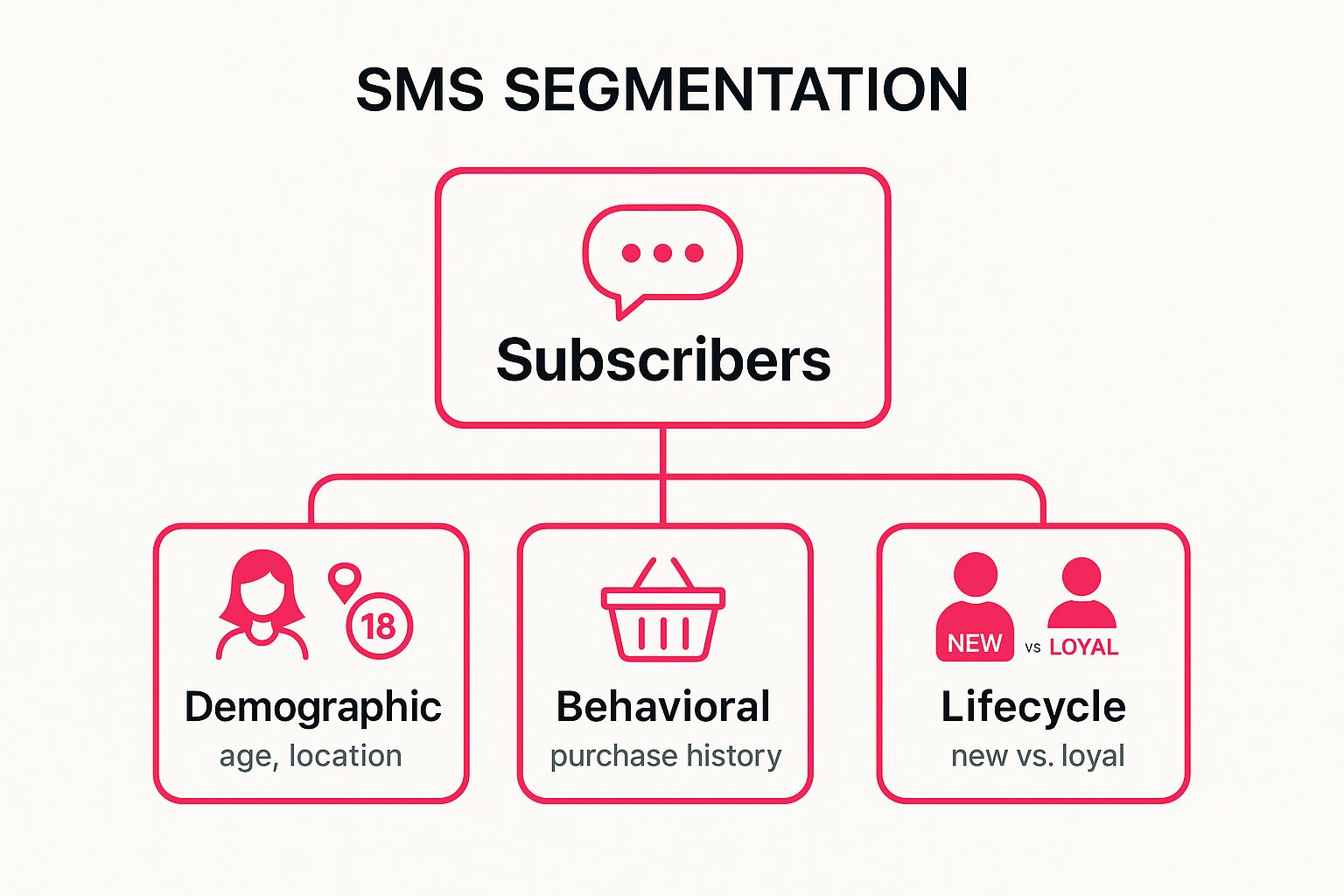
This hierarchy shows how broad subscriber data can be refined into specific, actionable groups for more effective targeting.
How to Implement It
A prime example is Home Depot, which segments customers by their past purchase categories. Someone who recently bought gardening supplies might receive a text about a sale on spring plants, while a customer who bought paint gets an offer for brushes and rollers. Similarly, Zappos creates a VIP segment for its most loyal shoppers, giving them exclusive early access to sales, which fosters brand loyalty and encourages repeat purchases.
Actionable Tips for Segmentation
- Start Broad, Then Refine: Begin with 3-5 core segments, such as new subscribers, recent purchasers, and high-value customers, then create more granular groups as you collect data.
- Use RFM Analysis: Segment your audience based on Recency (how recently they purchased), Frequency (how often they purchase), and Monetary value (how much they spend).
- Create a VIP Segment: Identify your top 10-20% of customers and reward them with exclusive offers, early access, and special perks to foster loyalty.
- Target Inactive Subscribers: Create a segment for users who haven’t engaged or purchased in a while and send them targeted re-engagement campaigns with a compelling offer.
Key Insight: Segmentation isn’t about exclusion; it’s about relevance. Sending the right message to the right person at the right time is far more effective than blasting the same message to everyone. To explore this topic further, discover more advanced customer segmentation techniques on cartboss.io.
8. Implement Two-Way Conversational Messaging
Transforming your SMS strategy from a one-way broadcast channel into an interactive dialogue is one of the most powerful best practices in SMS marketing. Two-way conversational messaging allows customers to reply, ask questions, and engage directly with your brand. This approach shifts SMS from being a simple announcement tool to a personal, responsive platform that builds stronger customer relationships and provides invaluable, direct feedback.
Instead of just pushing promotions, you create a channel for genuine interaction. This humanizes your brand, increases trust, and makes customers feel heard and valued. When subscribers know they can reply for help or information, they are far more likely to stay engaged with your text marketing program and view it as a helpful service rather than just another advertisement.
How to Implement It
A prime example is how Marriott hotels allow guests to text the front desk for service requests like extra towels or room service, creating a seamless and convenient customer experience. Similarly, 1-800-Flowers enables customers to complete entire gift orders through a guided conversational flow, handling everything from product selection to customization via text message. These brands leverage conversation to provide immediate utility and support.
Actionable Tips for Conversational SMS
- Set Up Auto-Responders: Use automated replies for common keywords like “HELP,” “INFO,” or “HOURS” to provide instant answers and manage expectations.
- Communicate Open Channels: Let subscribers know they can reply. A simple phrase like “Reply to this text with any questions!” can open the door to valuable conversations.
- Use AI with a Human Touch: Implement AI chatbots to handle frequently asked questions but always provide a clear and simple path for customers to escalate to a human agent.
- Ask Engaging Questions: Prompt interaction with your messages. For appointment reminders, ask users to “Reply Y to confirm.” For feedback, ask, “How was your experience today?”
Key Insight: Conversational SMS is not just about customer service; it’s a powerful sales and retention tool. Each interaction is an opportunity to understand customer needs better, solve problems proactively, and guide them through their purchasing journey in a personalized, supportive way.
Best Practices SMS Marketing Comparison
| Item Title | Implementation Complexity 🔄 | Resource Requirements ⚡ | Expected Outcomes 📊 | Ideal Use Cases 💡 | Key Advantages ⭐ |
|---|---|---|---|---|---|
| Obtain Explicit Consent and Maintain Compliance | Moderate to High: Requires legal knowledge and process setup | Moderate: Systems for opt-in/out tracking and record keeping | Legal protection, trust, better deliverability | Compliance-driven campaigns, regulated industries | Legal safety, higher engagement, reduced spam |
| Personalize Messages with Relevant Customer Data | High: Integration with CRM and data systems | High: Data management, automation tools | Up to 6x higher conversions, stronger loyalty | Targeted promotions, lifecycle messaging | Increased engagement, better ROI |
| Keep Messages Concise and Action-Oriented | Low to Moderate: Focus on copywriting and optimization | Low: Minimal tools needed, but requires testing | Higher readability and conversions, lower costs | Promotions needing quick responses | Clear CTAs, efficient communication |
| Timing and Frequency Optimization | Moderate: Requires data analysis and scheduling | Moderate: Time zone management and analytics | Higher open and conversion rates, reduced opt-outs | Time-sensitive promotions, frequent messaging | Optimized engagement, reduced fatigue |
| Integrate SMS with Omnichannel Marketing Strategy | High: Complex integrations across platforms | High: Advanced marketing stacks and coordination | Improved ROI, seamless customer journey | Cross-channel campaigns, brand consistency | Unified messaging, better attribution |
| Provide Clear Value and Incentives | Moderate: Strategy for exclusive offers and messaging | Moderate: Costly incentives and ongoing content | Increased acquisition and retention, higher loyalty | Loyalty programs, exclusive deal campaigns | Strong subscriber value perception, loyalty |
| Use Segmentation and Targeting Strategies | High: Requires advanced data segmentation and analysis | High: Data infrastructure and campaign management | Up to 760% revenue increase, better targeting | Highly targeted campaigns, diverse audiences | Significantly increased conversions and relevance |
| Implement Two-Way Conversational Messaging | High: Needs conversational AI and human support | High: Automation, monitoring, and staffing | Higher engagement, better support, real-time feedback | Customer service, appointment scheduling | Interactive engagement, reduced support costs |
Start Implementing These SMS Practices Today
The journey through the fundamentals of SMS marketing reveals a clear and powerful truth: success is not about sending more messages, but about sending the right messages. We have explored the critical pillars of this strategy, from the non-negotiable foundation of consent and compliance to the nuanced art of timing, personalization, and conversational engagement. Each practice we’ve detailed serves a singular purpose: to transform your SMS channel from a simple broadcast tool into a dynamic, revenue-driving engine built on trust and value.
Embracing these principles means moving beyond generic blasts and toward creating genuine connections. It’s about respecting the customer’s inbox, understanding their journey, and delivering content that feels less like marketing and more like a helpful, personalized conversation. The real magic happens when these elements work in harmony, creating an omnichannel experience where SMS complements your email, social, and on-site efforts seamlessly.
Key Takeaways for Immediate Action
To truly harness the power of text message marketing, focus on these core principles immediately:
- Audit for Compliance: Before sending another message, review your opt-in processes. Ensure you have explicit consent and provide clear, easy opt-out instructions. This is the bedrock of a sustainable SMS program.
- Prioritize Personalization and Segmentation: Move away from one-size-fits-all campaigns. Start with simple segmentation based on purchase history or engagement levels and use dynamic fields to include the customer’s name or a product they recently viewed.
- Establish a Testing Cadence: Don’t just set it and forget it. Commit to a regular A/B testing schedule for your offers, message copy, and send times. What works today may not work tomorrow, and continuous optimization is the key to long-term ROI.
- Integrate and Automate: Connect your SMS platform with your eCommerce store and other marketing tools. Automate essential flows like welcome series, order confirmations, and, most importantly, abandoned cart recovery. This is where you’ll see the most significant and immediate returns.
Ultimately, mastering the best practices for SMS marketing is an investment in your customer relationships. When you consistently deliver value, respect boundaries, and personalize interactions, you build a loyal subscriber base that not only converts but advocates for your brand. This approach turns a simple text message into your most effective tool for driving sales, recovering lost revenue, and fostering lasting customer loyalty. Start implementing these strategies today, and watch as your SMS channel becomes an indispensable asset for your business’s growth.
Ready to automate these best practices and supercharge your abandoned cart recovery? CartBoss is designed specifically for eCommerce stores to send perfectly timed, personalized, and globally compliant SMS reminders that convert lost sales effortlessly. See how much revenue you can recover by visiting CartBoss and starting your journey toward a more profitable SMS strategy.