


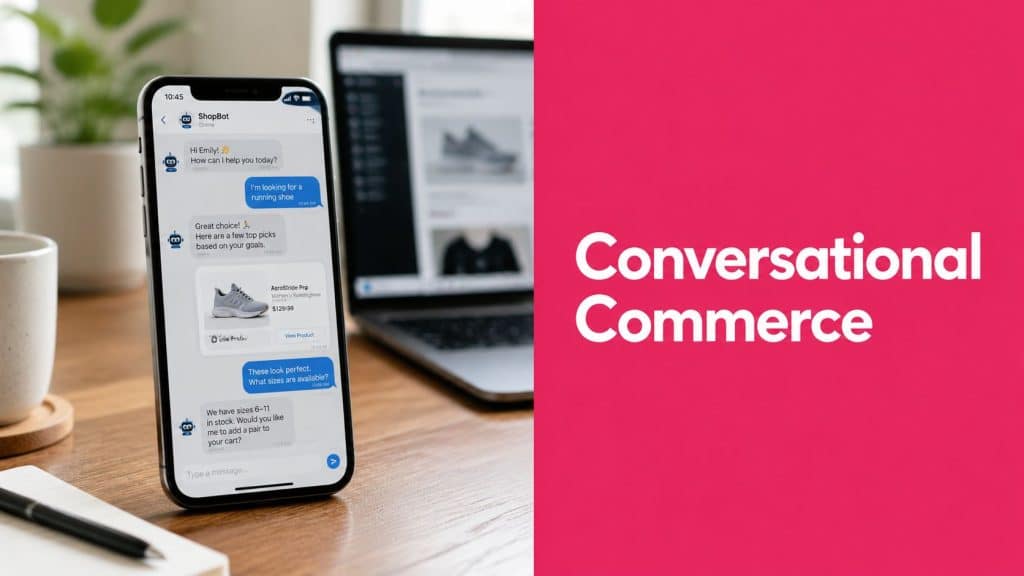
Abandoned carts rarely fix themselves. Once a shopper closes the tab, on-site conversation tools lose their reach, and the recovery job shifts to channels that can bring that buyer back.
That distinction gets missed in a lot of conversational commerce advice. Pre-purchase support and post-abandonment recovery solve different problems. Chatbots help while the shopper is still browsing, asking about sizing, delivery times, or promo codes. SMS does a different job. It starts a new conversation after the shopper has already left, which makes it far more useful for recovering revenue that would otherwise stay lost.
We see this pattern across e-commerce teams all the time. A shopper adds two products to cart, hesitates on shipping cost, and exits. The chatbot may have done its job while that person was on-site, but it cannot recover the sale once the session ends. A well-timed text can. It reaches the customer on a device they already use, carries a direct link back to checkout, and gives the brand one more chance to answer the objection that stalled the order.
That is the practical lens for this guide. Conversational commerce is not just about better on-site engagement. It is also about using the right channel at the right moment to recover customers you already paid to acquire. For brands tracking the top ecommerce trends reshaping the digital marketplace, that channel strategy matters because stronger conversations only count when they lead to completed orders.
Why Conversational Commerce Is a Priority in 2026
The market is already telling you where commerce is going. The global conversational commerce market was valued at USD $7.6 billion in 2024 and is projected to reach USD $34.4 billion by 2034, growing at a 16.3% CAGR, according to Envive’s conversational commerce statistics.
That growth matters because online shopping still has the same structural weakness it had years ago. Product pages don’t answer follow-up questions. Checkout doesn’t calm hesitation. A static store can’t do what a strong in-store salesperson does in real time.
The old store experience loses sales
Most e-commerce sites still expect shoppers to figure everything out alone:
- Product fit questions stay unanswered
- Shipping doubts appear late in checkout
- Promo confusion slows decision-making
- Return concerns surface right before purchase
Every one of those moments creates friction. Friction turns into delay. Delay turns into abandonment.
Conversation closes the gap
Conversational commerce fixes that by making the buying process interactive instead of passive. A shopper asks. The brand responds. The next step becomes clearer.
That can happen through chat, messaging apps, or SMS. The format matters less than the business outcome. The right conversation reduces uncertainty and helps the customer move toward purchase with less effort.
Practical rule: If the channel can’t reach the shopper at the moment hesitation appears, it won’t recover much revenue.
This is why conversational commerce now sits inside broader retention and conversion planning, not just support. If you’re already tracking shifts in customer behavior across channels, CartBoss has a useful breakdown of top e-commerce trends reshaping the digital marketplace that fits directly into this conversation.
In 2026, the question isn’t whether conversational commerce matters. It’s whether your store is using the right conversational channel at the right point in the customer journey.
What Is Conversational Commerce Really
Conversational commerce is selling through dialogue.
Not generic blasts. Not static forms. Not a chatbot bubble added to the corner of a site so the business can say it has AI.
It works more like a skilled store associate who stays available through the full buying journey. A shopper asks about sizing, delivery, compatibility, timing, or price. The business responds in a way that helps them keep moving instead of dropping off.

Think of it as a digital sales assistant
The simplest way to understand conversational commerce is this: it’s a two-way buying experience that helps customers move from interest to purchase and then into post-purchase support.
That dialogue can show up in several moments:
| Stage | What the conversation does |
|---|---|
| Awareness | Answers first questions and reduces uncertainty |
| Consideration | Recommends products, clarifies fit, compares options |
| Purchase | Removes checkout friction and helps finish the order |
| Support | Handles updates, follow-ups, and service requests |
A lot of businesses confuse this with customer service automation. That’s too narrow. Support is part of it, but the core commercial value comes from guidance that influences purchase decisions.
It isn’t just chat for the sake of chat
The strongest conversational flows do three things well:
-
They respond quickly
The shopper gets help while intent still exists. -
They use context
The message reflects cart contents, customer history, or the page the user came from. -
They move toward an action
The conversation doesn’t stall. It helps the shopper choose, buy, or return.
A useful conversational flow should answer one question and create one next step.
That makes conversational commerce very different from email newsletters or one-way promotional pushes. Traditional campaigns broadcast. Conversational commerce reacts, guides, and adapts.
The commercial definition that matters
If a message helps a shopper complete a purchase through a timely, relevant interaction, it belongs under conversational commerce.
That includes:
- On-site chatbots for pre-purchase help
- Messaging apps for ongoing customer communication
- SMS for urgent recovery, reminders, and direct re-engagement
The mistake is assuming all these channels do the same job equally well. They don’t. Some are better at answering questions while the shopper is active on-site. Others are better at bringing a shopper back after they’ve already left.
That distinction is where most revenue gains are won or lost.
The Core Channels and Technologies You Should Know
Not all conversational channels solve the same problem. Treating them as interchangeable is one of the fastest ways to waste budget.
The technical architecture behind conversational commerce relies on four layers: the interface, intelligence, integration, and enterprise systems. In practical terms, that means channels like chatbots or SMS connect to NLP and orchestration logic, then pull from APIs tied to inventory, CRM, and payment systems so the conversation stays accurate and useful, as outlined in this LinkedIn analysis of conversational commerce architecture.

On-site chatbots work best before exit
Chatbots help most when the shopper is still browsing.
They’re useful for:
- Product questions about sizing, fit, compatibility, or stock
- Checkout clarification when a user hesitates on shipping, returns, or payment
- Lead capture for visitors who aren’t ready to buy yet
Benchmarks cited in the verified data show chat-engaged shoppers convert at much higher rates than unassisted shoppers, and live chat before purchase can lift average order value. That’s strong evidence for pre-purchase support.
The weakness is reach. Once the visitor leaves, the chatbot loses access unless the customer comes back.
Messaging apps sit in the middle
WhatsApp, Messenger, and similar apps can support a richer conversation than SMS and often feel more familiar than on-site chat. They can work well for:
- Ongoing service conversations
- Post-purchase updates
- Higher-touch support flows
They also introduce platform dependency. You need to work inside someone else’s rules, identity layer, and delivery environment. For teams comparing stack options, a platform overview like the Clepher conversational commerce platform is useful for understanding how channel orchestration can fit into a broader commerce setup.
SMS wins when urgency and reach matter
For abandoned carts, SMS has a very different job from chatbots. It doesn’t sit and wait. It goes out and brings people back.
Verified data notes that SMS maintains a 99% open rate, compared with less than 20% for email and less than 5% for in-app chat for non-active users, according to Fin’s overview of conversational commerce. That’s the operational difference between passive and proactive recovery.
Here’s the practical comparison:
| Channel | Best use | Main weakness |
|---|---|---|
| Chatbot | Pre-purchase help on-site | Can’t recover people who already left |
| Messaging app | Ongoing customer conversations | Dependent on platform behavior |
| SMS | Urgent recovery and direct re-engagement | Needs tight copy and respectful frequency |
If you’re weighing message formats, CartBoss has a practical guide on SMS and RCS in e-commerce messaging that helps clarify channel fit.
The tech only matters if the data is connected
NLP and AI get the attention, but integration decides whether the experience works. If the channel can’t access inventory, pricing, promotions, order data, and customer context, the conversation falls apart fast.
A smart message with bad product data still loses the sale.
Key Business Benefits and How to Measure Them
Conversational commerce needs to pay for itself. If it doesn’t improve revenue, reduce support load, or recover lost sales, it’s just another tool in the stack.
One of the clearest operational gains is efficiency. Conversational AI helps companies reduce customer service costs by 15% to 70% and saves up to 4 minutes per query, according to Electro IQ’s conversational commerce statistics.
Revenue gains you can actually track
The strongest commercial benefits usually show up in four places:
-
Higher conversion rate
Track how many engaged shoppers complete a purchase compared with non-engaged shoppers. -
Lower cart abandonment impact
Measure cart recovery rate by channel, not just total recovered revenue. -
Higher order value
Watch whether guided conversations increase add-ons, bundles, or upgrades. -
Faster purchase decisions
Review time from first engagement to completed checkout.
These aren’t abstract metrics. They show whether the conversation removed friction or just created another touchpoint.
KPI map for store owners
A simple KPI framework keeps the program grounded:
| Business goal | What to measure |
|---|---|
| Recover lost sales | Cart recovery rate, recovered revenue |
| Reduce support cost | Cost per resolved query, agent workload |
| Improve buying journey | Response time, conversation completion rate |
| Build retention | Repeat purchase behavior, customer satisfaction scores |
The useful part is pairing each channel with the right KPI. Chatbots shouldn’t be judged the same way as SMS recovery. Chatbots often influence discovery and pre-purchase assistance. SMS should be judged by re-engagement, recovered checkout, and speed back to purchase.
If a team reports “good engagement” but can’t connect that engagement to completed orders, the program isn’t finished yet.
Personalization matters, but only if it moves the customer forward
Personalization gets overused as a buzzword. In practice, it means the message fits the customer’s context. Cart contents, language, timing, previous activity, and likely objections all matter. If you want a grounded overview of how to apply marketing personalization to your business, that framework helps separate useful personalization from gimmicks.
For ongoing measurement, stores should review campaign and recovery performance weekly. A structured analytics workflow like the one described in CartBoss’s guide to SMS campaign analytics for e-commerce helps keep optimization tied to profit, not vanity metrics.
The hard rule is simple. Measure conversations the same way you measure ads. By revenue, cost, and completed actions.
Your Step by Step Conversational Commerce Roadmap
A good conversational commerce setup doesn’t start with tools. It starts with one business problem.
If you try to launch chatbot support, abandoned cart SMS, post-purchase service messaging, upsells, and win-back automation all at once, execution gets sloppy. Start narrow. Build one profitable workflow first.

Step 1 and Step 2
-
Pick one outcome
Choose a single target such as abandoned cart recovery, support deflection, or faster pre-purchase assistance. Don’t mix goals in the first rollout. -
Choose the channel that fits the moment
If the customer is active on-site, chat can work. If the shopper has already left, proactive messaging becomes far more useful.
Many stores make the wrong call. They choose a channel based on trendiness instead of shopper state.
Step 3 and Step 4
-
Design short conversation flows
Keep messages direct. Every touchpoint should answer a likely objection or create a clear next action.Use this checklist:
- Start with intent by referencing the cart, product, or immediate need
- Remove one friction point such as shipping uncertainty or checkout effort
- Give one action like returning to cart or replying for help
- Avoid clutter because too many choices slow response
-
Connect the flow to your store data
The conversation should pull from real cart contents, live pricing, current availability, and customer language where possible.
A message without live store context feels automated in the wrong way. A message with live context feels helpful.
Step 5
- Launch, measure, and tighten weekly
For measurable ROI, aim for a 25–35% engagement rate on messaging campaigns and a 15–25% target for cart completion via chat on high-intent journeys, based on ContactPigeon’s conversational commerce benchmarks.
Review early performance with a short scorecard:
| What to review weekly | Why it matters |
|---|---|
| Engagement rate | Tells you if the message gets attention |
| Completion rate | Shows whether the flow creates action |
| Recovery by channel | Helps you decide where to invest more |
| Reply themes | Reveals friction you didn’t anticipate |
Keep the first version simple. Teams usually learn more from one live recovery flow than from weeks of planning.
If you’re mapping this into your broader stack, CartBoss has a useful primer on marketing automation for e-commerce that helps connect conversational workflows to retention operations.
The stores that win here don’t build the fanciest system. They build the clearest path back to checkout.
SMS Campaign Templates That Recover Lost Sales
Abandoned cart flows live or die on speed. Once a shopper leaves your site, on-site chat loses reach. Recovery has to happen off-site, and SMS is the channel that puts the message back in front of the customer while purchase intent still exists.
That distinction matters more than most conversational commerce guides admit. Chatbots are built for pre-purchase support while the shopper is still browsing. SMS is built for post-abandonment recovery after that shopper is gone. If the goal is recovered revenue, those are two different jobs and they need two different playbooks.

Why this recovery model works
For abandoned carts, the strongest sequence is simple. Send a short SMS first. Let the shopper click back to checkout or reply if they need help.
That order fits how people behave after leaving a store. They are no longer available to interact with a widget, but they may still respond to a relevant text on their phone. In practice, this means:
- Chatbots reduce hesitation before abandonment
- SMS brings back shoppers after abandonment
- Replies create a two-way conversation only when the customer signals intent
This is a revenue decision, not just a channel decision. Waiting for a lapsed shopper to return and start a chat creates unnecessary drop-off.
Template 1 for the early reminder
Send this soon after abandonment, while the product is still top of mind.
Template
Hi [First Name], you left [Product] in your cart. Your checkout is ready here: [Link]
Why it works:
- Specific product context helps the shopper reconnect with the purchase
- Plain wording keeps the message easy to process on a small screen
- One clear link gives the fastest route back to checkout
Best use: low-consideration products, repeat purchases, and stores with short buying cycles.
Template 2 for hesitation and questions
Use this when shoppers often leave because they need one more detail before buying.
Template
Hi [First Name], your cart is still waiting. Complete your order here: [Link]Questions before you buy? Reply to this text.
Why it works:
- Light urgency creates momentum without sounding aggressive
- Reply option catches objections that a generic reminder would miss
- Action plus support gives the shopper two valid ways to move forward
I like this format for categories with common objections, such as sizing, delivery timing, compatibility, or return policy concerns. It keeps the first message short while still opening the door to a real conversation.
For more examples by use case, offer type, and buyer intent, CartBoss has a practical guide to SMS templates for recovering abandoned carts that work.
Template 3 for the final recovery attempt
Use this as the last message in the sequence before you stop following up.
Template
Hi [First Name], we saved your cart for a little longer. Finish your order here: [Link]
Why it works:
- Short copy fits the channel
- Saved-cart framing adds gentle time pressure
- Single next step lowers the chance of hesitation
A final reminder works best when it feels like a service message, not a demand. The goal is to recover the sale without training customers to ignore your texts.
A short product walkthrough can help teams visualize how this kind of recovery flow gets implemented in practice:
Execution checklist for SMS recovery
Before launching, check these basics:
- Keep links clean so shoppers know where the tap leads
- Match the message to cart data so product names, prices, and availability stay accurate
- Use localized language when your customer base spans regions or languages
- Reduce checkout friction with pre-filled details where your stack allows it
- Respect consent and quiet hours to avoid compliance issues and list fatigue
- Review replies every week because customer objections often point to bigger checkout problems
Short texts recover carts. Longer explanations belong on the product page, FAQ, or support flow.
Good SMS recovery does one job well. It reminds the shopper, removes one point of friction, and gets them back to checkout before the sale goes cold.
Start Converting More Conversations Today
Conversational commerce works best when you stop treating it as one channel.
For active shoppers, chatbots help answer questions, guide product discovery, and reduce hesitation before checkout. For abandoned carts, that same approach loses power because the shopper is already gone. At that point, proactive SMS becomes the stronger move because it reaches the customer off-site and gives them a direct path back to purchase.
That’s the distinction most guides blur, and it’s the one that matters most for revenue.
If you’re building this from scratch, keep it simple:
- Use chat to support buying decisions on-site
- Use SMS to recover lost sales after abandonment
- Measure by recovered revenue and completed orders, not by vague engagement alone
The stores that win with conversational commerce don’t overbuild. They match the channel to the moment, remove friction fast, and keep the path back to checkout short.
Start with the highest-value workflow first. For most e-commerce brands, that’s abandoned cart recovery via SMS.
If you want the fastest path to turning abandoned carts into recovered revenue, CartBoss gives you an easy way to launch automated SMS recovery with localized messages, compliance-friendly delivery, and a smoother route back to checkout.