


Instead of juggling conversations across email, SMS, and social media, imagine having a single, intelligent hub for all of it. Customer engagement platforms do just that. They create a single, unified profile for every customer, tracking every click, purchase, and message to help you build genuine, lasting relationships.
What Is a Customer Engagement Platform
Think of a customer engagement platform as the central nervous system for your brand’s communication. It’s a specialized software built to help you manage, analyze, and get the most out of every interaction you have with a customer, no matter where it happens.
This isn’t just about collecting data; it’s about understanding the real person behind the screen. The platform pulls together every touchpoint—from their browsing history on your website to their latest support ticket—into a complete, 360-degree view of who they are and what they need.
Moving Beyond Disconnected Tools
In the past, you needed a pile of separate tools to run your business. You’d have one system for email marketing, another for live chat, and a third for SMS campaigns. This created a mess of fragmented data and, frankly, a pretty clumsy customer experience. It’s how a customer ends up getting a promo email for a product they just complained about to a support agent.
Customer engagement platforms clean up this chaos by bringing everything under one roof. They create a single source of truth, making sure every department—from marketing to sales to support—is on the same page and has the full context of every customer relationship.
By pulling all your customer data and communication channels into one place, these platforms let you have seamless, context-aware conversations. Your customers feel seen and valued, which is the bedrock of real loyalty.
The Core Purpose of an Engagement Platform
The end game here is to stop sending generic, transactional messages and start building meaningful relationships. When you have a complete picture of each customer, you can deliver highly personalized experiences without drowning in manual work.
For instance, a good platform can automatically:
- Send a personalized welcome series when someone new subscribes.
- Fire off an abandoned cart reminder via SMS with a unique discount code.
- Hit pause on marketing messages for a customer who has an open support ticket.
- Recommend products based on what they’ve bought and browsed before.
This level of personalization is no longer a nice-to-have; it’s critical. When customers feel understood, they stick around. The whole system is designed around a dynamic customer engagement model, mapping how users interact with your brand from their first visit to becoming a long-term fan. With all this data in one place, you can turn one-time buyers into lifelong advocates who shout your brand’s name from the rooftops.
Why These Platforms Are an E-commerce Game Changer
For any e-commerce store, moving away from a messy collection of marketing tools to one integrated customer engagement platform is a huge deal. It’s like cleaning out a chaotic garage where tools are scattered everywhere and replacing it with a perfectly organized, high-tech workshop. The result isn’t just a tidier operation—it’s a completely different way of building and growing your business.
This shift changes the entire dynamic you have with your customers. Instead of just reacting to problems after they’ve already happened, you start getting ahead of them. When you have a single view of every click, purchase, and support ticket, you can spot the early signs of a customer who might be getting frustrated or is about to leave. This gives you the chance to step in proactively with helpful content, a special offer, or a quick support check-in, which dramatically cuts down on customer churn.
From Reactive Support to Proactive Growth
The real magic of these platforms is how they use customer behavior to drive smart, helpful marketing. Let’s say a customer often looks at your high-end running shoes but has only ever bought socks. A customer engagement platform can see this pattern and automatically trigger a targeted campaign showing them the benefits of those specific shoes, maybe even sending a guide on marathon training.
This isn’t just another generic ad. It’s a personalized, useful nudge based on what they’ve already shown you they’re interested in. This kind of approach makes upselling and cross-selling feel less like a sales pitch and more like a genuinely thoughtful recommendation. As a result, you’ll see a natural increase in both average order value and customer lifetime value because you’re actually helping people find products they’ll love.
By connecting all your data points, you create a system that doesn’t just sell products—it solves problems for your customers. This shift from transactional to relational is what turns happy buyers into vocal brand advocates.
Achieving Massive Operational Efficiency
Beyond the immediate impact on revenue, customer engagement platforms deliver huge benefits on the operational side. Trying to manually run campaigns across email, SMS, and social media isn’t just a time sink; it’s a recipe for mistakes and inconsistent messaging. Automating these complicated, multi-channel workflows frees up your team from the grind of repetitive tasks.
Instead of spending hours pulling customer lists and scheduling emails, your team can finally focus on what really moves the needle:
- Developing creative campaigns that truly connect with your audience.
- Analyzing performance data to find strategic insights for growth.
- Innovating the customer experience to stay one step ahead of the competition.
This automation acts as a force multiplier, letting a small team make the kind of impact you’d normally expect from a much larger one. This kind of efficiency is a major reason why the market for these platforms is exploding. In 2023, the global customer engagement platform market was valued at USD 12.5 billion and is projected to climb to USD 38.4 billion by 2032. You can learn more about what’s driving this growth and how businesses are using technology to build stronger customer loyalty.
This is about more than just sending better emails. It’s about building a powerful competitive advantage where exceptional customer experiences become your single most effective marketing channel. By understanding and anticipating what your customers need, you create a loyal base that not only keeps coming back to buy but also encourages others to do the same, which is right in line with the top e-commerce trends reshaping the digital marketplace today.
The Core Features Every Platform Needs
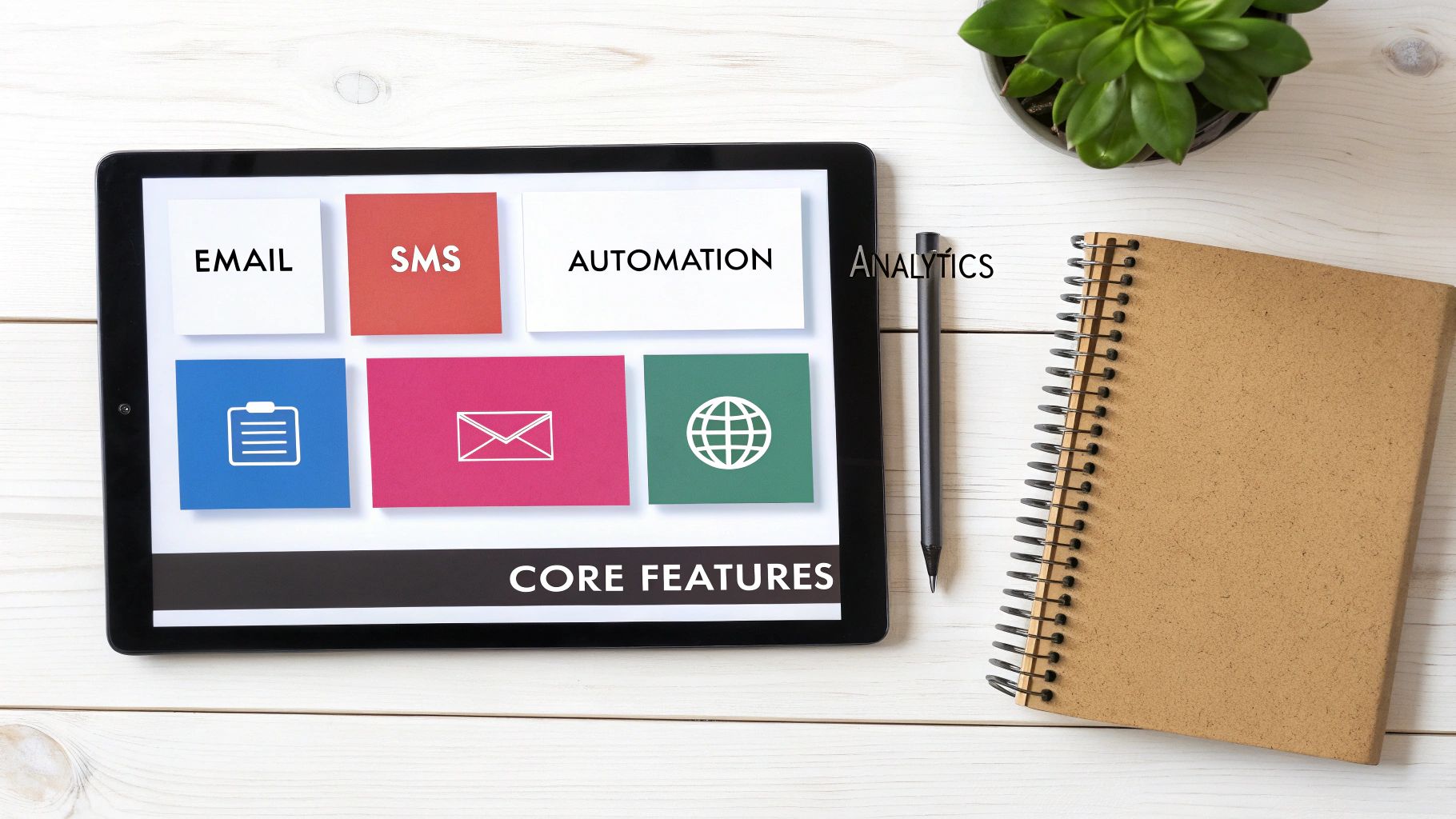
When you’re shopping for a customer engagement platform, it’s easy to get lost in a sea of buzzwords and flashy features. But underneath all the promises of AI and complex workflows, the best platforms are built on a handful of essential, non-negotiable features.
Think of it like building a house. You wouldn’t worry about picking out paint colors before you have a solid foundation and frame. These core features are your foundation. They’re the difference between a tool that actually helps you connect with customers and one that just adds another layer of complexity to your work.
A Unified Customer Profile
If there’s one feature that’s absolutely critical, it’s the unified customer profile. This is the command center for every single customer, pulling together every interaction they’ve ever had with your brand. Every purchase, every support ticket, every abandoned cart, and every opened email lives here.
Without this single source of truth, you’re flying blind. Your marketing team might send a “we miss you!” discount to someone who just spent an hour on the phone with your support team. A unified profile prevents these kinds of awkward, brand-damaging mistakes by giving everyone the full picture.
This 360-degree view is what lets you graduate from generic marketing blasts to genuinely personal conversations. It’s the engine that powers everything else.
True Omnichannel Communication
Your customers don’t live in a single channel, and neither should your marketing. They expect to hear from you on their terms, whether that’s email, SMS, live chat, or social media. A great platform lets you manage all of these conversations from one place without skipping a beat.
This is way more than just being able to send an email and an SMS. It’s about making them work together. For instance, if a customer ditches their cart, you could send a reminder email, and if they don’t open it after a few hours, follow up with a quick text. All of this is tracked in their profile, so you never send the same message twice. To see how to bring all these touchpoints together, check out our guide on omnichannel marketing software.
Powerful Segmentation and Personalization
Okay, so you have all this great customer data in one spot. Now what? You need powerful tools to slice and dice that data into meaningful groups. A good segmentation engine lets you create hyper-targeted audiences for your campaigns.
And I don’t just mean “all men ages 25-35.” You need to go deeper. You should be able to build segments like:
- Behavioral Data: Anyone who has viewed the “running shoes” category three times this week but hasn’t bought anything.
- Purchase History: Your VIP customers who haven’t made a purchase in the last 60 days.
- Engagement Level: Subscribers who open every email you send but never seem to click.
This is how you deliver messages that feel helpful and relevant, not like spam.
Automation and Workflow Builders
There’s no way you can manually manage every single customer interaction as you grow. That’s where automation and workflow builders come in. These tools let you map out automated “journeys” that trigger based on what a customer does.
For example, when a new customer makes their first purchase, a workflow can kick into gear:
- Immediately send a “Thank You” email.
- Wait a week, then send another email asking for a product review.
- Automatically add them to your “New Customer” segment for special offers down the road.
This lets your team step back from the repetitive stuff and focus on bigger-picture strategy, while the platform handles the day-to-day execution.
Analytics and Reporting Dashboards
Finally, you can’t improve what you can’t measure. A solid engagement platform gives you clear, easy-to-understand dashboards that show you what’s working and what isn’t. This is how you prove the platform is actually worth the investment.
You should be able to track key metrics like open rates, click-through rates, conversions from specific campaigns, and the holy grail: customer lifetime value. This data is what helps you fine-tune your approach and make smarter decisions.
Essential vs. Advanced Platform Features
To help you focus on what really matters when you’re starting out, here’s a quick breakdown of the absolute must-haves versus the nice-to-haves.
| Feature Category | Essential Functionality (Must-Have) | Advanced Functionality (Nice-to-Have) |
|---|---|---|
| Data & Profiles | Unified Customer Profile | Predictive AI Lead Scoring |
| Communication | Omnichannel Campaign Tools (Email, SMS) | AI-Powered Chatbots with NLP |
| Personalization | Rule-Based Segmentation Engine | Machine Learning Product Recommendations |
| Automation | Visual Workflow & Journey Builder | Complex, Multi-Branching Journey Orchestration |
| Analytics | Core Campaign & Performance Dashboards | Predictive Churn Analysis & Reporting |
Ultimately, start with a strong foundation. You can always add the more advanced features later as your strategy becomes more sophisticated.
Real-World E-commerce Engagement Strategies
Knowing what a customer engagement platform can do is one thing. Seeing it in action is where the magic really happens. Let’s move from theory to practice and look at how these platforms orchestrate real-world e-commerce scenarios that actually drive results.
Think of these strategies as a playbook for turning platform features into conversions and loyalty. It’s not just about blasting out messages; it’s about creating timely, relevant experiences that feel like a one-on-one conversation. The platform is the director, making sure every channel, message, and offer works together perfectly to guide the customer along their journey.
The Automated Abandoned Cart Sequence
The abandoned cart sequence is easily one of the most valuable workflows for any e-commerce store. With a customer engagement platform, this process goes way beyond sending a single, generic email. Instead, you can build an intelligent, multi-channel journey that adapts to what the customer does in real-time.
Here’s how a typical sequence might play out:
- The Trigger: A customer adds items to their cart but bounces without buying. The platform instantly flags this event.
- Email (1 Hour Later): A friendly, low-pressure email lands in their inbox. It shows images of the items they left behind and asks a simple question like, “Did you run into any trouble?” This soft approach often recaptures shoppers who just got distracted.
- SMS (4 Hours Later): If the email goes unopened, the platform triggers a text message. SMS is a high-immediacy channel, perfect for a direct note: “Still thinking it over? Your cart is waiting for you.”
- Email with Offer (24 Hours Later): For those still on the fence, another email arrives with a time-sensitive offer. Something like a 10% discount or free shipping creates a little urgency to seal the deal.
This layered approach meets customers on different channels, dramatically boosting the odds of recovering what would have been a lost sale.
The Personalized Birthday Campaign
Celebrating a customer’s birthday is a classic move to build a personal connection and spark a repeat purchase. An engagement platform automates and personalizes this at scale, making every single customer feel special.
The workflow is simple but incredibly effective:
- Segment Creation: The platform automatically pulls a list of customers whose birthdays are coming up in the next week.
- Personalized Offer: An email goes out with a celebratory message and a unique, one-time-use discount code created just for them. That exclusivity makes the offer feel more valuable.
- Follow-Up Reminder: A few days before the offer expires, a gentle SMS reminder is sent to anyone who hasn’t used their code yet, making sure the opportunity isn’t missed.
This strategy does more than just generate a sale. It creates a moment of delight that strengthens the customer’s emotional connection to your brand.
By automating these personal touchpoints, you build brand affinity and goodwill. A customer who feels celebrated is far more likely to become a long-term advocate.
The Post-Purchase Feedback and Review Loop
The customer journey doesn’t stop at checkout. That post-purchase window is a golden opportunity to gather valuable feedback, generate social proof, and set up the next purchase. A well-designed workflow can hit all three. For a deeper dive into modern engagement strategies, it’s worth exploring insights on understanding omnichannel loyalty and customer engagement.
A smart post-purchase sequence looks like this:
- Order Confirmation: An immediate email and SMS confirm the order details and set expectations for shipping. Clear communication is key.
- Satisfaction Survey (7 Days Post-Delivery): After the customer has had time to actually use the product, an automated email asks for their feedback via a simple one-click survey (like a 1-5 star rating).
- Review Request: If the feedback is positive (say, 4 or 5 stars), a follow-up email asks them to leave a public review on your site, with a direct link to make it dead simple.
- Service Recovery: If the feedback is negative, the platform can automatically create a support ticket and ping a customer service agent to proactively fix the problem.
This entire process helps you collect crucial user-generated content while turning potentially bad experiences into positive ones. Crafting these workflows is a core part of any solid engagement plan, and you can find more examples in our customer engagement strategy template.
How to Choose the Right Engagement Platform
Picking the right customer engagement platform is a huge decision. It’s a lot like choosing a central nervous system for your entire e-commerce operation. This isn’t just another app you’re adding to the pile; it’s the foundation for how you’ll build relationships and, ultimately, grow your business.
Get it right, and you’ll accelerate your success. Get it wrong, and you’re looking at wasted money, frustrated teams, and major roadblocks. To make a smart investment, you need a solid game plan that cuts through the marketing fluff and hones in on what your store actually needs.
Define Your Business Goals First
Before you even think about watching a single demo, stop and figure out your main goals. What’s the number one thing you need to achieve right now? Are you laser-focused on recovering abandoned carts and getting quick conversions? Or is your bigger play to boost customer lifetime value and build a loyal following?
You need to be specific. Your goals are your compass for this entire process. A platform that’s amazing for long-term retention might have totally different strengths than one built for rapid-fire sales campaigns.
- For a Conversion Focus: You’ll want to prioritize platforms with powerful, real-time automation triggers and channels that grab attention fast, like SMS.
- For a Retention Focus: Look for deep customer segmentation, tools for loyalty programs, and easy ways to collect post-purchase feedback.
Knowing your “why” from the get-go keeps you from getting distracted by flashy features that don’t actually move the needle for your business. It’s the first step to finding a platform that delivers real value.
Assess Scalability and Key Integrations
The platform you pick today has to work for the business you’ll be tomorrow. Think about your growth. Will the pricing cripple you once your contact list doubles? Can it handle a massive surge in messages during Black Friday without breaking a sweat? Scalability isn’t just about handling more volume; it’s about future-proofing your investment.
Integrations are just as critical. Your engagement platform can’t live on an island. It has to talk seamlessly with the tools you already depend on, especially your e-commerce platform (like Shopify or WooCommerce) and your CRM.
A deep, native integration with your core tech stack is a non-negotiable. Without it, you’re stuck with messy data, manual workarounds, and a disjointed customer experience—the very problems you’re trying to solve in the first place.
This flowchart shows how different customer situations demand different strategies, a process that completely depends on having integrated data.
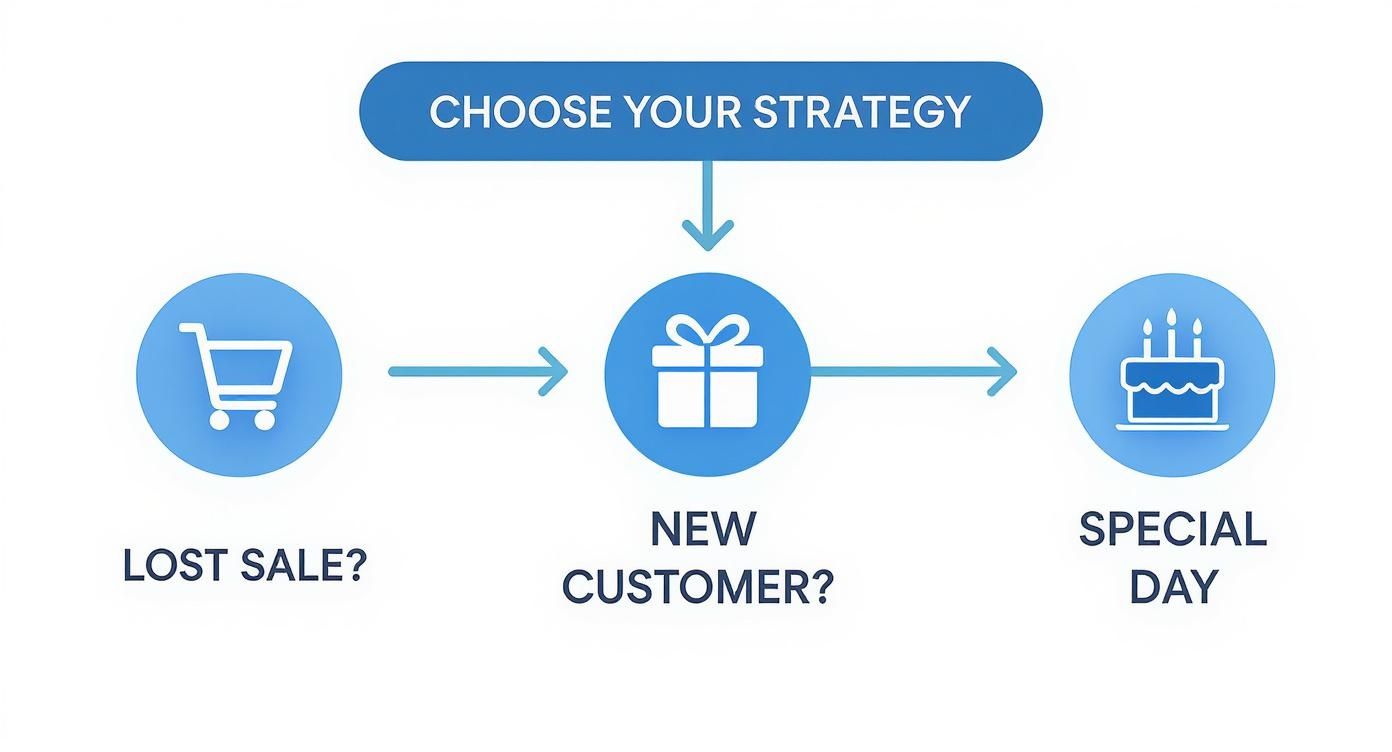
As you can see, the right move—whether it’s saving a lost sale or celebrating a birthday—hinges on having the right customer context at just the right moment.
Analyze User-Friendliness and Pricing Models
Finally, don’t forget about the people who will be using this thing every day, and don’t get fooled by the sticker price. A platform loaded with features is worthless if your team finds it too clunky to use. Look for a clean, intuitive interface and a visual workflow builder that lets your team launch campaigns without needing a developer on speed dial.
When it comes to pricing, you have to dig deeper. What’s really included in each plan? The market is growing at a 12.1% CAGR, partly because flexible cloud-based pricing and low-code tools are making these platforms more accessible. You can see more data on customer engagement platform adoption on mordorintelligence.com.
By carefully checking these key areas—goals, scalability, usability, and true cost—you can make a confident choice that will pay off for years to come.
The Power of SMS in Your Engagement Strategy
While a solid omnichannel strategy is important, some channels just pack a bigger punch in certain situations. In the noisy world of e-commerce, SMS cuts through the clutter like nothing else can. Its directness makes it the perfect tool for those high-intent moments that demand immediate action from your customers.
Think about it. Email inboxes are overflowing and social media feeds are a constant battle for attention. A text message, on the other hand, lands right on their phone with a sense of personal urgency. This is exactly why it’s so powerful for time-sensitive interactions where you absolutely need to get noticed.
When SMS Delivers Unmatched Impact
You shouldn’t send every message through every channel. SMS really shines during critical, conversion-focused moments where speed and visibility are everything. These are the touchpoints that can make or break a sale.
Here are a few high-impact scenarios where SMS is king:
- Abandoned Cart Recovery: A quick text can be the final nudge a distracted shopper needs to finish checking out, instantly recovering revenue you would have otherwise lost.
- Shipping and Delivery Updates: Proactive notifications give customers peace of mind and drastically cut down on “where is my order?” support tickets.
- Flash Sales and Limited-Time Offers: The sky-high open rates of SMS ensure your most urgent promotions are actually seen before they’re over.
These interactions are direct, transactional, and incredibly effective. Research consistently shows that SMS messages have an astonishing open rate, often hitting as high as 98%. That’s a direct line to your customer that no other channel can realistically match. For a deeper dive, check out our full SMS e-commerce guide on transforming sales with text marketing.
Finding the Right Tool for the Job
This is where it’s crucial to understand the difference between broad customer engagement platforms and specialized, SMS-first tools. A big, all-in-one platform is great for managing long-term, multi-channel journeys like loyalty programs or email newsletters. It acts as the central hub for your entire marketing ecosystem.
But a dedicated tool like CartBoss is built with one mission: to master those critical, high-revenue SMS moments with laser focus. It’s designed to do one thing exceptionally well—turn abandoned carts and other key touchpoints into profit.
For many e-commerce brands, the smartest setup is a hybrid one. Use your main platform for broad lifecycle marketing, but integrate a specialized SMS tool to dominate the moments that directly fatten your wallet.
This strategy gives you the best of both worlds. You get the holistic view and journey-building capabilities of a full platform, plus the raw conversion power of a dedicated SMS tool. It lets you build a flexible and cost-effective marketing stack that drives both long-term engagement and immediate sales.
Frequently Asked Questions
Jumping into the world of customer engagement platforms usually brings up a few questions. Let’s clear up some of the most common ones so you can move forward confidently and build a strategy that actually works for your e-commerce store.
CRM vs Customer Engagement Platform
What’s the real difference between a CRM and a customer engagement platform, anyway? It’s a common point of confusion, but the distinction is pretty simple when you break it down.
Think of a CRM (Customer Relationship Management) as your digital rolodex or filing cabinet. It’s a system of record, built mainly for sales teams to log customer data and keep track of deals. It tells you who your customers are.
A Customer Engagement Platform (CEP), on the other hand, is a system of action. It’s designed for marketers to create and manage real-time, personalized conversations across channels like email and SMS. While the CRM holds the data, the CEP is all about the how, when, and where you talk to your customers to drive real growth.
Implementation Timelines
So, how long does it take to get one of these platforms up and running? The answer really depends on how complex your setup is. For a small e-commerce store with a standard integration, you could be live in just a few days.
But for a larger, enterprise-level project with custom data migrations and multiple integrations, you might be looking at a timeline of several weeks or even months. The best game plan is to start small. Figure out your most critical integration (usually your e-commerce platform), launch with a couple of high-impact campaigns, and then expand from there.
Key KPIs to Track
What are the most important numbers to watch when it comes to customer engagement? Your key performance indicators (KPIs) should always tie directly back to your business goals. For e-commerce brands, these are the heavy hitters:
- Customer Lifetime Value (CLV): This tells you how much a customer is worth to your business over the long haul.
- Customer Retention Rate: This shows you how good you are at keeping customers coming back.
- Conversion Rates: Keep an eye on the performance of specific campaigns, like your abandoned cart recovery texts.
Of course, you’ll also want to monitor channel-specific metrics like email open rates and SMS response rates. Don’t forget to mix in some qualitative feedback from Customer Satisfaction (CSAT) surveys to get the full story.
Ready to master the most critical moments in your customer journey? CartBoss turns abandoned carts into profit with automated SMS campaigns that deliver an average 4,500% ROAS. Start recovering lost sales today!