


In the competitive e-commerce market, simply acquiring a customer is no longer enough. The real challenge, and the greatest opportunity, lies in keeping them actively engaged. Effective communication, personalized experiences, and proactive support are what transform one-time buyers into loyal, repeat customers. This is where dedicated customer engagement solutions become essential, moving beyond basic communication to create meaningful, ongoing dialogues that drive retention and increase lifetime value.
This resource provides a detailed breakdown of the top platforms designed to solve this very problem. We will analyze 12 leading tools, from specialized SMS marketing platforms like CartBoss to all-in-one CRM suites. Each review offers a practical, in-depth look at core features, specific use cases for online retailers, and crucial implementation considerations to help you make an informed decision.
You’ll find screenshots, direct links, and an honest assessment of each solution’s strengths and limitations. Whether you’re battling high cart abandonment rates on Shopify, aiming to enhance customer support, or looking to build a robust loyalty program, this guide will help you pinpoint the right tool. Integrating these platforms into your strategy is a key component of building a resilient online business, often as part of broader comprehensive E-commerce solutions. Let’s find the perfect fit for your store.
1. CartBoss
Best for: High-ROI Abandoned Cart Recovery via SMS
CartBoss stands out as a premier customer engagement solution specifically engineered to tackle one of e-commerce’s most persistent challenges: cart abandonment. While many platforms offer broad engagement features, CartBoss hones in on converting high-intent shoppers at the most critical moment with unparalleled efficiency. Its core strength lies in leveraging the immediacy and high visibility of SMS marketing to recapture lost revenue, making it an indispensable tool for Shopify and WooCommerce store owners.
The platform automates the entire recovery process with pre-configured, intelligent SMS campaigns. These messages are not just generic reminders; they are personalized with dynamic discount codes and pre-filled checkout links, drastically reducing friction for the customer. This targeted approach is what drives its reported average ROAS of 4500%, a figure that sets a high bar in the industry. For e-commerce businesses seeking a direct, measurable impact on their bottom line, CartBoss offers a potent and focused solution.
Key Features & Analysis
- Automated SMS Campaigns: CartBoss sends a sequence of timed SMS messages to shoppers who abandon their carts. The system is optimized out-of-the-box, but users can customize timing and content to fit their brand voice.
- Dynamic Discounts & Pre-filled Checkouts: It automatically generates unique discount codes and embeds them in a link that takes the customer back to a pre-filled checkout page. This removes barriers and incentivizes immediate action.
- Global & Compliance-Ready: With automatic language detection for over 30 languages and built-in GDPR/CCPA compliance features like do-not-disturb hours, it’s designed for international stores that need to respect customer privacy.
- Performance-Based Pricing: A key differentiator is its pricing model. There are no monthly subscription fees; you only pay a commission on the sales successfully recovered by the platform. This makes it a risk-free investment, as costs are directly tied to revenue generation.
Practical Use Case
An online fashion boutique struggling with a 75% cart abandonment rate can implement CartBoss in minutes via the Shopify app store. The platform automatically starts sending branded SMS messages to customers 30 minutes after they abandon a cart, offering a 10% discount to complete their purchase. The link in the SMS takes them directly to a checkout page with their shipping information already loaded, leading to a significant increase in recovered sales and turning a major revenue leak into a new profit center.
Pros:
- Exceptional ROI with performance-based pricing.
- Extremely high engagement rates (99% open rate).
- Fast, code-free setup for Shopify and WooCommerce.
- Built-in internationalization and compliance.
Cons:
- Primarily focused on SMS, requiring other tools for email or social media engagement.
- Advanced campaign customization may have a slight learning curve.
Website: https://www.cartboss.io
2. HubSpot CRM Suite
HubSpot’s CRM Suite stands out by offering a powerful, unified platform where marketing, sales, and customer service data converge. This integration provides a 360-degree view of every customer, making it one of the most comprehensive customer engagement solutions available. E-commerce businesses can track a customer’s entire journey, from their first ad click to their latest support ticket, all within a single, user-friendly interface. This holistic approach is crucial for creating a seamless and personalized experience.
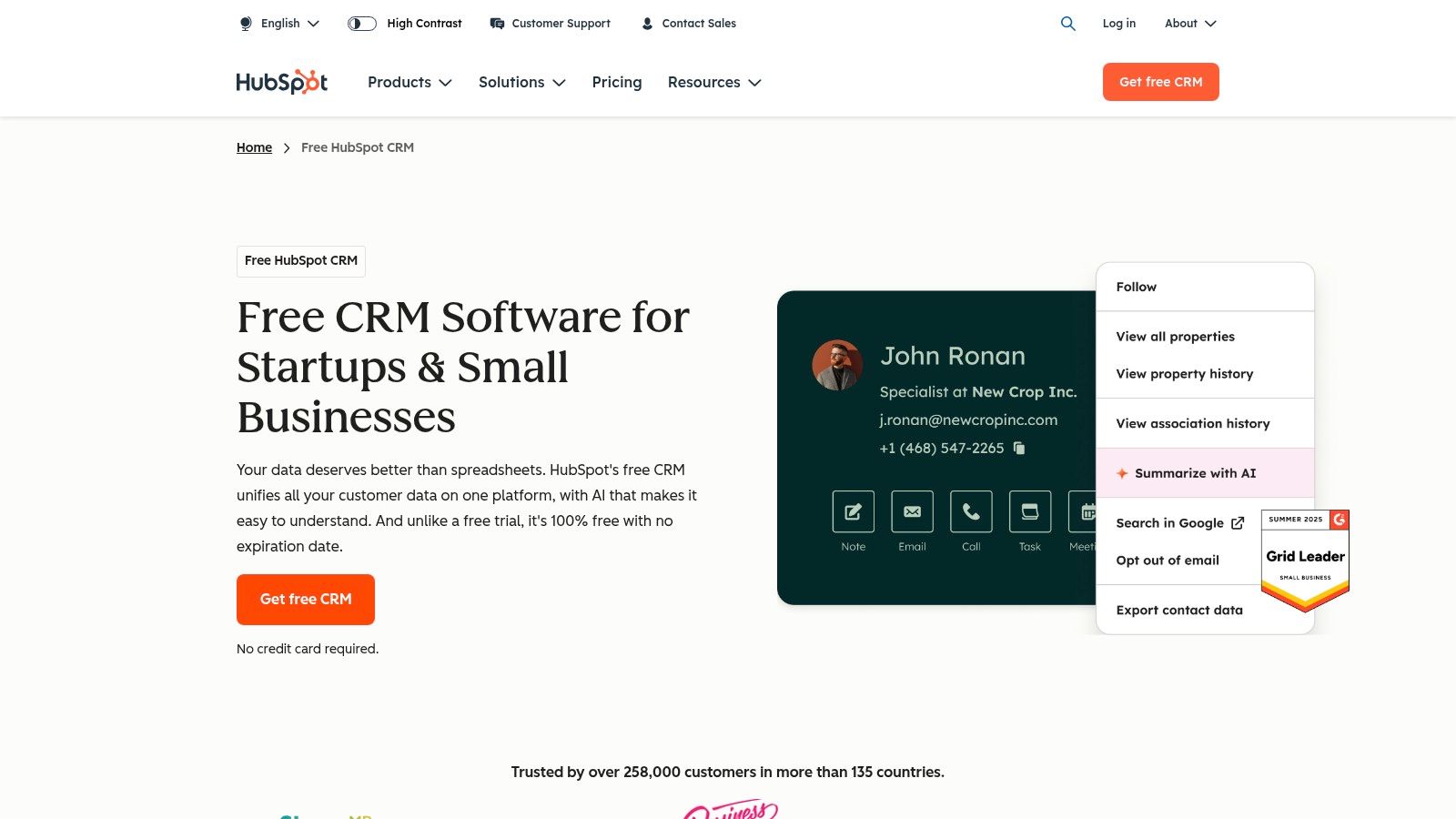
While many platforms specialize in one area, HubSpot’s strength is its breadth. The platform excels at creating a cohesive workflow, enabling teams to collaborate effectively. For a deeper understanding of how integrated platforms like HubSpot facilitate a unified customer journey, you can learn more about crafting an omnichannel customer experience. Its scalability ensures that as your e-commerce store grows, the platform grows with you.
Key Details & Use Cases
- Pricing: A generous free plan includes foundational tools like contact management, email marketing, and a shared inbox. Paid plans start at various price points for Marketing, Sales, and Service Hubs, unlocking advanced automation and reporting.
- Best Use Case: Ideal for e-commerce businesses seeking an all-in-one solution to replace a patchwork of disconnected tools. It is especially effective for managing inbound marketing funnels and nurturing leads through personalized email campaigns triggered by on-site behavior.
- Implementation Tip: Start with the free CRM to organize your contacts. Then, connect your e-commerce store (like Shopify or WooCommerce) to sync customer data and purchase history automatically.
| Pros | Cons |
|---|---|
| Extremely user-friendly interface. | Advanced features are locked behind expensive plans. |
| Scalable for businesses of all sizes. | Can feel overwhelming initially due to its vast features. |
| Extensive library of integrations. | Customization options can be limited on lower tiers. |
Website: https://www.hubspot.com/products/crm
3. Intercom
Intercom excels at real-time, conversational engagement, making it a premier solution for businesses that want to build personal relationships with customers directly within their app or website. Its strength lies in its sophisticated live chat and messaging capabilities, which feel less like a formal support ticket and more like a helpful conversation. This approach allows e-commerce stores to proactively engage visitors, guide them through the buying process, and provide instant support, transforming passive browsers into loyal customers.
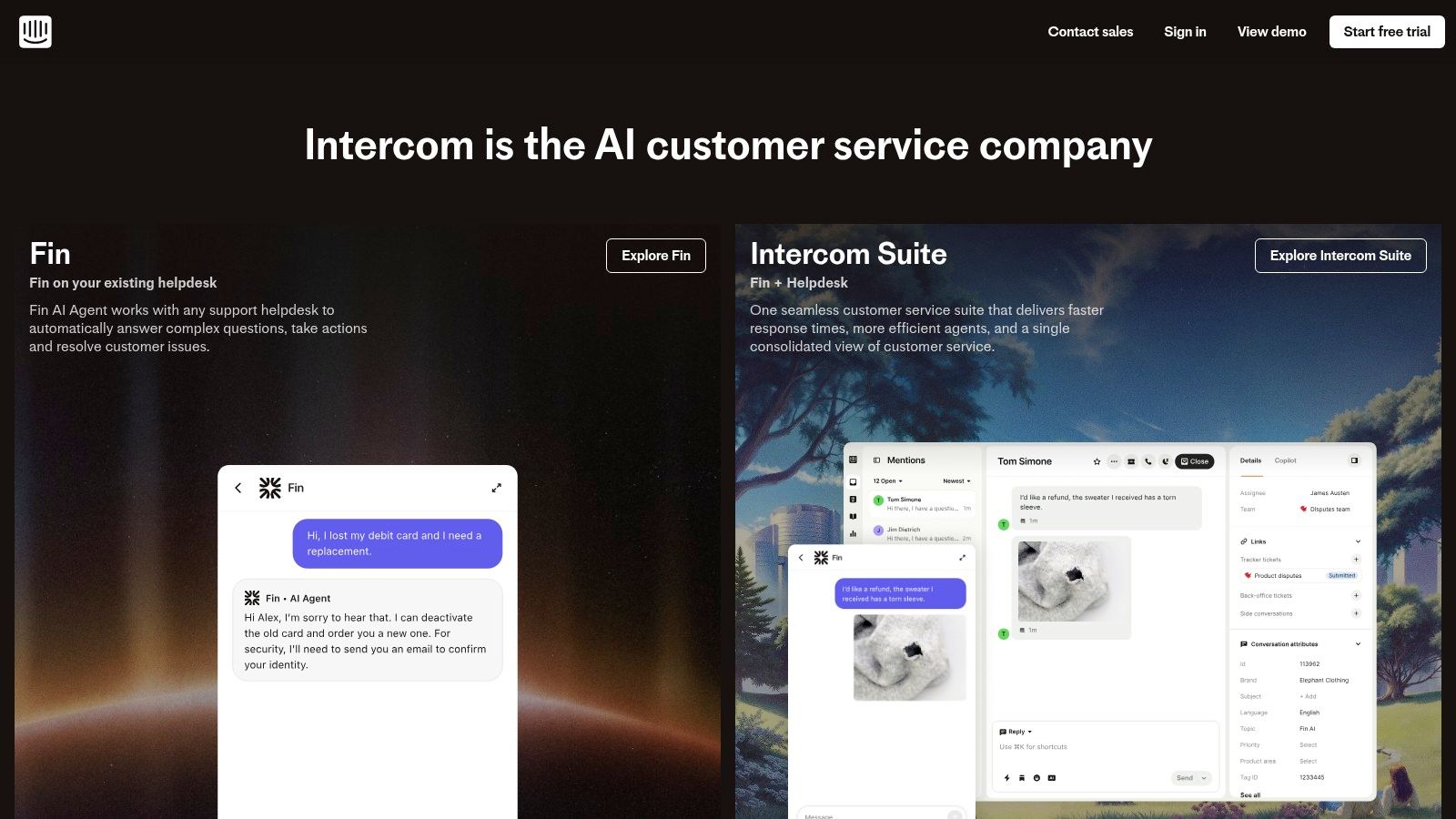
Unlike platforms focused solely on ticketing or email, Intercom centralizes all customer interactions into one contextual thread. The platform’s powerful automation and chatbots handle common queries, freeing up human agents to focus on high-value interactions. For businesses looking to extend their conversational strategy, pairing Intercom with other direct channels is effective; you can explore key strategies for this by learning more about SMS marketing best practices. This focus on immediate, personal communication makes Intercom one of the top-tier customer engagement solutions for driving conversions and satisfaction.
Key Details & Use Cases
- Pricing: Starts with an “Essential” plan from $39/month per seat. More advanced plans for “Pro” and “Premium” unlock features like custom bots, A/B testing, and advanced reporting, with custom pricing.
- Best Use Case: Perfect for e-commerce businesses that prioritize real-time support and proactive engagement. It is highly effective for reducing cart abandonment by triggering automated messages when a user shows exit intent or hesitates on the checkout page.
- Implementation Tip: Use the chatbot builder, Fin, to answer common pre-sale questions instantly (e.g., “Do you ship to Canada?”). Connect it with your primary e-commerce and marketing apps from its library of over 350 integrations to create a unified data flow.
| Pros | Cons |
|---|---|
| Enhances real-time customer communication. | Higher cost compared to some competitors. |
| Highly customizable to fit various business needs. | Can be complex to set up without technical help. |
| Powerful chatbot and automation features. | The pricing model can become expensive as you scale. |
Website: https://www.intercom.com/
4. Salesforce Experience Cloud
Salesforce Experience Cloud empowers businesses to create branded digital spaces like forums, help centers, and partner portals. Its core strength lies in its deep integration with the Salesforce CRM, allowing e-commerce companies to build highly personalized and data-driven community experiences. This platform moves beyond standard communication by fostering a direct connection between a brand and its audience, turning customers into advocates within a controlled environment.
This solution is particularly powerful for businesses that want to build a community around their products, offering a space for users to share tips, solve problems, and engage directly with the brand. By leveraging existing customer data from the CRM, Experience Cloud delivers relevant content and personalized interactions, making it one of the most robust customer engagement solutions for community-building. For a deeper dive into building such connections, explore this ultimate guide to increasing customer engagement.
Key Details & Use Cases
- Pricing: Pricing is based on user or login models and varies significantly by use case (e.g., customer community vs. partner portal). It typically requires a custom quote based on specific needs.
- Best Use Case: Excellent for e-commerce brands with a dedicated user base looking to build a self-service help center, a customer forum, or an exclusive loyalty portal. It is ideal for reducing support tickets and increasing brand loyalty through peer-to-peer interaction.
- Implementation Tip: Start by identifying a single, high-impact goal, such as creating a FAQ-driven community to deflect common support queries. Leverage pre-built templates to launch quickly before investing in heavy customization.
| Pros | Cons |
|---|---|
| Robust customization and branding options. | Can have a steep learning curve for new users. |
| Seamless integration with the Salesforce ecosystem. | Implementation can be complex and costly. |
| Strong analytics and reporting capabilities. | Best suited for businesses already using Salesforce CRM. |
Website: https://www.salesforce.com/products/experience-cloud/overview/
5. Zendesk Sell
Zendesk Sell shifts the focus of customer engagement solutions toward the sales process, providing a CRM designed to enhance sales team productivity, visibility, and effectiveness. For e-commerce businesses, this means equipping sales reps with tools to manage leads and opportunities more efficiently, directly impacting revenue. Its strength lies in simplifying the sales workflow, from tracking emails and calls to forecasting future performance, all within a clean, actionable interface.
The platform’s primary advantage is its native integration with the broader Zendesk ecosystem, particularly Zendesk for Service. This connection allows sales and support teams to share critical customer context, creating a unified front. When a sales rep can see a customer’s recent support tickets, they are better equipped to have relevant and empathetic conversations, turning a simple transaction into a relationship-building opportunity. This makes Zendesk Sell a powerful tool for aligning different customer-facing departments.
Key Details & Use Cases
- Pricing: Plans start with the Team tier at $19 per user/month, offering a full-featured sales CRM. Higher tiers like Growth and Professional add advanced sales reporting and forecasting. A 14-day free trial is available for all plans.
- Best Use Case: Excellent for e-commerce brands with a dedicated B2B or high-touch B2C sales team that needs to manage a lead pipeline. It’s also perfect for businesses already using Zendesk for customer support, as it creates a seamless data flow between sales and service.
- Implementation Tip: Connect your email client (like Gmail or Outlook) immediately to start tracking communications with leads. Leverage the mobile app to empower your sales team to update deals and access contact information while on the go.
| Pros | Cons |
|---|---|
| Intuitive and easy-to-use interface. | Limited marketing automation features built-in. |
| Seamless integration with Zendesk Support. | Customization options are less extensive than competitors. |
| Strong mobile app for sales productivity. | Can be costly for larger sales teams. |
Website: https://www.zendesk.com/sell/
6. Zoho CRM Plus
Zoho CRM Plus presents a unified customer experience platform that bundles sales, marketing, and support tools into a single, cohesive suite. This integration allows e-commerce businesses to manage omnichannel communication, from social media and live chat to email and phone calls, all from one dashboard. Its strength lies in offering a comprehensive set of features at a price point that is highly accessible for small to medium-sized businesses looking for powerful customer engagement solutions.
The platform is designed for businesses that need deep operational control without the enterprise-level price tag. With its powerful analytics and automation capabilities, you can track performance and streamline repetitive tasks, freeing up your team to focus on building meaningful customer relationships. To effectively leverage its reporting tools, it helps to understand which key performance indicators to monitor. You can dive deeper into the essential customer engagement metrics to track for a comprehensive view of your success.
Key Details & Use Cases
- Pricing: Zoho CRM Plus is offered at a straightforward price of $57/user/month (billed annually), which includes access to its entire suite of applications, making it a very cost-effective all-in-one solution.
- Best Use Case: Excellent for SMBs that have outgrown basic CRMs and need a single platform to manage the entire customer lifecycle. It’s particularly useful for automating lead nurturing sequences and providing integrated customer support.
- Implementation Tip: Begin by mapping out your key customer journey touchpoints. Then, use Zoho’s automation workflows (like Zia, the AI assistant) to create triggers for follow-up emails, task assignments, or support ticket escalations based on customer actions.
| Pros | Cons |
|---|---|
| Highly affordable all-in-one suite. | The interface can feel cluttered and less intuitive to some users. |
| Extensive customization options. | Initial setup and customization can be complex for beginners. |
| Strong automation and analytics features. | Integration with some third-party apps may be limited. |
Website: https://www.zoho.com/crm/crmplus/
7. Pega Customer Decision Hub
Pega Customer Decision Hub distinguishes itself by leveraging a sophisticated, always-on AI “brain” to drive real-time, one-to-one customer engagement. Unlike platforms focused on scheduled campaigns, Pega analyzes customer data across all channels to determine the next-best action for every individual interaction. For large-scale e-commerce enterprises, this means dynamically personalizing offers, content, and service actions at the exact moment a customer is browsing a product or contacting support, making it one of the most powerful enterprise-grade customer engagement solutions.
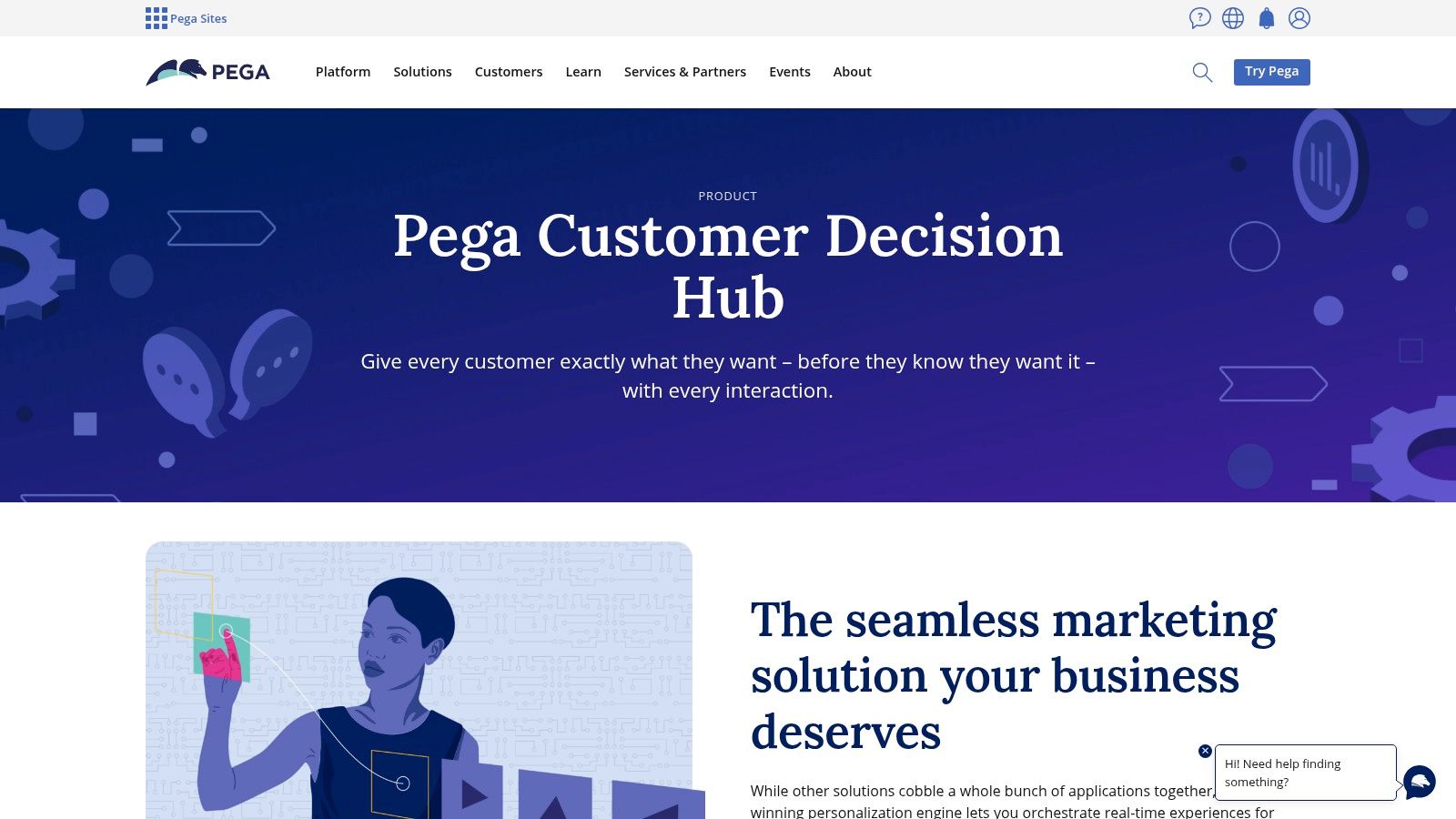
The platform’s core strength is its predictive analytics and decision management engine, which continuously learns and adapts. This allows businesses to move beyond simple segmentation and deliver hyper-personalized experiences that increase customer lifetime value and retention. Pega’s unified architecture ensures that insights from a service call can immediately influence a marketing offer, creating a truly connected and intelligent customer journey.
Key Details & Use Cases
- Pricing: Pega uses custom, quote-based pricing tailored to enterprise needs. It is a premium solution, so expect a significant investment.
- Best Use Case: Ideal for large, multinational e-commerce corporations with massive customer data sets and complex, multi-channel operations. It excels at optimizing retention strategies and maximizing cross-sell or upsell opportunities in real time.
- Implementation Tip: Given its complexity, a phased implementation is recommended. Start by integrating a single high-impact channel, like your e-commerce website, to prove ROI before expanding to other touchpoints like call centers or mobile apps.
| Pros | Cons |
|---|---|
| Powerful, real-time AI and decisioning engine. | Complex implementation requires specialized expertise. |
| Highly scalable for massive enterprise needs. | High cost of ownership, not suitable for SMBs. |
| True omnichannel personalization capabilities. | The user interface can have a steep learning curve. |
Website: https://www.pega.com/products/decision-hub
8. SAP Emarsys Customer Engagement
SAP Emarsys carves out its niche as an omnichannel customer engagement platform built for accelerating business outcomes through AI-driven personalization. It excels at unifying customer data from various sources to create a single, actionable profile. For e-commerce businesses already embedded in the SAP ecosystem, Emarsys offers a seamless extension, enabling highly personalized marketing automation and loyalty programs that leverage deep data insights.
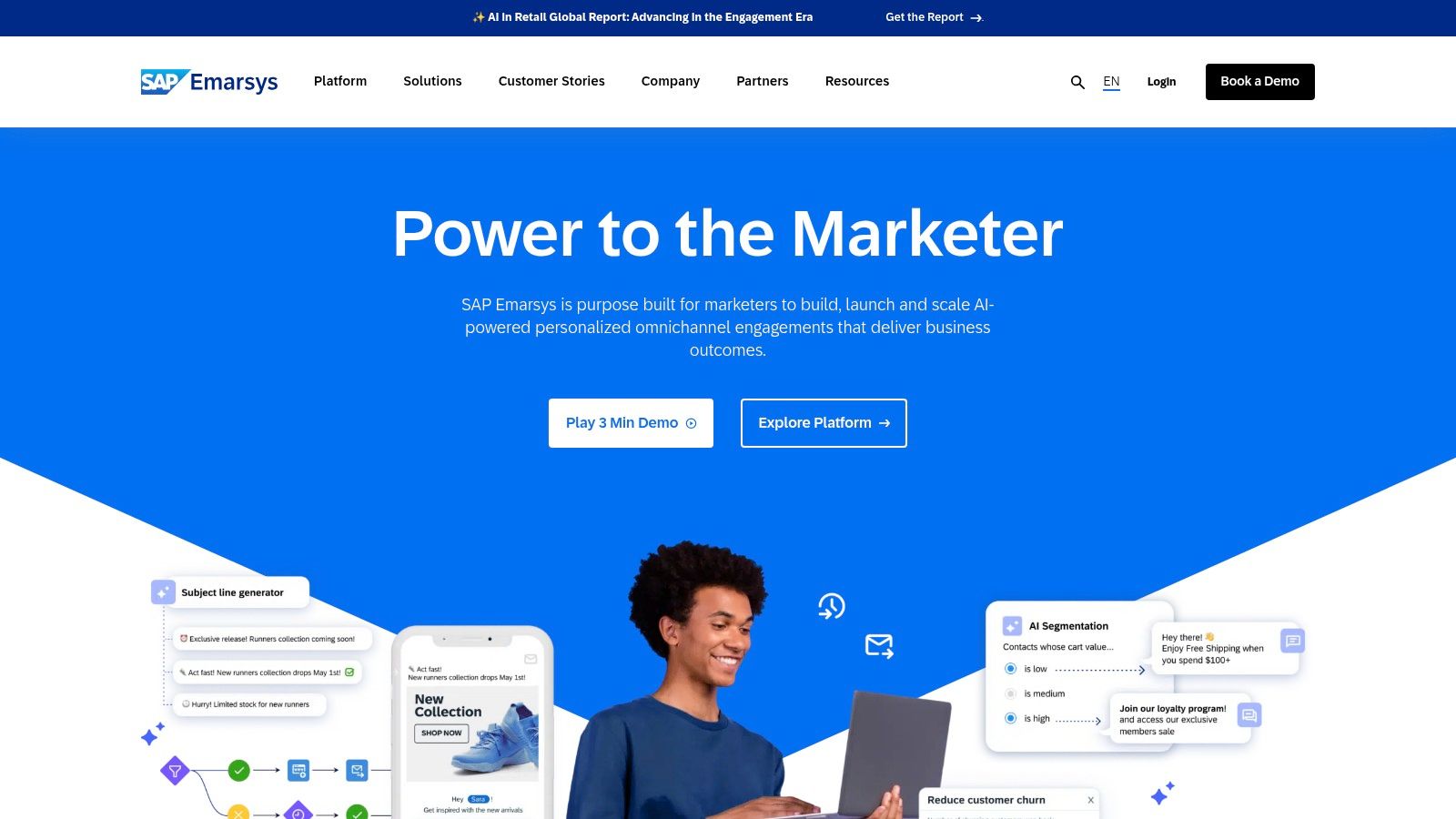
The platform’s key differentiator is its library of pre-built, industry-specific strategies and tactics. Instead of building campaigns from scratch, users can deploy proven automation workflows for objectives like cart abandonment, churn prevention, or cross-selling. This strategic, out-of-the-box approach makes it a powerful choice among customer engagement solutions for teams looking to execute sophisticated campaigns without extensive development resources.
Key Details & Use Cases
- Pricing: Pricing is customized based on business needs, contact database size, and feature sets. A demo is required to receive a tailored quote, positioning it as a premium solution.
- Best Use Case: Enterprise-level e-commerce brands, particularly those using SAP Commerce Cloud, that require sophisticated, AI-powered segmentation and personalization across email, mobile, social, and web channels.
- Implementation Tip: Leverage the pre-built “Tactics” library early on. Select a common e-commerce challenge, like recovering abandoned carts, and activate the corresponding automation to see immediate value and learn the platform’s workflow.
| Pros | Cons |
|---|---|
| Strong integration with the SAP ecosystem. | Can be cost-prohibitive for smaller businesses. |
| Pre-built strategies tailored to various industries. | The user interface can have a steeper learning curve. |
| Powerful AI-driven personalization and automation. | Less flexible for businesses outside of its core industry verticals. |
Website: https://www.emarsys.com/
9. ServiceNow Customer Service Management
ServiceNow Customer Service Management (CSM) excels by connecting customer service with other departments like engineering and operations on a single platform. This approach is powerful for e-commerce businesses dealing with complex issues that require cross-departmental collaboration, such as product defects or widespread shipping delays. By automating workflows and case routing, ServiceNow ensures that customer inquiries are not just answered but resolved efficiently by the right teams, making it a robust customer engagement solution for large-scale operations.
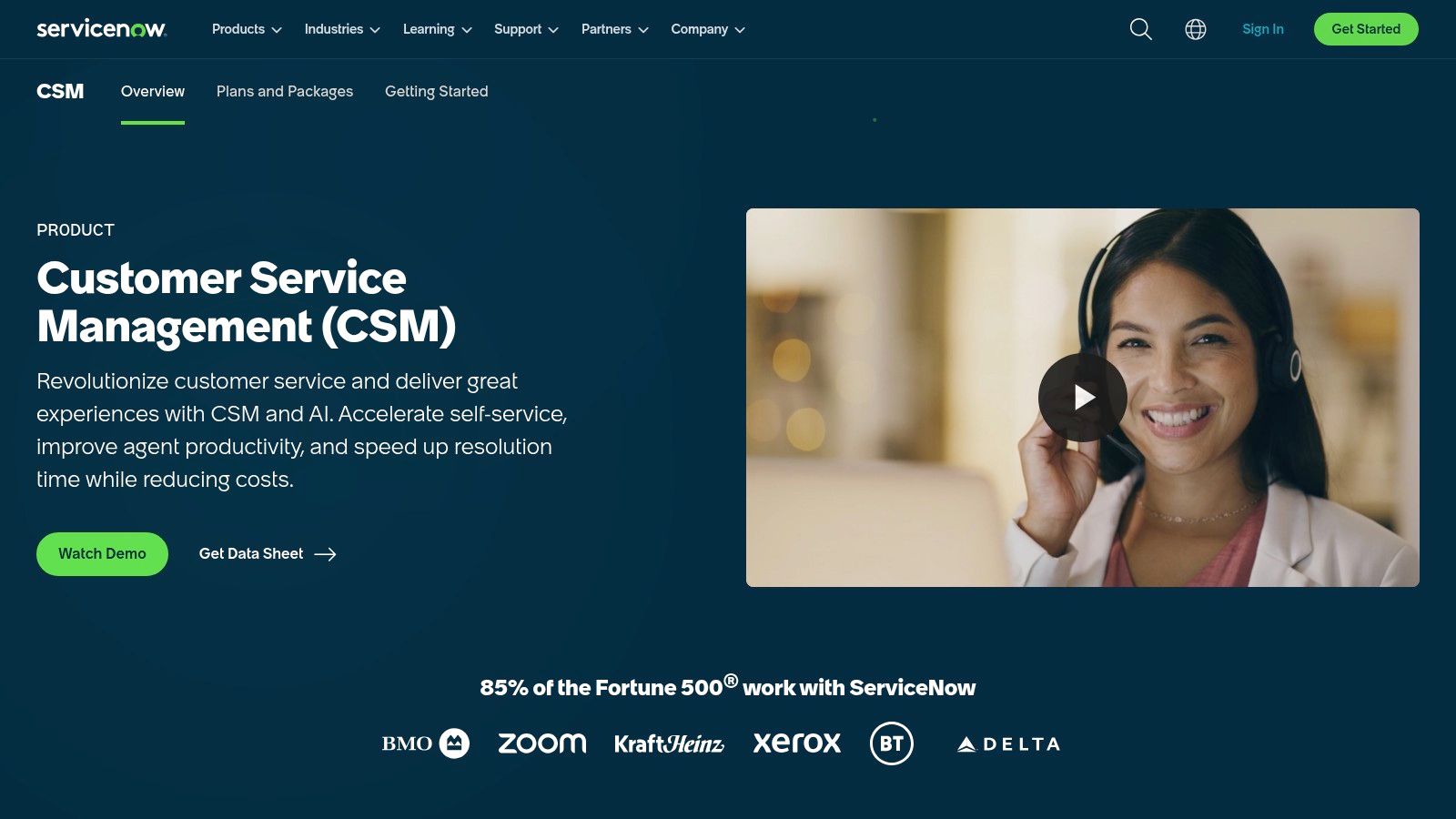
Unlike many platforms focused purely on communication, ServiceNow’s strength lies in operationalizing customer service. It uses AI-powered self-service portals and chatbots to deflect common inquiries, freeing up human agents to handle more complex problems. This focus on backend efficiency directly enhances the frontend customer experience by providing faster, more accurate resolutions.
Key Details & Use Cases
- Pricing: Pricing is customized based on organizational size, specific product needs, and implementation scale. A quote-based model is used, requiring direct contact with their sales team for a detailed proposal.
- Best Use Case: Best suited for large enterprises and e-commerce businesses with intricate operational dependencies. It’s ideal for companies that need to manage service level agreements (SLAs) and resolve customer issues that span multiple internal departments.
- Implementation Tip: Start by mapping out your most common and complex customer service workflows. Use ServiceNow to automate one or two of these processes first, like returns or technical support, before expanding its use across the entire organization.
| Pros | Cons |
|---|---|
| Enhances operational efficiency through automation. | Implementation can be complex and resource-intensive. |
| Highly scalable for large, growing organizations. | May be too feature-heavy and costly for smaller businesses. |
| Strong omnichannel and self-service capabilities. | Requires significant technical expertise to customize fully. |
Website: https://www.servicenow.com/products/customer-service-management.html
10. Oracle CrowdTwist Loyalty and Engagement
Oracle CrowdTwist shifts the focus of customer engagement from transactional interactions to long-term loyalty. It provides a highly adaptable platform for creating sophisticated reward programs that go beyond simple purchase points. E-commerce businesses can use CrowdTwist to reward customers for a wide range of activities, including social media shares, reviews, and survey participation, turning every interaction into a loyalty-building opportunity. This comprehensive data collection provides deep insights into customer behavior.
The platform’s strength lies in its ability to build custom loyalty ecosystems tailored to a brand’s specific goals. Instead of a one-size-fits-all approach, CrowdTwist enables businesses to design unique reward structures that resonate deeply with their audience. For a closer look at how such platforms bolster brand allegiance, explore these effective customer retention strategies. This level of customization makes it a powerful tool for fostering a dedicated community around your brand.
Key Details & Use Cases
- Pricing: Oracle CrowdTwist operates on a quote-based model. Pricing is customized based on the scale of the business, the complexity of the loyalty program, and specific feature requirements.
- Best Use Case: Excellent for enterprise-level e-commerce brands or established retailers looking to build a deeply integrated and highly customized loyalty program. It is particularly effective for brands that want to incentivize and track non-transactional engagements to build a more holistic view of their customer relationships.
- Implementation Tip: Begin by mapping out all potential customer touchpoints where you can reward engagement, not just purchases. Integrate CrowdTwist with your existing marketing automation and CRM platforms to ensure loyalty data informs and personalizes all customer communications.
| Pros | Cons |
|---|---|
| Highly customizable loyalty programs. | Can have a steep learning curve and long setup time. |
| Rewards non-purchase engagement activities. | The cost structure may be prohibitive for small businesses. |
| Provides deep, actionable customer data. | Requires significant strategic planning to implement effectively. |
Website: https://www.oracle.com/cx/loyalty/
11. Freshworks Customer Service Suite
Freshworks offers an AI-powered, omnichannel customer service suite designed for speed and simplicity. It centralizes customer conversations from various channels like email, phone, live chat, and social media into a single, unified agent workspace. For e-commerce businesses, this means support teams can quickly resolve issues without switching between multiple tabs, providing faster, more contextual responses that enhance the customer experience.
The platform’s strength lies in its user-friendly interface and rapid deployment, allowing businesses to get up and running quickly. Freshworks stands out as one of the most accessible customer engagement solutions by embedding AI and automation into everyday workflows, such as using Freddy AI for intelligent ticket routing and chatbot-led self-service. This frees up human agents to focus on more complex, high-value customer interactions that build loyalty.
Key Details & Use Cases
- Pricing: A free plan is available for up to 10 agents. Paid plans like Support Desk start at $15/agent/month (billed annually), with more comprehensive Customer Service Suite plans offering advanced features like AI and omnichannel support at higher tiers.
- Best Use Case: Excellent for e-commerce stores needing a robust, out-of-the-box support solution that is easy for agents to learn and use. It’s particularly effective for businesses looking to leverage AI-powered chatbots to handle common queries like “Where is my order?” or “What is your return policy?”
- Implementation Tip: Begin by integrating your primary support channels (e.g., email and website chat). Then, configure the AI-powered Freddy Self-Service bots with your knowledge base to automate answers to frequently asked questions, immediately reducing agent workload.
| Pros | Cons |
|---|---|
| Quick deployment and intuitive interface. | Some advanced features are only in higher-tier plans. |
| Strong AI and automation capabilities. | Reporting dashboards can be less customizable than competitors. |
| Unified omnichannel agent workspace. | Integrations library is solid but not as extensive as some rivals. |
Website: https://www.freshworks.com/customer-service-suite/
12. Microsoft Dynamics 365 Customer Service
Microsoft Dynamics 365 Customer Service brings enterprise-grade power to customer interactions, leveraging deep integration within the Microsoft ecosystem. Its strength lies in using AI-driven insights to predict customer needs and automate resolutions, making it a formidable choice among customer engagement solutions. For large-scale e-commerce operations, this platform centralizes data from various touchpoints, offering a unified agent desktop that combines case management with real-time analytics.
The platform excels at providing omnichannel engagement, allowing support teams to connect with customers seamlessly across chat, email, social media, and voice channels. This robust, data-first approach empowers businesses to move beyond reactive support to proactive service. By connecting with tools like Power BI and the full Microsoft suite, it transforms raw customer data into actionable strategies for improving satisfaction and retention, making it a scalable foundation for growth.
Key Details & Use Cases
- Pricing: Pricing is on a per-user, per-month basis. The Customer Service Professional plan starts at around $50/user/month, with the more comprehensive Customer Service Enterprise plan offering advanced AI and customization features at a higher price point.
- Best Use Case: Best suited for large enterprises or rapidly scaling e-commerce businesses that are already invested in the Microsoft software ecosystem. It is ideal for companies that need powerful analytics and workflow automation to manage high volumes of complex customer inquiries.
- Implementation Tip: Leverage the native integration with Microsoft Teams to facilitate collaboration between customer service agents and other departments. This allows subject matter experts to be pulled into a case quickly for faster, more accurate resolutions.
| Pros | Cons |
|---|---|
| Powerful AI and analytics capabilities. | Can be complex and may require specialized training. |
| Deep integration with other Microsoft products. | The cost can be prohibitive for smaller businesses. |
| Highly scalable for enterprise-level needs. | Implementation process can be lengthy and intensive. |
Website: https://dynamics.microsoft.com/en-us/customer-service/overview/
Customer Engagement Solutions Feature Comparison
| Product | Core Features / Characteristics | User Experience / Quality Metrics | Value Proposition | Target Audience | Unique Selling Points | Price Points |
|---|---|---|---|---|---|---|
| 🏆 CartBoss | SMS cart recovery, automated campaigns, Shopify/Woo integration, GDPR/CCPA compliant | ★★★★★ 99% SMS open rate, 50%+ CTR, 4500% ROAS | 💰 Zero subscription fees, high ROI | 👥 eCommerce stores, Shopify & Woo users | ✨ Pre-filled checkout, dynamic discounts, 30+ languages | 💰 Free trial, pay per use |
| HubSpot CRM Suite | Unified marketing, sales & service platform | ★★★★ User-friendly, scalable | 💰 Free plan available | 👥 SMB to enterprise | ✨ Extensive integrations, free essential features | 💰 Free + paid tiers |
| Intercom | In-app messaging, live chat, automation | ★★★★ Real-time communication | 💰 Higher cost | 👥 SMBs to mid-market | ✨ 350+ app integrations, customizable workflows | 💰 Paid plans |
| Salesforce Experience Cloud | Customizable portals, Salesforce CRM integration | ★★★★ Robust analytics | 💰 Enterprise grade | 👥 Large enterprises | ✨ Strong customization, personalized content | 💰 Premium pricing |
| Zendesk Sell | Email integration, sales forecasting, mobile access | ★★★★ Intuitive UI | 💰 Integrates with Zendesk Support | 👥 Sales teams, SMBs | ✨ Seamless support integration | 💰 Paid plans |
| Zoho CRM Plus | Omnichannel communication, analytics, automation | ★★★★ Good customization | 💰 Affordable for SMBs | 👥 Small to medium business | ✨ Extensive customization options | 💰 Competitive pricing |
| Pega Customer Decision Hub | AI-driven real-time decisions, predictive analytics | ★★★★ Strong AI capabilities | 💰 Scalable for large enterprises | 👥 Large enterprises | ✨ Predictive analytics, omnichannel | 💰 Enterprise pricing |
| SAP Emarsys Customer Engagement | AI personalization, marketing automation | ★★★★ Deep SAP integration | 💰 Industry-tailored solutions | 👥 Enterprises | ✨ Pre-built strategies, AI-driven marketing | 💰 High cost |
| ServiceNow Customer Service | Automated workflows, AI self-service, omnichannel | ★★★★ Operational efficiency | 💰 Scalable solution | 👥 Large organizations | ✨ AI-powered self-service | 💰 Premium pricing |
| Oracle CrowdTwist Loyalty | Custom loyalty programs, data collection, marketing integration | ★★★★ Enhances retention | 💰 Strong loyalty focus | 👥 Enterprises | ✨ Non-purchase engagement activities | 💰 Enterprise pricing |
| Freshworks Customer Service | Omnichannel support, AI chatbots, advanced analytics | ★★★★ User-friendly, quick deployment | 💰 Fast ROI | 👥 SMBs to mid-market | ✨ AI-powered automation | 💰 Paid plans |
| Microsoft Dynamics 365 CS | AI insights, omnichannel, MS product integration | ★★★★ Scalable, strong analytics | 💰 Enterprise focus | 👥 Enterprises | ✨ Deep MS product ecosystem | 💰 Premium pricing |
Final Thoughts
Navigating the landscape of customer engagement solutions can feel overwhelming, but the journey from selection to implementation is a pivotal step toward building a resilient and profitable e-commerce business. Throughout this guide, we’ve explored a diverse set of platforms, from all-in-one CRM giants like HubSpot and Salesforce to specialized, high-impact tools like CartBoss. The key takeaway is clear: there is no single “best” solution for everyone. The right choice hinges entirely on your unique business context, including your size, budget, technical resources, and primary engagement goals.
For instance, a rapidly scaling e-commerce store grappling with high cart abandonment rates might find immediate, measurable value in a targeted solution like CartBoss, which excels at converting lost sales via SMS. Conversely, a larger enterprise aiming to unify sales, marketing, and support data across multiple departments would benefit more from the comprehensive ecosystems offered by Zendesk Sell or Zoho CRM Plus. The critical first step is to conduct an internal audit of your biggest engagement challenges and opportunities.
Your Path to Choosing the Right Solution
Before you commit to a platform, follow this strategic checklist to ensure you make an informed decision:
- Define Your Core Problem: Are you trying to reduce cart abandonment, improve customer support response times, build a loyalty program, or personalize marketing campaigns? Be specific. A tool designed for customer service (like Freshworks) has different strengths than one built for marketing automation (like SAP Emarsys).
- Assess Integration Capabilities: Your new tool must seamlessly connect with your existing e-commerce platform (e.g., Shopify, WooCommerce) and other essential software. Check for native integrations or robust API support to avoid creating data silos.
- Consider Scalability: Your business will grow, and your chosen customer engagement solutions must grow with it. Evaluate the pricing tiers and feature sets of platforms like Microsoft Dynamics 365 or ServiceNow to ensure they can support your future needs without requiring a costly migration.
- Prioritize User Experience: The most powerful tool is useless if your team finds it difficult to use. Take advantage of free trials and demos. Involve the team members who will use the software daily to get their feedback on its usability and workflow.
Looking Ahead: The Future of Engagement
The world of e-commerce is in constant flux. As you implement these tools, it’s also wise to keep an eye on emerging trends that will shape future customer interactions. For example, the growing adoption of alternative payment methods is a significant development. Proactive businesses should investigate how cryptocurrency is transforming e-commerce transactions to understand how it might impact customer loyalty, global sales, and checkout experiences. Staying ahead of these curves ensures your engagement strategy remains relevant and effective.
Ultimately, investing in the right customer engagement solutions is an investment in your customer relationships. By choosing a tool that aligns with your strategic goals and empowering your team to use it effectively, you create a foundation for sustainable growth, turning one-time buyers into lifelong brand advocates.
Ready to tackle cart abandonment and boost revenue with a tool designed for immediate impact? CartBoss uses automated, pre-populated SMS messages to recover lost sales and engage customers at the most critical moments. See how CartBoss can transform your customer engagement strategy and deliver a measurable ROI from day one.