


Stop chasing new leads for a second. Think of your business like a garden. Planting new seeds (getting new customers) is definitely part of the job, but the real, lasting growth? That comes from taking care of the plants you already have. The customer retention rate formula is simply the tool that tells you how well your garden is actually doing.
Why Customer Retention Is Your Hidden Growth Engine
So many businesses get obsessed with acquisition, throwing all their time and money at finding the next new customer. That’s like trying to fill a leaky bucket—you’re always working, but the water level never seems to rise. The real secret to a full bucket, and a healthy business, is to plug the leaks. That’s where customer retention comes in. It’s your most powerful, yet often overlooked, growth engine.
This isn’t just some feel-good idea; it’s a financial reality. Customer retention has long been one of the most reliable signs of a company’s long-term health. In fact, some groundbreaking findings have shown that boosting your customer retention by just 5% can skyrocket profits by 25% to 95%. For a deeper look at the numbers behind this, you can check out the detailed retention data from Wall Street Prep.
Focusing on retention builds a stable foundation for your business. Loyal customers don’t just stick around; they tend to spend more over time, trust you enough to try new products, and become your best marketers through word-of-mouth.
Moving from Metric to Mindset
It’s crucial to see retention as an active strategy, not just a passive number you check once a quarter. Every single customer who decides to stay with you is proof that you’re delivering real value, from your product quality to your customer service. Their loyalty creates a kind of momentum that hunting for new customers just can’t match on its own.
This is exactly why the customer retention rate formula is so important. It’s more than a simple calculation; it’s a health check for your business. It gives you a clear score, shows you exactly where you stand, and shines a light on your biggest opportunities for improvement. Once you master a few core principles, you can turn this metric into real, tangible growth. For a complete rundown of strategies, check out our essential guide to the best practices for customer retention.
How to Calculate Customer Retention Rate
Calculating your customer retention rate isn’t about getting bogged down in complex math; it’s really just a simple loyalty headcount. Think of it as the clearest way to see how many of your original customers are actually sticking with you over a specific time. The formula itself is surprisingly straightforward, helping you turn raw data into a powerful, easy-to-understand percentage.
Imagine a local coffee shop with a loyalty program. The owner wants to know how many of the regulars from the start of the month are still coming in by the end. Critically, she needs to ignore any new faces who just signed up to get a true measure of loyalty.
This infographic breaks down the flow of the customer retention rate formula beautifully.
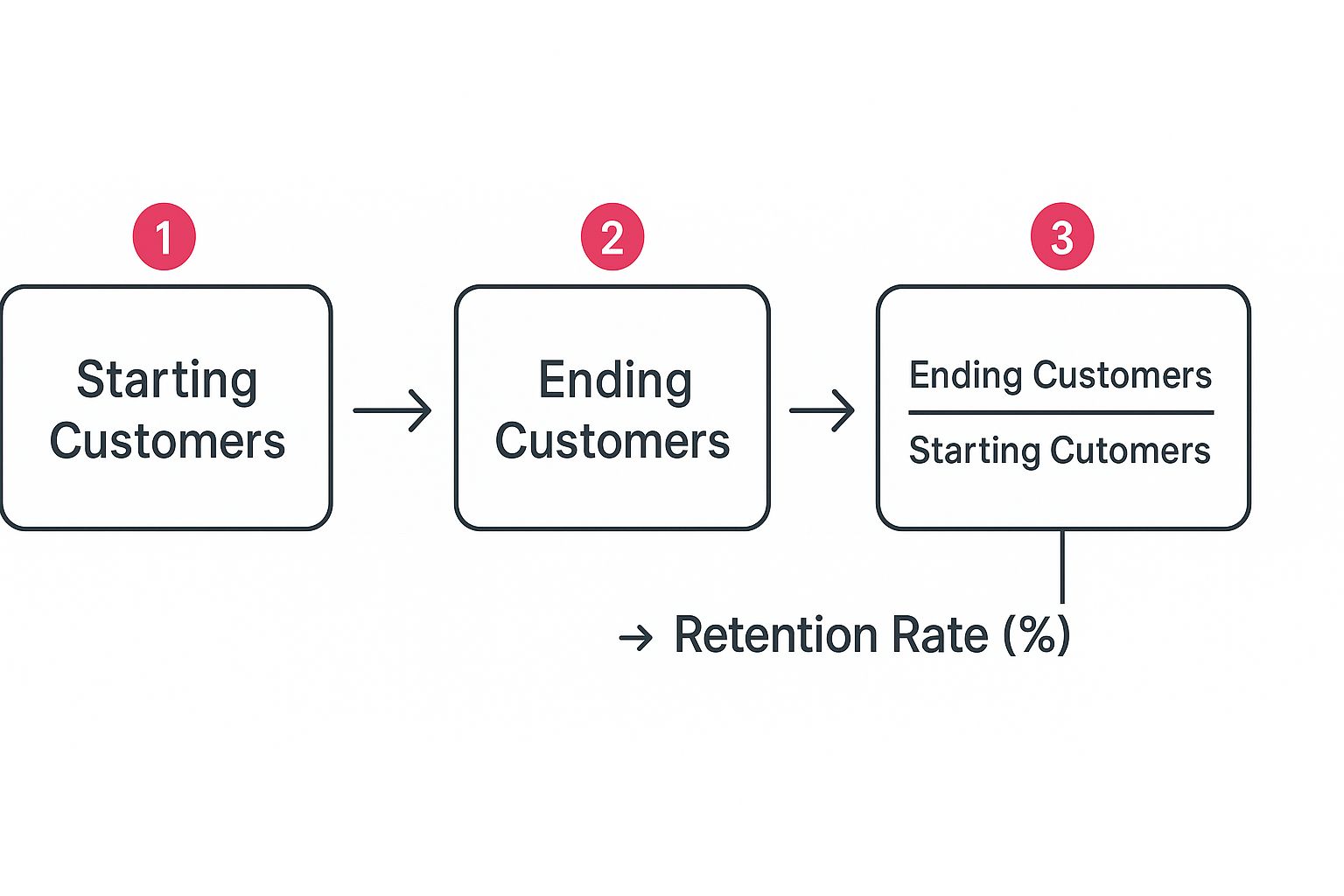
As you can see, the process moves logically from identifying your starting customer base, accounting for new and ending customers, and finally applying the formula to get your final retention percentage.
The Customer Retention Rate Formula
The most common formula you’ll see is CRR = ((E – N) / S) x 100.
At first glance, the letters might look a bit like algebra homework, but each one represents a simple, crucial piece of information about your customer base. Getting this right is the key to an accurate picture of your business’s health.
To make it crystal clear, here’s a quick reference for what each part of the formula means and why it matters.
Customer Retention Rate Formula Components
| Variable | What It Represents | Why It’s Important |
|---|---|---|
| S | Starting Customers | The total number of customers at the very beginning of the period you’re measuring (e.g., the start of a quarter or month). This is your baseline. |
| E | Ending Customers | The total number of customers you have at the very end of that same period. This shows your overall customer count after all activity. |
| N | New Customers | The number of brand-new customers you acquired during that period. This variable is crucial for isolating your original customer group. |
The most important step is subtracting the new customers (N) from your ending total (E). This is vital because it isolates the original group of customers, making sure you’re only measuring the loyalty of those who were with you from the start.
A Practical Walkthrough: “The Daily Grind”
Let’s put this into action. Imagine our coffee shop, “The Daily Grind,” wants to calculate its customer retention rate for the month of April.
- Identify Starting Customers (S): On April 1st, The Daily Grind had 200 members in its loyalty program. So, S = 200.
- Count New Customers (N): Throughout April, they were busy and signed up 50 new members. So, N = 50.
- Count Ending Customers (E): By the last day of the month, April 30th, their total member count is 230. So, E = 230.
Now, we just have to plug these numbers into our formula:
CRR = ((230 – 50) / 200) x 100
First, we subtract the new customers from the ending total: 230 - 50 = 180. This tells us that out of the original 200 members, 180 of them are still active customers.
Next, we divide that by the starting number of customers: 180 / 200 = 0.9.
Finally, we multiply by 100 to turn that decimal into a percentage: 0.9 x 100 = 90%.
Boom. The Daily Grind has a customer retention rate of 90% for April. This means they successfully kept an impressive 90% of their original customer base. This single number gives the shop owner a clear benchmark for success and shows the health of her customer relationships.
This calculation is a fundamental metric for gauging customer loyalty. For an even more detailed breakdown, you can check out this complete guide on customer retention rate calculation.
Putting the Formula into Practice with Real Examples

The theory behind the customer retention rate formula is one thing, but seeing it in action with real numbers is where it all starts to click. The beauty of this formula is how well it adapts to just about any business model you can think of.
Let’s walk through three different scenarios to see how you can apply it to your own company, whether you’re in software, e-commerce, or even running a local gym.
We’ll use the same core formula for each one:
CRR = ((E – N) / S) x 100
Seeing it applied consistently will help you get comfortable with the math, no matter what your business looks like.
Example 1: The Fast-Growing SaaS Startup
Let’s start with a new SaaS company, “ConnectSphere.” They want to figure out their CRR for the second quarter (Q2). For a startup like them, this number is huge—it helps prove stability to investors and shows whether their users are sticking around.
Here’s what their Q2 looked like:
- Starting Customers (S): On April 1st, they had 500 paying subscribers.
- New Customers (N): They had a great quarter, bringing in 150 brand-new subscribers.
- Ending Customers (E): By the time June 30th rolled around, their total subscriber count was 610.
Now, let’s plug those numbers into the formula:
CRR = ((610 – 150) / 500) x 100
- First, figure out how many of the original customers stuck around: 610 – 150 = 460. So, 460 of the initial 500 subscribers were still with them.
- Next, divide that by the starting number: 460 / 500 = 0.92.
- Finally, turn it into a percentage: 0.92 x 100 = 92%.
ConnectSphere’s customer retention rate for Q2 is a very healthy 92%. That’s a strong signal that their product is delivering value and keeping its early users happy.
Example 2: The Bustling E-commerce Store
Next up, let’s look at an online boutique called “Modern Threads.” They want to calculate their annual customer retention to see how many one-time shoppers are turning into loyal, repeat buyers.
Here are their numbers for the year:
- Starting Customers (S): At the beginning of the year, they had 10,000 people who had made at least one purchase.
- New Customers (N): Over the next 12 months, they attracted 8,000 first-time buyers.
- Ending Customers (E): By the end of the year, their total customer count stood at 15,000.
Let’s run the calculation:
- ((15,000 – 8,000) / 10,000) x 100
- Find the retained customers: 15,000 – 8,000 = 7,000.
- Divide by the starting customer base: 7,000 / 10,000 = 0.7.
- Convert it to a percentage: 0.7 x 100 = 70%.
Modern Threads has an annual retention rate of 70%. For a retail business, that’s a solid number and shows they have a strong foundation of returning customers.
Example 3: The Community Gym
Finally, let’s bring it down to a local level with “Apex Fitness,” a membership-based gym. They run their retention numbers every month to keep a pulse on their community and spot any churn problems before they get out of hand.
Here’s the data for July:
- Starting Members (S): On July 1st, they had 800 active members.
- New Members (N): They signed up 40 new people during the month.
- Ending Members (E): On July 31st, their total member count was 790.
Let’s see what their monthly retention looks like:
- ((790 – 40) / 800) x 100
- Calculate how many members were retained: 790 – 40 = 750.
- Divide by the starting member count: 750 / 800 = 0.9375.
- Make it a percentage: 0.9375 x 100 = 93.8%.
Apex Fitness managed to retain 93.8% of its members in July. That’s an excellent result that points to a happy and satisfied community.
What Is a Good Customer Retention Rate
So you’ve run the numbers using the customer retention rate formula, and you have a percentage staring back at you. Now what? The big question on every business owner’s mind at this point is simple: Is this number any good?
The honest answer? It depends. There’s no magic number that works for everyone. A fantastic retention rate for an e-commerce store might spell trouble for a SaaS company. It all comes down to your industry, your business model, and even how long you’ve been operating.
Think of it like a fitness goal. An elite marathoner’s “good” mile time is worlds apart from what a casual jogger aims for. Context is everything. Your goal isn’t to hit some mythical industry standard but to figure out what’s healthy for your specific business.
Industry Benchmarks for Retention
To give you a better frame of reference, let’s look at how wildly retention rates can vary. A good customer retention rate for many e-commerce brands often hovers around 30%. For a subscription-based business like a SaaS platform, a “good” rate is much, much higher—think 80-95%—because their entire model relies on that recurring revenue.
Here’s a rough guide to what you might expect in different sectors:
- Retail & E-commerce: A rate between 25% and 35% is generally considered solid. The nature of retail often involves more one-off purchases and less long-term commitment.
- SaaS & Software: These businesses aim way higher. 80% is a decent starting point, but top-tier SaaS companies can push past 95% monthly retention.
- Media & Entertainment: Think streaming services. These companies often see retention rates above 85% because their content is what keeps users subscribed month after month.
- Financial Services: Trust and “stickiness” are huge here. Because of this, retention is typically very high, often exceeding 90%.
Beyond a Single Number: The Power of Trends
While industry benchmarks are a helpful starting point, the real power comes from tracking your CRR as a trend over time. Is your rate inching up month-over-month or quarter-over-quarter? A static number tells you where you are today; a trend tells you where you’re headed.
Your retention rate is a direct reflection of customer satisfaction and loyalty. An upward trend signals that your efforts to improve products and services are paying off. A downward trend is an early warning sign that something is wrong, giving you a chance to investigate before it spirals.
Analyzing this trend is far more valuable than a one-off calculation. It helps you connect your retention to real business activities, like a new product launch, a pricing change, or a shift in your customer service approach. This focus on long-term loyalty is also how you boost your bottom line. To dig deeper into this, check out our strategies to increase customer lifetime value by building stronger retention.
Ultimately, your “good” retention rate is one that is consistently improving. Use the formula not just to get a score, but to create a story of your company’s journey toward building a loyal, happy customer base.
Moving Beyond Customer Count to Revenue Retention

Knowing your customer retention rate is a solid first step. It gives you a basic health check on your business. But it has one big, glaring blind spot: it assumes every customer is worth the same.
In the real world, that’s almost never true. Think about it. Losing a single major client who makes up 15% of your income hurts a lot more than losing ten small customers who only account for 2% combined. This is where you need a sharper tool.
Enter Revenue Retention Rate (RRR). While the standard customer retention rate formula just counts heads, RRR follows the money. It shifts your focus from how many customers you keep to how much revenue you keep from those customers.
It’s entirely possible to have a great-looking customer retention rate while your revenue is quietly bleeding out. Say you retain 95% of your customers—amazing! But what if that lost 5% happens to be all of your highest-paying accounts? Your customer count looks healthy, but your bottom line is in deep trouble.
Gross vs. Net Revenue Retention
To really get the full story, we need to break revenue retention down into two distinct types. This split helps you see not just what you’re holding onto, but also how well you’re growing the value of your most loyal customers.
- Gross Revenue Retention (GRR): This is your baseline. It measures the percentage of recurring revenue you’ve kept from existing customers but—and this is key—it excludes any expansion revenue from upsells or cross-sells. It’s a pure look at churn and downgrades, showing how well you protect your core revenue. A 90% GRR means you held onto 90 cents of every dollar you started with.
- Net Revenue Retention (NRR): Now this is where things get really interesting. NRR takes your GRR and adds back all the expansion revenue from upsells, upgrades, and add-ons. It shows you the combined impact of churn and growth within your existing customer base. If your NRR is over 100%, you’ve hit a huge milestone: the growth from your current customers is more than making up for the revenue you’re losing to churn.
A high Net Revenue Retention rate shows that your business can grow even without acquiring a single new customer. It proves that your existing relationships are not just stable but are actively becoming more valuable over time.
This is why top-performing companies obsess over revenue retention alongside customer retention, especially when customer spending varies. It weights each customer by their financial impact, giving you a much truer picture of your company’s stability. A business might retain 90% of its customers but only 85% of its revenue if its biggest spenders walk away. To dig deeper into this, check out the insights on how revenue retention provides a deeper look into business stability on CustomerGauge.com.
When you move beyond simple customer counts to embrace revenue retention, you’re adopting a more mature, powerful view of loyalty. It’s no longer just about who stays. It’s about whose spending stays—and grows—with you. That insight is what separates a good business from a truly resilient one.
Proven Strategies to Improve Your Retention Rate

Knowing your customer retention rate is a great start, but the number itself doesn’t change anything. It’s just data on a spreadsheet. The real growth happens when you take that number and actively work to improve it.
This is where you switch from just calculating to executing. The goal isn’t to launch massive, complex projects, but to implement practical tactics that turn one-time buyers into genuine, loyal fans. It’s all about building relationships, not just processing transactions.
Design a Frictionless Customer Experience
Think about the entire journey a customer takes with your brand, from their very first click to their tenth purchase. It needs to be as smooth and easy as possible. Every bump in the road, every point of friction, is a potential exit ramp for them to leave and never come back.
Start by getting the simple things right:
- Effortless Onboarding: Make the first purchase and account creation process a breeze. Offer a guest checkout option, but give them a simple way to create an account after the sale is complete. Highlight the perks, like order tracking and faster checkouts next time.
- A Painless Returns Process: Nothing kills future sales faster than a complicated or costly returns policy. Make yours crystal clear and easy to find. A smooth return can actually build a ton of trust and encourage a customer to buy from you again.
- Proactive Communication: Don’t make customers hunt for information. Send timely updates about their order status, shipping, and delivery. This small act manages their expectations and builds confidence in your brand.
Build a Proactive Feedback and Communication System
You can’t fix problems you don’t even know exist. Instead of waiting for customers to complain, you should be the one starting the conversation. Actively seek out their opinions and make it incredibly easy for them to share their thoughts. This shows you’re listening and gives you priceless insights.
A great way to do this is by sending an automated follow-up email a week or two after a purchase. Ask for a quick review or rating. If you get negative feedback, see it as an opportunity to make things right. A study found that 80% of a firm’s future profits will derive from 20% of existing customers, so keeping that core group happy is absolutely essential.
When you actively resolve a customer’s issue, you often create more goodwill than if the problem never happened in the first place. This “service recovery paradox” turns a negative experience into a powerful loyalty-building moment.
Personalize Communication and Offer Real Value
Generic, one-size-fits-all marketing is a surefire way to get ignored. Your customers expect you to understand their specific needs and what they’ve bought before. Use the data you have to create personalized experiences that feel relevant and valuable.
- Segment Your Audience: Don’t talk to everyone the same way. Group customers based on purchase history, location, or how often they buy. Then, send them targeted offers and content that actually makes sense for them.
- Create a Valuable Loyalty Program: Reward your repeat customers with points, exclusive discounts, or early access to new products. The key is to make the rewards genuinely appealing and easy to earn.
- Send Strategic Discounts: Instead of a generic “10% off everything” sale, send a targeted offer like 20% off or a $10 store credit to encourage a second purchase. This shows you value their business enough to make a real investment in getting them back.
Improving retention is all about creating experiences that keep people coming back. It’s directly tied to your ability to reduce customer churn. For a deeper dive into more tactics, check out these proven customer retention best practices. By putting these strategies into practice, you can turn your CRR from a static metric into a dynamic engine for sustainable growth.
Frequently Asked Questions About Customer Retention
Even after you’ve got the customer retention rate formula down pat, a few questions usually pop up when it’s time to actually put those numbers to work. Let’s tackle some of the most common ones so you can move from just calculating your rate to making confident, strategic decisions.
How Often Should I Calculate My Retention Rate?
The perfect timing really boils down to your specific business and how often your customers buy from you.
If you’re running a SaaS or any other subscription business, checking your retention rate monthly or quarterly is the way to go. This rhythm lines up perfectly with billing cycles, making it easy to spot trends or problems that might be tied to a recent product update or a shift in pricing.
On the other hand, e-commerce and retail stores might get more value from quarterly or annual calculations. The most important thing isn’t some rigid schedule, but consistency. Pick a timeframe that makes sense for your business, and stick with it. That’s how you’ll get a clear picture of your performance over time.
Can My Customer Retention Rate Be Over 100%?
Nope, your standard customer retention rate can’t go above 100%. Think about it: the formula is designed to see how many customers from an initial group you managed to hang onto. You simply can’t keep more customers than you started with, so the ceiling is 100%.
But—and this is a big but—it’s crucial to know the difference between this and Net Revenue Retention (NRR). Your NRR can absolutely soar past 100%. This happens when the extra money you make from existing customers (think upgrades, add-ons, and expansions) is more than the revenue you lose from the customers who churned.
What Is the Difference Between Retention and Churn?
Retention rate and churn rate are essentially two sides of the same coin. They measure the exact same thing, just from opposite angles.
- Retention Rate: This is the percentage of customers you keep over a certain period.
- Churn Rate: This is the percentage of customers you lose in that same timeframe.
They have a simple, inverse relationship. If your quarterly customer retention rate is 85%, then your churn rate for that quarter is automatically 15%. Both numbers are vital for telling the complete story of your customer loyalty.
Ready to turn those insights into action? CartBoss helps you boost retention and recover lost sales automatically with powerful SMS campaigns. Re-engage customers who have drifted away and bring them back to complete their purchase.
See how CartBoss can recover your lost revenue!