


The whole debate over email vs SMS marketing isn’t about crowning a single champion. It’s about knowing which tool to pull out of your toolbox for the job at hand. Think of it this way: email is your go-to for building lasting relationships with rich, detailed content. SMS, on the other hand, is all about speed and driving urgent action.
Your best strategy comes down to what you’re trying to achieve, who you’re talking to, and what you need to say.
Email vs SMS Marketing: A Strategic Overview
To build a powerhouse marketing strategy, you first have to grasp the fundamental differences between email and SMS. While both are designed to connect you with customers, they live in completely different neighborhoods and play very different roles.
Email is a destination. It’s where you send thoughtful, non-urgent content that people can digest on their own time. But SMS? That’s your channel for short, sharp, high-priority messages that demand to be seen right now.
Getting this distinction wrong is a fast track to annoying your customers and racking up unsubscribes. A long, detailed company newsletter sent via text would feel completely intrusive. By the same token, an urgent flash sale alert sent by email could easily get buried in a crowded inbox and opened hours too late.
Core Differences at a Glance
So, how do they really stack up? Email gives you the creative canvas for stunning visuals and long-form storytelling, making it perfect for building your brand. SMS, with its tight character limit, forces you to be direct and punchy—ideal for time-sensitive offers that need a clear call to action.
The heart of the email vs. SMS decision is simple: Use email to nurture and inform, but use SMS to activate and convert. One builds the relationship, the other cashes it in.
Email vs SMS at a Glance
This table gives you a quick, high-level comparison to see where each channel shines. It sets the stage for a much deeper look at their performance and how you can use them strategically.
| Metric | Email Marketing | SMS Marketing |
|---|---|---|
| Primary Use Case | Nurturing leads, brand storytelling, detailed promotions | Urgent alerts, flash sales, immediate notifications |
| Content Format | Long-form text, rich media (images, videos), HTML design | Short-form text (160 characters), links, simple media (MMS) |
| Average Open Rate | 20-32% | Approximately 98% |
| Audience Expectation | Informational, less time-sensitive updates | Immediate, high-priority, and actionable messages |
| Message Immediacy | Low (read within hours or days) | High (read within minutes) |
In the end, the smartest marketers don’t pick a side—they integrate both. This guide will show you exactly when and how to use each channel to get the biggest bang for your buck.
By combining their strengths, you create a seamless customer journey that feels more like a conversation than a monologue. This is the core idea behind what is multi-channel marketing. An integrated approach ensures your message isn’t just seen, but that it actually gets people to act.
Comparing Critical Engagement Metrics
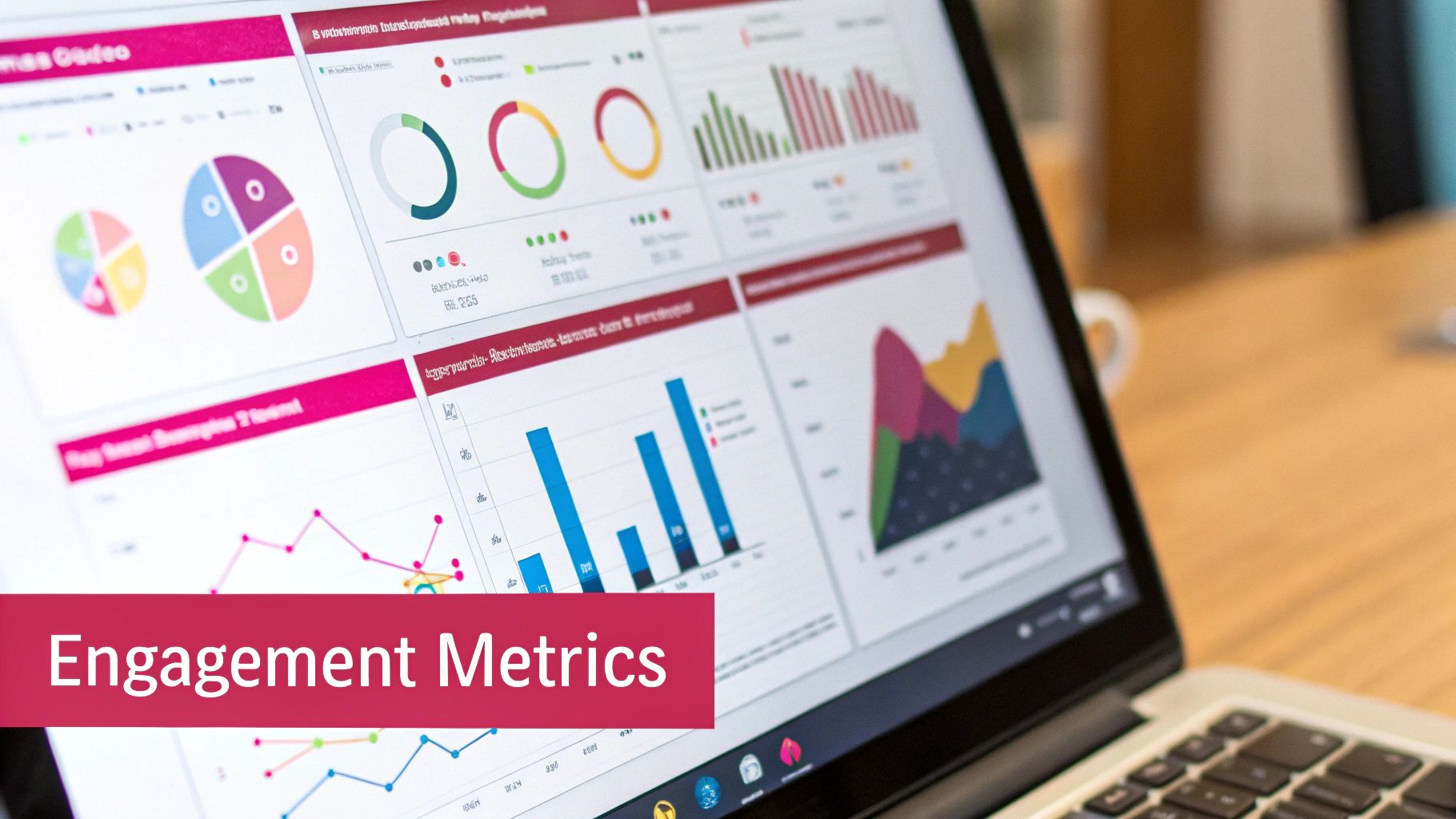
When you’re deciding between email and SMS, the conversation usually kicks off with open rates. It’s a huge piece of the puzzle, for sure, but stopping there doesn’t give you the full picture. Digging into the nitty-gritty of engagement metrics reveals a much more nuanced story about how your customers actually interact with each channel.
The most dramatic difference is how quickly people see your message. SMS boasts a staggering 98% open rate, which absolutely dwarfs email’s average of 20-32%. This gap is all about immediacy. Most people read a text within 90 seconds, while an email might sit unopened for 90 minutes or more.
This near-guaranteed visibility makes SMS an incredibly powerful tool for messages that need immediate attention.
Click-Through Rates Tell a Different Story
While open rates for SMS are sky-high, click-through rates (CTR) give us a clearer view of who’s actually taking action. This is where the comparison gets really interesting.
SMS typically pulls in a higher CTR, often landing somewhere between 6-19%, while email CTRs hover around 2.6%. It makes sense—a short, punchy text with a single, clear link is practically begging for a quick tap.
But don’t write off email’s lower CTR as a failure. An email can pack in multiple links, detailed product info, and rich storytelling. A customer might click one of several links, save the email for later, or just soak up the brand message without clicking at all. Those are all valuable outcomes that a simple CTR metric can’t capture.
Conversion and Response Rate Dynamics
At the end of the day, you want customers to do something. That’s where conversion and response rates come in, and it’s where the unique strengths of each channel really shine.
- SMS for Immediate Action: With an average response rate of 45% (compared to email’s 6%), SMS is built for back-and-forth. This makes it the undisputed champ for flash sales, limited-time offers, or any campaign where you need a fast customer reaction. The path from text to checkout is short and sweet.
- Email for Considered Purchases: Even though email’s conversion rate might be lower per message, it often drives higher-value sales. It gives you the space to explain complex products, showcase benefits, and build the trust a customer needs before making a bigger purchase.
An SMS can convince a customer to buy a discounted t-shirt in two minutes. An email is what convinces them to invest in a $500 winter coat after reading customer reviews and watching a product video.
Interpreting the Metrics for Your Strategy
Relying on a single metric is a recipe for disaster. A smart strategy means looking at these numbers in the context of what you’re trying to achieve with each campaign.
Think about an abandoned cart reminder sent via SMS. Its only job is immediate recovery. Success is measured by how quickly it brings that customer back to complete their purchase. This is a huge reason why consumers often prefer business texts for urgent alerts. You can dive deeper into this by checking out the latest SMS marketing statistics.
On the other hand, a weekly email newsletter might have a modest open rate and CTR, but its real value is in building long-term brand loyalty. You measure its success over months, through repeat purchases and a higher customer lifetime value.
The key is to match your channel to the customer behavior you want and measure success accordingly. It’s time to move beyond the simplistic “which channel has the best numbers?” debate.
Analyzing Cost and Return on Investment
Every marketing dollar needs to pull its weight, so let’s get straight to the financial breakdown of email versus SMS. On the surface, their pricing models look like they come from different planets.
Email marketing usually runs on a subscription model based on your contact list size. This gives you a predictable monthly fee and the ability to send a ton of messages without constantly watching the meter.
SMS marketing, on the other hand, is almost always priced per message. This can feel more expensive upfront, especially when you’re planning a big campaign. But think of it this way: with a pay-as-you-go model, you’re investing directly into touchpoints that are almost guaranteed to be seen.
The True Cost Is More Than Just the Price Tag
Simply comparing cost-per-message is a trap. It doesn’t tell you the real story. The real value is found by looking at what each dollar actually accomplishes. An email might cost a fraction of a cent to send, but if it gets buried in a crowded inbox and never gets opened, that money is just gone.
That slightly more expensive SMS message, however, is almost guaranteed to be opened within minutes. It can drive an immediate sale, making its higher initial cost an incredibly profitable investment. It’s time to shift our focus from raw cost to real-world returns.
The most expensive marketing channel is the one that doesn’t work. While SMS has a higher per-unit cost, its directness and immediacy often translate to a more efficient path to conversion for time-sensitive offers.
Unpacking the ROI for Each Channel
Return on investment (ROI) is where the strategic differences between email and SMS really shine. To get a handle on this, it’s essential to understand how to calculate marketing ROI to properly measure what’s working.
Email is legendary for its consistently high ROI, mostly because its low cost makes it perfect for long-term nurturing. It’s fantastic at building a brand connection and walking customers through complex buying decisions over time. This slow-burn approach builds customer lifetime value (CLV), delivering returns that can grow for months or even years. For a deeper dive into the numbers, check out our detailed analysis of SMS marketing vs. email marketing: cost and ROI breakdown.
SMS, in stark contrast, delivers its ROI with explosive speed. It’s the go-to channel for campaigns that need an immediate reaction, like:
- Flash Sales: Creating urgency that drives sales within hours.
- Abandoned Cart Recovery: Nudging a shopper to finish their purchase while they’re still in the buying mindset.
- Limited-Time Offers: Pushing exclusive deals that won’t last long.
While the upfront cost is higher, the rapid conversion cycle means you see a significant return almost instantly.
When a Higher Cost Delivers a Better Return
The numbers don’t lie: both channels can be ridiculously profitable. Email marketing is famous for an impressive ROI, with figures often landing between $36 to $40 for every dollar spent. But the instant nature of SMS can produce even more stunning results in the right situation. We’ve seen SMS campaigns generate up to $71 for every dollar spent.
This huge difference highlights a critical point: the “best” ROI is completely tied to your campaign goal. An expensive SMS campaign is the most profitable choice when you need speed. For example, trying to clear out seasonal inventory with a 24-hour flash sale? That’s a perfect job for SMS. The higher cost is easily justified by the immediate cash flow and the money saved by not having dead stock.
Conversely, if you’re nurturing new leads who aren’t quite ready to buy, a low-cost email sequence is the smarter financial move. It keeps your brand on their radar without a big investment until they’re ready to make a purchase. Your budget decisions should always be linked to the strategic outcome you want, not just the upfront price.
Understanding Audience Preference and Reach
Effective marketing isn’t just about blasting messages out—it’s about meeting your customers on their terms. This means you have to look past raw performance numbers and really get into where, when, and how your audience actually wants to hear from you. The real difference between email and SMS often boils down to the vibe of each channel.
Email is seen as a more professional, less in-your-face space. It’s where customers expect to get detailed info, browse promotions when they have a spare moment, and connect with richer brand stories. They can flag an email, come back to it later, and read it when they’re in the right headspace.
SMS, on the other hand, is a direct and personal line. A text message feels less like a marketing broadcast and more like a tap on the shoulder from a friend. That intimacy is its greatest strength for urgent messages, but it’s a double-edged sword. If you’re not careful and respectful, it can easily feel disruptive.

Where Do Customers Prefer to Connect?
Getting this right is the key to a strategy that feels helpful instead of annoying. People have developed clear expectations for how they want brands to communicate on each platform.
- Email for Rich Content: Customers are generally happy to get emails for things that aren’t time-sensitive, like product launch announcements, deep-dive newsletters, and brand updates. It’s the perfect channel for building a relationship over time with consistent, valuable content.
- SMS for Urgent Updates: When it comes to time-sensitive info, SMS is the undisputed champion. People actually welcome texts for flash sale alerts, shipping notifications, and appointment reminders because that immediacy delivers real value.
The core difference is all about perception. Email is a destination you plan to visit for information. SMS is an interruption that demands immediate action. Use them in the wrong context, and you risk breaking trust and racking up unsubscribes.
Global Reach and Accessibility
Your ability to connect with people also hinges on the tech itself. While it feels like everyone has a smartphone, there are important distinctions between the global reach of email and SMS.
While 53% of consumers say they actually prefer SMS for communication, it’s used by 81% of Americans, with billions of texts flying back and forth daily. Globally, SMS reaches about 65% of the population, making it a massive and incredibly reliable network.
Email marketing is no slouch either, with user numbers projected to hit 4.6 billion by 2025. But even with that huge user base, SMS consistently smokes email in direct engagement. We’re talking a staggering 98% open rate for SMS compared to just 21.5% for email. You can find more details in these SMS marketing statistics.
The data tells a clear story: while email has a slightly larger global footprint, SMS is fundamentally more accessible. It doesn’t even need an internet connection to be delivered. This makes it an absolute powerhouse in regions where mobile data can be spotty but cellular networks are solid.
Navigating the Regulatory Landscape
Finally, respecting your audience means playing by the rules, and the rules for these two channels are very different.
Email Compliance (CAN-SPAM Act):
- You must provide a clear and obvious way for people to opt-out.
- Every email has to include your physical mailing address.
- Deceptive or misleading subject lines are a big no-no.
SMS Compliance (TCPA & CTIA):
- You need explicit written consent before sending a single marketing text.
- Messages must include clear opt-out instructions (e.g., “Reply STOP to unsubscribe”).
- There are strict rules about messaging times, often called “quiet hours.”
The regulatory bar for SMS is much higher, which makes sense given how personal it is. But don’t think of this as a hurdle. It’s a framework for building trust. When you get explicit consent for texts, you’re engaging an audience that has actively raised their hand to hear from you. That makes for a much more receptive—and valuable—subscriber list.
Choosing The Right Channel For Every Scenario
The real debate in email vs SMS marketing isn’t about which is “better” in theory—it’s about making the right call in the heat of a campaign. Forget abstract metrics for a moment. Let’s get into a practical playbook of common marketing scenarios to help you pick the perfect channel for your specific goal.
Your choice always boils down to the nature of your message and what you want the customer to do. Are you trying to build a long-term relationship or drive a sale right now? Answering that one question is the first step.
This simple decision tree can help guide your thinking based on urgency and how much you need to say.
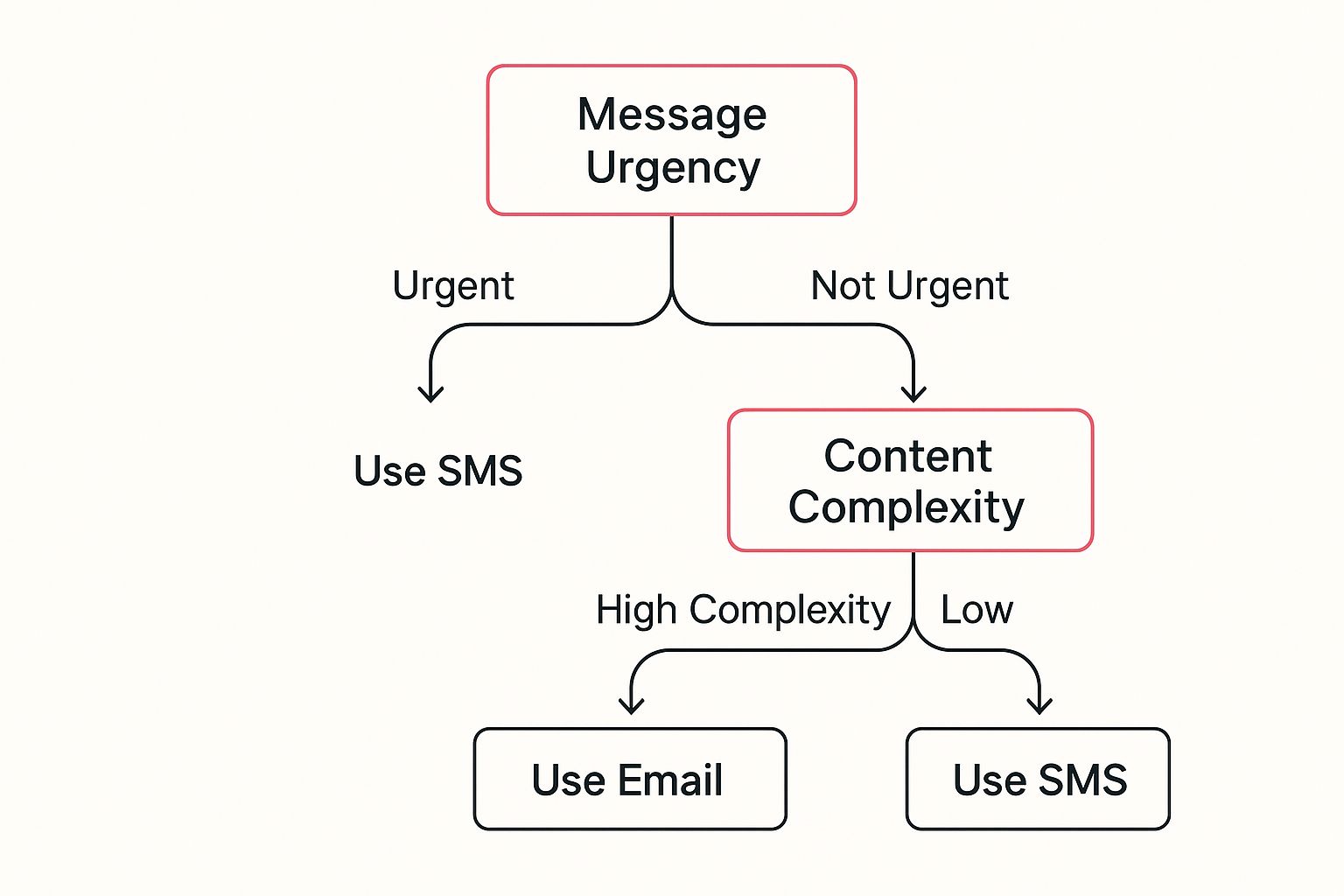
This visual guide hits on the fundamental divide: urgent, simple messages are built for SMS. More complex, less time-sensitive content belongs in an email. Sticking to this framework helps you avoid common mistakes, like sending a long-form newsletter via text or a flash sale alert by email (where it will likely get buried).
When To Send An Email
Think of email as your workhorse for building relationships and delivering rich, detailed content that customers can check out on their own time. It shines when your message needs more than just a quick glance and a tap.
You’ll want to choose email for these key scenarios:
- In-Depth Newsletters: This is email’s home turf. You have the space to share company updates, blog content, behind-the-scenes stories, and product education that really builds brand loyalty.
- Feature-Rich Confirmations: Go way beyond a simple “Order Received.” Use email to send receipts packed with product images, shipping details, links to support articles, and even cross-sells for related items.
- Complex Lead Nurturing: When you’re guiding a potential customer through a bigger purchase decision, a sequence of well-crafted emails can educate them on the benefits, answer their questions, and build the trust you need to get the sale.
When To Send An SMS
SMS is your direct line for high-priority messages that demand immediate attention. Its superpower is its ability to cut through the noise and get someone to act instantly, making it perfect for anything time-sensitive.
Deploy SMS for these high-impact situations:
- Driving Flash Sales: Nothing creates urgency quite like a text announcing a sale that ends in a few hours. A message like, “FLASH SALE! 50% off all hoodies for the next 3 hours. Shop now!” is almost guaranteed to be read on the spot.
- Appointment Confirmations and Reminders: Drastically reduce no-shows and improve the customer experience by sending a quick text to confirm a booking and another reminder 24 hours before.
- Urgent Shipping Alerts: Give customers peace of mind with real-time updates. A simple “Your order has shipped!” or “Your package is out for delivery!” text is a welcome and valuable touchpoint.
The core principle is context. An email is a conversation you have in the living room; an SMS is a quick, important note you pass in a crowded hallway. Both are useful, but mixing them up makes the entire interaction awkward and ineffective.
For a broader perspective, it’s helpful to understand the principles behind choosing the right digital marketing channels for your business as part of your overall strategy.
The Ultimate Test Abandoned Cart Recovery
Nowhere is the email vs SMS marketing choice more critical than in abandoned cart recovery. This is where a blended approach really shines, creating a sophisticated flow that uses the strengths of both channels. The goal isn’t just to send a reminder; it’s to build an intelligent sequence that adapts to what the customer does—or doesn’t do.
A powerful abandoned cart strategy might look like this:
- Immediate SMS Nudge (15-30 minutes post-abandonment): Send a simple, direct text. “Hey [Name], did you forget something? Your cart is waiting for you: [Link].” This message is designed to catch them while they’re still in that shopping mindset.
- Persuasive Email Follow-Up (1-3 hours post-abandonment): If the SMS doesn’t convert, follow up with an email. Here, you can show off images of the items they left behind, sprinkle in some customer reviews, and tackle potential blockers like shipping costs or return policies.
- Final Incentive Email (24 hours post-abandonment): As a final push, send another email offering a small, time-sensitive discount. “Complete your order now and get 10% off!” This creates one last bit of urgency to close the sale.
This multi-step process shows how perfectly email and SMS can work together. By orchestrating these touchpoints, you build a system that’s far more effective and responsive. This kind of coordinated communication is a cornerstone of a successful omnichannel customer experience, making the customer journey feel connected and seamless.
Which Channel To Use A Scenario-Based Guide
Still trying to decide which channel fits your specific need? This quick guide breaks down common marketing goals and shows you when to use email, SMS, or a combination of both for the best results.
| Marketing Goal | Recommended Channel | Strategic Reasoning |
|---|---|---|
| Welcome New Subscribers | Perfect for a warm, detailed introduction to your brand story and what to expect. | |
| Announce a Flash Sale | SMS | The immediacy and high open rate of SMS create the urgency needed to drive quick action. |
| Share a New Blog Post | Gives you the space to include an engaging summary, images, and a clear call-to-action. | |
| Send an Order Confirmation | Both | Use email for the detailed receipt and SMS for a quick “Your order is confirmed!” notification. |
| Ask for a Product Review | Allows the customer to respond on their own time and provides space for a detailed, thoughtful review. | |
| Send a Shipping Update | SMS | Customers appreciate real-time, bite-sized updates about their package’s location. |
| Recover an Abandoned Cart | Both | A multi-channel approach (SMS first, then email) covers all bases and maximizes recovery rates. |
Ultimately, the best strategy often involves using both channels in harmony. By understanding the unique strengths of each, you can create a marketing machine that communicates with customers in the right way, at the right time.
Integrating Email and SMS for a Cohesive Strategy
The smartest marketers know the email vs SMS marketing debate isn’t about picking a winner. The real magic happens when you treat them as a team, working together in a single, unified strategy. Instead of making them fight for attention, a cohesive plan leverages each channel’s unique strengths to guide customers along a journey that feels natural and genuinely helpful.
Think of it like a good conversation. Email sets the stage perfectly, delivering rich, detailed stories that build your brand and connect with your audience. SMS then jumps in for those critical moments that need a quick, immediate response. When you get the timing right, they amplify each other’s power, driving better engagement and, ultimately, more sales.
Building a Coordinated Customer Journey
The trick is to map out your customer touchpoints and decide which channel fits each stage best. An integrated strategy means no more sending the same message twice. It’s all about getting the right information to the customer, in the right format, at just the right time. Plus, research shows that 85% of people who subscribe to a brand’s texts are also on their email list, which is a massive opportunity for smart, coordinated messaging.
A product launch is a perfect example. You can use a series of well-crafted emails to build excitement and tell the full story behind the new product. Then, on launch day, a quick and direct SMS with a link to buy drives that immediate rush of traffic and sales.
This approach respects your customer’s attention. They get the in-depth content in their inbox and the can’t-miss alert on their phone.
Orchestrating email and SMS isn’t about blasting the same message everywhere. It’s about telling a continuous story, where each channel plays its own complementary role in moving the customer from one step to the next.
An Integrated Strategy in Action
Let’s walk through a common ecommerce scenario to see how this plays out. Say a new customer just signed up for your newsletter.
- Welcome Email Series: The journey starts in their inbox with a welcome sequence. The first email delivers their sign-up discount and a warm hello. The next few can introduce your brand story, showcase best-selling products, and share useful content—all without any pressure to buy.
- First Purchase Promotion via Email: Once they’re settled in, you might send an email with a special offer for their first purchase. Email gives you the space to include gorgeous product photos, customer reviews, and a compelling call-to-action to nudge them toward that first buy.
- Exclusive Flash Sale via SMS: A few weeks later, you launch a 24-hour flash sale. This is where SMS shines. A short, urgent text like, “Heads up! Get 30% off EVERYTHING for the next 24 hours only. Shop now: [link]” cuts straight through the noise and drives immediate action in a way an email just can’t match.
This coordinated flow uses email for relationship-building and SMS for quick activation. By using both, you create more meaningful touchpoints without overwhelming your subscribers, leading to a much more dynamic and responsive communication strategy. To dive deeper into setting up these kinds of workflows, check out our guide on marketing automation for ecommerce.
Frequently Asked Questions
When you’re trying to figure out where SMS and email fit into your strategy, a few questions always seem to pop up. Let’s tackle them head-on so you can make the right call for your business.
Which Is More Effective SMS or Email Marketing?
Honestly, neither one is “better” than the other—it all comes down to what you’re trying to accomplish. If you need to get eyes on a message right now, nothing beats SMS. With a jaw-dropping 98% open rate, it’s the king of urgency.
But if you’re looking to tell a richer story, send out a newsletter, or build a deeper relationship with your customers, email is still your best friend. The smartest brands don’t pick a side; they use both channels together, letting each one do what it does best.
Can I Use SMS and Email Marketing Together?
Not only can you, but you absolutely should. Thinking of them as separate tools is a mistake. When you combine them, you can create some incredibly effective campaigns. For instance, you could use a series of emails to build hype for a new product, then send a quick SMS the moment it drops to spark immediate sales.
A killer strategy we see work time and time again is for abandoned carts: send an SMS reminder within minutes of the cart being left, then follow up with a more detailed email an hour later if they haven’t come back. This one-two punch gives you the best shot at winning back that sale.
What Is the Biggest Difference in Compliance?
The biggest hurdle is consent, and it’s way stricter for SMS. To send a promotional text, you need explicit written consent from your customers. This isn’t just a suggestion; it’s a hard requirement under regulations like the TCPA in the US.
Email compliance, mostly governed by laws like the CAN-SPAM Act, is a bit more relaxed. The main requirement is to give people a clear and simple way to opt out. Because a text message feels so much more personal and direct, the bar for getting permission is justifiably higher.
Ready to turn abandoned carts into your biggest revenue source? CartBoss uses the power of automated SMS to re-engage customers and recover lost sales on autopilot. Start converting up to 50% more abandoned carts today.