



Loyalty isn’t something you can buy with a simple “buy ten, get one free” punch card anymore. It has to be earned. You earn it through consistent, personalized, and genuinely valuable interactions that make your customers feel seen and appreciated. True loyalty today is built on solid relationships, not just transactions.
Beyond Points: The New Era of Customer Loyalty
In a market flooded with choices and aggressive advertising, knowing how to build real customer loyalty is no longer a “nice-to-have” skill—it’s a core growth strategy. The old rules are out. Customers are smarter, the competition is more intense, and the price of getting a new customer through the door just keeps going up.
This pressure is forcing smart brands to pivot. Instead of chasing short-term sales, they’re focusing on long-term relationships. It’s a deliberate shift away from generic, one-size-fits-all programs toward something far more meaningful. The real goal is to maximize Customer Lifetime Value (CLV) by making people want to come back, not because they have to, but because they feel a genuine connection to your brand.
The Soaring Cost of Acquisition
The numbers don’t lie—focusing on retention is a financial no-brainer. Over the last five years, customer acquisition costs have shot up by nearly 60%. On average, merchants are now losing $29 for every new customer they bring in. This model is completely unsustainable, which is why building loyalty isn’t just a good idea; it’s essential for survival.
But here’s the catch: even though it’s more important than ever, building that loyalty is getting harder. In 2024, 69% of consumers said they were loyal to specific brands. That sounds pretty good until you realize it’s a drop from 77% in 2022. This tells us that while people are willing to be loyal, their trust is fragile and needs a much more thoughtful approach to win over.
To really get a handle on this, let’s break down the core pillars of modern customer loyalty. The old tactics are dead. Success today is built on a new foundation that prioritizes genuine connection over simple transactions.
| Pillar | Description | Key Action |
|---|---|---|
| Genuine Value | Providing top-tier products, outstanding service, and useful content that solves real problems. | Go beyond discounts; become an indispensable resource for your customers. |
| Personalized Journeys | Using customer data to create tailored recommendations, relevant messages, and unique offers. | Show customers you know them by making every interaction feel personal and relevant. |
| Thriving Community | Building spaces where customers can connect with each other and your brand, like a VIP group or exclusive forum. | Turn passive buyers into active brand advocates who feel part of something bigger. |
These pillars aren’t just abstract concepts; they are actionable strategies that work together to create an experience that keeps customers coming back, regardless of what your competitors are doing.
The Foundation of Modern Loyalty
The framework for building deep-seated loyalty rests on three fundamental pillars. Get these right, and you’ll create an experience that stands up to the competition.
- Deliver Genuine Value: This is about more than just discounts. We’re talking high-quality products, exceptional service, and content that actually helps your customers. Value is the entry fee for earning their attention.
- Personalize the Journey at Scale: Customers expect you to know them. This means using their purchase history and browsing behavior to craft recommendations, messages, and offers that feel like they were made just for them.
- Build a Thriving Community: Loyalty really takes off when customers feel like they belong to something. Create spaces—a VIP Facebook group, an exclusive forum—for them to connect with you and each other. This is how you turn passive buyers into your most vocal advocates.
This image really drives home the business outcomes that a strong loyalty strategy delivers.
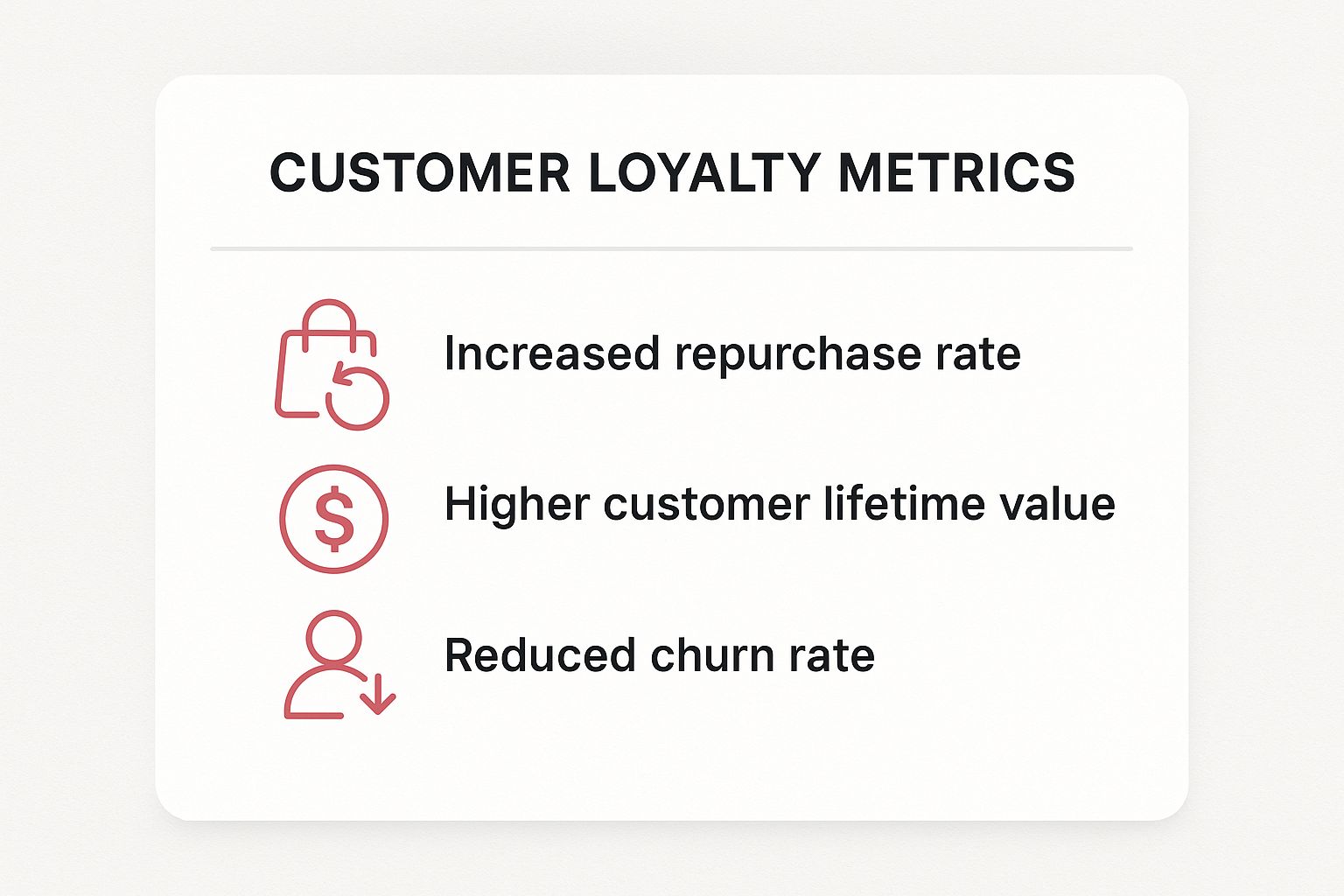
As you can see, the benefits hit your bottom line directly through more repeat business, higher customer value, and lower churn.
The main takeaway is simple: today’s customers don’t just buy products; they buy into relationships. They want to feel understood, valued, and connected. Generic programs fail because they treat everyone the same, completely missing the personal touches that build real, lasting loyalty.
Beyond just transactional loyalty, deep customer relationships are nurtured through consistent engagement. The best brands borrow strategies to boost engagement and retention from all sorts of fields to keep people invested. By understanding these pillars, you can finally ditch the outdated points system and start building a loyal following that will stick with you for the long haul.
Crafting a Truly Personal Customer Journey
Let’s be honest: generic marketing doesn’t build loyalty. It just adds to the noise. Today’s customers are bombarded with messages, and the only ones that actually land are the ones that feel like they were written just for them.
Real, lasting loyalty happens when your customers feel seen—when they believe you get their individual needs, what they like, and their history with your brand. This is so much more than just dropping a {{first_name}} tag into a mass email. True personalization is about using the data you have to create experiences that feel genuinely one-on-one.
It’s about showing your customers you’ve been paying attention.
From Data Points to Personal Connections
Every click and purchase on your site is a breadcrumb, a valuable clue left behind by your customer. Their purchase history, the products they look at, even the carts they abandon—these aren’t just dry metrics. They’re direct expressions of what your customers want. The real magic is turning that raw data into a meaningful conversation.
Think about it. A customer frequently buys a specific brand of running shoes from your store. Sending them a generic “10% off everything” blast is lazy. What if, instead, you sent them a quick text the moment a new model from that exact brand drops?
That’s not marketing; that’s a valuable heads-up. It shows you know their preference and are delivering relevant, timely information. This is how you start building loyalty that can’t be stolen by a competitor’s discount code.
We’re seeing a massive shift toward this kind of data-driven personalization. The latest research shows 60% of brands now focus on Customer Lifetime Value (CLV) as a core metric. To get there, 58% of businesses are pouring resources into creating more tailored customer journeys, often using automation to make it happen at scale.
This is where a tool like CartBoss becomes a secret weapon. It lets you automate these meaningful touchpoints without burying your team in manual work.
Smart Segmentation for Maximum Impact
You can’t have a personal conversation with everyone if you’re yelling the same thing at the whole crowd. The first practical step is to get smart with audience segmentation. It’s simply about grouping customers based on who they are and what they do.
Here are a few powerful segments you can build right away:
- VIP Customers: These are your top spenders. They deserve the gold treatment. Think exclusive early access to sales, special discounts, or even a personal thank-you text from the founder.
- First-Time Buyers: Their first experience is everything. Follow up with a helpful tip on how to use their new product or a special offer on a complementary item to get them to come back for a second purchase.
- Lapsed Customers: These are the ones who haven’t bought from you in a while. A well-timed “We miss you!” text with a compelling offer can be incredibly effective at winning them back.
- Category-Specific Buyers: Group customers by the product categories they love. If someone only ever buys skincare, stop sending them promos for your new line of men’s hoodies. It just shows you’re not listening.
Once you have these segments, you can design highly relevant SMS and email campaigns that speak directly to each customer’s situation.
Using SMS for a Truly Personal Touch
Email is great for newsletters and longer content, but nothing beats SMS for immediate, personal, and high-impact messages. Its conversational feel makes it the perfect channel for building a closer, more authentic relationship.
Just look at how these scenarios play out with a simple text:
| Scenario | Customer Segment | Personalized SMS Example |
|---|---|---|
| Post-Purchase Follow-Up | First-Time Buyer | “Hi Alex! Hope you’re loving your new camera. Here’s a quick guide to get you started: [link]. Let us know if you have questions!” |
| VIP Early Access | Top Spenders | “Maria, you’re one of our best customers! As a thank you, get 24-hour early access to our summer sale. Shop now before anyone else: [link]” |
| Helpful Replenishment Reminder | Repeat Buyer | “Hey Sam! Looks like you might be running low on your favorite coffee blend. Want to reorder with one click? [link]” |
These messages just work. They’re timely, relevant, and genuinely helpful. They feel less like marketing blasts and more like a personal concierge service. This is the kind of attention that creates a powerful emotional connection, making customers feel valued for more than just their last transaction.
For an even deeper dive into this, check out our ultimate guide to increasing customer engagement to find more powerful strategies you can use.
Building Direct Connections with SMS Marketing
Let’s face it: email inboxes are a war zone. While your carefully crafted email might get buried, a simple text message lands right in your customer’s pocket, cutting through all the digital noise. That’s the power of SMS marketing—it offers an immediate, personal connection that’s tough to replicate. In a crowded market, this is gold for building real customer loyalty.
But here’s the catch. That power is also its biggest risk. An unwanted promotional email is easy to ignore or delete. An unwanted text? That feels intrusive and personal.
The secret is to stop thinking about SMS as a channel for aggressive flash sales. Instead, see it as your direct line for building genuine, one-on-one relationships with the people who matter most to your business.
Moving Beyond Blasts to Build Bonds
A successful SMS loyalty strategy isn’t about shouting louder; it’s about whispering the right thing at the right time. It all starts with respecting your customer’s attention. Every single message you send should feel like a welcome, valuable interaction—not just another marketing blast they have to deal with.
This means using what you know about your customers to send texts that are timely, relevant, and actually helpful.
Think about the customer journey. Each stage is a new chance to strengthen that bond with a well-timed text. A quick post-purchase check-in, an exclusive VIP alert, a simple feedback request… these small touchpoints add up. They create a powerful sense of being seen and appreciated.
Here are a few ways a thoughtful text can make a huge impact:
- The Post-Purchase Check-In: A few days after an order arrives, a simple text asking, “Hey, how are you loving your new gear?” shows you care about their experience, not just their money.
- The Exclusive VIP Alert: Make your top customers feel like insiders. Give them early access to a new drop or a private sale via SMS. It reinforces their status and makes their loyalty feel rewarded.
- The Quick Feedback Request: Forget long, boring email surveys. A quick text asking for a 1-5 star rating is far more likely to get a response. It shows you value their opinion and are always listening.
When you automate these interactions correctly, you turn transactional moments into meaningful connections. A tool like CartBoss is perfect for this, letting you set up campaigns based on specific customer actions, so the right message always finds the right person at the perfect moment.
The most effective SMS loyalty campaigns feel less like marketing and more like a premium concierge service. They anticipate needs, provide genuine value, and make the customer feel seen.
The Dos and Don’ts of SMS Loyalty Campaigns
The intimacy of SMS means the rules are different. Get it right, and you build unshakable trust. Get it wrong, and you can burn a customer relationship for good.
Here’s a quick-and-dirty guide to keeping your texts welcomed, not blocked.
SMS Loyalty Best Practices
| Do | Don’t |
|---|---|
| Get Explicit Permission | Text Without Consent |
| Always have a crystal-clear opt-in. No exceptions. | Unsolicited texts are a fast track to getting blocked and breaking compliance rules. |
| Provide Clear Value | Only Send Sales Pitches |
| Every text should be helpful—a shipping update, a useful tip, an exclusive offer. | A constant stream of discounts just trains customers to wait for a sale. |
| Keep It Personal and Conversational | Use Overly Formal Language |
| Use their name. Reference their last purchase. Make it sound like a real person wrote it. | Texts should be approachable, not sound like they came from a corporate legal department. |
| Mind Your Timing | Send Messages at Odd Hours |
| Respect “do-not-disturb” hours. Send texts when they’re actually useful. | Nobody wants a 20% off coupon waking them up at 3 AM. That’s a guaranteed unsubscribe. |
While SMS is your direct line, it’s just one piece of the puzzle. It works best as part of a complete strategy. While SMS marketing offers immediate direct connections, other channels like email marketing also play a vital role in building lasting relationships. For events and time-sensitive announcements, a comprehensive guide to email marketing can provide additional strategies for engagement.
Ultimately, mastering SMS is a cornerstone of modern customer loyalty. It gives you a direct line to your best customers, allowing you to create those small moments of delight that make them stick around for the long haul. To really sharpen your skills, you can explore how to boost sales and retention with SMS marketing and take your campaigns to the next level.
Designing a Loyalty Program People Actually Want
Let’s be honest, most loyalty programs are forgettable. They end up as digital dust—confusing, uninspired, with rewards that feel completely out of reach. If you want to build a program that customers actually get excited about, you need to think beyond the basic “buy ten, get one free” model.
The real goal isn’t just to bribe people into coming back. It’s to create an experience that feels genuinely rewarding and makes customers want to stick with your brand. This means designing a system that layers in excitement and real value.
Beyond Points and Discounts
The best loyalty programs I’ve seen make customers feel seen and appreciated. Instead of just a measly 5% discount after ten purchases, they use structures that build momentum and give people something to work toward.
- Tiered Programs: These are fantastic for rewarding your most dedicated customers. As they spend more, they unlock new tiers—think Bronze, Silver, Gold—each with better perks. It might be free shipping, early access to new drops, or exclusive products. It gamifies the experience and gives customers a clear goal.
- Value-Based Rewards: Loyalty isn’t just about how much someone spends. Why not reward customers for actions that help you grow? Give them points for leaving a review, sharing a product on social media, or referring a friend. It shows you value their support, not just their wallet.
- Gamified Experiences: Inject a little fun into it. I love “surprise and delight” moments, like randomly dropping bonus points into an account or sending an unexpected gift to a long-time customer. A small, unexpected treat often creates a much stronger emotional bond than a predictable discount.
A key part of how to build customer loyalty is making the reward system feel both desirable and achievable. If the top-tier rewards are so exclusive that only a tiny fraction of customers can ever reach them, the program will demotivate the majority of your user base.
This shift toward more engaging systems is a huge reason the loyalty management market is exploding. Projections show a 23.5% compound annual growth rate (CAGR), pushing the market to an expected $24.44 billion by 2029. That boom shows just how seriously businesses are taking this.
Pinpointing What Truly Motivates Your Customers
To build a program people crave, you first have to understand what makes them tick. What do your customers really want? Is it saving a few bucks, gaining status, or getting exclusive access?
Don’t guess—ask them. Run a simple poll via email or SMS to see which potential rewards get them excited. You might be surprised to find that early access to a new collection is way more appealing to your VIPs than another discount code.
Think about what drives your customers and build features around it:
| Customer Motivation | Program Feature Example |
|---|---|
| Financial Savings | Offer points that translate directly into discounts or free products. This is the clearest value proposition. |
| Exclusivity & Status | Create a VIP tier that unlocks products, content, or services that regular customers can’t get. |
| Convenience | Give top-tier members perks like free, expedited shipping or a dedicated customer service line. |
| Personal Recognition | Send personalized birthday offers or a small gift on their customer anniversary. It shows you’re paying attention. |
Of course, clear communication is the glue that holds all of this together. A confusing program is a dead program. Customers need to know exactly where they stand, how to earn more points, and what rewards they can claim. Use simple language and give them an easy-to-find dashboard to track everything.
For a deeper dive into the nuts and bolts of setting one up, our guide on how to create a customer loyalty program is a great place to start. When you combine the right structure with compelling, achievable rewards, you don’t just encourage more spending—you build a real, lasting connection.
Turning Customer Service into Your Loyalty Engine
Let’s be honest: every customer support ticket is a moment of truth. It’s a crossroads where that customer’s journey with you either gets stronger or veers off toward a competitor. When you truly grasp how to build customer loyalty, you stop seeing service as a cost center. It becomes your most powerful retention machine.
Building real loyalty isn’t just about closing a ticket or fixing a single problem. It’s about creating consistently positive, memorable interactions that make people feel genuinely heard and valued. This is how you turn a complaint into a success story and a frustrated buyer into your biggest fan.
Empower Your Team to Delight Customers
Often, the biggest obstacle to incredible service isn’t a lack of effort—it’s rigid policies. When your support team has the autonomy to actually solve problems, they can work wonders.
Think about it. An agent who can offer a small store credit or a free accessory to make things right—without needing three levels of management approval—can instantly flip a negative experience on its head.
This approach transforms your team from people reading scripts into problem-solving heroes. The secret? Trust them. Give them clear guidelines, of course, but also the flexibility to go that extra mile. A customer who feels like a real human helped them out is far more likely to stick around.
Excellent customer service isn’t about being perfect; it’s about making things right when they go wrong. A well-handled complaint often builds more loyalty than a thousand flawless transactions because it demonstrates that you truly care.
For instance, say a customer receives an item that was damaged in transit. The standard, robotic response is to start a return process. A loyalty-focused response? Immediately ship a replacement and tell the customer to keep or donate the damaged one. This small act respects their time and creates massive goodwill.
Moving from Reactive to Proactive Support
Fixing problems when they pop up is table stakes. But what if you could step in before a minor issue sours the whole experience? That’s the core idea behind proactive support—anticipating needs and reaching out before the customer even has to.
It can be as simple as an automated SMS a few days after delivery. A quick message like, “Hey [Name], just checking in to see if you’re loving your new [Product]? Let us know if you need anything!” shows you care beyond just the initial sale.
Here are a few proactive strategies you can roll out:
- Post-Delivery Check-ins: Automate a friendly follow-up to make sure everything arrived safely and lives up to their expectations.
- Usage Tips and Guides: If you sell a product with a bit of a learning curve, send some helpful content to get them started. This cuts down on frustration and potential support tickets.
- Alerts for High-Value Customers: Notice a loyal customer hasn’t purchased in a while? A personal “we miss you” message can be incredibly effective at bringing them back.
These tactics don’t just reduce the strain on your support team; they make customers feel looked after. It’s a powerful way to show you’re invested in their happiness with your products. This approach also beautifully complements other outreach, like SMS campaigns designed to recover abandoned carts, creating a consistently helpful brand presence.
Turn Feedback into Your Greatest Asset
Finally, never forget that your customer service team is sitting on a goldmine of feedback. They’re on the front lines, hearing directly from your customers about what’s working and, more importantly, what’s not.
You need a system to collect and act on this intel.
Talk to your team regularly. What are the common complaints? Is a certain product page causing confusion? Is one shipping option always a headache? Viewing this “negative” feedback as a gift is fundamental to building lasting customer loyalty. When customers see their suggestions actually lead to improvements, it solidifies their trust and deepens their connection to your brand.
Got Questions About Building Customer Loyalty? We’ve Got Answers.
As you start putting a real loyalty strategy in place, you’re bound to have some questions. That’s a good thing. It means you’re thinking critically about what will actually connect with your customers instead of just checking a box. Let’s dig into some of the most common ones I hear from store owners.
How Quickly Can I See Results from a Loyalty Strategy?
This is the big one, isn’t it? While a perfectly timed SMS campaign can give you an instant sales bump, true loyalty is a long game. It’s a marathon, not a sprint.
You’ll want to watch your leading indicators first. These usually start to move within the first 3 to 6 months and include things like higher repeat purchase rates, more people engaging with your messages, and customers actually using the rewards you offer.
But for the big-picture metrics, like a significant lift in Customer Lifetime Value (CLV), you should be prepared for it to take closer to a year of consistent, smart effort. My best advice? Don’t try to do everything at once.
Pick a specific customer group to start with—maybe your top 10% of spenders or everyone who made their first purchase last month. Testing your ideas on a smaller scale lets you learn what works much faster, so you can fine-tune your approach before you roll it out to everyone.
Do I Need a Complicated or Expensive Loyalty Program?
Absolutely not. In fact, making things too complicated is one of the fastest ways to kill a loyalty program. The best strategies are the ones that deliver real, easy-to-understand value. That rarely requires some expensive, convoluted system.
A simple, well-executed idea will beat a confusing, feature-packed program every single time.
For instance, you could create a VIP group for your biggest spenders and give them early access to new products or sales. This costs you next to nothing but creates a massive amount of goodwill. Another great tactic is a “surprise and delight” campaign, where you randomly send a loyal customer a small gift or some bonus points. It’s unexpected and builds a powerful emotional bond.
The key is to focus on simplicity, clear value, and excellent execution. Don’t get bogged down trying to build a multi-layered, gamified behemoth from day one. Start small, deliver on your promises, and build from there.
What Are the Biggest Mistakes to Avoid in Loyalty?
Knowing how to increase customer loyalty is just as much about sidestepping common mistakes as it is about trying new things. The biggest error I see is thinking loyalty is just a transaction. If your whole plan is built on discounts, you’re not building loyalty—you’re just training customers to wait for a sale, which slowly erodes your brand’s value.
Another huge pitfall is being inconsistent with your communication. This can go one of two ways: either you spam customers with so many messages they just tune you out completely, or you go radio silent for months. Both are equally damaging to the relationship.
A third critical mistake is making your program too hard to figure out. If a customer can’t quickly see how they earn rewards and what those rewards get them, they’ll check out fast. Clarity is everything.
And finally, the absolute fatal flaw: ignoring customer feedback. Loyalty is a two-way street. If you aren’t listening to what your customers are telling you—with their words and their actions—your efforts are almost guaranteed to miss the mark.
Can SMS Campaigns Really Build Loyalty?
Yes, they absolutely can—but only if you use them the right way. Just blasting out one promo after another is a surefire way to get blocked and lose a customer for good. The real magic of SMS is that it feels personal and conversational. You have to use it to provide genuine value, not just to sell, sell, sell.
To get you started, here are a few simple ideas for SMS campaigns that focus on building a relationship instead of just pushing for a sale.
SMS Loyalty Campaign Quick-Start Ideas
These simple but effective SMS campaigns can help you start building stronger customer relationships right away. They feel less like marketing and more like a helpful, personal service.
| Campaign Type | Objective | Example Message |
|---|---|---|
| Post-Purchase Check-In | Show you care beyond the sale | “Hi Jamie, just checking in to see if you’re loving your new sneakers! Let us know if you need any help breaking them in.” |
| Helpful Reminder | Be proactive and helpful | “Hey Alex! Looks like you might be running low on your favorite coffee. Want to reorder with one click? [Link]” |
| Exclusive ‘Just for You’ Offer | Make them feel special | “Maria, as a thank you for being one of our best customers, here’s a private 20% off code just for you: VIP20. Enjoy!” |
Messages like these feel less like marketing and more like a premium concierge service. They are timely, relevant, and build the kind of connection that keeps customers coming back again and again.
Ready to turn these ideas into action? CartBoss makes it simple to automate powerful SMS campaigns that recover abandoned carts and build lasting customer relationships. Stop leaving money on the table and start turning lost visitors into loyal fans, all on autopilot. Start recovering sales today with CartBoss.