



Building Your Measurement Foundation From Day One
Look, I’ve talked to a lot of marketing directors, and the biggest mistake I see them make is diving headfirst into the creative without a solid measurement plan. They get so caught up in the fun stuff that they forget the most important part: figuring out how to track their success. Trust me, winning campaigns start with measurement, not brainstorming.

Defining Clear, Measurable Objectives
Top-performing marketing teams know that clear objectives are essential. These objectives need to be tied to real business results, not just vanity metrics. Seriously, who cares about a ton of new followers if they don’t convert into customers or leads? Remember SMART objectives: Specific, Measurable, Achievable, Relevant, and Time-bound. For instance, instead of “increase website traffic,” shoot for something like a 20% increase in qualified leads from organic search in three months.
Brand awareness plays a key role too. It’s important to understand how your campaigns are affecting how people perceive your brand, even if it’s hard to measure directly. Check out these brand awareness measurement strategies for some helpful tips.
Selecting the Right Tracking Tools
Don’t think you need to spend a fortune on fancy tools. Plenty of affordable options, even free ones like Google Analytics, provide powerful tracking. The trick is choosing tools that fit your budget and your specific needs. I’ve seen small businesses do amazing things with simple, well-configured setups.
International campaigns have their own set of challenges. Tracking things like market penetration, brand awareness, and localized engagement is key. For example, a global brand might aim for a 10% market share increase in a year. By carefully monitoring metrics like Return on Ad Spend (ROAS) and Cost Per Acquisition (CPA) across different regions, they can really understand how their campaign is performing financially and how audiences are engaging. Here’s a great resource on measuring international marketing campaign success: How do you measure the success of an international marketing campaign?.
Setting Up Your Attribution Model
Finally, you need a solid attribution model. This helps you connect your marketing efforts to actual conversions. Whether you use first-click, last-click, or something more complex like a multi-touch model, a good attribution model shows you which channels and campaigns are actually driving results. This is where you get real insights, allowing you to optimize your spending and strategy. Don’t just collect data – understand what’s truly influencing customer behavior.
This foundational work may not be the most glamorous part of marketing, but it’s arguably the most crucial. It’s the difference between throwing spaghetti at the wall and strategically targeting your efforts for maximum impact.
Let’s talk metrics. To help you figure out which ones to focus on, I’ve put together this table:
Essential Metrics by Marketing Objective
A comprehensive comparison of which metrics align with different business objectives and how to prioritize them
| Business Objective | Primary Metrics | Secondary Metrics | Tracking Frequency |
|---|---|---|---|
| Increase Brand Awareness | Impressions, Reach, Social Media Engagement (Shares, Likes, Comments) | Website Traffic, Brand Mentions | Weekly/Monthly |
| Generate Leads | Lead Volume, Conversion Rate, Cost Per Lead (CPL) | Lead Quality, Time to Conversion | Daily/Weekly |
| Drive Sales | Sales Revenue, Return on Ad Spend (ROAS), Average Order Value (AOV) | Customer Acquisition Cost (CAC), Customer Lifetime Value (CLTV) | Daily/Weekly |
| Improve Customer Retention | Customer Churn Rate, Customer Lifetime Value (CLTV), Repeat Purchase Rate | Customer Satisfaction, Net Promoter Score (NPS) | Monthly/Quarterly |
This table gives you a starting point for choosing the right metrics based on your goals. Remember to adjust the tracking frequency based on your specific needs and the pace of your campaigns. Tracking too often can be overwhelming, while not tracking often enough can mean missing crucial insights.
Mastering Conversion Tracking That Drives Real Results
Clicks are just the beginning. To really understand marketing campaign effectiveness, you need to dive into the customer journey and see what truly influences buying decisions. That’s where conversion tracking comes in.
Micro vs. Macro Conversions: Unveiling the Customer Path
Macro conversions are the ultimate goals: the sales, subscriptions, or demo requests you’re striving for. They’re the obvious signs of a successful campaign. But fixating only on macro conversions is like seeing only the tip of the iceberg.
Micro conversions are the smaller steps along the way. Think newsletter sign-ups, resource downloads, adding items to a cart, or even just spending a certain amount of time on a key page. These may seem small, but they reveal crucial engagement details and show you which interactions are guiding customers toward that final purchase.
Let’s say you’re running a campaign for CartBoss, our SMS cart recovery tool. A new customer subscribing to a paid plan? That’s your macro conversion. Visiting the pricing page, checking out the feature comparison, or watching a product demo video? Those are your micro conversions. Tracking these reveals what resonates with your audience and where potential snags might exist in your sales funnel.
Identifying the Real Revenue Drivers
Many tracking setups miss the mark by focusing on vanity metrics. Sure, high website traffic or social media buzz might look impressive on a report, but if they don’t lead to revenue, they’re just noise. That’s why identifying the interactions that actually drive revenue is paramount.
This means digging deeper than surface-level numbers. Ask yourself which blog posts are driving the most demo requests. Which email sequence has the highest conversion rates for your SMS campaigns? By understanding these specific touchpoints, you can optimize your campaigns for maximum impact.
Understanding industry benchmarks is also incredibly helpful. Knowing that the average e-commerce conversion rate is around 2.35% globally, but can be over 5% with a well-optimized campaign puts things in perspective. Learn more about measuring marketing campaign effectiveness. This knowledge helps you set realistic goals and see how you stack up against the competition.
Real-World Success: Turning Insights into Action
I’ve seen firsthand how focusing on the right conversion tracking can be game-changing. One marketing team I worked with saw a 200% increase in conversion rates simply by properly measuring and optimizing their funnels. A minor tweak to their landing page copy, based on micro conversion data, significantly improved click-throughs to the pricing page. That small change had a ripple effect, ultimately boosting sales.
By understanding the customer journey and tracking both micro and macro conversions, you gain incredibly valuable insights. This allows you to transform your campaigns, pinpoint real revenue drivers, and avoid costly optimization mistakes. It’s about working smarter, not just harder.
Cracking The Code On Cross-Channel Attribution
Cross-channel attribution. It’s the dream, right? Knowing exactly which marketing efforts led to that sweet, sweet conversion. But let’s be real, it’s also often a marketer’s biggest nightmare. So many get bogged down trying to perfectly map every single touchpoint of the ridiculously complex customer journey. And honestly, a lot of attribution models are more theoretical than practical.
Take a look at this infographic – it shows the kind of ROI and Conversion Rate boosts you can get with effective campaign measurement.
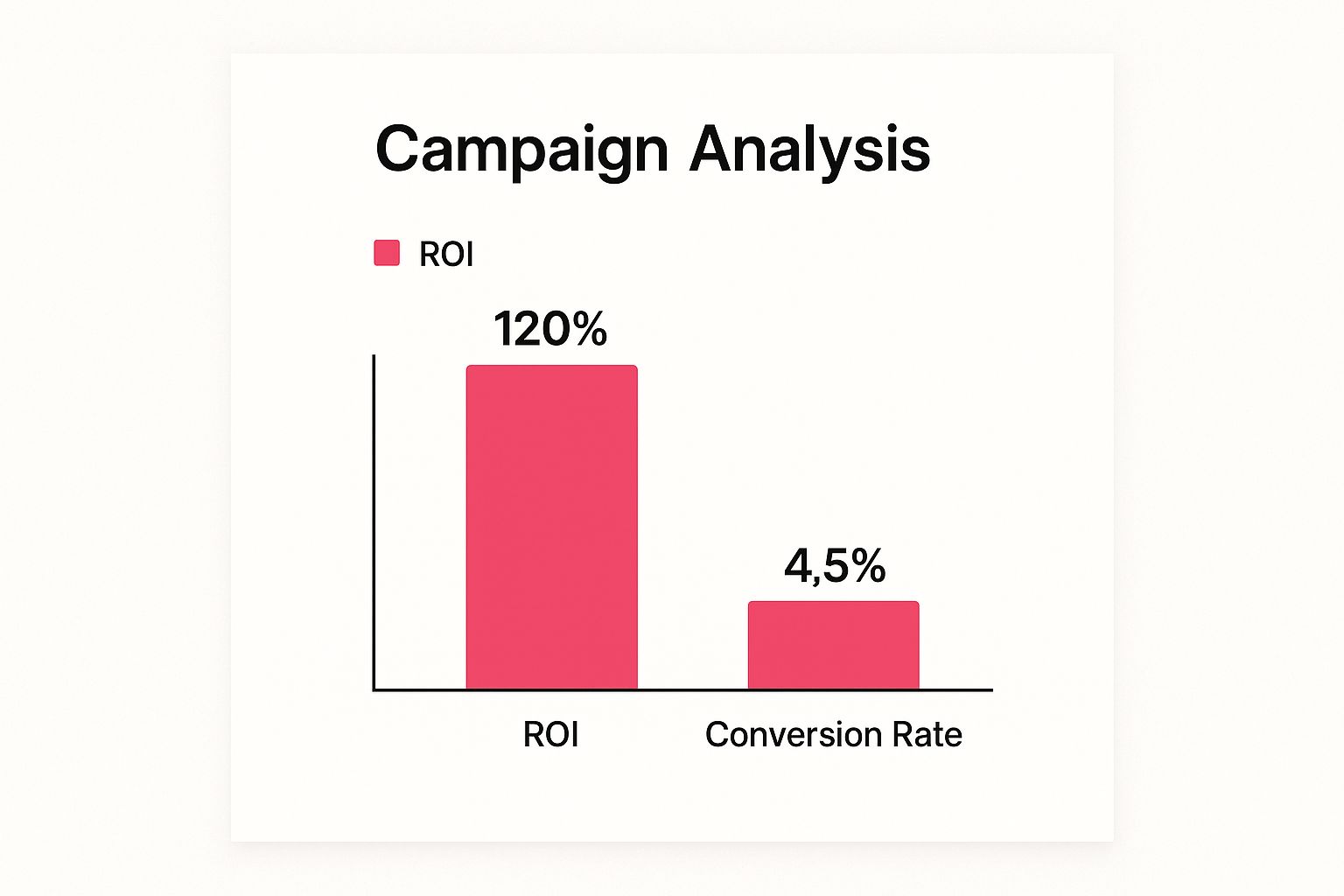
A solid strategy can lead to a 120% ROI and a 4.5% Conversion Rate. That’s not chump change. It underscores how crucial proper measurement really is.
Navigating the Messy Reality of Attribution
Customer journeys aren’t linear. They’re messy, chaotic sprints across devices and platforms. Someone might see your ad on Instagram, click a link in your email a week later, then finally buy something from a Google search two weeks after that. Trying to perfectly attribute every touchpoint? It’s a recipe for migraines.
Instead of getting lost in the weeds, focus on understanding the influence of each channel. Think about it this way: maybe social media created initial awareness, while email nurtured the lead and finally convinced them to buy. This approach to cross-channel attribution means figuring out which channels – social media, email, Google Ads – are actually moving the needle. And you need solid analytics to do it right. For example, you might discover that 40% of conversions come from social media and 30% from email marketing. For more on measuring marketing performance, check out this blog post.
Choosing the Right Attribution Model (for You)
Forget one-size-fits-all solutions. The right attribution model for you depends on your business, your resources, and how complicated your customer journey is. If you’re just starting out, a simple first-click or last-click model might be enough to get your feet wet. As your business grows, you can explore more nuanced models like linear or time-decay. If you’re interested in mastering conversion tracking, a robust creative testing framework can be invaluable. Also, our guide on how to measure marketing effectiveness dives deeper into this topic.
To help you choose the right attribution model, let’s look at a comparison of some common ones:
This table breaks down the pros, cons, and ideal scenarios for each model, giving you a clearer picture of which might be the best fit for your needs.
Attribution Model Comparison Guide
Side-by-side comparison of different attribution models with their strengths, weaknesses, and best use cases
| Attribution Model | Best For | Advantages | Limitations | Implementation Difficulty |
|---|---|---|---|---|
| First-Click | Simple tracking, early-stage businesses | Easy to implement, identifies initial touchpoints | Ignores later influential touchpoints | Easy |
| Last-Click | Focus on closing channels, eCommerce | Clear conversion attribution, easy to understand | Undervalues earlier stages of the customer journey | Easy |
| Linear | Businesses valuing all touchpoints equally | Distributes credit evenly across all channels | Can be too simplistic for complex journeys | Medium |
| Time-Decay | Businesses with shorter sales cycles | Gives more credit to touchpoints closer to conversion | May undervalue early-stage awareness building | Medium |
| Position-Based | Businesses emphasizing first and last touchpoints | Balances early and late-stage influence | Less emphasis on mid-funnel engagement | Medium |
As you can see, each model has its own set of trade-offs. Choosing the right one is about understanding your specific needs.
Real-World Wins With Attribution Data
I’ve seen firsthand how attribution data can revolutionize a marketing strategy. One company I worked with discovered their display ads were a secret weapon for top-of-funnel awareness. They’d been underestimating their impact. Armed with this insight, they shifted budget from underperforming social media to display and saw a 150% ROI jump. They were literally leaving money on the table before understanding their attribution data.
The key takeaway? Don’t drown in complicated reports. Focus on actionable insights. Understand the influence of each channel on the customer journey. That’s how you make smarter budget decisions and boost your marketing effectiveness.
Turning Data Into Strategic Gold

Think of raw data like a mountain of LEGO bricks. Sure, it’s something, but until you sort it and build something useful, it’s not much help. So many marketing teams get bogged down in metrics that don’t actually drive decisions. The real value comes from turning that data into actionable insights – the kind that fuel real business growth.
Separating the Signal From the Noise
The first trick is learning to filter out the irrelevant stuff. Not all metrics are born equal. Vanity metrics like page views or follower counts can be alluring, but they rarely paint the whole picture. In my experience, seasoned analysts zero in on the metrics directly tied to business outcomes. What really moves the needle for your bottom line? Is it leads, sales conversions, or customer lifetime value? Pinpointing the key performance indicators (KPIs) that matter for your specific business is essential.
Also, smart marketing teams segment their data for clearer comparisons. This could be by customer demographics, location, or even product categories. I once worked with a SaaS company that discovered their most valuable customers were small businesses in the tech industry. By concentrating their marketing on this specific group, they tripled their marketing efficiency.
Spotting Opportunities (Before Your Competitors Do)
Data analysis isn’t just about reviewing the past; it’s about predicting the future. Trend analysis can uncover emerging opportunities and potential pitfalls. Imagine analyzing search trends and noticing a surge of interest in a new product category. You could get a head start on crafting a marketing strategy before your rivals even notice. Keeping an eye on your competitors’ campaigns is equally insightful. Are they pouring resources into a new channel? Finding success with a certain type of content? Competitive benchmarking can reveal areas where you can gain a competitive advantage. For a deeper dive into this, check out our article on how to measure campaign effectiveness.
Catching Problems While They’re Still Fixable
Data is also a powerful troubleshooting tool. Regularly monitoring your KPIs lets you identify problems early before they snowball. Let’s say your conversion rates suddenly plummet. This could indicate a website issue, a failing ad campaign, or even changing customer behavior. Early detection gives you time to adjust your strategy and minimize any negative impact.
Practical Techniques for Actionable Insights
You don’t need to be a statistics whiz to glean useful insights from your data. Simple techniques like cohort analysis (comparing customer groups over time) and A/B testing (comparing different versions of a campaign) can offer incredibly useful information. For example, comparing customer cohorts acquired from different channels might reveal that organic search customers have a much higher lifetime value than those from paid ads. This kind of information can be invaluable when deciding how to allocate your budget.
Even predictive modeling can be surprisingly straightforward and effective. By identifying patterns in past results, you can make informed predictions about future performance. If you notice that your sales typically jump by 15% during the holidays, you can adjust your spending and inventory accordingly.
Turning data into strategic gold is an ongoing journey. It’s about continually refining your methods, experimenting with fresh ideas, and always seeking new ways to connect the dots. This persistent effort is what sets truly great marketers apart. By focusing on actionable insights, you transform data from a passive reporting tool into a powerful engine for growth and profitability.
Choosing Tools That Actually Deliver Value
Let’s face it, the world of marketing technology can be overwhelming. There are countless tools out there making big promises, but which ones truly deliver? I’ve seen it all, from marketing teams with massive budgets to those bootstrapping it, and the reality is, you don’t need to spend a fortune to get results. Some of the most effective setups I’ve encountered actually use free tools in incredibly clever ways.
Building Your Measurement Tech Stack: From Free to Pro
A good measurement tech stack doesn’t have to be complex. It’s about finding the right tools for your needs. I always recommend starting with the basics, like Google Analytics. Seriously, I’ve seen free Google Analytics setups that rival expensive enterprise platforms. Take a look at this example:
This kind of data is incredibly valuable for understanding your traffic sources. A spike in organic search? Your SEO is working. Tons of visits from social media? Your social strategy is on point.
Once you’ve mastered the basics, then think about adding more specialized tools. Maybe you need a better attribution platform or a dedicated social listening tool. The important thing is to focus on what each tool can do for you and the ROI it provides, not just how fancy the dashboards look. By the way, we’ve put together a guide on how to optimize your marketing spend that you might find helpful.
Avoiding Integration Nightmares and Data Accuracy Issues
I’ve learned this the hard way: Integrating new tools can be a real pain. Before you jump in, think about how it will fit with your current setup. Will it work with your CRM and other marketing tools? I’ve seen teams waste weeks – even months – wrestling with incompatible systems.
Data accuracy is crucial, too. Bad data leads to bad decisions. Make sure any tool you’re considering prioritizes data quality and clearly explains how it collects and processes information. I’ve seen firsthand how costly decisions based on bad data can be, and it’s not a fun experience.
Calculating the Actual ROI on Tool Investments
Don’t just take the vendor’s word for it. Calculate the ROI yourself. How much time and money will this tool save you? Will it boost conversions or give you deeper customer insights? I once worked with a team that invested in a pricey automation platform but never fully integrated it. They ended up paying for a tool they hardly ever used – a total waste.
When choosing measurement tools, remember it’s all about value. Start small, focus on your specific needs, and don’t be afraid to experiment. Building the right tech stack is an ongoing process. And sometimes, the best tools are the ones you already have.
Turning Insights Into Performance Breakthroughs
This is where measuring your marketing campaign effectiveness goes from feeling like a chore to a secret weapon. The best marketers I’ve worked with aren’t just hoarding data; they’re actively using it to improve their campaigns, bit by bit. And these small improvements, over time, make all the difference.
From Data to Dollars: Real-World Examples
I’ve witnessed firsthand how focusing on data can unlock insane growth. One e-commerce brand, after analyzing their data, completely overhauled their marketing approach and saw a 300% revenue increase in just six months. Another company more than doubled their ROAS (Return on Ad Spend) simply by shifting their budget based on which channels were actually performing. And another cut their acquisition costs in half by finding and fixing issues in their conversion funnel. These aren’t just stories; they’re proof of what’s possible.
For a deeper dive into building effective marketing strategies, check out our guide on measurable growth. It’s packed with tactics that actually deliver.
Testing Your Way to Winning Campaigns
The top-performing marketing teams are always testing. They know that what works today might not work tomorrow. They embrace A/B testing to compare different versions of everything – ads, landing pages, even email subject lines. They analyze the results, see what works best, and quickly adapt. This constant experimentation helps them stay ahead of the game and squeeze every drop of value from their marketing spend. But they’re also smart enough to know when to stop testing and scale the winning strategies. It’s a delicate balance.
Balancing Short-Term Gains and Long-Term Brand Building
Getting those quick wins is important, sure, but the best marketers never lose sight of the bigger picture. They know that building a strong brand is crucial for long-term success. This means balancing those short-term performance goals with efforts that cultivate brand loyalty. For example, retargeting ads might bring in sales today, but investing in content marketing can build a community and attract new customers organically tomorrow. It’s about finding the right mix for your specific business.
Practical Optimization Frameworks: Budget, Creative, and Beyond
Here are some practical frameworks to help you transform data into real action:
- Budget Reallocation: Look at your channel attribution data. Where are your most valuable conversions coming from? Shift your budget accordingly. Don’t be afraid to pull the plug on underperforming channels, even if they seem important.
- Creative Testing: Experiment with different ad creatives, messaging, and calls to action using A/B testing. Follow the data and iterate. You’d be surprised at how even small tweaks can have a big impact.
- Landing Page Optimization: Dive into your landing page data. Are there any bottlenecks? Test different headlines, layouts, and calls to action to improve conversion rates. A well-optimized landing page can significantly impact your results.
Avoiding Optimization Traps: Don’t Fall for These Mistakes
I’ve seen marketers make these optimization mistakes time and time again:
- Over-optimizing: Constantly changing things without giving them enough time to breathe.
- Ignoring qualitative data: Getting so caught up in the numbers that they ignore valuable customer feedback.
- Not tracking the right metrics: Focusing on vanity metrics instead of the ones that truly matter for their business objectives.
By avoiding these common pitfalls and using data-driven frameworks, you can turn measurement into a growth engine. It’s all about making smarter decisions, improving your campaign performance, and ultimately, driving real business results. Don’t just measure—optimize.
Your Blueprint For Measurement Excellence
So, how do you actually put all this measurement talk into practice? This isn’t just some theory; it’s a real-world action plan you can use right now. Whether you’re a measurement beginner or a total pro, this blueprint will help you boost your marketing effectiveness.
Building Measurement Into Your Team’s DNA
You don’t need a whole analytics team to measure campaign effectiveness. Honestly, you can start by building those skills within your existing marketing team. Give your marketers the power to own the whole process – from setting up tracking in Google Analytics to analyzing the results. It’s like teaching them to fish instead of just giving them dinner. This builds a culture of data-driven decisions throughout your team.
Establishing a Reporting Rhythm That Drives Action
Regular reporting is crucial, but don’t fall into the trap of reports that just sit there gathering dust. Your reports need to actually do something – they need to inform decisions. A quick weekly check-in on key metrics can help you spot trends and make adjustments on the fly. A deeper monthly dive can uncover bigger strategic insights. It’s about finding the right rhythm for your business and how your campaigns run.
Creating a Culture of Data-Driven Optimization
Data should be the engine, not the caboose. Make data-driven optimization a habit, something your team does instinctively. See a dip in conversion rates? Don’t freak out. Dive into the data, understand why it’s happening, and make changes. Celebrate the wins, learn from the losses, and keep tweaking things. For more on calculating marketing ROI, check out this helpful resource: You might be interested in: how to calculate marketing ROI.
Practical Templates and Troubleshooting Guides
Here’s a trick that’s saved me countless hours: create practical templates for things you do often. This could be a template for setting up conversion tracking or a checklist for A/B testing ad creatives. Templates take out the guesswork and ensure everyone’s doing things consistently.
And let’s be real – sometimes things go wrong. That’s why troubleshooting guides are your best friend. What do you do when your tracking breaks? How do you fix data discrepancies? Having these guides ready to go will save you time and headaches.
Measuring Your Measurement Program’s Success
Here’s the meta part: you can even measure how well your measurement program is doing! Look for signs like:
- Improved Decision Making: Are your marketing decisions based more on facts and less on gut feelings?
- Increased ROI: Are your campaigns performing better? Are you seeing higher conversion rates, lower acquisition costs, and a better return on your ad spend?
- Faster Optimization Cycles: Are you spotting and fixing problems quicker? Are you adapting to market shifts faster than the competition?
These are the telltale signs of a successful measurement program. It’s not about hoarding data; it’s about using it to get real business results.
Realistic Timelines and Benchmarks
Rome wasn’t built in a day, and neither is a strong measurement program. Set realistic timelines and clear benchmarks. Maybe that’s a 10% increase in conversion rates in three months or a 20% drop in customer acquisition costs in six months.
Continuous Improvement: Never Stop Learning
Marketing is constantly changing, so your measurement approach needs to keep up. Stay current with the latest tools and techniques, try new things, and never stop learning. The more you put into measurement, the more you’ll get out of it.
Ready to turn abandoned carts into profits? See how CartBoss can boost your SMS marketing and recover lost sales without breaking a sweat.