


Ever had a customer add a bunch of items to their online cart, get all the way to the checkout, and then… just vanish?
That’s cart abandonment. It’s the digital equivalent of a shopper in a brick-and-mortar store filling their cart to the brim, rolling it up to the checkout line, and then just walking out the door, leaving everything behind. For any e-commerce business, this isn’t just a minor hiccup; it’s a huge lost opportunity.
Understanding Cart Abandonment: The Critical Moment of Hesitation
At its core, cart abandonment is a clear sign that a customer hesitated right before making a purchase. They’ve already shown strong interest—they browsed your products, found something they liked, and took that crucial step of adding it to their cart. But somewhere between that moment and hitting the “buy” button, something gave them pause.
This isn’t a rare thing, either. It’s a massive challenge for online stores everywhere. The global online shopping cart abandonment rate is currently around 70.19%. Think about that for a second. That means for every ten shoppers who add an item to their cart, a staggering seven of them will leave without buying.
The Scale of the Problem
Imagine your e-commerce store is a physical shop. For every ten customers who fill up a shopping basket, you’d see seven of them just leave it sitting in an aisle. It paints a pretty clear picture of just how much revenue is being left on the table. This moment of hesitation isn’t just a single lost sale; it’s a potential customer relationship that never got off the ground.
The first step to fixing this is figuring out why it happens. Shoppers get cold feet for all sorts of reasons, from unexpected shipping costs to a complicated checkout process. We dive deep into these barriers in our guide on the top reasons for shopping cart abandonment.
To give you a clearer picture of what we’re dealing with, let’s break down the key ideas.
Cart Abandonment at a Glance
This table offers a quick snapshot of the core concepts behind cart abandonment and why it matters so much to your bottom line.
| Concept | Key Statistic | Primary Implication |
|---|---|---|
| User Intent | 92% of first-time visitors have no intention to buy immediately. | Many abandoned carts come from users who are just browsing or comparing prices—not necessarily “lost” sales. |
| Financial Impact | E-commerce brands lose an estimated $18 billion in sales revenue each year. | Recovering even a tiny fraction of these carts can dramatically increase your overall revenue. |
| Checkout Friction | 26% of shoppers abandon carts due to a long or complicated checkout. | Simplifying the path to purchase is one of the most effective ways to lower your abandonment rate. |
The main takeaway here? Don’t look at abandoned carts as failures.
Think of them as warm leads. These are shoppers who were just one click away from converting, which makes them the absolute best audience to re-engage. By tackling the friction points in your checkout, you can turn this common e-commerce headache into a major growth opportunity.
The Real Reasons Shoppers Abandon Carts

So, we know what cart abandonment is. But the real million-dollar question is why it happens. A shopper ditching a full cart isn’t a random event; it’s a direct response to something on your site that created a moment of hesitation.
Think of every abandoned cart as a breadcrumb trail leading you straight to a point of friction. By understanding these reasons—which are often simpler than you’d think—you can start turning those moments of doubt into confident purchases.
The Pain of Unexpected Costs
Picture this: you’ve found the perfect item, you’re happy with the price, and you head to the checkout, wallet in hand. Then, suddenly, the total balloons with extra fees. This is sticker shock, and it’s the number one killer of online sales.
Study after study confirms that hidden costs like shipping, taxes, and random fees are the biggest deal-breakers for shoppers. In fact, a whopping 55% of shoppers walk away because the shipping costs were simply too high. This one factor beats almost everything else.
When a customer has mentally agreed to a price, springing extra costs on them at the very last second feels like a classic bait-and-switch. It shatters trust and sends them running to a competitor who’s more upfront.
Your product price isn’t the real price. The real price is the total amount a customer sees right before they have to pull out their credit card. Any surprises at this stage are absolute conversion killers.
The fix? Be transparent from the start. A shipping calculator on the product page or a clear banner with your shipping policy can eliminate that nasty surprise and keep your customers on the path to purchase.
Friction from Forced Commitments
Another huge hurdle is demanding that shoppers create an account to buy something. An incredible 34% of shoppers will abandon a purchase if you force them to register before checking out. This is especially true for first-time buyers who aren’t ready to commit to a long-term relationship with your brand just yet.
Forcing someone to sign up throws a bunch of annoying obstacles in their way:
- It’s a Time Sink: It adds extra steps and forms, turning a simple transaction into a chore.
- Privacy Alarms Go Off: People are wary of sharing their info or getting spammed with marketing emails.
- It Feels Like a Hassle: They might not shop with you again and don’t want another password to forget.
The easiest, most effective solution is to offer a guest checkout. It removes the barrier, respects the customer’s time, and lets them buy with minimal friction. You can always ask them to create an account after the sale is complete.
A Complicated or Untrustworthy Checkout
Your checkout process is the final exam for your store’s user-friendliness and security. If it’s confusing, long, or just feels sketchy, customers will bolt.
Look out for these common checkout flaws:
- A lengthy or confusing process will cause 26% of users to give up. Too many pages, pointless form fields, or no progress bar can make the whole thing feel like it’s going to take forever.
- Security concerns will stop 17% of shoppers dead in their tracks. If your site is missing trust signals like an SSL certificate (the little padlock icon) or security badges from names like Norton or McAfee, customers won’t risk their payment details.
These issues sow seeds of doubt at the most critical moment. Keep your checkout forms simple and make sure your trust signals are front and center. For a deeper dive, check out the top 5 reasons why customers abandon their carts and find out how to tackle each one head-on.
How Cart Abandonment Changes Across Devices and Industries
Not all abandoned carts are created equal. Where a customer shops and what they’re shopping for completely changes their behavior. Think about it: someone quickly scrolling through fashion on their phone will bail on a purchase for totally different reasons than someone meticulously comparing high-end electronics on a desktop.
Understanding these differences is the secret to building recovery strategies that actually work. A one-size-fits-all approach is doomed to fail because the context—the device, the industry, even the customer’s location—plays a massive role in that last-second hesitation.
This infographic gives you a quick look at the core numbers, showing just how big the problem is and, more importantly, how much potential there is for recovery.
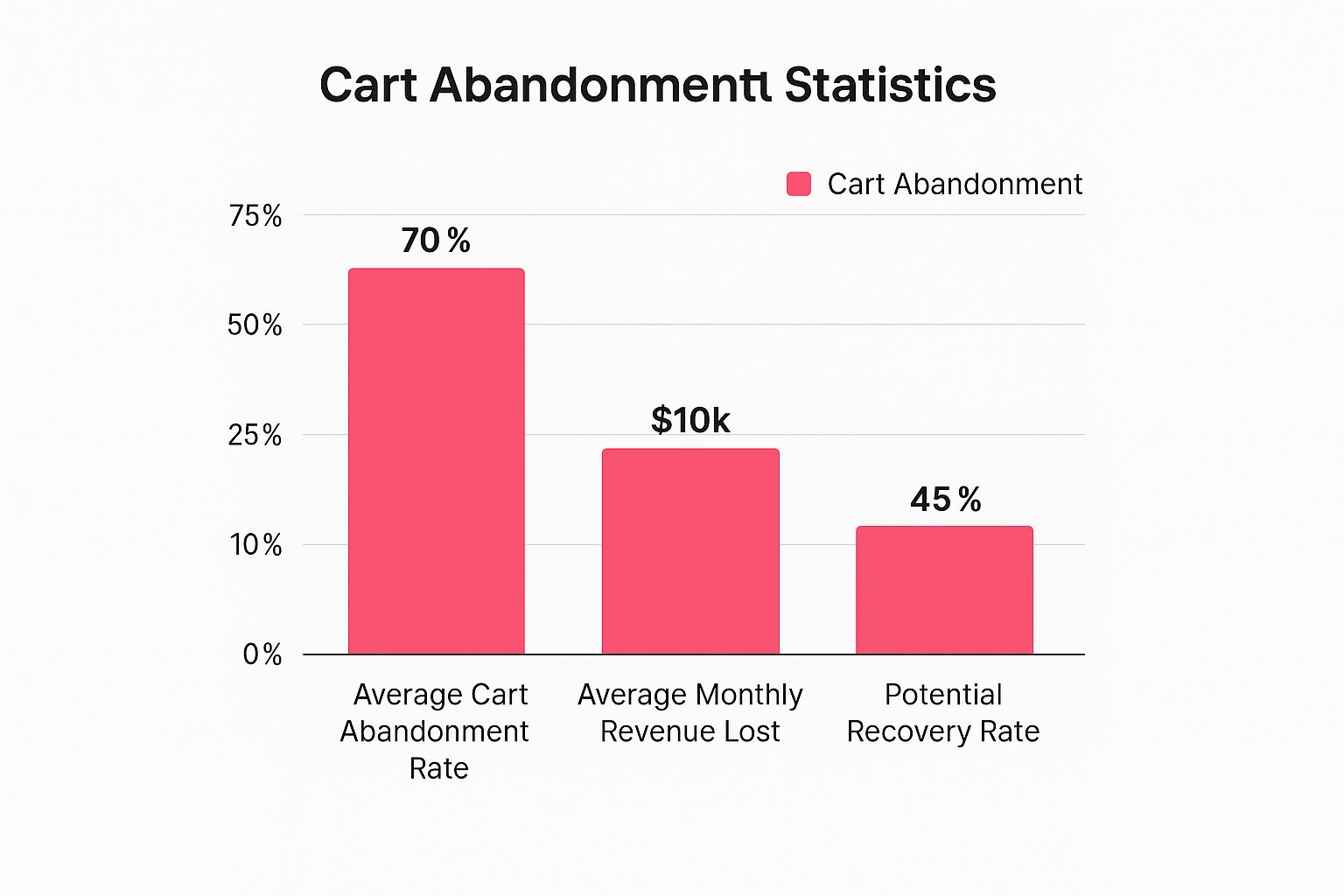
The data makes it clear: while abandonment is high across the board, a huge chunk of that lost revenue is very much recoverable if you use the right tactics.
Mobile vs. Desktop: The Experience Gap
The device a customer is using is one of the single biggest factors in whether they complete a purchase. Mobile phones now drive most e-commerce traffic, but they also have the highest abandonment rates, often soaring above a staggering 85%.
So why the massive gap compared to desktops, which sit around 73%? It all comes down to the user experience and the shopper’s mindset.
- Mobile Friction: Let’s be honest, typing on a tiny screen is a pain. Filling out long address and payment forms is frustrating, and security worries can feel much more real when you’re on a mobile network.
- Desktop Focus: Shoppers on a desktop are often in a more focused, “ready to buy” mode. The bigger screen makes it easier to see product details, compare specs, and breeze through checkout forms.
- The Distraction Factor: Mobile users are constantly bombarded with notifications, calls, and real-world interruptions. It’s incredibly easy to get sidetracked and completely forget about a purchase you were about to make.
The key takeaway here is simple: a checkout process designed for a desktop will almost always fail on a mobile device. Mobile optimization isn’t just about making your site look good on a small screen; it’s about radically simplifying every single step.
Abandonment Rates by Industry
Just as devices shape user behavior, so do industries. The type of product and the typical buying journey have a massive impact on whether a customer clicks “buy” on their first visit.
For instance, someone booking a family vacation will naturally take a lot more time and compare more options than someone buying a t-shirt. This “just browsing” phase is much longer in industries with high-ticket items or complex decisions, leading to more abandoned carts that aren’t truly “lost,” but just “paused.”
Regional Cart Abandonment Rate Comparison
It’s also crucial to remember that buying habits aren’t universal. Cultural norms, payment preferences, and delivery logistics create significant differences in cart abandonment rates from one region to another. A strategy that works perfectly in North America might fall flat in Asia.
| Region | Average Abandonment Rate | Common Contributing Factors |
|---|---|---|
| Middle East & Africa | Up to 93% | Preference for cash-on-delivery, complex delivery logistics, and high cross-border shipping costs. |
| Asia-Pacific | Around 84% | Diverse payment methods (digital wallets), high mobile usage, and strong “comparison shopping” culture. |
| Europe | Around 80% | Concerns about data privacy (GDPR), preference for local payment options, and varied shipping expectations. |
| North America | Around 75% | High shipping costs, guest checkout preferences, and sensitivity to unexpected fees at checkout. |
These regional variations highlight why localized strategies are so important. For example, the rate in the Middle East and Africa can hit 93%, while Asia sits closer to 84%, driven by completely different factors. To dig deeper, you can learn more about these regional cart abandonment statistics and get a clearer global picture.
Proactive Strategies to Prevent Cart Abandonment
Knowing why shoppers ditch their carts is one thing. But stopping them from leaving in the first place? That’s where the real magic happens. Instead of just reacting to lost sales, you can build a checkout experience so smooth and trustworthy that customers see no reason to bail.
Think of it as being proactive, not just reactive. Each strategy here is a direct counterpunch to the most common reasons for abandonment. By fixing the friction points, you can slash your abandonment rate and lift conversions before you even need to think about a recovery campaign.
Streamline Your Checkout Flow
A clunky, confusing checkout is an absolute conversion killer. Studies have shown that 26% of shoppers will give up on a purchase if the process is just too complicated. Your mission is simple: make buying from your store as easy as humanly possible.
Imagine your checkout is the express lane at the grocery store. The fewer steps and distractions, the faster people get through.
- Offer Guest Checkout: Forcing someone to create an account is a massive roadblock. In fact, 34% of online transactions are dropped because a site demanded account creation. Always give shoppers a guest checkout option. It respects their time and privacy.
- Simplify Your Forms: Do you really need their middle name and date of birth? Probably not. Cut every single non-essential field. Each box a customer has to fill is another tiny reason to quit.
- Show Their Progress: A visual progress bar (like Shipping > Payment > Confirm) is a lifesaver. It shows customers exactly where they are in the process and how much is left, which really helps manage expectations and cut down on anxiety.
When you simplify the path to purchase, you remove the mental hurdles that cause customers to second-guess their decision.
Eliminate All Cost Surprises
Here it is: the #1 reason for cart abandonment. Unexpected costs. Nothing sours a deal faster than seeing the total price jump at the final step because of high shipping fees or taxes. This “sticker shock” is responsible for a whopping 55% of all abandoned carts.
Trust is built on transparency. The price a customer sees on the product page should be almost identical to the final price they pay. Hiding fees until the very end is a guaranteed way to lose a sale.
Get ahead of this by building cost transparency from the start:
- Use a Shipping Calculator: Put a shipping cost calculator right on the product page or in the cart itself. Don’t make them wait.
- Display Policies Clearly: Make your shipping and tax info impossible to miss. A simple banner like “Free Shipping on Orders Over $50” at the top of your site works wonders.
- Bundle Costs When Possible: If it makes sense for your business, offer flat-rate shipping or even build the cost into the product price to offer “free” shipping. Customers are much happier to pay a slightly higher product price than a separate, jarring shipping fee.
Build Unshakable Trust and Credibility
In a digital world full of scams, shoppers are understandably wary of where they enter their credit card info. A lack of trust signals can kill a sale on the spot, with 17% of shoppers leaving because they didn’t trust the site with their payment details.
Your job is to make your checkout page feel as secure as a bank vault.
Key Trust Signals to Display Prominently:
- Security Badges: Logos from trusted names like Norton, McAfee, and TRUSTe give instant visual proof that their data is safe.
- Payment Logos: Showing logos for Visa, Mastercard, and PayPal adds legitimacy and gives customers familiar, trusted ways to pay.
- Customer Reviews & Testimonials: Social proof is incredibly powerful. A glowing review placed strategically on the checkout page can be the final nudge a hesitant customer needs.
- Clear Return Policy: An easy-to-find and easy-to-understand return policy dramatically lowers the perceived risk of buying. If they know they can return an item without a hassle, they’ll feel much more confident hitting “buy.”
By putting these proactive measures in place, you create an environment that encourages people to complete their purchase, not abandon it. For a more detailed playbook, check out our complete guide on how to reduce cart abandonment and start turning more of your browsers into buyers.
Winning Back Lost Sales with Cart Recovery Campaigns
Even with a perfectly smooth checkout process, some shoppers are just going to leave. It’s inevitable. Life gets in the way, a distraction pops up, or they simply get cold feet. But this isn’t a dead end—it’s where reactive strategies come in to turn these almost-sales into a serious revenue stream.
Instead of just writing these people off, a cart recovery campaign lets you get back in front of them. These are automated sequences, usually through email and SMS, that give shoppers a gentle nudge. They remind them what they were about to buy and make it ridiculously easy to jump back in and finish the order.
Think of it this way: a customer who abandoned a cart isn’t a cold lead; they’re one of your warmest prospects. They’ve already shown clear buying intent. All they need is a timely, helpful reminder to pick up where they left off.
Crafting a Powerful Email Recovery Sequence
Email is the classic workhorse of cart recovery. It gives you enough space to remind customers about the specific products they liked, show off your brand’s personality, and maybe even dangle a small incentive to seal the deal. A well-timed email sequence can claw back a huge chunk of otherwise lost sales.
The secret is all in the timing and relevance. Sending one email is okay, but a multi-step sequence is where the real power is. It lets you go from a simple reminder to a more compelling offer without ever feeling pushy.
Here’s a proven three-step email flow that just works:
- The First Reminder (Send after 30-60 minutes): This one should be a simple, friendly nudge. The purchase is still fresh in their mind. A subject line like, “Did you forget something?” is perfect. Make sure to include pictures of the items they left behind and a direct link straight back to their cart.
- The Follow-Up (Send after 24 hours): Now you can introduce a bit of urgency or handle common objections. Try a subject line like, “Your items are selling fast!” You can also use this email to feature a few customer reviews or mention your easy return policy to build more confidence.
- The Final Offer (Send after 3-5 days): If they still haven’t come back, this is your last shot. This is the time to sweeten the pot with a small incentive, like free shipping or a modest 5-10% discount. Just be sure to make the offer time-sensitive to get them to act now.
Leveraging the Immediacy of SMS Recovery
Email is great, but SMS recovery is your secret weapon for cutting straight through the noise. Text messages have an average open rate of 99%—they are almost guaranteed to be seen. Their instant nature makes them perfect for catching distracted shoppers, especially those browsing on their phones.
The power of SMS is in its short, direct format. This isn’t the place for a marketing essay. It’s all about a clear, actionable message that makes it completely effortless for the user to tap a link and buy.
When you’re using SMS, keep these best practices in mind:
- Compliance is Crucial: You absolutely must have explicit consent (an opt-in) from customers before you send them marketing texts. This is non-negotiable to comply with regulations like TCPA and GDPR.
- Keep it Short and Sweet: Get straight to the point. Include your store name, a link to their cart, and a clear call to action. That’s it.
- Personalize the Message: Using the customer’s first name makes the text feel more personal and way less like a generic spam blast.
An effective SMS can be as simple as: “Hey [Name], it’s [Your Store Name]. You left some great items in your cart! We saved them for you here: [Link]”. This friendly, helpful message can produce incredible results.
For businesses ready to dive in, there are detailed guides that show you exactly how to recover an abandoned cart with automated messages. By combining a smart email flow with a timely SMS strategy, you build a comprehensive safety net that catches sales that would have otherwise been lost forever.
Got Questions About Cart Abandonment? We’ve Got Answers.
We’ve already covered what cart abandonment is, why it keeps happening, and some solid strategies to fight it. Now, it’s time to get into the nitty-gritty and answer the common questions that pop up once store owners decide to take this seriously. Think of this as your quick-reference guide to clearing up any confusion.
What Is a Good Cart Abandonment Rate?
Everyone wants to know the magic number, but the truth is, a “good” rate is all about your industry. The global average might be a scary 70%, but most stores see rates somewhere between 60% and 80%. The travel industry, for example, naturally has higher abandonment because people take longer to plan and book trips compared to, say, buying a t-shirt.
Instead of obsessing over a universal benchmark, the real win is focusing on your own improvement. Figure out your store’s current abandonment rate—that’s your baseline. From there, every percentage point you chip away is a victory. Progress over perfection is the name of the game.
Where Should I Start to Reduce Abandonment?
Honestly, the single best thing you can do right now is to go through your own checkout. Don’t just click around—act like a first-time customer. Add an item to your cart and try to complete the purchase from start to finish.
This simple exercise is incredibly revealing.
You’ll immediately feel the pain points your customers experience, whether it’s being forced to create an account, getting hit with surprise shipping fees at the last second, or wrestling with a confusing form. Fixing these core issues almost always gives you the biggest and fastest boost in conversions.
How Do I Calculate My Cart Abandonment Rate?
Calculating your Cart Abandonment Rate (CAR) is simple, and it’s a metric you absolutely need to track. Here’s the formula:
(1 - (Total Completed Transactions / Total Carts Created)) x 100
Let’s say you had 1,000 carts created in a month, and 300 of those shoppers actually completed their purchase. The math would look like this: (1 - (300 / 1000)) x 100 = 70%. Your cart abandonment rate would be 70%.
What Is the Best Timing for Recovery Messages?
When it comes to recovery messages, timing is everything. Whether you’re using email or SMS, that first message needs to go out while the buying impulse is still warm. Sending a reminder 30-60 minutes after they’ve left is the sweet spot—it’s quick enough to catch them before they’ve completely moved on.
A proven, effective sequence often looks like this:
- First Reminder: Send it after 1 hour. A gentle nudge is all you need.
- Second Reminder: Follow up after 24 hours. They may have just needed a day to think it over.
- Final Reminder: Send this one after 3 days, maybe with a small discount to seal the deal.
Once you understand the key strategies for abandoned cart recovery, you can set up an automated system that brings these potential customers back to your store.
Ready to turn those almost-sales into actual profit? With CartBoss, you can automate powerful SMS recovery campaigns that re-engage customers and boost your revenue, all on autopilot. Stop letting sales slip through your fingers and start winning them back. Get started with CartBoss and see the difference for yourself.