


Language localization is all about adapting your product, service, or content to feel completely at home in a new market. It goes way beyond just swapping out words; the goal is to create an experience that feels native and intuitive to local users, like it was made just for them.
Beyond Words: Adapting the Entire Experience
Think of it like this: translation is like changing the color of a suit. Localization is like having that suit expertly tailored to fit a specific person perfectly—adjusting the shoulders, sleeves, and cut until it feels like a second skin.
This deeper level of adaptation is what separates brands that feel foreign and clunky from those that feel familiar and trustworthy. It means looking at everything from the humor in your ads to the colors on your website and making sure they resonate with local culture.
Localization isn’t just a cosmetic touch-up. It’s a core business strategy that shows customers you genuinely understand and respect their culture. It’s the difference between speaking at an audience and speaking with them.
So, what exactly gets “localized”? It boils down to a few key components that separate a simple word-for-word translation from a truly native experience.
Core Components of Language Localization
A quick look at the essential elements that separate true localization from basic word-for-word translation.
| Component | What It Means for Your Business |
|---|---|
| Cultural Nuances | Adjusting idioms, slang, and cultural references that might not make sense or could even be offensive in a new region. |
| Visual & Design Elements | Swapping out images, graphics, and even layouts to reflect local tastes and avoid culturally inappropriate visuals. |
| Functional Adjustments | Changing formats for dates, times, currencies, and units of measurement to match local standards. For example, showing prices in Euros for a German customer, not US Dollars. |
Getting these details right is what makes an international presence feel seamless. Often, this involves customizing multilingual features in enterprise platforms to make sure every piece of content truly connects.
And this isn’t just a “nice-to-have” anymore. The web is becoming less and less English-centric. The dominance of English online fell by 14% between 2022 and 2025, while languages like Spanish and German surged.
By 2030, with nearly 5 billion consumers in non-English-speaking regions, a localized shopping experience will be a basic expectation. To get there, you’ll need a solid grasp of multilingual website best practices.
Translation vs. Localization: Why It Matters for Sales
When you start selling in new countries, it’s easy to think “translation” and “localization” are the same thing. They’re often used interchangeably, but trust me, understanding the difference is a game-changer for your sales.
Translation is pretty straightforward: it’s about swapping words from one language for another. It gets the job done, making sure a sentence is grammatically correct and people can technically understand it.
But localization? That’s about translating the entire experience. It starts with translation but goes way deeper. It adapts everything—from cultural jokes and images to the checkout layout and even the payment options—to feel completely natural to a local buyer.
Simply put, translation changes what you say. Localization changes how your audience feels.
Going Beyond Just Words
Let’s say your call-to-action is “Add to Cart.” A direct translation is fine, but is it the most powerful option? In some countries, a phrase like “Secure Your Order” hits differently. In others, “Add to Basket” feels more familiar. These small tweaks build a sense of security and trust that directly nudges conversion rates up.
That’s the heart of it. Translation is a literal, word-for-word swap. Localization is a thoughtful, adaptive process that considers the entire customer journey. A solid global strategy isn’t just about being understood; it’s about making a genuine connection.
Translation makes your content readable. Localization makes it relatable. And when it comes to sales, relatability is what convinces a customer to click “buy.”
This concept map breaks down how localization pulls in so many different elements beyond just the text itself.
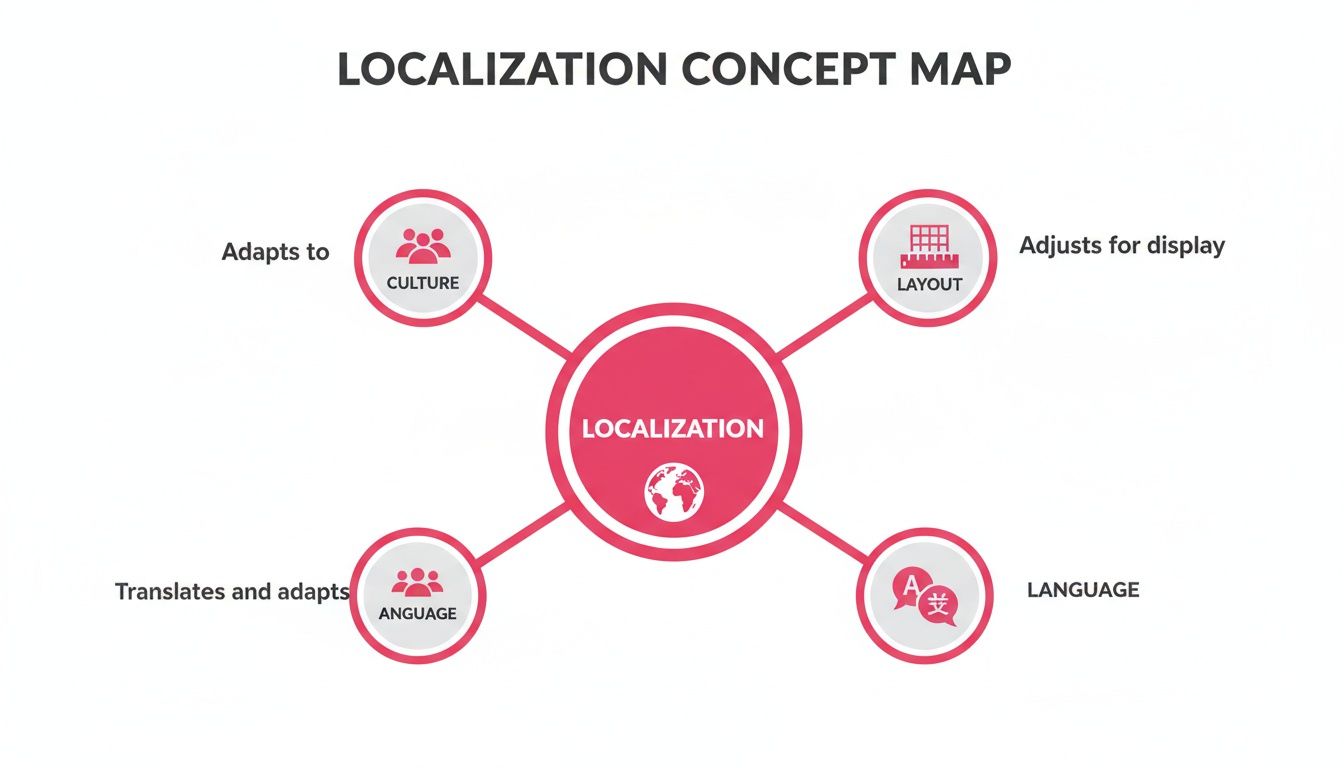
As you can see, real localization is about creating an experience that feels like it was built just for that customer, adapting to cultural norms, adjusting design, and fine-tuning the language for the biggest impact.
Translation vs. Localization at a Glance
So, how does this choice really play out for your business? A poorly localized experience can feel awkward or even offensive, sending potential customers running. But get it right, and international buyers will feel like you truly get them.
This table cuts right to the chase, showing how these two approaches stack up.
| Business Aspect | Translation (The What) | Localization (The How) |
|---|---|---|
| Primary Goal | Linguistic accuracy | Emotional connection and engagement |
| The Process | A one-step, linguistic task | A multi-step strategic process |
| Focus | Words and grammar | The entire user experience |
| Business Outcome | Informs the customer | Persuades and converts the customer |
Ultimately, localization is one of the most powerful forms of personalization in digital marketing because it speaks directly to a person’s life and culture.
When you nail those small details, you’re not just selling a product. You’re showing a level of care that builds real brand loyalty and unlocks massive sales potential in new markets.
The Real Business Impact of E-commerce Localization
Putting money into language localization isn’t just another marketing expense—it’s a direct investment in your bottom line. When customers feel like you’re speaking their language, they don’t just browse. They buy, they come back for more, and they tell their friends about you. This is the point where localization stops being a “nice-to-have” and becomes a core driver of e-commerce growth.

The numbers tell a crystal-clear story. Shoppers are far more likely to click “buy” if the entire experience—from product descriptions to checkout instructions and even currency—is in their native language. A properly localized site builds instant trust and gets rid of the friction and doubt that cause so many shoppers to abandon their carts.
Driving Conversions and Slashing Abandonment Rates
One of the biggest leaks in any e-commerce sales funnel is the abandoned cart, and a generic, one-size-fits-all approach is often the culprit. Customers bail when they run into unexpected shipping costs, confusing payment options, or a checkout process that just feels foreign and untrustworthy.
Localization plugs these leaks. By showing customers familiar payment methods, laying out clear shipping policies in their own language, and using culturally relevant messaging, you create a smooth, frictionless path to purchase. It might seem like a small change, but it can have a massive impact on your conversion rates, turning hesitant visitors into confident buyers.
Here’s a powerful stat: A study found that 76% of online shoppers prefer to buy from sites that provide information in their own language. Even more telling, 40% will never buy from websites in other languages. That’s a huge, often untapped, chunk of revenue just waiting for you.
This is exactly why top brands see localization as a fundamental step when expanding your business internationally. It’s not just about reaching new markets; it’s about winning them over.
Maximizing Customer Lifetime Value and ROAS
The perks of localization don’t stop after the first sale. When a customer has a great, intuitive shopping experience, they’re much more likely to come back. This boosts their Customer Lifetime Value (LTV), a critical metric for any business looking for sustainable growth. Loyal, repeat customers are the bedrock of a strong e-commerce brand.
On top of that, smart localization makes your marketing budget work harder. When your ads, landing pages, and SMS recovery messages are all localized, they connect on a deeper level with your target audience. This leads to higher engagement, better click-through rates, and a much stronger Return on Ad Spend (ROAS). For any store with its eyes on global growth, these benefits are too big to ignore. Our own guide on expanding your business internationally dives into even more detailed strategies.
Market data backs this up completely. The global localization market is set to more than double, jumping from USD 62.7 million in 2025 to USD 137.3 million by 2032. Some brands have seen their organic performance skyrocket by 2,500% with localized social media, and 84% of marketers directly link revenue growth to their localization work. For e-commerce stores, this means a localized SMS campaign can pull in an incredible 4,500% ROAS by re-engaging shoppers in a way that truly connects.
How Localization Supercharges SMS Cart Recovery
Beyond your website and product pages, language localization delivers some of its most powerful and immediate results in a place you might not expect: your customers’ text message inbox. SMS marketing, especially for abandoned cart recovery, is a high-stakes, high-impact channel where the right message can make all the difference.
Think about it from the customer’s point of view. A generic text message in a language they don’t really understand is confusing at best. At worst, it looks like spam. It’s an instant signal that the brand doesn’t actually know them. That message gets ignored or deleted in seconds, and the sale is lost for good.
Now, picture this instead. A potential customer in Spain abandons their cart. A few minutes later, their phone buzzes with a perfectly timed SMS—written in natural, colloquial Spanish—reminding them about the items they left behind. It might include a friendly nudge or even a small, localized discount. This message doesn’t feel like an ad; it feels like a helpful, personal reminder from a brand that gets them.
This is where the idea of what is language localization stops being just a concept and starts becoming a direct revenue driver.

From Friction to a Finished Sale
The whole point of a cart recovery campaign is to remove friction and make it as easy as possible for the customer to complete their purchase. A language barrier is one of the biggest roadblocks you can throw in their way.
Localizing your SMS cart recovery messages tackles this problem head-on. By speaking to customers in their native language, you accomplish several key things right away:
- You Build Immediate Trust: A native-language message feels familiar and secure, chipping away at the hesitation that often leads to abandoned carts.
- You Create Urgency: A clear, understandable message about a forgotten cart feels more pressing and actionable.
- You Improve the User Experience: The customer can read, understand, and act on the message without having to mentally translate it, creating a seamless journey back to their cart.
Automating the Localization Process
Manually tracking every customer’s language and sending tailored messages would be an impossible task for any growing e-commerce store. This is where automation tools become absolutely essential. Modern SMS recovery platforms like CartBoss are designed to handle this complexity for you.
A truly effective SMS strategy doesn’t just send messages; it sends the right message to the right person in the right language, every single time. This level of precision is what separates a good campaign from a great one.
Here’s a peek at how it works behind the scenes:
- Automatic Language Detection: The system automatically figures out the customer’s preferred language based on their browser settings or location.
- Pre-Translated Messages: It then pulls from a library of pre-written, expertly translated message templates that match the detected language.
- Localized Checkout Link: The message includes a link that takes the customer straight back to a pre-filled checkout page, already set to their native language.
This automated workflow turns a potentially lost sale into a recovered one with zero manual effort. The entire experience, from the initial text reminder to the final payment screen, feels completely native.
For more tips on making your text messages hit the mark, check out our guide on how to personalize SMS campaigns for maximum cart recovery success. By combining smart automation with thoughtful localization, you can dramatically boost engagement, recover more carts, and increase your overall revenue.
Your Framework for a Winning Localization Strategy
Turning localization from a good idea into a real growth engine for your business takes a solid, actionable plan. A successful strategy isn’t about translating everything all at once; it’s about making smart, data-driven decisions that give you the biggest bang for your buck. Let’s break down the process into manageable steps so you can expand globally without the overwhelm.
The first move is always market identification. Instead of just guessing, dive into your analytics. See where your international traffic is already coming from. A big clue is often finding regions with high website engagement but surprisingly low conversion rates—that’s a classic sign that a language or cultural barrier is stopping sales right at the finish line. Prioritize those high-potential markets first.
Once you’ve picked a target market, the real work of adapting your store begins. And trust me, this goes way beyond just swapping out text. It means taking a deep dive into what makes that culture tick.
Building a Culturally Fluent Experience
True localization means making every single touchpoint feel like it was built for the local customer. This isn’t just about one thing; it’s a multi-layered approach that covers what people see, how they interact with your site, and the language they read. For a smooth rollout, you need to nail these core areas:
- Visual and Copy Adaptation: Swap out images, graphics, and even color schemes to match local tastes. An image that works perfectly in North America might fall completely flat in Japan. The same goes for ad copy, slogans, and product descriptions—they need to be tweaked to reflect local sayings and values.
- Currency and Payment Methods: This one is absolutely non-negotiable. Displaying prices in the local currency is a must. Just as important is offering payment methods they actually use. If customers in Germany prefer Sofort or Giropay, making them use a credit card just creates friction and leads to lost sales.
- Technical SEO and Legal Stuff: You’ll need to adapt your website’s structure for international SEO. Using hreflang tags helps search engines show the right language version to the right users. On top of that, you have to stay compliant with local rules, like GDPR in Europe.
A winning localization strategy is proactive, not reactive. It anticipates the needs and expectations of a new market, creating a seamless experience that feels intentionally designed for local customers from their very first visit.
This demand for tailored experiences is fueling massive growth in the language services market. It was valued at a huge USD 71.53 billion in 2024 and is expected to rocket to USD 127.53 billion by 2032. This boom is all about businesses expanding into diverse regions like North America, where over 68 million people speak a language other than English at home. You can discover more about these market trends on Fortune Business Insights.
Leveraging Automation for Consistency
Keeping a consistent brand voice and a smooth customer experience across multiple languages is a major headache. This is where automation becomes your best friend. Tools like CartBoss use automatic language detection and pre-translated messages to make sure every customer interaction—from a cart recovery SMS to the final checkout page—is perfectly localized, without you lifting a finger.
By blending careful market analysis, deep cultural adaptation, and smart automation, you can build a framework that scales. To see how top brands are already doing this, check out these real-world localization strategy examples. This approach transforms localization from a daunting task into a repeatable process that drives real, sustainable international growth.
Got Questions About Localization? We’ve Got Answers.
As you start thinking about what localization could mean for your brand, a few practical questions always pop up. Here are the straight-up answers to the most common ones we hear from e-commerce store owners.
How Much Does Localization Cost?
That’s the big one, right? The honest answer is: it really depends. The price tag is tied to a few things, like which languages you’re targeting, how complex your content is (think technical manuals vs. fun marketing copy), and the tools you use.
Simple text translation can be just a few cents per word. But a full-blown localization project, complete with design tweaks and cultural consulting, is a bigger strategic investment. That said, using automated tools for specific jobs, like SMS cart recovery, can deliver a massive ROAS with very little upfront cost.
Which Markets Should I Localize for First?
Whatever you do, don’t just throw a dart at a map. Start with the data you already have. Jump into your website analytics and see where your international traffic is coming from.
Pay close attention to regions with lots of visitors but surprisingly low conversion rates. That’s a huge red flag that a language or cultural barrier is getting in the way of sales. Zero in on these high-potential markets first—you’ve already got an audience waiting.
A classic mistake is trying to go global all at once. It’s so much more effective to pick one or two key regions, nail the localized experience there, and then expand once you see a solid return.
This focused strategy helps you get all the little details right, building a strong foundation before you take over the world.
Ready to turn abandoned carts into profit in any language? CartBoss uses automatic language detection and pre-translated messages to recover sales on autopilot. Start recovering more sales today!