


70.22% of online shopping carts are abandoned on average, which means most checkout journeys need help before they ever become revenue. That is the actual context for YITH WooCommerce Recover Abandoned Cart Premium. It sits in the older, email-first generation of recovery tools, and it still matters because it turned abandoned carts into a trackable workflow instead of a vague loss.
For WooCommerce store owners, that shift changed the game. A cart stopped being a dead end and became a recoverable lead that could be segmented, contacted, and measured. That historical role is why YITH still works as a benchmark, even if modern recovery now extends into SMS and other channels.
Table of Contents
- The Role of YITH WooCommerce Recover Abandoned Cart Premium
- Configuring the Rule-Based Email Recovery Pipeline
- Addressing Checkout Friction Before Sending Reminders
- Comparing Email Workflows to SMS Cart Recovery
- Navigating SMS Compliance and Consent Requirements
- Strategic Migration to Automated SMS Recovery
The Role of YITH WooCommerce Recover Abandoned Cart Premium
YITH WooCommerce Recover Abandoned Cart Premium earned its place by formalizing cart recovery inside WooCommerce. YITH’s product page reports 13,330 customers, a 4.5/5 rating from 88 customer ratings, and 97% customer satisfaction with support, which is a strong sign that the plugin has been used across many real stores. It gave merchants a way to treat abandonment as a measurable event instead of guessing what happened after checkout stalled.
The core value was the ability to define when a cart becomes abandoned, choose how many reminder emails to send, set timing intervals, and include incentives such as coupons. The plugin also added reporting for abandoned carts, pending orders, sent messages, recovered carts, email conversion rates, and recovered value, so recovery performance was visible in a way standard WooCommerce does not provide on its own. A store that wants broader coordination across channels can use this older email workflow as a reference point alongside estrategia omnicanal para resellers.
Practical rule: if recovery can’t be measured, it can’t be improved.
That is why YITH still matters historically. It established the baseline for automated follow-up, personalized cart reminders, and revenue attribution in WooCommerce. Modern SMS tools move faster and face stricter compliance and consent requirements, but they still build on the same operational logic YITH helped normalize, detect the drop-off, follow up on a schedule, and track the order that comes back.
Configuring the Rule-Based Email Recovery Pipeline
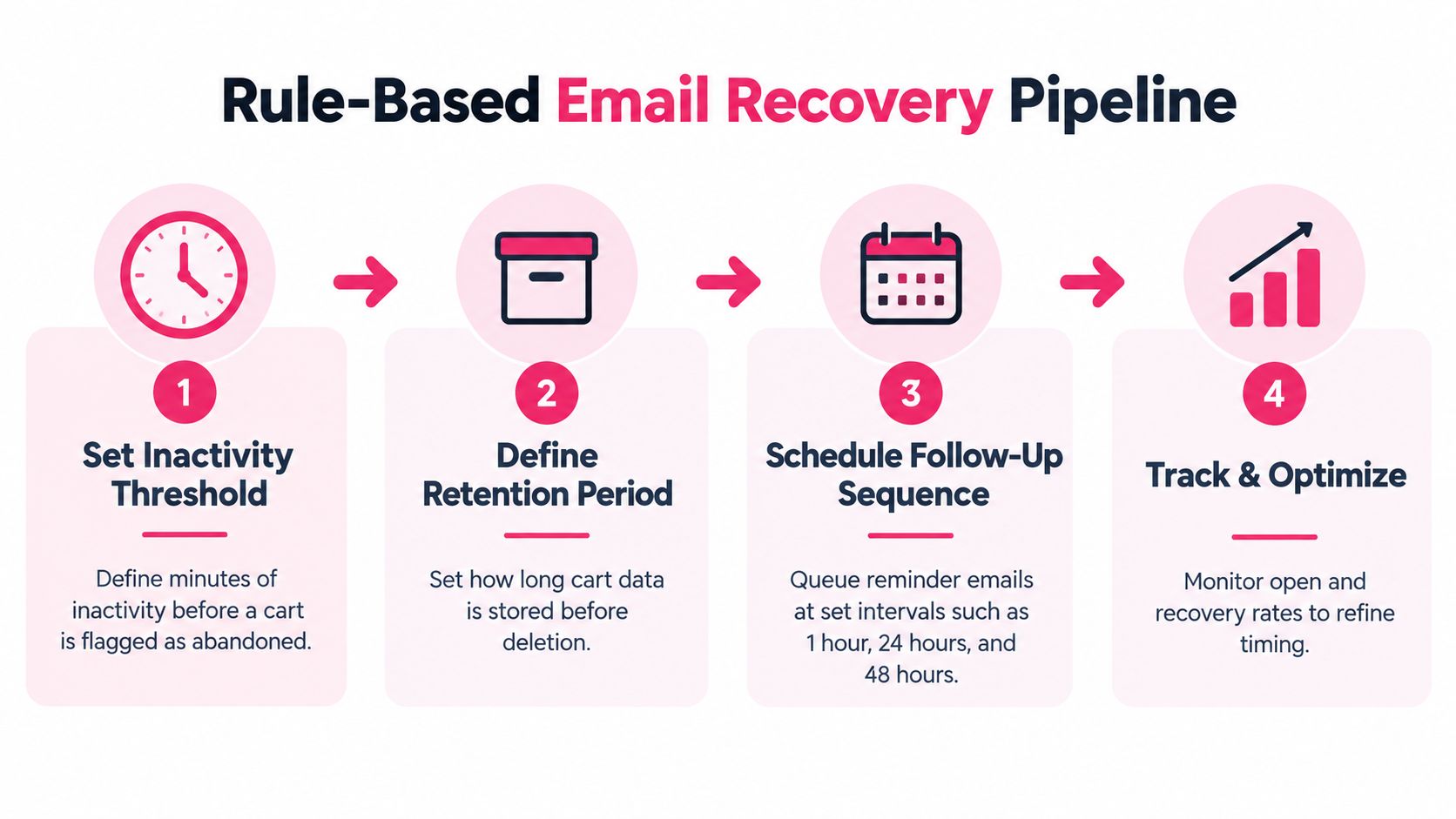
The strongest way to use YITH is as a rule-based recovery pipeline, not as a loose reminder system. The admin sets the inactivity threshold, defines how long abandoned-cart records stay in the database, and schedules one or more follow-up emails at timed intervals such as hours, 24 hours, or several days. That structure gives you control over both speed and persistence, which matters because not every shopper leaves for the same reason.
Start with timing, then tighten the message
A shorter first delay usually works as a gentle nudge for shoppers who were interrupted, while later messages can introduce urgency or an incentive. The plugin’s dynamic content matters here because the reminder can reflect the exact items left behind instead of reading like a generic marketing blast. That alone makes the message feel like a service email, not noise.
The technical guardrails matter just as much as the copy. Recovery should be checked against WooCommerce session duration, order-status transitions, coupon expiry, and the store’s scheduled-task system so buyers aren’t contacted after they’ve already completed an order or after an offer has expired. YITH’s documentation describes the workflow as configurable abandoned-cart detection followed by automatic email delivery and customizable message content, which is exactly the kind of setup that should be tested before it goes live.
Build the pipeline in the right order
- Set the abandonment threshold so a cart isn’t flagged too early.
- Define the retention window so stale records don’t linger forever.
- Schedule the reminders around likely hesitation points.
- Track the response and adjust the timing.
For stores that want a deeper practical playbook for sequencing reminders, this guide from CartBoss is useful, abandoned cart email best practices and strategies to recover sales.
The main mistake I see is over-tuning the email copy before the workflow itself is stable. If the cart gets marked abandoned too soon, or if a coupon expires before the second reminder lands, the sequence breaks no matter how polished the wording is.
Addressing Checkout Friction Before Sending Reminders
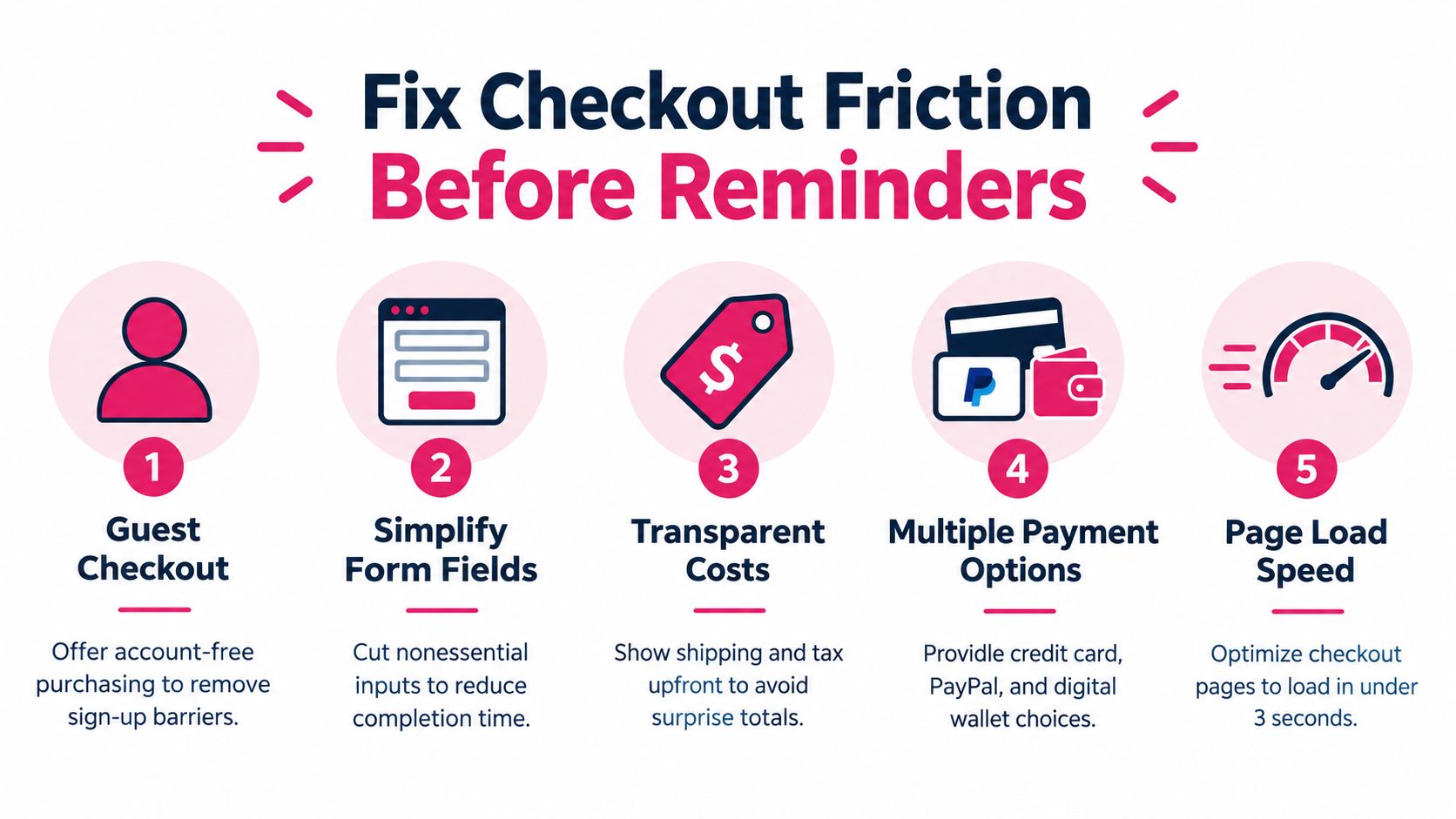
A reminder won’t rescue a checkout that already frustrates buyers. Baymard data cited by Shopify shows that unexpected extra costs are a reason for abandonment for 40% of shoppers, 20% cite slow delivery, 18% are blocked by forced account creation, and 17% leave because checkout is too long or complicated. The average US checkout displays 23 form elements by default, while usability testing suggests a checkout can work with roughly 12–14 elements. Those numbers point to a simple truth, fix the friction first, then automate the follow-up. The source for those checkout findings is Shopify’s breakdown of Baymard’s checkout research.
What to fix before recovery starts
- Guest checkout: Remove account creation as a barrier.
- Form reduction: Cut nonessential fields that slow completion.
- Cost transparency: Show shipping and tax before payment.
- Payment choice: Offer familiar payment methods, not just one option.
- Checkout speed: Keep pages responsive so intent doesn’t cool off.
Recovery messages work better when they echo the exact friction buyers faced.
That means your reminder copy should not pretend the problem was forgetfulness if the underlying issue was a surprise shipping charge. A practical message can acknowledge the blocker directly, then point back to the cart or checkout path that resolves it. That’s much stronger than a generic “You left something behind” note.
For teams trying to clean up the checkout flow before any recovery sequence launches, this CartBoss guide on checkout optimization is a useful companion. The point isn’t to replace YITH with a checkout fix, it’s to stop using recovery software as a bandage for avoidable friction.
Comparing Email Workflows to SMS Cart Recovery
Email recovery is the older benchmark, and YITH fits that model well. It gives WooCommerce stores a rule-based reminder flow that is familiar to manage, easy to measure, and useful for testing subject lines, timing, and coupon logic. SMS changes the standard because it reaches shoppers in a channel that usually gets seen faster and demands tighter consent handling. Klaviyo’s research with Recharge found that 18% of customers prefer abandoned-cart notifications by SMS, and SMS vs email marketing is a useful way to compare the trade-offs between the two channels.
Email vs SMS Recovery Metrics
| Metric | Email Plugins (YITH) | SMS Automation (CartBoss) |
|---|---|---|
| Primary channel | Scheduled email reminders | Automated text reminders |
| Best use case | Rule-based follow-up inside WooCommerce | Fast recovery when immediacy matters |
| Success signal | Recovered carts, email conversion rates, recovered value | Clicks, completed orders, revenue per delivered message |
| Message style | Longer, more descriptive reminders | Short, direct prompts with a recovery link |
| Incentives | Coupons can be included | Unique discount links can be included |
| Reporting focus | Abandoned carts, sent messages, recovered carts | Clicks, conversions, revenue attribution |
The operational difference matters. Email plugins are built around sequences and dashboards, while SMS campaigns are judged by what happens after the click. With SMS, open-rate reporting matters less, because delivery and visibility are usually high enough that the question is whether the message drives action. A cleaner test compares a first reminder without an incentive against a second message with a limited discount, then segments the results by country, device, and first-time versus returning customer.
Measure SMS by revenue, not by vanity metrics.
That rule saves a lot of misread reporting. If a text is opened but never clicked, it has not recovered the cart. If a message drives a click but the checkout link is not unique, attribution gets muddy and it becomes harder to judge whether the reminder or the offer did the work. Email can still handle slower, rule-based follow-up well. SMS is the sharper tool when speed matters, but it only pays off when tracking, consent, and the recovery path are set up carefully.
Navigating SMS Compliance and Consent Requirements
Email recovery and SMS recovery do not sit under the same rules. In the United States, automated commercial text messages generally require the recipient’s prior express written consent under the Telephone Consumer Protection Act, and the FCC treats texts as telephone calls under TCPA rules. It also says written consent is required when an autodialed or prerecorded message contains an advertisement, and the sender must be able to prove that consent. For store owners comparing SMS setup and compliance details, CartBoss’s SMS marketing compliance guide is a useful companion.
Build consent the defensible way
A workable consent record keeps the phone number, timestamp, source page, disclosure text, and the specific campaign or business named in the disclosure. Consent should not be inferred just because a shopper entered a number at checkout. The FCC also says opt-out requests must be honored, so STOP handling should happen immediately and suppression records should be retained.
The one-to-one consent rule raises the bar further. The FCC said its rule took effect on January 27, 2025, and requires prior express written consent for marketing robocalls or robotexts from each individual seller. Consent gathered through a comparison-shopping or lead-generation site cannot be treated as blanket permission for messages from dozens of sellers, and the disclosure has to be clear and conspicuous.
Use this compliance checklist
- Name the store clearly in the consent language.
- Explain the message type the shopper is agreeing to receive.
- Include opt-out instructions in the flow.
- Store proof of consent for audits and complaints.
- Suppress numbers immediately after a STOP request.
- Avoid shared lead lists for recovery campaigns.
YITH’s email model is simpler because the permission environment is narrower. SMS works better for urgency, but it needs a much tighter legal foundation. Without that foundation, the recovery sequence becomes a liability instead of a revenue channel.
Strategic Migration to Automated SMS Recovery
The smartest path is not “email or SMS.” It’s deciding which workflow should own which part of the recovery journey. YITH is still useful when you want a dependable WooCommerce email baseline, especially if you need structured timing, coupon-based incentives, and clear reporting on recovered carts. SMS becomes the stronger layer when speed, consent, and direct response matter more than long-form follow-up.
A practical migration plan starts with segmentation. Use email for broad follow-up and SMS for shoppers who have explicitly opted in, then keep the checkout link unique so you can trace recovered orders correctly. CartBoss can fit into that layer as an SMS recovery tool that sends automated reminders, supports pre-filled checkout links, and applies dynamic discounts, but it should be treated as one operational option inside a controlled workflow, not as a shortcut around consent or checkout quality.
The best teams don’t rip out the old system on day one. They keep the email backbone, add SMS where permission exists, and compare results by revenue per recovered cart instead of by message volume.
If you already rely on YITH, use it as your benchmark for timing, measurement, and message discipline. If you’re ready to add SMS recovery with clear consent handling and more immediate follow-up, visit CartBoss and review how it handles abandoned carts, recovery links, and campaign tracking for WooCommerce stores.