


The Real Cost of Abandoned Carts: Beyond the Numbers
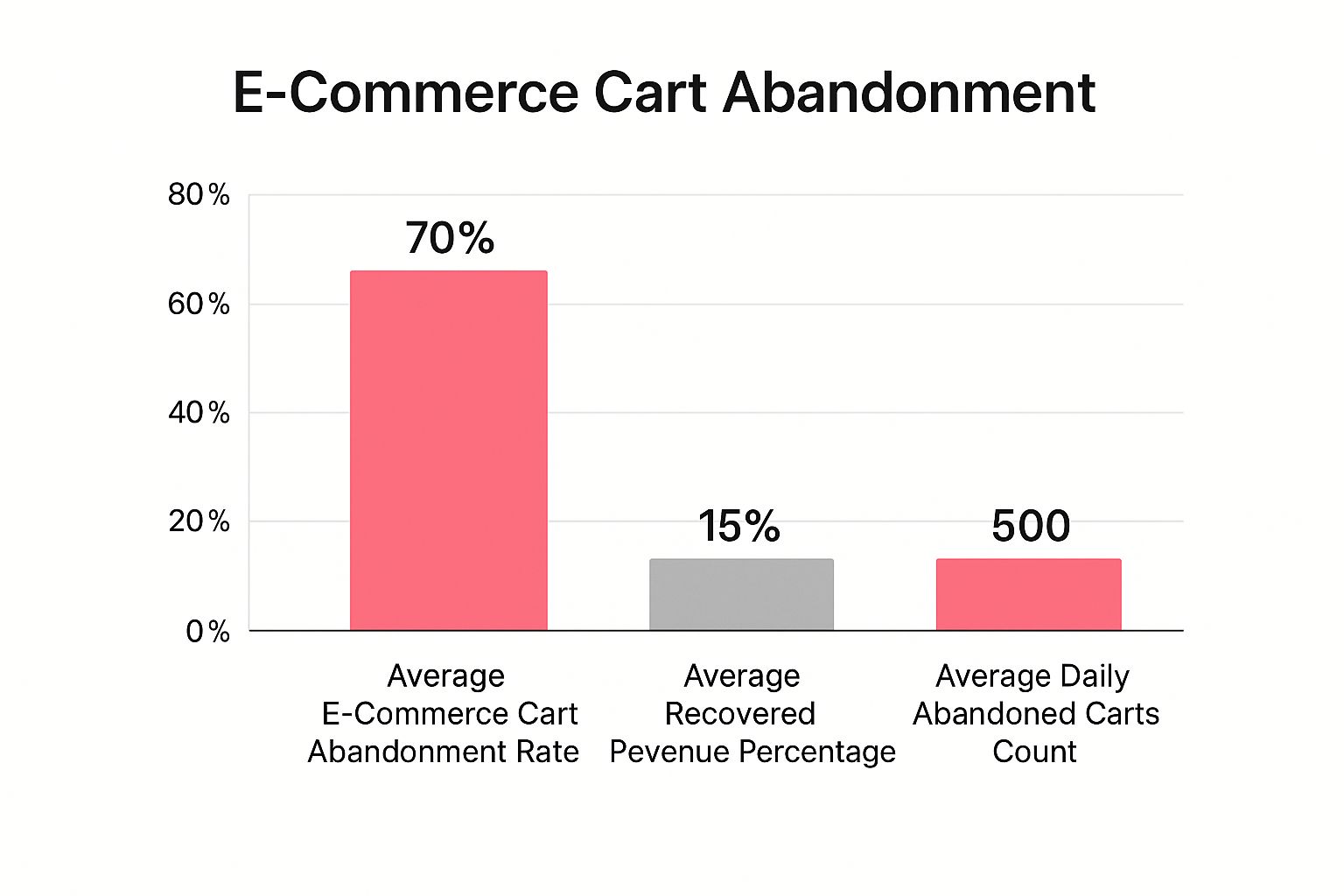
The infographic above highlights some key abandoned cart metrics: average e-commerce cart abandonment rate, average recovered revenue percentage, and the average daily abandoned cart count. While abandonment is a real issue, a significant chunk of revenue can be recovered through dedicated abandoned cart recovery strategies. This underscores the value of a robust recovery plan to recapture lost sales and boost your bottom line.
The Economic Impact: Trillions Lost
Abandoned carts aren’t just individual lost sales; they represent a substantial loss to the global e-commerce market. The global average cart abandonment rate sits at a stubbornly high 70.19% as of 2023. This translates to roughly 7 out of 10 online shopping carts being abandoned before purchase.
This high abandonment rate leads to an estimated annual loss of approximately $4 trillion globally. Find more detailed statistics here. This highlights the critical need for businesses to focus on abandoned cart recovery. For instance, a business processing 1,000 orders daily with a 70% abandonment rate could be losing 700 potential sales each day.
Mobile Abandonment: A Growing Challenge
The rise of mobile commerce adds another layer of complexity. Mobile cart abandonment rates are even higher, hitting 80.2%. Several factors contribute to this, including smaller screens, complex checkout processes, and security concerns on mobile.
However, this also presents a significant recovery opportunity. Optimizing the mobile checkout and implementing targeted mobile recovery campaigns can help businesses recover a substantial portion of these lost sales. Effective strategies include SMS reminders, push notifications, and mobile-optimized emails.
To better understand the breakdown of cart abandonment across different devices, let’s take a look at the following table:
Cart Abandonment Rates by Device Type
Description: Comparison of abandonment rates across different shopping platforms
| Device Type | Abandonment Rate | Contributing Factors |
|---|---|---|
| Desktop | 69.82% | Long or complex checkout forms, unexpected costs, website errors, comparison shopping |
| Mobile | 80.2% | Small screen size, difficulty navigating checkout, security concerns, slow loading times |
| Tablet | 77.18% | Similar to mobile, but with slightly improved navigation |
This table illustrates the difference in abandonment rates between desktop and mobile devices. While desktop abandonment is lower, mobile represents a larger share of lost potential revenue due to its higher usage. Addressing the specific challenges of each platform is crucial for effective recovery.
Turning Lost Opportunities into Revenue
Abandoned carts are not just lost revenue; they’re missed chances to build customer relationships. Each abandoned cart represents a potential customer interested in your products. Effective recovery strategies re-engage these customers, nurture their interest, and convert them into loyal buyers.
Furthermore, data from abandoned carts offers valuable insights into customer behavior, preferences, and pain points. This information can be used to optimize the overall shopping experience, refine product offerings, and personalize marketing efforts.
Why Shoppers Abandon: The Psychology Behind the Exit
Understanding why shoppers abandon their carts is crucial for effective abandoned cart recovery. It’s not simply about the numbers; it’s about understanding the psychology driving these exits. This means exploring the customer’s mindset and identifying the emotional and cognitive factors that cause hesitation at the checkout.
Decision Points and Hesitation
The online shopping journey is full of decision points where a customer might abandon their cart. These range from unexpected shipping costs and complex checkout processes to simply browsing and comparing prices. For instance, a customer might add items to their cart to save them for later, with no intention of buying immediately. You might be interested in: 5 Reasons Why Customers Abandon Their Carts.
Decision fatigue plays a role, especially with lengthy or information-heavy checkout processes. This can cause purchase hesitation, leading to cart abandonment even if the customer initially intended to buy.
Price Sensitivity and Trust Concerns
Price sensitivity is a major factor in abandoned carts. Unexpected costs like shipping or taxes can deter customers, especially if these weren’t clearly displayed upfront. This is common in product categories where price comparison is prevalent.
Price isn’t the only concern; trust is also vital. Customers must feel confident that their payment information is secure and the website is legitimate. A lack of clear contact information, secure payment badges, or customer testimonials can increase trust concerns and lead to cart abandonment.
The Emotional Journey: From Interest to Hesitation
A customer’s emotional state significantly influences their purchasing decision. Initial excitement and interest in a product can shift to negative emotions like frustration, anxiety, or distrust during checkout. These negative feelings can quickly outweigh the initial positive ones, resulting in cart abandonment.
Understanding this emotional journey is key to creating effective recovery messages. Instead of simply pushing for a sale, personalized messages addressing specific concerns can rebuild trust and re-engage the customer’s initial interest. This empathetic approach can significantly improve your abandoned cart recovery rate.
Crafting Recovery Emails That Actually Convert

Generic cart abandonment emails just don’t work anymore. To win back lost sales, you need a smarter plan for your recovery emails. This means understanding the right timing, adding a personal touch, and writing messages that connect with your audience.
The Power of Personalization and Timing
The first recovery email is key. Send it within one hour of the abandoned cart, while the customer is still thinking about the product. This email is a gentle nudge, usually without any special offers. A simple “Did you forget something?” in the subject line can be very effective.
Follow-up emails can be sent over the next few days, gradually adding incentives. For instance, email number two (sent after 24 hours) might offer free shipping. The third email (after 72 hours) could offer a small discount. This encourages buying without making your products seem less valuable.
Abandoned cart emails have a great average open rate of 41.18%, with a 21% click-through rate. Even better, conversion rates can be as high as 50%. That means half the people who click on these emails complete their purchase. This shows the power of well-timed, personalized follow-ups. Find more detailed statistics here.
Crafting Compelling Subject Lines
Your subject line is the first impression. It needs to be catchy and make people want to open the email. Keep subject lines short, personalized, and add a sense of urgency or curiosity.
Here are a few good examples:
- Still thinking about it? Your [Product Name] is waiting.
- Did you forget something? Your cart misses you!
- Complete your purchase and get free shipping!
- Don’t miss out! Your cart is expiring soon.
A/B testing different subject lines helps you figure out what works best for your audience.
Addressing Abandonment Reasons and Building Trust
Your email content should address why people might abandon their carts. High shipping costs? Highlight free shipping or other delivery options. Security concerns? Emphasize your secure checkout and certifications.
Adding social proof, like customer reviews, can also build confidence. Positive feedback from other shoppers helps reduce hesitation. Clear product images and descriptions also remind customers why they wanted the item in the first place. You might be interested in: Learn more in our article about recovering abandoned carts with text messages.
Mobile Optimization Is Key
Many people shop on their phones, so your emails must be mobile-friendly. They should look good on any screen size. Use large buttons and clear calls-to-action. A simple mobile checkout process is crucial for a smooth experience.
Building a Multi-Stage Recovery Sequence
One email might not be enough. A series of three or four emails gives you the best chance of recovering a sale. Each email should have a clear purpose and offer increasingly attractive incentives, ending with a final reminder or last-chance deal. This reinforces the value and encourages customers to buy.
To illustrate a recommended timeline and content strategy, consider the following table:
Abandoned Cart Email Sequence Timeline: Recommended timing and content approach for a 3-part email recovery sequence
| Email Number | Timing | Primary Message | Incentive Strategy | Expected Conversion Rate |
|---|---|---|---|---|
| 1 | Within 1 hour | Gentle reminder, highlight items left in cart | None | ~10% |
| 2 | 24 hours later | Remind customer about items, address potential concerns | Free shipping | ~15-20% |
| 3 | 72 hours later | Last chance to recover cart, reinforce product value | Small discount (5-10%) | ~5-10% |
This table outlines a common approach, but remember to test and refine your own sequence based on your specific audience and products. A well-planned sequence can significantly improve your recovery rate.
Industry-Specific Recovery: What Works in Your Market

Online shoppers abandon their carts for various reasons. Someone leaving behind a cart of groceries likely has different motivations than someone abandoning a high-end electronic. This means your abandoned cart recovery strategy must be tailored to your specific industry. What works for apparel may not work for electronics, and subscription services require a different approach altogether.
Understanding Industry Benchmarks
Knowing your industry’s average abandoned cart recovery rates and revenue per recipient (RPR) is essential for evaluating your own performance. Benchmarking against your competitors helps identify areas for improvement and potential growth.
For instance, hardware and electronics typically see higher RPR from abandoned cart emails. Top hardware brands can achieve a $75.66 RPR, while electronics follows closely at $66.89. Home & garden and automotive also perform well.
The food & beverage industry has the highest average open rate for abandoned cart emails at 52.16%, coupled with a click rate of 6.63% and a conversion rate of 3.66%. These metrics demonstrate the power of targeted campaigns. Explore industry benchmarks further in this Klaviyo blog post. For WooCommerce specific strategies, see this article on WooCommerce Abandoned Cart Recovery.
Tailoring Your Approach
Let’s explore how different industries require distinct recovery strategies:
- High-Value Items (Electronics, Luxury Goods): Focus on building trust and addressing price concerns. Offering payment plans, extended warranties, or highlighting exceptional customer service can encourage purchases.
- Subscription Services: Abandoned carts might indicate hesitation about commitment. Offer free trials, flexible subscription options, or emphasize the value of recurring deliveries.
- Fashion and Apparel: Sizing concerns or browsing behavior often drive cart abandonment. Showcase size guides, offer free returns, or suggest similar items.
- Everyday Essentials (Groceries, Toiletries): Convenience and speed are key. Streamline the checkout process, offer express delivery, and remind customers of needed items.
Messaging and Incentives
Your messaging and incentives should also align with your industry. A small discount might suffice for groceries, while a high-value item might require a more significant offer or financing.
Consider these factors:
- Price Point: Higher prices require more compelling incentives.
- Purchase Frequency: Focus on convenience and reminders for frequent purchases. Offer stronger incentives and address hesitations for less frequent buys.
- Customer Lifetime Value (CLTV): Invest more in recovering high-CLTV customers for greater long-term revenue.
By understanding your market and customers, you can create targeted abandoned cart recovery campaigns. This leads to higher conversion rates, increased revenue, and stronger customer relationships. Focusing on each customer’s needs within your industry’s context maximizes your recovery potential.
Multi-Channel Recovery: Beyond the Inbox
Email remains a cornerstone of abandoned cart recovery. However, relying solely on email is a missed opportunity. Savvy brands are embracing a multi-channel strategy, incorporating SMS, push notifications, and retargeting ads to dramatically improve conversion rates.
The Power of SMS: Immediate Impact
SMS messages have incredibly high open and click-through rates, making them perfect for urgent reminders. They act as a quick nudge, reminding customers about the items waiting in their cart. This is especially effective for limited-time sales or in-demand products that might sell out. Explore various SMS recovery platforms to find the best fit for your business.
Push Notifications: Gentle Nudges
Push notifications offer a less direct approach. These small pop-ups appear on a customer’s device, even when they aren’t browsing your website. They serve as subtle reminders, particularly helpful for customers who haven’t engaged with your recovery emails.
Retargeting Ads: Staying Top of Mind
Retargeting ads, often facilitated through platforms like Google Ads, display the specific products a customer abandoned as they browse the web. This keeps your brand and products visible, reminding them of their initial interest. This strategy is particularly powerful for higher-priced items or purchases requiring more consideration.
Crafting a Cohesive Multi-Channel Strategy
The core of multi-channel success lies in coordination. Each channel should work together to create a unified and personalized customer experience. Don’t just send the same message across all platforms. Instead, adapt your messaging to suit each channel and the customer’s specific stage in the buying process.
For example:
- Email: Share detailed product descriptions and compelling customer testimonials.
- SMS: Send time-sensitive discounts and direct links to their abandoned cart.
- Push Notifications: Offer concise reminders and highlight free shipping deals.
- Retargeting Ads: Display visually appealing product images and positive customer reviews.
Timing and Tracking: Optimizing for Success
Timing is essential for effective multi-channel recovery. Begin with an SMS message shortly after abandonment, followed by an email within an hour. Use push notifications and retargeting ads over the next few days, progressively sweetening the deal with increased incentives.
Utilize cross-channel tracking, often available through analytics platforms like Google Analytics, to understand which combinations of channels drive the most valuable conversions. This data empowers you to refine your campaigns and allocate your budget strategically. By analyzing the complete customer journey across all channels, you gain invaluable insights into what works and what doesn’t, continually improving your abandoned cart recovery strategy.
Checkout Optimization: Preventing Abandonment at the Source

The most effective way to tackle abandoned carts? Stop them before they happen. Optimizing your checkout is key to dramatically reducing the number of shoppers who leave without buying. This involves understanding why customers hesitate and providing solutions that encourage them to complete their purchase. This proactive strategy is crucial for maximizing conversions and boosting your profits.
Streamlining the Checkout Flow
A clunky checkout process is a major culprit in cart abandonment. Imagine a long, complicated road filled with unexpected detours. Shoppers are much more likely to abandon their journey if it’s too difficult. A streamlined checkout, however, is like a smooth, open highway – easy to navigate and conducive to a quick arrival.
Here’s how to simplify your checkout:
- Minimize Form Fields: Request only essential information. Fewer fields mean a faster, less tedious process.
- Guest Checkout Option: Don’t force account creation. Allowing guest checkout removes a major hurdle, especially for new customers.
- Clear Progress Indicators: Keep customers informed about their progress. A visual progress bar helps build commitment and encourages completion.
- Offer Multiple Payment Options: Provide a variety of payment methods, from PayPal and credit cards to Apple Pay and Google Pay. Catering to diverse preferences removes a potential barrier.
Building Trust and Security
Sharing personal and financial information requires trust. A lack of trust can create hesitation and ultimately lead to abandoned carts. Build trust by incorporating these elements:
- Secure Payment Badges: Display recognizable security badges from companies like Norton or McAfee. These badges reassure customers that their information is safe.
- Clear Contact Information: Make it easy for customers to contact you. Provide a phone number, email address, and physical address (if applicable). This demonstrates credibility and availability.
- Customer Testimonials and Reviews: Showcase positive feedback to build social proof and validate your business’s reliability.
Mobile Optimization: A Must-Have
With most online shopping now happening on mobile devices, optimizing your checkout for smartphones is essential. This means addressing the specific needs of mobile shoppers:
- Simplified Navigation: Ensure easy navigation on smaller screens with large buttons, clear fonts, and a streamlined layout.
- Fast Loading Times: Speed matters. Slow loading times frustrate mobile shoppers and lead to abandoned carts.
- Mobile-Friendly Payment Options: Offer mobile-optimized payment methods like Apple Pay and Google Pay for a smooth transaction.
Testing and Iteration: Continuous Improvement
Even the most optimized checkout can be improved. Regular testing helps identify specific friction points and inform targeted solutions:
- Checkout Usability Testing: Observing real users interacting with your checkout process reveals areas for improvement and provides valuable feedback.
- A/B Testing: Experiment with different checkout designs and features to discover what works best for your target audience.
Learn more about reducing cart abandonment in our article: how to reduce checkout abandonment. To further expand your recovery strategies, consider a multi-channel approach. Combining email and SMS can be a powerful addition to your toolkit. Continuously optimizing your checkout creates a smooth, trustworthy experience that encourages conversions and reduces abandoned cart rates.
Measuring Recovery Success: Beyond Basic Metrics
Simply recovering abandoned carts isn’t enough. You need to understand the real impact of your recovery program. This means going beyond simple conversion rates and looking deeper into metrics that truly reflect your success. This includes analyzing the revenue contribution and the effect on long-term customer lifetime value.
Establishing Meaningful Benchmarks
To accurately measure the effectiveness of your abandoned cart recovery efforts, you need to establish benchmarks specific to your business model. This involves considering factors such as your industry, average order value, and customer demographics. For instance, a luxury brand might aim for a higher average recovered cart value than a business selling everyday items. Learn more in this helpful article about abandoned cart recovery statistics.
Attributing Conversions Across Touchpoints
Understanding what’s truly driving conversions requires accurate attribution across various touchpoints. What happens if a customer interacts with an email, an SMS message, and a retargeting ad before finally making a purchase? How do you assign credit? Multi-touch attribution models can help analyze each touchpoint’s contribution, providing a more complete understanding of your strategy’s effectiveness. This gives you a much clearer picture of your marketing ROI.
Calculating the True ROI of Your Recovery Program
Calculating the true return on investment (ROI) of your recovery program means factoring in all costs. This includes the costs of your recovery platform, email marketing software, SMS messages, and any discounts offered. By comparing the recovered revenue against these expenses, you determine the actual profitability of your efforts. This data helps justify the investment and optimize your spending for maximum return. Checkout optimization is also key; explore these proven strategies to boost ecommerce sales.
Building Dashboard Reporting
A well-designed dashboard is vital for monitoring and showcasing the impact of your program. This dashboard should track key metrics such as:
- Recovery Rate: The percentage of abandoned carts recovered.
- Revenue Recovered: The total value of recovered sales.
- Cost per Recovered Cart: The average cost associated with each recovery.
- Customer Lifetime Value Impact: The long-term value generated by recovered customers.
This data offers valuable insights into your program’s performance, enabling continuous optimization.
Testing and Adapting to Changing Behaviors
Customer behavior is always changing. Ongoing testing is crucial to maintain the effectiveness of your recovery strategies. A/B test different email subject lines, messaging, and incentive structures to find what resonates best with your audience. By regularly analyzing performance and adapting your methods, you stay ahead of the curve and maximize your recovery potential.
Reclaim lost revenue and boost sales with CartBoss, the leading SMS abandoned cart recovery solution. Transform your abandoned carts into profit with CartBoss!