


When you’re weighing email marketing against SMS marketing, the core difference is pretty straightforward. Email is your tool for building relationships with rich, detailed content, while SMS is all about driving immediate action with short, punchy messages. The right choice really hinges on what you’re trying to achieve: a deep, ongoing conversation or a quick, powerful burst of engagement.
Choosing Your Channel: Email vs. SMS at a Glance
Getting a grip on the unique strengths of each channel is the first real step toward a solid marketing strategy. Both are fantastic for talking to customers, but they do very different jobs and get very different results. Think of email marketing as your canvas for storytelling. It’s where you can roll out detailed product features, build brand loyalty with a great newsletter, or educate your audience with a welcome series. You’ve got space to work with.
On the flip side, SMS marketing is built for speed and simplicity. Its real magic is how it cuts through all the digital noise and lands right in your customer’s pocket, demanding to be seen. This makes it perfect for time-sensitive deals, flash sales, shipping updates, and appointment reminders. The conversational, direct feel of a text creates an urgency and exclusivity that email just can’t match.
Key Performance Metrics Compared
The numbers don’t lie—they paint a clear picture of how these two channels work in the real world. When you look at conversion and click-through rates, you see a massive difference in how people react. Because a text message is short and usually has one clear call to action, it makes the decision-making process incredibly simple for the user.
This simplicity is why SMS pulls an average click-through rate (CTR) of 6.1%, which is more than double email’s 2.6% average. The gap gets even wider when you look at conversions. SMS marketing boasts an average 29% conversion rate, blowing past email’s 15.2%. If you want to dig deeper into how SMS can boost sales, there’s some great data over at info.joinsubtext.com.
To give you a better feel for these numbers, here’s a quick side-by-side look at the key metrics.
Quick Comparison: Email Marketing vs. SMS Marketing
This table breaks down the essential performance stats, showing you exactly where each channel shines.
| Metric | Email Marketing | SMS Marketing |
|---|---|---|
| Open Rate | ~21% | ~98% |
| Click-Through Rate | ~2.6% | ~6.1% |
| Conversion Rate | ~15.2% | ~29% |
| Best For | Nurturing, Storytelling, Detailed Content | Urgency, Immediate Action, Time-Sensitive Offers |
As you can see, the immediacy of SMS gives it a huge advantage in getting customers to open, click, and buy right now.
The infographic below really brings these performance differences to life.
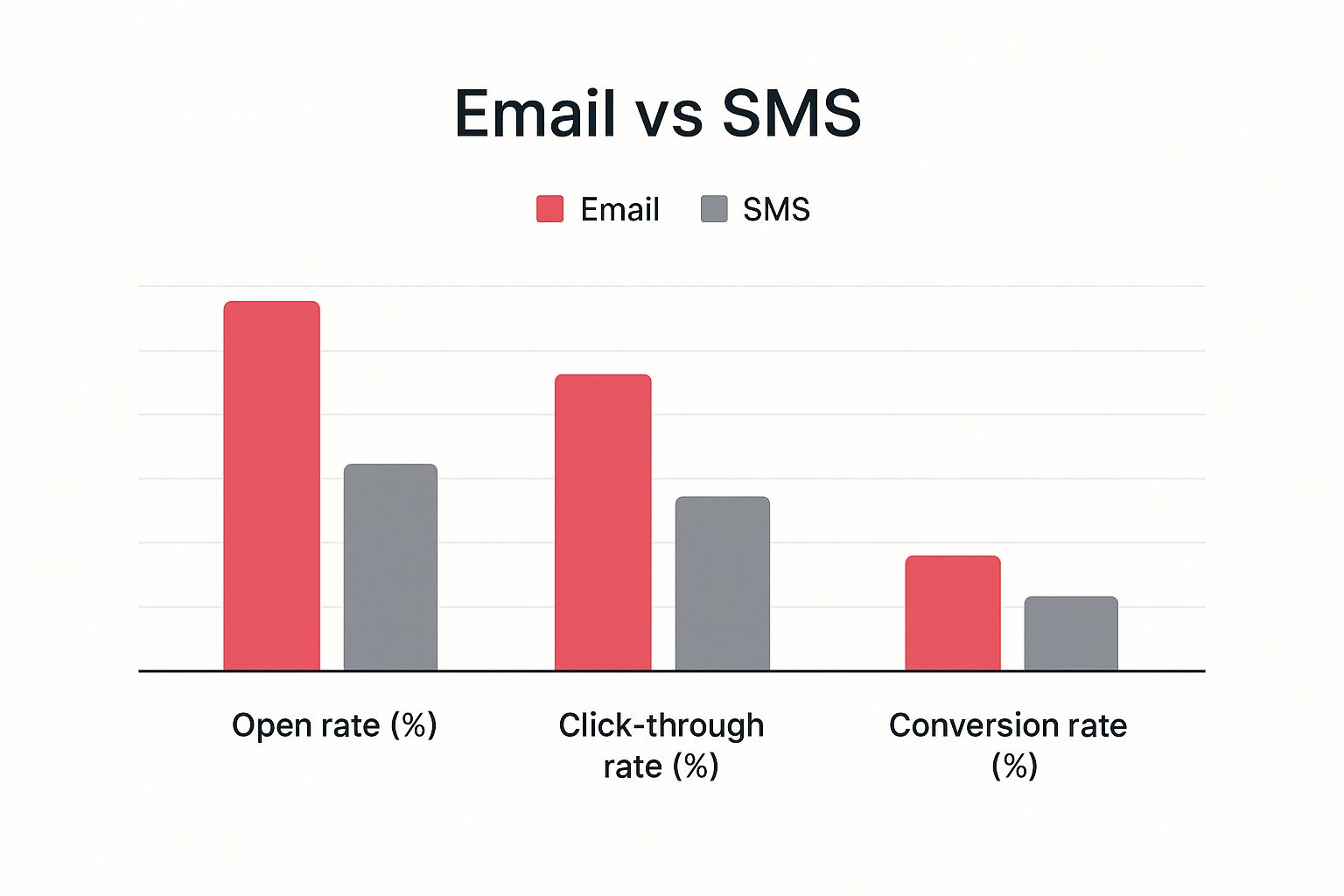
The data makes it crystal clear. While email absolutely has its place for building a brand over the long haul, SMS is the undisputed champion when you need to get your audience to take direct, measurable action.
Comparing Engagement Rates and Audience Reach
When you stack email and SMS marketing side-by-side, the engagement numbers jump right off the page. But the real story isn’t just about which one gets more opens. It’s about understanding why and what that means for your strategy.
The power of SMS is its raw immediacy. The numbers are almost hard to believe: SMS commands an average open rate of 98%, and 82% of people read a text within five minutes of it landing on their phone. It’s the closest thing to a guaranteed eyeball in marketing.
This makes text messaging perfect for anything that needs instant attention. Think flash sales, shipping alerts, or last-minute appointment reminders. A notification pops up, and people react almost instinctively. It just cuts through the noise in a way email can’t.
Understanding Audience Preferences
It’s not just about how many people you reach, but who you’re reaching. Sure, your email list is probably bigger. But anyone who gives you their phone number has shown a much higher level of trust and intent. They’ve essentially pre-qualified themselves as highly engaged.
“The core difference in engagement isn’t just the open rate; it’s the mindset. An email can be saved for later, but a text message feels like a live conversation happening right now.”
This shift in how customers see the channel is everything. Email is for browsing, learning, and considering. SMS is for doing. A customer might be perfectly happy to get a long weekly newsletter in their inbox, but for a 24-hour flash sale, they’d much rather get a quick text.
Email’s Role in Deeper Engagement
On the other hand, email is where you build relationships. Its open rates might be lower—hovering around 28-39%—but the people who do open are often ready to spend more time with your brand. This makes email the perfect place for:
- Rich Storytelling: Sharing your brand’s mission and backstory.
- Educational Content: Sending detailed product guides or useful tutorials.
- Visual Showcases: Using beautiful images and design to show off new products.
You simply have more room to work with in an email. You can build a narrative and create an emotional connection that’s impossible in a 160-character text. The engagement here isn’t about instant clicks; it’s about building long-term loyalty.
Of course, incredible engagement rates don’t mean much if they aren’t profitable. You have to weigh the results against the cost. To get a better handle on the numbers, check out our guide on the cost and ROI breakdown of SMS vs email marketing to see how it all shakes out.
Analyzing Cost Structures and Marketing ROI
When it comes to email vs. SMS marketing, the conversation always lands on one thing: the budget. The way you pay for each channel is completely different, and that directly impacts how you’ll measure success and where you’ll spend your marketing dollars.
Email marketing almost always runs on a subscription model. You pay a monthly fee based on how many contacts you have or how many emails you send. This makes email incredibly cost-effective for large-scale communication. Sending a campaign to 10,000 subscribers costs pretty much the same as sending to 100, making it the clear winner for things like newsletters, lead nurturing, and just staying in front of your audience without a per-message cost racking up.
SMS marketing, on the other hand, is a different beast. It’s almost always priced on a per-message basis. Yes, the cost for a single text is higher than a single email, but that’s the point. This structure forces you to focus on high-impact, conversion-focused campaigns. You’re not just sending a message; you’re paying for immediate, direct access to a customer’s most personal device.
Justifying the Cost with Superior Returns
That higher per-message cost for SMS often pays for itself, and then some. Because SMS has near-perfect open rates and much higher click-through and conversion rates, the return on investment (ROI) can blow email out of the water for specific, time-sensitive campaigns. An urgent flash sale or an abandoned cart reminder sent via SMS is far more likely to get a click and a conversion, making the per-message cost an investment that pays off quickly.
The key is to stop thinking in terms of cost-per-send and start thinking about cost-per-acquisition. A single, well-timed text that recovers a high-value abandoned cart delivers a massive ROI that easily covers its small initial expense.
For example, a smart e-commerce store might use email for its weekly promotional calendar but save SMS for its most valuable actions: abandoned carts and alerts for VIP customers. This blended approach makes the most of your budget, using the low-cost channel for broad reach and the high-impact channel for guaranteed engagement where it counts. If you want to dive deeper into the numbers, our guide to SMS marketing pricing is a great resource for building your budget.
Calculating True ROI for Each Channel
To figure out your true ROI, you have to look past the obvious costs. For email, you need to factor in your platform fees, any design resources, and the time it takes to create content. For SMS, it’s the per-message fees, platform costs, and any carrier surcharges.
- Email ROI: Email is a long game. It’s perfect for building customer lifetime value (LTV). Its low cost allows you to continuously nurture relationships that lead to repeat purchases over time.
- SMS ROI: SMS is all about immediate revenue. It’s the go-to for campaigns where speed and direct action are what you need to close a sale right now.
Ultimately, the smartest strategy doesn’t pit email against SMS. It uses them together, allocating budget based on what you’re trying to achieve with each message.
Matching the Channel to Your Marketing Goal

Knowing the strengths of email and SMS is one thing, but putting them to work effectively is where the magic happens. The real art is picking the right tool for the right job. A message sent on the wrong channel can feel annoying or get completely ignored, while the right one feels genuinely helpful and makes people act.
This isn’t about crowning a permanent winner in the email vs. SMS showdown. It’s about creating a smart, flexible strategy where your communication method perfectly matches your campaign goal. Every message needs a clear purpose, and that purpose will tell you whether it belongs in an email inbox or a text thread.
When Email Is the Clear Champion
Email really shines when you need more room to tell a story, share details, and build a deeper connection. It’s the perfect channel for content that needs more than a few seconds of your customer’s time. Think of it as your primary tool for building long-term brand value and educating your audience.
Email is the undisputed king for things like:
- Detailed Newsletters: Perfect for sharing company news, interesting content, or multiple product highlights in a visually engaging way.
- Customer Onboarding: You can guide new users with a welcome series that walks them through your product or service step-by-step.
- Educational Content: Sending in-depth guides, case studies, or tutorials that position your brand as an expert in your niche.
- Order and Shipping Confirmations: Providing detailed receipts and tracking info that customers can easily find, save, and refer back to.
In these situations, the goal isn’t just a quick click—it’s about delivering valuable information and nurturing the customer relationship. Email’s format allows for a level of branding and storytelling that SMS just can’t match.
Where SMS Excels for Immediate Impact
SMS is your go-to for messages that are urgent, personal, and need an instant reaction. Its incredible power comes from its 98% open rate, with most texts being read within just a few minutes of delivery. This makes it an absolute game-changer for time-sensitive messages that need to cut through the noise.
The strategic advantage of SMS is its ability to create a sense of urgency and exclusivity. A text message feels like a direct, personal tap on the shoulder, making it perfect for high-stakes moments in the customer journey.
SMS is the superior choice for goals like:
- Flash Sales and Limited-Time Offers: Announcing a 24-hour sale that demands immediate action and plays on FOMO (fear of missing out).
- Appointment Reminders: Slashing no-shows by sending a quick, impossible-to-miss reminder the day before an appointment.
- Urgent Alerts: Notifying customers about critical updates like “back in stock” alerts for hot items or last-minute changes to an event.
- Abandoned Cart Recovery: Sending a timely nudge with a direct link to a pre-filled checkout, capturing revenue that would have otherwise been lost.
For these moments, the short-and-sweet nature of SMS is a feature, not a bug. It drives a single, clear call to action with unmatched effectiveness. If you want to see the numbers behind this, our guide on calculating the ROI of SMS marketing breaks it all down.
By matching the channel to the goal, you ensure every message you send lands with maximum impact.
Optimal Channel for Common Marketing Scenarios
To make it even clearer, here’s a quick-reference table to help you decide which channel fits your specific marketing goal. Think of this as your cheat sheet for making the right call every time.
| Marketing Goal | Recommended Channel | Strategic Reason |
|---|---|---|
| New Customer Welcome Series | Allows for a detailed, multi-step introduction to your brand and products without feeling intrusive. | |
| Abandoned Cart Recovery | SMS | The high open rate and immediacy are perfect for nudging a customer to complete their purchase right now. |
| Weekly Content Newsletter | Provides the space needed for rich media, multiple articles, and in-depth storytelling. | |
| 2-Hour Flash Sale Alert | SMS | Creates urgency and ensures the message is seen instantly, maximizing participation in a short time frame. |
| Order & Shipping Updates | Customers expect detailed transactional info here, which they can easily file and reference later. | |
| Appointment Reminders | SMS | Drastically reduces no-shows by delivering a short, unmissable reminder at the perfect time. |
| “Back in Stock” Notification | SMS | Capitalizes on immediate demand by alerting interested customers the moment a popular product is available. |
| Request for Product Review | Gives the customer time to reflect and write a thoughtful review without feeling rushed. |
Ultimately, the most powerful marketing strategies don’t choose one channel over the other—they use both in harmony, letting each one play to its strengths.
Navigating Compliance and Building Customer Trust

When it comes to email and SMS marketing, compliance isn’t just a box to tick—it’s the entire foundation of customer trust. Getting this wrong doesn’t just hurt your brand’s reputation; it can hit you with crippling financial penalties that can stop a business in its tracks.
Each channel plays by its own set of rules. Email marketing is largely governed by the CAN-SPAM Act, which lays out the requirements for commercial messages and gives people the right to opt out. While the rules are firm, they are generally more forgiving than what’s required for SMS.
On the other hand, text message marketing falls under the Telephone Consumer Protection Act (TCPA). The TCPA is notoriously strict, and for good reason—texting is a far more personal and immediate form of communication. The penalties for non-compliance are severe, ranging from $500 to $1,500 for a single text message.
The Critical Role of Consent
The biggest compliance hurdle between the two channels is how you get permission. Both require a clear and simple way for users to opt out, but the rules for opting in are worlds apart.
- Email (Implied Consent): Under CAN-SPAM, you can often email someone if you have an existing business relationship with them. This is a form of implied consent. Of course, explicit opt-ins are always better for engagement, but they aren’t always a legal must-have.
- SMS (Explicit Written Consent): The TCPA is much tougher. It demands express written consent before you can send a single marketing text. A user has to knowingly and clearly agree to receive promotional texts from you, usually by checking a box that isn’t pre-ticked or texting a specific keyword.
The bottom line is this: you can’t just take a phone number from a past order and add it to your marketing list. Your customer must explicitly say “yes” to receiving promotional texts. This creates a higher barrier to entry but guarantees you’re building a list of people who actually want to hear from you.
This strict requirement for SMS is why building a subscriber list can feel slower. But it’s also the reason why that list is so powerful—every single person on it is there because they chose to be.
For businesses operating globally, these rules get even more layered with regulations like GDPR. To get a better handle on this, you can learn more about ensuring GDPR compliance in e-commerce SMS marketing and how to navigate these international laws.
Ultimately, transparency is non-negotiable. Your opt-out process should be instant and easy for both channels. Be upfront about what subscribers can expect and always respect their choices. This ethical approach is the only way to build a brand people trust and a marketing strategy that lasts.
How to Integrate Email and SMS for Better Results
The real debate isn’t email marketing vs SMS marketing. The smartest marketers know it’s not about picking a winner—it’s about making them work together. An integrated strategy uses the unique strengths of each channel to create a seamless customer journey that boosts engagement and, most importantly, drives more sales.
Instead of seeing them as rivals, think of them as a tag team.
This unified approach is where the magic happens, letting you build powerful automated workflows. Imagine this: a customer clicks a link in your email newsletter. An hour later, an automatic SMS hits their phone with a special, time-sensitive offer for that exact product. This creates a hyper-relevant experience that feels responsive and personal, not like a generic marketing blast.
Building a Unified Customer Profile
The secret to making this work is unified data. When your email and SMS platforms are in sync, you build a complete picture of each customer. This is crucial for avoiding message fatigue—like sending an SMS promo for a product someone just bought through an email link. Nobody wants that.
This is why platforms that combine both email and SMS, like Sendinblue, are becoming so popular. They make it much easier to manage these multi-channel strategies without the headache.
An integrated strategy lets you use behavioral triggers across channels. If a customer ignores a promotional email, a follow-up SMS can cut through the noise and recapture their attention, turning a missed opportunity into a sale.
This approach lets you use email for rich storytelling and SMS for immediate action. You could launch a new product line with a beautifully designed email, then fire off a text to alert subscribers about a 24-hour launch discount. To see how to put this into practice, check out our SMS marketing best practices playbook and get the most out of every message you send.
The future for SMS marketing is looking incredibly strong, with a projected compound annual growth rate (CAGR) of 20.8% in the U.S. through 2030. This explosive growth just underscores how vital it is to integrate texting into your marketing mix if you want to stay competitive. You can dig into the full report on these key SMS and text marketing statistics on mozeo.com.
Frequently Asked Questions
When you’re trying to figure out where SMS and email marketing fit into your strategy, a lot of questions pop up. Getting clear, straightforward answers is the only way to build a plan that actually works and sidesteps the common traps.
Can SMS Marketing Replace Email Marketing Entirely?
No, and you really shouldn’t try. Each channel has its own job to do, and they’re much more powerful when they work together instead of competing.
Think of email as your reliable workhorse. It’s perfect for nurturing customer relationships with detailed newsletters, educational content, and telling your brand’s story. SMS, on the other hand, is all about speed and urgency. It’s the best tool for driving immediate action with things like flash sales, appointment reminders, or critical alerts. A smart strategy uses both, letting you talk to customers in the right way at the right time.
What Is the Biggest Mistake to Avoid with SMS Marketing?
The single biggest mistake you can make is sending messages without getting explicit permission first—what we call an “opt-in.” This isn’t just a friendly suggestion; it’s a legal minefield. Regulations like the TCPA are serious business, and breaking the rules can lead to massive fines.
Sending marketing texts to people who didn’t ask for them is the fastest way to kill brand trust and push potential customers away for good. Always make sure you have a clear, documented record of a user’s consent before you even think about adding them to a list.
Beyond that, you have to make your opt-out process dead simple. Respecting a customer’s inbox and their choices is non-negotiable if you want to build a brand people actually trust.
How Do I Measure the Success of My Campaigns?
You have to track the right things for the right channel. Since their goals are different, their key performance indicators (KPIs) will be, too.
For email marketing, you’ll want to keep an eye on these classic metrics:
- Open Rate: What percentage of people actually opened your email?
- Click-Through Rate (CTR): Of those who opened it, who clicked a link?
- Conversion Rate: How many people took the action you wanted them to take?
- Unsubscribe Rate: Who decided they’d had enough and opted out?
For SMS marketing, the game changes. It’s much more about immediate action:
- Click-Through Rate (CTR): With open rates sitting at nearly 100%, clicks are what really show you who’s engaged.
- Conversion Rate: This is the bottom line—did your text drive a sale or a specific action?
- Response Rate: If you’re running a two-way campaign, this tracks direct engagement.
But at the end of the day, the most important metric for both is Return on Investment (ROI). You need to know if the money you’re spending is actually bringing in more revenue. That’s the true measure of success.
Ready to turn abandoned carts into your biggest revenue source? CartBoss uses the power of automated SMS to recover lost sales on autopilot, boosting your store’s profit. Discover how CartBoss can transform your revenue today!