


Put simply, retargeting advertising is the art of showing ads specifically to people who’ve already visited your website or interacted with your brand. Think of it as a friendly digital tap on the shoulder—a way to get a second chance to turn a curious browser into a happy customer.
Your Second Chance to Make an Impression

Picture this: someone lands on your online store. They look around, add a cool product to their cart, but then… life happens. A phone call, a notification, or just a random distraction pulls them away, and they leave without buying anything. With most advertising, that lead would be gone for good.
But retargeting completely changes the game. It gives you a direct line back to these high-intent individuals.
This strategy is all about focusing on a “warm” audience—people who already know who you are. Instead of throwing your marketing budget at a huge, cold audience and just hoping for the best, you’re concentrating on folks who have already raised their hand and shown interest. It’s a much smarter, more efficient way to spend your ad dollars.
How Does It Work?
The magic behind retargeting is actually pretty straightforward. It all starts with a small, unnoticeable snippet of code, usually called a pixel or a tag, that you place on your website. This code works anonymously to “tag” each person who visits.
Later, when that same person is browsing other websites or scrolling through social media, your ads can show up. It’s why you sometimes feel like ads for a product you just looked at are “following” you around the internet. It’s not a coincidence; it’s a deliberate strategy designed to keep your brand fresh in their mind and gently nudge them back to your site to finish what they started.
Key Takeaway: Retargeting isn’t about shouting at everyone; it’s about having a relevant conversation with a small, qualified group. This precision leads to much higher engagement and a better return on your ad spend compared to broader campaigns.
The Impact on Your Bottom Line
The numbers speak for themselves. Studies show that retargeted visitors are 43% more likely to convert than people seeing your brand for the first time. Why? Because you’re not a stranger anymore—you’re a familiar face.
Consider that shopping cart abandonment is a huge problem for online stores, with rates often hovering around a staggering 70%. Retargeting is one of the most effective tools to fight this, with some reports showing it can reduce cart abandonment by 26%. It’s not uncommon for marketers to see their overall conversion rates jump by as much as 150% after implementing a solid retargeting strategy. To get the full scope, it’s worth exploring more of these powerful retargeting statistics.
How Retargeting Technology Actually Works
Ever wonder how those ads seem to follow you around the internet? It’s not magic, but it is clever. To really get what retargeting advertising is all about, we need to peek behind the curtain at the simple technology that makes it all happen. Don’t worry, you don’t need a programming degree to understand this.
At the heart of it all is something called a retargeting pixel.
Think of the pixel as a tiny, invisible tripwire. It’s just a small piece of code, usually from an ad platform like Google or Meta, that you place on your website.
When someone new lands on your site, they trigger this code. It then discreetly drops a “cookie”—a small, anonymous text file—into their web browser. This process is invisible to the visitor and doesn’t grab any personal details like their name or email. It just marks their browser as having paid you a visit.
The Two Main Retargeting Methods
Now, not all retargeting is built the same. The technology generally splits into two main camps, each with its own purpose and data source. Knowing the difference is key to picking the right strategy for your business.
The most common approach you’ll see is pixel-based retargeting. This is the method we just talked about, using that digital tripwire. It’s all about re-engaging anonymous visitors who browsed your site and then clicked away.
- How it works: Once the pixel tags a visitor, ad networks can spot that browser cookie. As that person moves around the web—reading news sites, scrolling social media, or visiting blogs in the same network—your ads will pop up, gently reminding them of what they were looking at.
- Best for: This is perfect for top-of-funnel goals. Think building brand awareness or just bringing people back for a second look. It’s your go-to for reaching the 98% of visitors who don’t convert on their first visit.
The second method is list-based retargeting. This one is much more direct because it works with customer information you already have, like an email list from your newsletter or contacts from your CRM.
With list-based retargeting, you upload your contact list to a platform (like Facebook Custom Audiences or Google Customer Match). The platform then confidentially matches that information to its user base and shows your ads only to those people. It’s an incredibly effective way to upsell to existing customers or reconnect with leads that have gone cold.
The infographic below shows how a typical pixel-based campaign flows from start to finish.
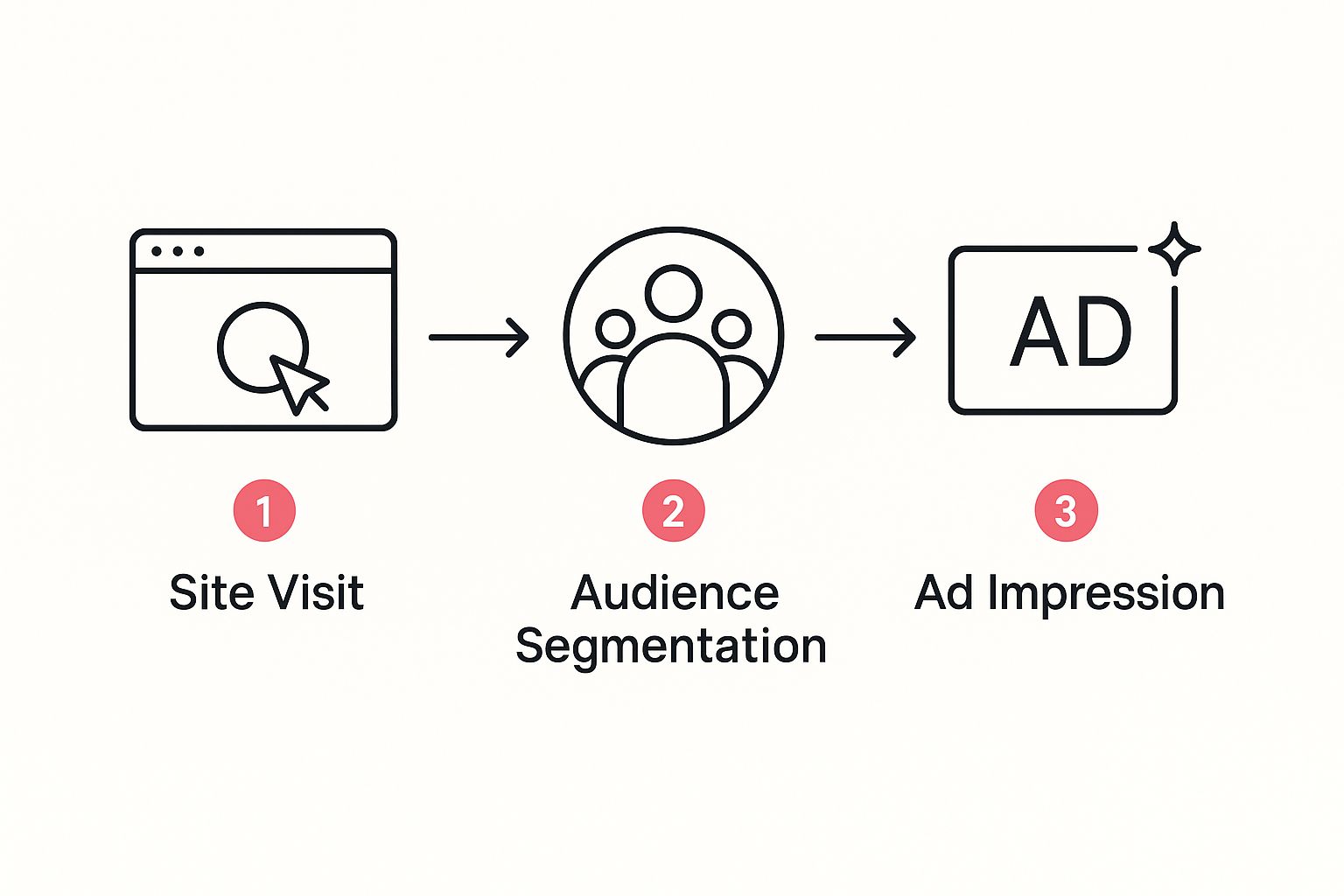
This visual really captures that simple journey from a first-time site visit to seeing a relevant ad elsewhere—the core mechanic for bringing a potential customer back into the fold.
From Anonymity to Action
Once a user gets “tagged” by your pixel, they’re automatically added to your retargeting audience list. This is where the real strategy kicks in. You can—and should—create different audience buckets based on what people actually did on your site.
For example, you could build separate lists for:
- General Visitors: People who hit your homepage and bounced.
- Product Viewers: Folks who checked out specific product pages but didn’t add anything to their cart.
- Cart Abandoners: The highest-intent group. These are the people who added items to their cart but left before checking out.
By segmenting your audience this way, you can serve up ads that speak directly to their level of interest. A cart abandoner might see an ad with a 10% discount to nudge them over the finish line, while a general visitor might just see a simple brand ad.
This personalization is what makes retargeting so powerful. It’s also a huge factor in achieving a high return on ad spend. To get a better handle on this, you can learn more about how to calculate ROAS and see the direct impact these segmented campaigns have on your bottom line.
The Business Case for Retargeting Your Audience

Knowing how retargeting works is one thing, but seeing its direct impact on your bottom line is what really makes it a must-have in your marketing toolkit. The true power of retargeting comes down to efficiency. You stop spending money on cold audiences and start focusing your budget on people who have already raised their hand and shown interest.
These aren’t just random people browsing the web. They’re “warm” leads who’ve already visited your site, looked at your products, or even put something in their cart. By reconnecting with this highly specific group, you give yourself a much better shot at making a sale.
This shift from casting a wide net to precision targeting isn’t just a fleeting trend. The global retargeting market is on track to hit $6.3 billion by 2025, which shows just how much faith marketers are putting into it. In fact, it’s responsible for about 43% of digital ad revenue, proving it’s a major growth engine for businesses of all sizes.
Drive Higher Conversion Rates
The most compelling reason to get on board with retargeting is its incredible ability to boost conversion rates. Think about it: a first-time visitor is usually just exploring, weighing their options, and not quite ready to pull the trigger. But someone who sees your retargeting ad has already shown they’re interested, making them far more likely to come back and finish what they started.
It’s the difference between a window shopper and someone who returns to the store to try on that specific jacket they were eyeing earlier. That second visit is all about intent.
Retargeting campaigns consistently blow standard display ads out of the water. By reminding potential customers of what caught their eye, you bridge the gap between initial curiosity and a final purchase, turning those near-misses into real, measurable revenue.
Rescue Abandoned Carts and Recapture Lost Revenue
For any e-commerce business, the abandoned cart is a familiar headache. A customer finds something they love, adds it to their cart, and then…poof. They’re gone. This is where retargeting swoops in to save the day (and your sales).
You can create campaigns that zero in on users who abandoned their carts, often with a perfectly timed and personalized ad.
- Scenario 1 (E-commerce): A shopper adds a pair of running shoes to their cart but gets distracted by a phone call. Later that day, an ad for those exact shoes pops up on their Instagram feed, maybe with a friendly nudge like, “Still thinking about it? Here’s 10% off to help you decide.”
- Scenario 2 (B2B): A project manager downloads your free guide on productivity. A few days later, they see a LinkedIn ad for a webinar that builds on the guide’s concepts, gently guiding them to the next step.
These timely reminders work wonders at bringing people back into the fold. If you’re curious about why shoppers leave in the first place, our article covering the main https://www.cartboss.io/blog/reasons-for-cart-abandonment/ provides some great insights.
Achieve a Better Return on Ad Spend
Because retargeting focuses on a smaller, more qualified group of people, it’s naturally more cost-effective. You’re not burning cash showing ads to people who have no idea who you are. Instead, every dollar is invested in re-engaging someone who’s already familiar with your brand.
This laser-focused approach leads to a much higher Return on Ad Spend (ROAS). Simply put, you get more bang for your buck, making it one of the smartest financial moves in digital marketing.
To get a better handle on the financial upside, you can explore other strategies to lower customer acquisition cost. Ultimately, by lifting conversion rates and keeping your brand top-of-mind, retargeting doesn’t just drive sales—it builds a more profitable and sustainable marketing machine for your entire business.
Powerful Retargeting Strategies You Can Use
Once you’ve got the basics down, you can start digging into the really fun part: deploying specific strategies that actually move the needle for your business. Let’s be clear—not all retargeting is created equal. A truly smart approach goes way beyond just flashing the same generic ad at every person who ever landed on your site.
The secret sauce is matching your message to what the user actually did. What were they looking for? What did they show interest in?
When you segment your audience and customize your campaigns, you transform your advertising from a simple, and frankly, annoying reminder into a genuinely helpful and relevant conversation. It’s all about picking the right strategy for the right person at just the right moment.
This is what separates a forgettable ad from one that makes someone say, “Oh yeah, I wanted that!” and click “Buy.” Let’s walk through some of the most effective strategies you can start using today.
Choosing Your Retargeting Strategy
Deciding on a retargeting strategy can feel overwhelming with all the options available. The key is to align your approach with your specific business goals and understand where your audience is in their buying journey. Are you trying to close a sale, find new customers, or build a community?
This table breaks down the core strategies to help you see which one fits your needs best.
| Strategy Type | Best For | Key Objective | Example Use Case |
|---|---|---|---|
| Dynamic Retargeting | E-commerce stores with product catalogs | Drive immediate sales & recover abandoned carts | A customer views a specific pair of boots. You show them an ad featuring those exact boots. |
| Search Retargeting | Businesses in competitive markets | Capture new, high-intent customers | Someone searches “best hiking backpacks.” You show them an ad for your top-rated backpack. |
| Engagement-Based | Brands focused on community & long-term value | Nurture leads & build brand loyalty | A user watches 75% of your product video. You retarget them with a webinar invitation or a related blog post. |
| Email/CRM Retargeting | Businesses with an existing email list | Re-engage inactive subscribers & upsell current customers | A subscriber hasn’t opened an email in 90 days. You show them a “We miss you!” offer ad on social media. |
Think of these strategies not as isolated tactics, but as different tools in your marketing toolkit. The most successful campaigns often blend multiple approaches to create a comprehensive and persuasive customer journey.
1. Dynamic Retargeting: The Personal Shopper Ad
For any e-commerce store, dynamic retargeting is an absolute must-have. Forget generic brand ads. This strategy automatically creates ads featuring the exact products a user looked at, added to their cart, or even previously bought from your store. It’s personalization on a whole other level.
Think about it. A potential customer spent time browsing three specific pairs of sneakers on your site but got distracted and left. With dynamic retargeting, the ad they see on social media or another website an hour later will feature those exact sneakers. It’s a powerful and incredibly relevant nudge that feels less like an ad and more like a helpful shopping assistant.
One of the best uses of this strategy is to recover abandoned carts, turning what looks like a lost sale into a successful purchase.
- Who it’s for: E-commerce stores of all sizes. Seriously.
- When to use it: Always. It’s a workhorse for cart abandonment, upselling with related products, and cross-selling with complementary items.
2. Search Retargeting: Reaching People in “Buy Mode”
What if you could advertise to people based on what they’re searching for, even if they’ve never been to your website? That’s the magic of search retargeting. This strategy lets you show your display ads to people who have recently searched for keywords that are directly related to what you sell.
For example, say you sell high-end coffee beans. You can target users who just searched for things like “best single-origin arabica beans” or “gourmet coffee subscriptions.” You’re tapping directly into their expressed interest and introducing your brand as the perfect answer to their search.
This strategy is brilliant because you get to connect with fresh, high-intent audiences who are actively looking for a solution like yours. It’s the precision of search advertising combined with the wide reach of display ads—a powerful combo for finding new customers.
3. Engagement-Based Retargeting: Building Your Tribe
Not every touchpoint is about making an immediate sale. Sometimes, your goal is to nurture a relationship and build a loyal following around your brand. That’s where engagement-based retargeting shines. It focuses on people who have interacted with your content, even if they haven’t visited your site yet.
This includes people who have:
- Watched a significant portion of your video ad.
- Liked, shared, or commented on one of your social media posts.
- Started filling out a form but didn’t hit submit.
These actions are clear signals of interest that are absolutely worth cultivating. You can retarget these engaged users with content that pulls them deeper into your world, like an invitation to a webinar, a link to a popular blog post, or a fun behind-the-scenes video. It’s a softer sell, focused on building trust and making sure your brand stays top-of-mind.
This is also a fantastic strategy to pair with SMS marketing. Imagine targeting someone who engaged with a social post but later abandoned their cart. A follow-up text can be the perfect nudge to complete their purchase. For more ideas on this, check out our guide to improve cart recovery with SMS for practical tips. By weaving these digital touchpoints together, you create a seamless journey that gently guides people back to your store.
Selecting the Right Retargeting Platform

Once you’ve nailed down your strategy, your next big decision is picking where to actually run your campaigns. Think of the platform as the engine for your whole retargeting machine; it’s what connects you to your audience in the digital spaces they already know and love.
The goal isn’t to find the platform with the most bells and whistles. It’s about finding the one that fits your specific audience, budget, and what you’re trying to achieve. A platform that’s a home run for a fashion e-commerce store might completely strike out for a B2B software company. You have to size them up based on who uses them, what kinds of ads you can run, and how much it costs.
Google Ads and the Display Network
When it comes to sheer reach, nothing beats the Google Display Network (GDN). This thing is a juggernaut. It gives you access to a massive network of over two million websites, apps, and videos where your ads can show up, letting you follow your audience just about anywhere they wander online.
Because it’s so massive, the GDN is a pretty safe bet for almost any kind of business. An e-commerce brand trying to win back abandoned carts? A local plumber who just wants to stay top-of-mind? Google’s reach works for both. You can serve up simple text ads, eye-catching image ads, or even video ads to people who’ve already checked out your site.
What really makes it powerful is how you can layer your retargeting with other Google data, like what someone has been searching for. This helps you find people who not only know your brand but are actively in the market for what you sell.
Meta For Facebook and Instagram
If your audience spends their time scrolling through social media—and let’s be honest, whose doesn’t?—then you need to be on Meta’s ad platform. This covers both Facebook and Instagram, giving you a visually-driven environment that’s perfect for showing off products and telling your brand’s story. You’re meeting people where they are, in a more relaxed, personal mindset.
For e-commerce, Meta is a goldmine. Its dynamic retargeting can automatically create carousel ads showing the exact products a person just looked at on your site. It’s personal, it’s relevant, and it works. The targeting is also incredibly granular, letting you build audiences from people who did anything from watching 75% of your video to engaging with a specific post.
Key Insight: Choosing a platform is all about matching your message to the user’s mindset. On Google, people are often in problem-solving or research mode. On Meta, they’re in discovery and entertainment mode. Your ads need to respect that context.
LinkedIn For B2B Professionals
When you’re trying to reach professionals, decision-makers, or people in specific industries, LinkedIn is the undisputed champion. Yes, the clicks can cost more than on other platforms, but the quality of the audience you can target is second to none. The investment is often well worth it.
You can start with people who visited your website and then drill down with powerful filters. Imagine targeting by:
- Job Title: Reach Directors, VPs, or C-suite executives.
- Company Size: Focus on scrappy startups or enterprise-level corporations.
- Industry: Get in front of the right people in finance, tech, or healthcare.
This makes LinkedIn perfect for promoting high-ticket services, webinars, or in-depth whitepapers to a precise professional audience. You can even upload a list of leads from your CRM to make sure your ads are hitting key people at your target accounts. Sometimes, a well-timed text can support this outreach; you can adapt some of these SMS templates for recovering abandoned carts for a B2B follow-up.
Finally, you absolutely cannot ignore mobile. With mobile devices now driving about 60.67% of all web traffic and over 92% of users getting online via their smartphones, a mobile-first approach is non-negotiable. Your ads have to look great and work flawlessly on a small screen. This is where your customers are, and platforms that nail the mobile ad experience are the ones that will help you turn that initial interest into a sale.
Common Questions About Retargeting Advertising
Even when you’ve got the basics down, retargeting can feel like it’s full of tricky details. That’s totally normal. Getting those details right is often what separates a campaign that nails it from one that just annoys people.
Let’s tackle some of the most common questions that pop up. We’ll clear the air on confusing terms, talk real-world costs, and look at the tech that makes it all click. By the end, you’ll have the practical answers you need to get started with confidence.
Is Retargeting the Same as Remarketing?
This is easily one of the biggest points of confusion. You’ll hear “retargeting” and “remarketing” thrown around like they’re the same thing, and honestly, these days they often are. But if you want to get technical, there’s a classic distinction worth knowing.
Think of it like this:
- Retargeting is traditionally about ads. It’s the “ad following you around the internet” thing. A visitor comes to your site, leaves, and then sees your display ads on other websites. This is all powered by browser cookies and is focused on bringing anonymous visitors back to become customers.
- Remarketing, in its classic sense, was all about email. You already have a customer’s contact info, and you use it to re-engage them. A perfect example is sending an abandoned cart email. You’re “remarketing” to an existing contact to get them to finish a purchase.
In reality, the line has blurred completely. Platforms like Google Ads now use the term “remarketing” for their entire suite of re-engagement tools, including display ads. So, while a subtle difference exists, don’t get too hung up on it. The main takeaway is that both are about getting a second chance to connect with an interested person.
How Much Does Retargeting Actually Cost?
There’s no single price tag on retargeting, which can be both a good and a bad thing. The cost is all over the map, but the good news is that it’s widely seen as one of the most cost-effective ad strategies out there. You’re not shouting into the void; you’re talking to people who already know you, which means less wasted money.
Your costs will typically be based on one of two models:
- Cost-Per-Click (CPC): You pay only when someone clicks your ad. Simple. This is perfect for campaigns where your main goal is to drive traffic back to your site.
- Cost-Per-Mille (CPM): You pay a set price for every 1,000 times your ad is shown (an “impression”). This is the go-to for brand awareness campaigns where just being seen is the primary win.
So what pushes the price up or down? A few key things:
- Audience Size: Want to reach more people? You’ll need a bigger budget.
- Industry Competition: In a crowded market like fashion or electronics, you’ll have to bid higher to get your ads seen.
- Ad Placement: A banner on a major news site will cost more than one on a niche blog.
- Campaign Duration: The longer you run your ads, the more you’ll spend.
The most important thing to remember is that you are in the driver’s seat. You set the daily or lifetime budget, so you never have to worry about spending more than you’re comfortable with.
How Can I Avoid Annoying My Audience?
This is a big one. Nobody wants to be the brand that feels “creepy” or just plain annoying. It’s a valid fear, but luckily, it’s one you have complete control over. Being respectful is all about smart campaign management.
Your number one tool here is frequency capping. Every major ad platform has this feature, and it lets you set a limit on how many times one person sees your ad in a given time frame (say, no more than 5 times a day). This is your first line of defense against driving people crazy.
Next up, rotate your ads. Seeing the exact same creative over and over for weeks is a guaranteed way to make your audience tune you out. Keep things fresh. Swap in new images, tweak the headline, or introduce a different offer. This not only prevents burnout but also helps you test which messages actually work.
Finally, get smart with your targeting. You absolutely must exclude converters—the people who already bought the thing! There’s nothing more irritating than being chased by ads for a product you now own. Instead, you can move them to a new list for a future campaign, maybe to cross-sell a related product. You can apply this thoughtful approach everywhere; for instance, learn the abandoned cart email best practices and strategies to work in tandem with your ads, not against them.
What Is a Retargeting Pixel?
The “pixel” is the tiny engine that makes this all work. It sounds super technical, but the concept is surprisingly simple. A pixel is just a small, invisible snippet of code that you add to your website.
Here’s how it works: When someone lands on your site, their browser loads this bit of code. The pixel then drops an anonymous cookie (a tiny text file) into their browser. This cookie contains no personal information—no name, no email, nothing identifiable. It just acts as a unique ID marker, flagging that browser as one that has visited your site.
Later, when that person is browsing other sites in your ad network (like sites that show Google or Meta ads), the network’s system spots that cookie. That’s the signal! It tells the system, “Hey, this is one of our people. Show them the ad.”
Getting the pixel on your site is usually a simple copy-and-paste job. Ad platforms give you clear instructions, and popular website builders like Shopify or WordPress often have plugins that handle the whole thing for you. It’s a one-time setup that unlocks all of your retargeting power.
Ready to stop losing sales to abandoned carts? CartBoss uses the power of automated SMS to re-engage your customers and recover lost revenue on autopilot. Turn missed opportunities into profit and see your sales soar. Get started with CartBoss today and watch your conversions climb.