



At its core, SMS marketing is simply sending promotional or transactional messages straight to your customers’ phones via text. It’s a direct, personal line of communication that cuts right through the noise of crowded email inboxes and busy social media feeds. Your message lands exactly where you know your customers will see it.
Understanding SMS Marketing And Why It Matters
Think about the difference between getting a generic flyer in the mail and getting a quick text from a friend about a sale at your favorite store. That text feels personal, timely, and instantly useful. That’s the magic of what makes SMS marketing so powerful. It shifts business communication from a broad, megaphone-style announcement to a direct, one-on-one conversation.
This channel taps into the simple fact that almost everyone has a mobile phone, creating an immediate connection. While emails might sit unread for days, text messages are almost always opened within minutes. This speed makes it a total game-changer for time-sensitive promotions, critical updates, and building real customer relationships. If you want a deeper dive into the basics, check out this great resource on What is SMS Marketing.
The Power Of A Direct Channel
The real strength of SMS marketing is in its straightforward, no-frills approach. A text message arrives in a space that’s usually reserved for conversations with friends and family. This gives it a sense of priority and importance that few other marketing channels can ever hope to achieve.
For businesses, this translates into some serious advantages:
- Unmatched Visibility: With open rates hitting as high as 98%, your message is practically guaranteed to be seen.
- Immediate Action: The short, punchy nature of SMS drives quick responses, making it perfect for flash sales or limited-time offers.
- Stronger Relationships: Helpful texts—like shipping confirmations or back-in-stock alerts—build genuine trust and loyalty with your customers.
“SMS marketing is no longer just a trend; it’s a fundamental shift in how brands communicate. Its power lies in its ability to create a personal, immediate connection with customers in a way that feels more like a conversation than an advertisement.”
Having this direct line to your audience is priceless. It completely bypasses ad blockers and social media algorithms, ensuring your message lands right in your customer’s hands.
SMS Marketing Vs Email Marketing At A Glance
To truly get a feel for its unique role, it helps to put SMS side-by-side with its digital cousin, email marketing. Both are crucial tools in any marketer’s belt, but they play very different games. Think of one as a sniper rifle for urgent, high-impact messages, while the other is a wide net for casting a broader, more detailed story.
This quick comparison table breaks down the key differences.
| Metric | SMS Marketing | Email Marketing |
|---|---|---|
| Open Rate | As high as 98% | Around 21-37% |
| Response Time | Typically within 90 seconds | Can take hours or days |
| Message Length | Short & concise (160 characters) | Long-form, detailed content |
| Best For | Urgent alerts & flash sales | Newsletters & brand stories |
| Perception | Personal & immediate | Formal & informational |
As you can see, each channel has its own strengths. While email is fantastic for nurturing leads with in-depth content, SMS is unbeatable when you need to grab attention and drive action right now.
The Undeniable Benefits of Text Message Marketing

Knowing what SMS marketing is shows you its potential, but the real magic is in the tangible results it brings to your business. While other channels are busy yelling into a crowded room, text messages cut straight through the noise. They offer a direct, uncluttered line to your customers where they’re already paying attention—their phones.
This isn’t just about sending another promotional message; it’s about making a real impact where it counts. The benefits go way beyond simple communication, translating directly into measurable growth in engagement, customer loyalty, and, most importantly, revenue.
Let’s break down exactly why you can’t afford to ignore this channel any longer.
Unbeatable Engagement And Open Rates
The single biggest reason to get on board with SMS marketing is its incredible engagement. Imagine sending out a promotion knowing that it will almost certainly be read. With text marketing, that’s not a fantasy—it’s the reality.
The global SMS marketing industry is a juggernaut, with spending recently hitting an enormous $327.1 billion. This massive investment is fueled by some eye-watering stats. Around 98% of all text messages are opened and read, a number that absolutely dwarfs the average email open rate.
Even better, text messages can pull in response rates as high as 45%, blowing email’s 6% out of the water. With an opt-out rate hovering near zero, it’s clear that customers actually value this type of communication. This means your most critical announcements, from flash sales to event reminders, get seen almost every single time.
“When an email lands in a crowded inbox, it’s a suggestion. When a text message arrives on a locked screen, it’s an event. That fundamental difference in user perception is what drives the superior performance of SMS.”
This high-impact visibility leads directly to faster action from customers and higher conversions for your time-sensitive campaigns.
The Power Of Immediacy And Urgency
In a world of instant gratification, speed is everything. SMS is simply the fastest way to get a message to someone and get them to act on it. Most texts are read within just three minutes of being received, making it the perfect tool for creating a powerful sense of urgency.
Think about these scenarios where speed is your secret weapon:
- Flash Sales: Announce a 2-hour sale and watch customers scramble to buy. The short time frame, delivered instantly, creates a powerful fear of missing out (FOMO).
- Event Reminders: A quick “See you in an hour!” text before a webinar or in-store event can dramatically boost attendance.
- Last-Minute Promotions: Got extra inventory or a slow afternoon? A simple “25% off until we close!” text can completely turn your day around by driving immediate traffic.
This kind of speed is a strategic advantage. It lets you be nimble and react to what’s happening in the market in a way slower channels just can’t match.
Forging Stronger Customer Relationships
Beyond just sales, text messaging helps you build a more personal, one-on-one connection with your audience. Because it feels like a conversation, it comes across less like mass marketing and more like a helpful update from a brand they trust.
Transactional messages are a perfect example. Sending order confirmations, shipping updates, and delivery alerts via SMS provides genuine value and builds customer confidence. It keeps them in the loop and reassured every step of the way.
This personal touch builds loyalty that sticks. When customers feel seen and valued, they’re far more likely to come back and become advocates for your brand. To do this right, it’s vital to follow the latest SMS marketing best practices for engagement and ROI.
How To Build Your SMS Marketing Strategy
A powerful tool is useless without a solid plan. Launching an SMS marketing program might seem like a huge undertaking, but if you break it down into clear steps, it’s much more manageable. A good strategy makes sure every single text you send has a purpose, clicks with your audience, and brings back real, measurable results.
Think of it like building a bridge. You need a strong foundation (your subscriber list), a well-designed structure (your messages), and a way to measure the traffic (your analytics). Skip a step, and you’ll have a hard time reaching your destination—more sales and happier customers.
This flow chart breaks down the core steps to get your first campaign up and running.
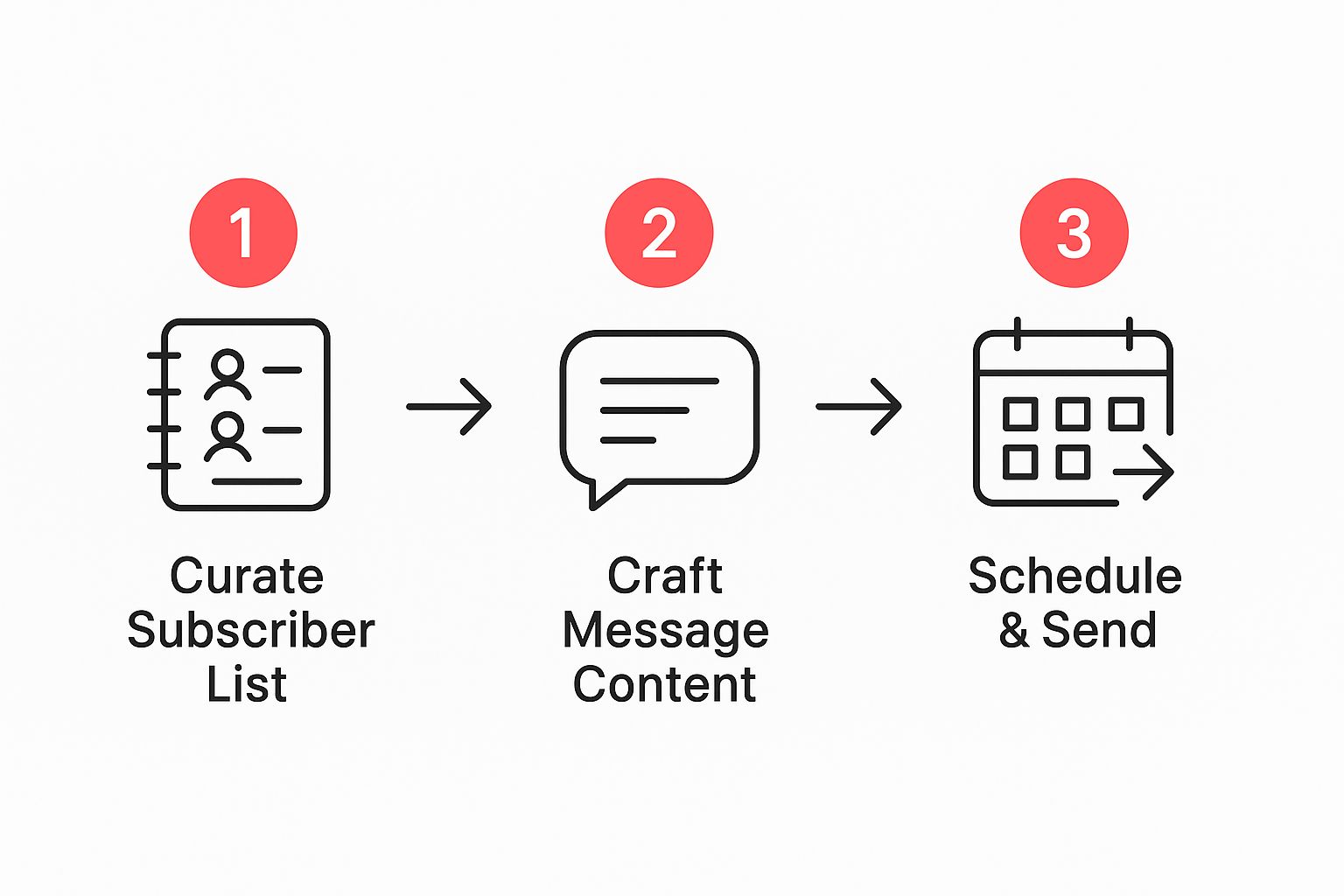
As you can see, a great campaign always starts with a quality list, moves to thoughtful content, and ends with smart execution.
Build A Compliant and Engaged List
The absolute first step—and this one is non-negotiable—is building your contact list. Unlike other channels, you can’t just text anyone you want. You absolutely must have explicit, written consent from every single person before sending them marketing messages. This isn’t just a friendly suggestion; it’s the law under regulations like the TCPA.
The best way to get people on board is to offer them something valuable in return. Give them a reason to hand over their phone number.
- Exclusive Discounts: Offer a 15% off coupon for anyone who signs up.
- Early Access: Let SMS subscribers be the first to know about new product drops.
- Valuable Content: Send helpful tips or alerts they can’t get anywhere else.
When the benefit is clear, you attract people who are genuinely interested, which means they’re far more likely to engage with your texts later on.
Choose The Right SMS Platform
Once you start getting contacts, you’ll need a platform to manage your list and send out campaigns. Texting customers one-by-one from your phone just won’t work—it’s not scalable or compliant. An SMS marketing platform is your command center for everything from automation to analytics.
When you’re picking a provider, look for features that actually help your business. For eCommerce stores, a platform like CartBoss is a game-changer because it’s built to solve problems like abandoned cart recovery, automated message flows, and easy integration with Shopify and WooCommerce.
Segment Your Audience For Personalization
Sending the same generic message to your entire list is a rookie mistake. The real magic of SMS happens when you get personal. Segmenting your audience just means grouping subscribers based on things they have in common.
“A message for everyone is a message for no one. Segmentation transforms your SMS marketing from a broadcast into a meaningful conversation, dramatically increasing relevance and response.”
You can create segments based on things like:
- Purchase History: Target customers who bought a specific product with a relevant upsell.
- Location: Send special offers for local events or promotions.
- Engagement Level: Reward your most loyal subscribers with VIP perks.
Personalized messages feel like they were written just for them, and that makes them far more likely to convert.
Craft Compelling Copy That Converts
You’ve only got 160 characters to make an impact, so every word counts. Your copy needs to be clear, short, and persuasive, with a strong call-to-action (CTA) that tells people exactly what to do next.
A great text message tells them who you are, what the deal is, and what to do now. Emojis can add a bit of personality and grab attention, but don’t overdo it. Always include a link—preferably a shortened one to save space—so they can take action right away. This channel is a powerhouse; SMS marketing in the Americas recently grew by 42% and boasts a click-through rate of 12%—that’s more than five times higher than email.
Track Your Results And Optimize
Finally, what’s the point of a strategy if you don’t track your success? Keeping an eye on key metrics is crucial for figuring out what’s working and what isn’t. The most important numbers to watch are your click-through rate (CTR), conversion rate, and unsubscribe rate. A solid grasp of these figures is key to improving your SMS marketing ROI.
If a campaign has a low CTR, try A/B testing your copy or the offer itself. If your conversion rate is lagging, take a hard look at your landing page to see what’s getting in the way. To make life easier, you can streamline your entire process by automating workflows with Zapier, which connects your SMS platform to all the other tools you rely on.
Popular Types Of SMS Marketing Campaigns
Once you’ve got a strategy in place, the real fun begins. Knowing what SMS marketing is in theory is one thing, but seeing it in action shows you just how versatile it really is. It’s not a single tool—it’s a whole toolbox, with different campaign types built to hit specific goals at different points in the customer journey.
Think about it like this: you wouldn’t use a hammer to turn a screw. In the same way, the kind of text you send depends entirely on what you want your customer to do next. Are you trying to land an immediate sale, build trust after a purchase, or win back a hesitant shopper? Each scenario calls for a totally different approach.
By looking at these different campaign types, you can start to see how SMS fits into your wider marketing efforts, taking you from simple blasts to smart, relationship-building conversations.
Promotional Messages That Drive Sales
Promotional messages are the workhorses of SMS marketing. Their goal is simple: drive action and make money. These are the texts that shout about sales, share discount codes, and create a powerful sense of urgency that gets customers to buy now.
Because texts are almost impossible to ignore, they are the perfect way to deliver time-sensitive offers that would just get buried in a crowded email inbox. The trick is to make the offer feel exclusive and genuinely valuable.
Here are a few classic examples:
- Flash Sales: “SURPRISE! ⚡ Get 30% OFF everything for the next 3 hours only. Don’t miss out! Shop now: [link]”
- New Product Drops: “It’s here! Our new Summer Collection just landed. Be the first to get yours before it sells out: [link]”
- Holiday Promotions: “Our Black Friday deals are LIVE! Get up to 50% off sitewide. The best deals go fast, so hurry! [link]”
These messages work because they are direct, exciting, and have a crystal-clear call-to-action (CTA). They tap into the fear of missing out (FOMO) and push your most engaged subscribers to make a quick decision.
Transactional Messages That Build Trust
Not every text needs to sell something. Transactional messages are automated texts sent in response to a specific customer action, and their main job is to provide helpful information and build trust. These are the messages that make your customers feel looked after and in the loop.
Think of them as the digital version of a friendly and reliable store clerk keeping you updated. They deliver huge value and reinforce the idea that your brand is dependable and focused on the customer.
A great transactional SMS reassures the customer that you’ve got everything under control. It’s not about making another sale; it’s about confirming the value of the sale they just made, which is crucial for building long-term loyalty.
Common transactional messages include:
- Order Confirmations: “Thanks for your order, Jane! We’ve received it (#12345) and will let you know when it ships. View details: [link]”
- Shipping Updates: “Good news! Your order #12345 has just shipped. Track your package here and get ready: [link]”
- Delivery Alerts: “Heads up! Your package has been delivered. We hope you love it! Let us know what you think.”
These simple, helpful updates are a cornerstone of a great post-purchase experience.
Conversational Messages That Recover Revenue
This is where SMS marketing gets really powerful. Conversational messages go beyond one-way blasts and open the door for real, two-way interaction. They’re designed to engage customers on a personal level, answer their questions, and gently guide them back to complete a purchase they were on the fence about.
The most valuable type of conversational message is the abandoned cart reminder. When a customer adds items to their cart but leaves without paying, a well-timed text can be the perfect nudge to bring them back. It’s not uncommon for abandoned cart texts to see click-through rates of over 50%.
Platforms like CartBoss are built specifically for these automated yet personal interactions, making it dead simple to recover sales that would otherwise be gone for good. For a deep dive, you can check out our guide on how to set up effective abandoned cart SMS reminders. These messages often work best with a small incentive and a direct link back to a pre-filled checkout, making it incredibly easy for the customer to pick up where they left off.
How CartBoss Powers Your SMS Marketing
Knowing the theory behind SMS marketing is one thing, but actually putting it to work is where you see real growth. This is exactly where a powerful, purpose-built tool becomes your most valuable player. While plenty of platforms can send a basic text, a specialized solution like CartBoss was designed from the ground up to solve the biggest headaches for ecommerce stores.
Think of CartBoss less as a simple messaging tool and more as an automated sales recovery partner. It connects all the dots we’ve talked about—from getting compliance right to automating entire campaigns—into one smooth system. It’s built to turn the complex job of winning back lost sales into a simple, set-and-forget process.
Effortless Sales Recovery and Automation
The real magic of CartBoss lies in its laser focus on recovering abandoned carts. It’s a fact that a shocking number of shoppers leave without buying, but a well-timed text message can bring a huge chunk of them right back. CartBoss automates this entire workflow with pre-built, optimized messages that are already proven to convert.
And these aren’t just generic, boring reminders. CartBoss is packed with smart features to squeeze every last drop of potential out of your recovery efforts:
- Pre-Filled Checkouts: When a customer clicks the link in a recovery text, their cart is instantly restored and their details are already filled in. This removes all the annoying friction, making it ridiculously easy to finish the purchase.
- Dynamic Discounts: You can automatically generate and apply unique discount codes to sweeten the deal. It’s a powerful nudge for hesitant shoppers to act right away.
- Smart Timing: Messages are sent at the perfect moment to grab attention without being intrusive, thanks to a built-in do-not-disturb mode that respects your customers’ time.
A great SMS tool doesn’t just send texts; it tears down every possible barrier between a customer’s impulse and their final purchase. When you make the checkout process that effortless, you dramatically increase your chances of recovering a sale.
Simplified Compliance and Global Reach
One of the biggest hurdles for businesses getting started with SMS is figuring out all the legal rules for consent. CartBoss takes care of these headaches for you, making sure every single message you send is fully compliant with regulations like GDPR and TCPA. This removes a major roadblock and lets you focus on your strategy with total peace of mind.
Better yet, CartBoss is built for global business from day one. It automatically detects the recipient’s country and sends messages from a library of professionally translated templates. This means you can connect with customers all over the world in their native language, creating a much more personal and effective experience.
This combination of automated power and built-in compliance makes it one of the most effective tools for any online store looking to boost its bottom line. To see how these features come together, explore our detailed guide on SMS marketing for ecommerce and start turning more visitors into loyal customers.
What’s Next for SMS Marketing?
If you think SMS marketing is old news, think again. It’s not going anywhere—in fact, it’s just getting smarter. The future isn’t about replacing text messages but making them more interactive and seamlessly woven into the entire customer experience. The very things that made SMS so powerful in the first place, its directness and near-universal reach, are still its biggest strengths.
The next evolution of SMS is all about blending that classic simplicity with more sophisticated tech. It’s not a total reinvention, but an enhancement. Picture it less like a one-off text blast and more like the start of a dynamic, helpful conversation that adapts to what each customer needs, right in the moment.
The Rise of Smarter Messaging
One of the most exciting shifts we’re seeing is the move toward AI-driven personalization. Imagine sending messages that go beyond simple segmentation. Instead, AI crafts texts that match a customer’s unique tone, preferred timing, and even their intent. This creates a level of personalization that feels genuinely one-on-one.
Another huge leap forward is the growth of Rich Communication Services (RCS). Think of RCS as SMS on steroids. It transforms a standard text thread into an interactive, app-like experience right inside the native messaging app.
With RCS, you can:
- Send high-resolution images and product carousels.
- Incorporate branded sender information to build immediate trust.
- Add interactive buttons like “Buy Now” or “Track Package” directly in the message.
This technology turns a simple text into a rich, engaging experience without forcing your customer to download yet another app.
The future of SMS marketing is all about combining the intimacy of a text message with the functionality of a web browser. It’s about delivering richer, more convenient experiences right where your customers already are—their messaging app.
Why SMS Remains a Cornerstone of Marketing
Even with all these fancy new features, the core appeal of SMS isn’t going to change. Its simplicity is its superpower. In a world cluttered with complex algorithms and crowded social media feeds, the direct, clean nature of a text message is more valuable than ever. It will always be the best channel for urgent, can’t-miss communications.
The numbers back this up. The SMS marketing industry is set to grow at a compound annual growth rate (CAGR) of 20.8% through 2030 in the United States alone. Why? Because nearly everyone has a smartphone, making SMS a universal touchpoint for brands. If you want to dive deeper into the figures, check out our full breakdown of SMS marketing statistics and performance insights.
Ultimately, building out your SMS strategy today is a future-proof move. By embracing new technologies while staying true to the channel’s core strengths, you’re setting up a communication system that will deliver results for years to come.
A Few Common Questions About SMS Marketing
As you get more comfortable with the idea of text message marketing, a few practical questions always pop up. It’s totally normal. Getting clear answers is the last step before you can jump in and launch your own SMS program with confidence.
Let’s tackle the big ones head-on so you can move forward without any second-guessing.
Is SMS Marketing Even Legal?
This is usually the first question people ask, and for good reason. The answer is a simple yes, as long as you do it the right way. SMS marketing is all about permission. The absolute key to staying on the right side of laws like the Telephone Consumer Protection Act (TCPA) is getting clear, undeniable consent from your subscribers.
You have to be able to prove that a person explicitly agreed to get marketing texts from you. This isn’t something you can bend the rules on.
- Explicit Opt-In: A customer must take a clear action to subscribe. Think checking a box at checkout or texting a keyword to your number. You can’t just scrape phone numbers from past orders and add them to your list.
- Easy Opt-Out: Every single message must give subscribers a simple way to leave, like replying “STOP.”
Following these rules isn’t just about avoiding a legal headache; it’s about building trust. When your customers know they’re in control, they’re much more likely to listen to what you have to say.
How Much Does SMS Marketing Cost?
The cost can vary, but it’s probably more affordable than you think, especially when you look at the returns. The pricing usually involves a couple of moving parts.
When you’re looking at the cost, don’t forget to think about the return on investment (ROI). A channel with a 98% open rate is going to deliver a lot more bang for your buck than cheaper, less effective options.
Most platforms run on a pay-as-you-go model or a monthly subscription. Here’s a quick breakdown of what to expect:
- Cost Per Message: This is your main expense. It’s often just a fraction of a cent to a few cents per text, depending on who you go with and how many you send.
- Platform Fees: Some services have a monthly fee that covers their software, features, and any support you might need.
- Keyword Costs: You might find a small fee for dedicated short codes or custom keywords.
The best way to keep costs in check is to focus on sending valuable, targeted messages to a list of people who actually want to hear from you. That way, you’re not wasting a dime on texts that don’t drive sales.
Can SMS Really Work For My Small Business?
Absolutely. In fact, SMS marketing is a fantastic tool for small businesses, allowing them to connect with customers on a personal level that big brands with huge ad budgets often miss. You don’t need a massive team or a bottomless wallet to get incredible results from a smart SMS campaign.
The direct, one-on-one nature of a text message helps you build real relationships with your customers. Because it’s easy to get started and many platforms are built to be user-friendly, it’s one of the most accessible and high-impact marketing channels out there today.
For a small business, a focused strategy—like recovering abandoned carts or sending flash sale alerts to loyal customers—can create a serious and immediate jump in revenue. It just goes to show you don’t have to be big to make a big impact with SMS.
Ready to turn your abandoned carts into profit? CartBoss makes it easy to set up automated, high-converting SMS campaigns that win back lost sales on autopilot. Get started today and see your revenue soar. Find out more at CartBoss.io.