


When you start looking into SMS marketing, the first question is usually about the cost. The short answer is that you can expect to pay anywhere from $0.01 to $0.05 per message, plus a monthly fee for the platform you use. But the real answer is a bit more nuanced than that.
Your final bill is a mix of a few key things: how many messages you’re sending, which provider you go with, and what extra features you need to run your campaigns.
A Realistic Look at SMS Marketing Costs
Trying to pin down the exact cost of SMS marketing can feel like you’re trying to hit a moving target. The per-message price is what everyone focuses on, but it’s just one piece of a much bigger puzzle.
A good way to think about it is like your mobile phone plan. You have a base monthly fee just for having the service, and then you pay for what you actually use—in this case, the texts you send out.
Several factors come together to determine your total investment. The most obvious one is your sending volume. Just like buying in bulk, the more messages you send, the lower your per-message rate tends to be. But there are other costs to keep on your radar.
The Primary Cost Components
Your monthly invoice will be a blend of a few different charges, so it’s good to know what they are from the start. This helps you build a realistic budget and avoid any surprises when the bill arrives. The main things you’ll see are:
- Platform Subscription Fees: This is the flat monthly or annual fee you pay for access to the software itself. It covers things like the dashboard, analytics, customer support, and all the campaign-building tools.
- Per-Message Rates: This is the direct cost for every single SMS (or MMS, which costs more) that you send to a subscriber. It’s the core usage-based part of your bill.
- Carrier Surcharges: These are small fees that mobile carriers like T-Mobile, Verizon, and AT&T charge for using their networks to deliver business texts. Your SMS provider simply passes this cost along to you.
- Keyword and Number Fees: Sometimes, providers will charge extra for things like a dedicated short code (the 5-6 digit number you text from) or specific vanity keywords you want to reserve.
To put it all together, here’s a quick overview of what you can expect to see on your bill.
SMS Marketing Cost At a Glance
| Cost Component | Typical Price Range | What It Covers |
|---|---|---|
| Platform Subscription | $25 – $500+ per month | Access to software, features, analytics, and support. |
| Per-Message Rate | $0.01 – $0.05 per SMS | The cost for each individual text message sent. |
| Carrier Surcharges | ~$0.002 – $0.005 per SMS | Fees from mobile carriers for network usage. |
| Keywords/Numbers | $5 – $1,000+ per month | Dedicated short codes, long codes, or vanity keywords. |
As you can see, the costs can add up, but they are predictable once you understand the components.
While the average cost of an SMS message can be as low as a penny, it adds up quickly with volume. For a company sending 100,000 messages in a month, the usage fees alone could easily land somewhere between $4,000 to $5,000.
This is why picking the right platform is so important for keeping costs under control. To see how different services stack up, check out our guide on the top 5 affordable SMS marketing services & pricing comparison. It breaks down the numbers to help you find the best fit for your budget and your business.
Decoding Your SMS Marketing Invoice

When you first look at an SMS marketing invoice, it can feel like you’re trying to read a new language. You see the basic cost-per-message, but then a bunch of other line items pop up that can be pretty confusing. Don’t worry, they all follow a logical pattern once you get the hang of it.
Think of it like picking a cell phone plan. Some people want to pay for the exact data they use, no more, no less. Others prefer the consistency of a flat monthly bill. SMS marketing platforms work the same way, offering different options to fit how often you send messages and what your budget looks like.
Common Pricing Models Explained
Most providers build their pricing around one of three core models. Getting familiar with these is the first step to figuring out your costs and picking a plan that actually makes sense for your business.
- Pay-As-You-Go (PAYG): This is as straightforward as it gets. You buy a bundle of message credits and use them whenever you need to, with no monthly fees. It’s a perfect starting point for businesses with irregular campaigns or anyone just dipping their toes into SMS.
- Monthly Subscriptions: With a subscription, you pay a set fee each month for a specific number of message credits and access to the platform’s features. This gives you predictability, which is great for businesses that send messages on a consistent schedule.
- Tiered Plans: This is a popular type of subscription where your cost per message drops as you send more. For instance, a plan might be $99 for 2,500 messages a month, but you could jump to a higher tier and get 10,000 messages for $299. Your total bill is higher, but your effective cost for each text is much lower.
This tiered model is built to reward growth, making it a smart choice for businesses that are actively scaling their SMS marketing.
Uncovering Potential Hidden Costs
The price you see on the pricing page isn’t always the full story. The total cost of SMS marketing often has a few extra fees that can sneak up on you if you’re not looking for them. They aren’t exactly “hidden,” but they’re easy to miss in the fine print.
A critical part of budgeting is accounting for carrier surcharges and registration fees. These are non-negotiable costs passed on from mobile networks and regulatory bodies, ensuring your messages are delivered reliably.
Here are the most common charges to watch for on your invoice:
- Carrier Surcharges (A2P 10DLC Fees): Mobile carriers like AT&T and T-Mobile tack on tiny fees for every business (Application-to-Person) text sent through their network. We’re talking fractions of a cent per message, but they can really add up if you’re sending thousands of texts.
- Short Code or Long Code Leasing: If you want a dedicated number for your brand—like a memorable 5-6 digit short code—you’ll have to pay a monthly or quarterly leasing fee. A short code alone can run you anywhere from $500 to $1,500 per month.
- Premium Rates for MMS: Sending a message with a picture or GIF (MMS) will almost always cost more than a plain text SMS. If you want to get into the weeds on why, check out our guide explaining what separates SMS and MMS messaging.
- Keyword Rental: Some platforms will charge an extra monthly fee to reserve specific keywords for your campaigns, like “Text DEALS to 55555.”
Once you know to look for these costs, you can scan any provider’s pricing with confidence and put together a budget that won’t have any nasty surprises.
How SMS Provider Pricing Models Compare
Picking an SMS provider isn’t as simple as just finding the cheapest price per text. It’s really about finding a platform that fits how your team works. The cost of SMS marketing is tangled up with the kind of provider you choose, and they generally fall into two main camps.
First, you have the developer-focused, API-first platforms. Think of these as the raw ingredients. They’re powerful, super flexible, and built for businesses that have a technical team ready to code custom solutions. Pricing is almost always usage-based, which gives you incredible control over every penny you spend.
Then you have the all-in-one marketing platforms. These are designed for marketers, not developers. They’re user-friendly, packed with features, and let you launch campaigns fast without touching a single line of code. Their pricing usually involves a monthly subscription that bundles features and a set number of message credits together.
Developer Platforms vs. All-In-One Software
So, which one is right for you? It all comes down to your resources and what you’re trying to achieve.
A developer-centric model offers total customization, but you absolutely need the technical chops to manage it. It’s like being handed a box of high-end engine parts—you can build a world-class race car, but only if you’re a skilled mechanic.
An all-in-one platform is more like buying a brand-new car right off the lot. It’s ready to go, complete with a simple dashboard, built-in navigation (your analytics), and cruise control (automation). This convenience often comes with a higher price tag, but it saves you from needing a dedicated development team. If you want to see how this plays out in the real world, you can check out some detailed comparisons of top SMS marketing platforms for ecommerce to see how their features and costs stack up.
Choosing a provider is a strategic decision. An API-first platform might look cheaper with its low per-message cost, but the total cost of ownership—factoring in developer salaries and ongoing maintenance—can easily end up being more than a straightforward subscription.
The different pricing models can feel a bit abstract, so let’s break them down. Most providers, whether they’re built for developers or marketers, use some form of tiered pricing. The more you send, the less you pay per message. It’s a clear financial incentive to scale up your campaigns.
Comparison of SMS Marketing Platform Pricing Models
To help you visualize the differences, here’s a quick table comparing the typical pricing structures you’ll encounter.
| Provider Type | Common Pricing Model | Best For | Example Providers |
|---|---|---|---|
| All-in-One Platforms | Monthly/Annual Subscription | E-commerce stores, marketing teams, businesses without developers. | Postscript, Attentive, CartBoss |
| API-First Platforms | Pay-As-You-Go (Usage-Based) | Tech companies, large enterprises, businesses with in-house dev teams. | Twilio, Sinch |
| Hybrid Platforms | Subscription + Usage Fees | Businesses needing both a user-friendly interface and API flexibility. | Klaviyo, Omnisend |
As you can see, the “best” model really depends on your team’s skills and your business goals. There’s no one-size-fits-all answer.
A Look at Real-World Pricing
Let’s make this even more concrete. Here’s a typical pay-as-you-go pricing structure from a major API-first provider. Notice how the cost per message drops as the sending volume goes up.
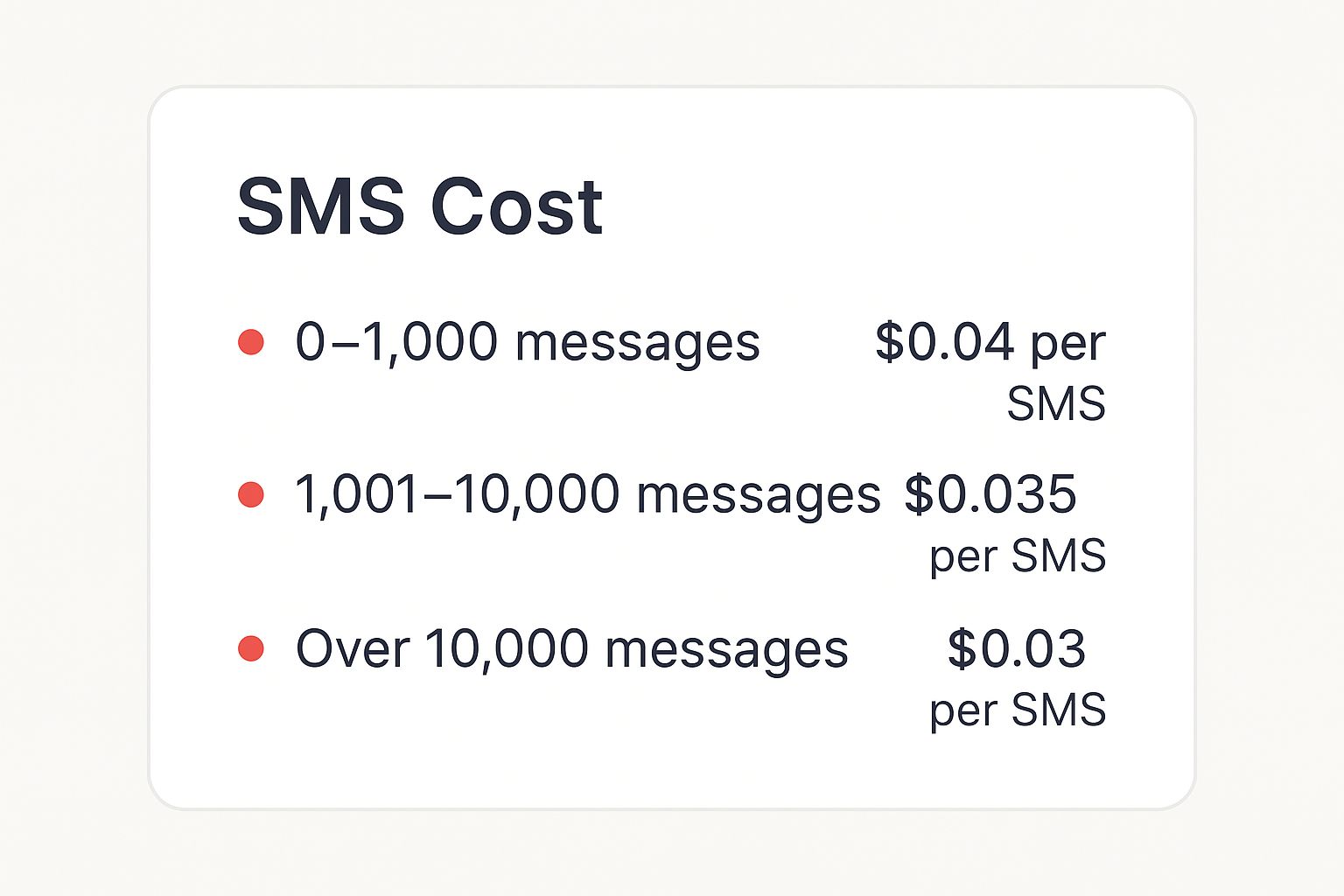
This model offers incredibly detailed, usage-based billing, but it puts the burden on your team to manage everything from compliance to deliverability through code. For most e-commerce businesses, an all-in-one solution provides a much clearer and more direct path to seeing a return on investment by making campaign setup and management a breeze.
Key Variables That Impact Your Final Bill
Figuring out the per-message rate is a good first step, but the final cost of SMS marketing is rarely that simple. A few key variables can dramatically change what you end up paying, turning a seemingly low price into a much bigger expense.
Knowing what these factors are helps you plan smarter, more cost-effective campaigns right from the start.
The biggest factor by far is message volume. Just like buying in bulk at Costco, the more texts you send, the less you pay for each one. SMS providers reward high-volume senders with lower rates, creating a powerful economy of scale.
A small business sending 1,000 texts a month might pay $0.04 per SMS. In contrast, an enterprise sending one million could see that rate drop to just $0.015. This means as your contact list grows, your efficiency actually improves, making SMS an increasingly profitable channel.
Message Type and Destination
Beyond just how many texts you send, what you send and where you send it play a huge role in your final bill. These two factors can easily double or even triple your costs if you aren’t paying close attention.
- SMS vs. MMS: Sending a plain text message (SMS) is always the most affordable option. But if you want to include a GIF, image, or video (MMS), expect to pay a premium. MMS messages typically cost 2-3 times more than a standard SMS because they use more data to deliver that richer content.
- Domestic vs. International: Where your customers are located matters. Sending texts within your own country is standard, but sending internationally always comes with higher fees from cross-border carriers. These costs can vary wildly from one country to another.
Your message’s final destination and content are critical cost drivers. International sends are always more expensive, and a simple choice like adding an image can instantly multiply the cost of a campaign.
For example, sending a message to a neighboring country could be slightly more expensive, while sending one across the globe could be significantly pricier. For a deeper dive, platforms like Rebrandly offer insights into how these costs are calculated.
The Impact of Message Length
Finally, one of the most overlooked variables is the length of your message. A standard SMS is capped at 160 characters. If you go even one character over this limit, your message gets broken down into multiple segments, and you get billed for each one.
A message with 161 characters will be sent as two separate texts, doubling your cost for that send. A 350-character message will be split into three segments, tripling the cost. This is why keeping your copy concise isn’t just good marketing—it’s a smart financial decision.
To get the hang of this, you might want to check out our guide on decoding the SMS character limit. By managing these four variables—volume, type, destination, and length—you gain direct control over your SMS marketing spend.
Calculating Your SMS Marketing ROI
Talking about the costs of SMS is only half the story. The real question every store owner has is: does this investment actually make me money? This is where we stop thinking about SMS as just another expense and start seeing it for what it truly is—a powerful engine for growth.
The conversation around the cost of SMS marketing isn’t complete without looking at its impressive return on investment (ROI). Other marketing channels can feel like a shot in the dark, but SMS delivers numbers that directly drive revenue, thanks to its near-perfect open rates.
Compared to other channels, SMS marketing is remarkably cost-efficient. You might pay between $0.01 and $0.05 per message, but it’s common to see campaigns bring in an estimated $4 for every $1 spent. That kind of ROI makes SMS a no-brainer for businesses of any size.
The Simple ROI Formula
At its core, calculating ROI is straightforward. It’s a clean, simple way to see if your campaigns are profitable and to justify putting more budget behind what works.
The formula is just: (Return – Investment) / Investment x 100
Let’s make that real. Say you spend $500 on an SMS campaign that brings in $2,500 in new sales. Your ROI would be a massive 400%. That means for every single dollar you put in, you got four dollars back.
This simple math takes your marketing out of the realm of guesswork and turns it into a data-driven strategy. For a deeper dive, check out our guide on calculating the ROI of SMS marketing for your ecommerce store.
Key Metrics That Drive Your Return
Your overall ROI is built on a few smaller, but critical, metrics. If you keep an eye on these, you’ll know exactly why your campaigns are working (or not) and how to tweak them for even better results.
- Conversion Rate: This is the big one. It’s the percentage of people who click your link and make a purchase. This metric is the most direct line between your text message and your bank account.
- Customer Acquisition Cost (CAC): How much does it cost you to get a new customer through SMS? With acquisition costs sometimes as low as $0.10 per new subscriber, SMS is one of the most efficient ways to grow your customer list.
- Click-Through Rate (CTR): A high CTR means your message was compelling enough to make someone tap the link. Think of it as the first domino to fall—it’s a great early sign that your conversions will be strong.
Beyond just SMS, it’s always a good idea to explore broader strategies to improve your overall marketing ROI. By focusing on these key metrics, you can fine-tune your approach and make sure every dollar you spend on text message marketing is working as hard as possible for your business.
Smart Strategies to Lower Your SMS Costs
Okay, so you understand the numbers. But just knowing what you’re spending isn’t enough—the real magic happens when you start actively managing those SMS costs to boost your profitability.
With a few smart moves, you can cut down your spend without hurting your campaign performance one bit. It’s all about working smarter, not just blasting out more messages. These aren’t complex, drawn-out fixes; they’re practical tweaks you can make right now to see immediate results.
Practice Proactive List Hygiene
Think of your subscriber list like a garden. It’s a living asset, but it needs regular weeding to thrive. Paying to send texts to dead or wrong numbers is the digital equivalent of watering concrete. It’s a complete waste of money.
Setting up a routine to clean your list is one of the fastest ways to slash costs. A clean list means you’re only texting subscribers who are actually engaged and likely to buy, which sends your ROI straight up.
Here’s where to start:
- Remove Invalid Numbers: Regularly scrub your list for numbers that keep bouncing back with failed deliveries.
- Sunset Inactive Subscribers: It’s time to say goodbye to the ghosts. Create a simple rule to remove anyone who hasn’t opened, clicked, or bought from a message in a set time, like 90 or 180 days.
A smaller, fired-up list of engaged fans will always outperform a massive list of people who couldn’t care less. You’ll spend less on each campaign and watch your conversion rates climb. It’s a classic win-win.
Use Segmentation and Automation Wisely
Stop sending the same generic blast to everyone. That’s old-school thinking. Instead, use segmentation to send laser-focused messages to smaller, more relevant groups. This naturally leads to higher conversion rates from fewer sends, which is a direct path to lower costs. You could target customers based on what they’ve bought before, where they live, or how often they shop.
Automation is your other secret weapon for efficiency. Set up automated flows for things like welcome messages, abandoned cart reminders, or post-purchase check-ins. These ensure you’re sending timely, relevant texts that basically print money on autopilot. Each automated message works harder for you, justifying its cost many times over.
And while you’re zeroing in on SMS, it’s always a good idea to look at broader e-commerce cost reduction strategies to get your whole business running leaner.
Answering Your Questions About SMS Costs
When you’re digging into the numbers, a few common questions always pop up. Getting these sorted out upfront helps you build a solid budget and really understand where your money is going.
How Much Does SMS Marketing Cost For a Small Business?
Getting started with SMS marketing is surprisingly affordable, especially for a small business. You can realistically jump in for around $25 to $50 a month. That price usually gets you the platform fee and enough credits to send between 500 and 1,500 messages.
Many small businesses get the most bang for their buck with a Pay-As-You-Go model. This is perfect if you don’t run campaigns every single week. It ditches the monthly subscription fee, so you just buy message credits as you need them—ideal for seasonal promotions or occasional announcements.
Are There Hidden Fees I Should Watch Out For?
Yes, it’s smart to keep an eye out for extra charges that might not be on the main pricing page. They aren’t always “hidden” on purpose, but you can easily miss them if you don’t know what to look for.
A few common ones to ask about are:
- Carrier Pass-Through Fees: These are tiny surcharges that mobile networks like Verizon or T-Mobile tack on.
- Number Leasing: If you want a dedicated short code or a memorable vanity number, expect a monthly fee.
- Keyword Rentals: This is a fee for reserving specific words, like “DEALS,” that customers can text to opt into your list.
Before you commit, always ask a potential provider for a full rundown of every possible fee. It’s the best way to avoid any surprises down the road.
The biggest factor that changes your cost per message is the type you send. A rich media message (MMS) with a picture will always cost more than a simple plain-text (SMS) message.
Is Sending MMS More Expensive Than SMS?
Absolutely. Sending an MMS—which is just a message with a picture, GIF, or video—costs more than a standard text. You can expect an MMS to be anywhere from two to three times more expensive per send.
The trade-off is that the visual punch of an MMS can seriously boost engagement and sales. You just need to be strategic about it. Save your MMS sends for high-impact campaigns where a visual is essential, like showing off a new product or an irresistible sale. It’s all about making sure that extra cost pays for itself.
Ready to turn those abandoned carts into guaranteed sales? CartBoss offers automated SMS campaigns that recover lost revenue on autopilot, with zero subscription fees and an average ROAS of 4,500%. Get started with CartBoss today and see how easy it is to boost your store’s profit.