


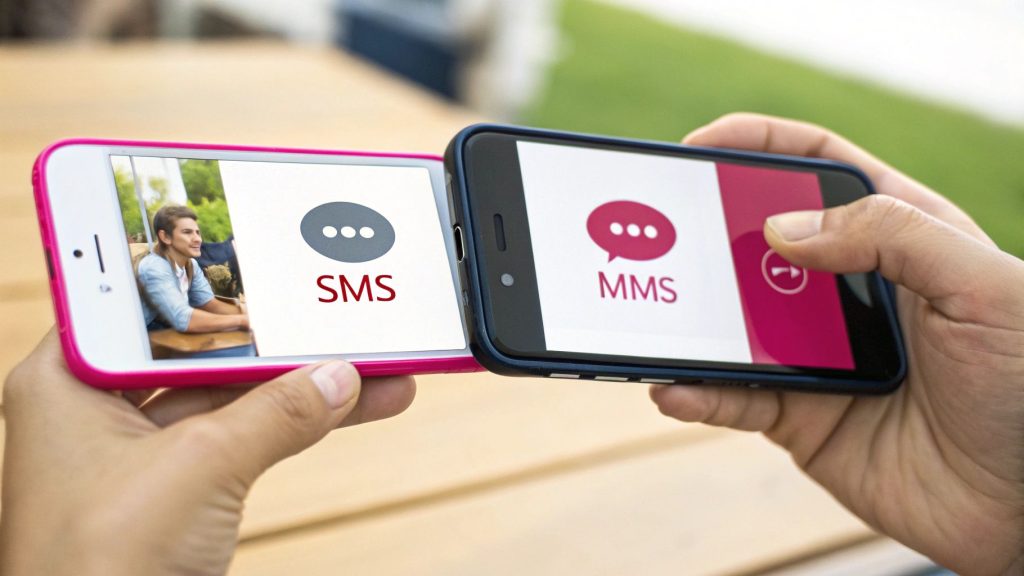
Let’s get straight to it: the big sms and mms messaging difference boils down to one thing. SMS (Short Message Service) is your classic, text-only workhorse. MMS (Multimedia Messaging Service) is what you use when you want to send pictures, GIFs, videos, and other media.
Your choice really depends on what you’re trying to accomplish. Do you need to get a simple, direct message across? Or are you looking for a richer, more visual way to connect with your audience?
Understanding The Core Differences
Before you start mapping out complex campaigns, you’ve got to nail down the fundamentals of these two messaging formats. They both land in a customer’s native texting app, but that’s where the similarities end. Their capabilities, costs, and how you should use them couldn’t be more different.
Getting this right is the first step to building a mobile marketing plan that actually works. To get a wider view of the strategy, you can check out our detailed guide on what is SMS marketing and how it can help your business.
The most obvious distinction is media support. SMS is the universal standard for plain text. It’s perfect for quick alerts, order confirmations, and simple calls to action. Best of all, it’s incredibly reliable and works on practically every mobile phone ever made.
MMS, on the other hand, is built for making a visual splash. It handles all kinds of media, gives you way more characters to work with, and even lets you add a subject line. Think of it like a mini-email delivered right to someone’s text inbox. This makes MMS the go-to for showing off products, sending picture-based coupons, or telling a brand story that text alone just can’t capture.
Key Takeaway: Think of SMS as the quick, reliable messenger for urgent information and MMS as the creative storyteller for visually compelling campaigns.
To help you see the differences at a glance, we’ve put together a simple breakdown of what sets these two message types apart.
Quick Look At Key Distinctions Between SMS and MMS
| Feature | SMS (Short Message Service) | MMS (Multimedia Messaging Service) |
|---|---|---|
| Content Type | Text-only messages | Text, images, videos, audio, GIFs |
| Character Limit | 160 characters per message | Up to 1,600 characters or more |
| Media Support | None (links can be included) | Embedded images, videos, audio files |
| Cost | Lower cost per message | Higher cost per message |
| Use Case | Transactional alerts, reminders, quick promos | Product showcases, visual coupons, brand stories |
This table gives you a solid foundation. SMS is your cost-effective tool for speed and simplicity, while MMS is your investment in higher engagement through rich media.
A Detailed Comparison Of Technical Features
Sure, the basic difference between SMS and MMS seems clear, but the technical details are what really make or break a campaign. The technology behind each format shapes everything from message length and media options to whether your text even lands in a customer’s inbox. Getting these details right is key to making smart, strategic decisions for your store.
At its core, SMS is built for one thing: speed. Its entire structure is designed around lean, text-only data that zips across cellular networks. This simplicity is why it’s so reliable and works on virtually any phone, but it also comes with some pretty strict limits on what you can actually send.
MMS, on the other hand, was created to pick up where SMS left off. It bundles media files and longer text into a bigger package, opening up a ton of creative marketing possibilities. The catch? This extra capability brings more variables into the mix that can affect your costs and deliverability.
This infographic breaks down the main technical differences at a glance.
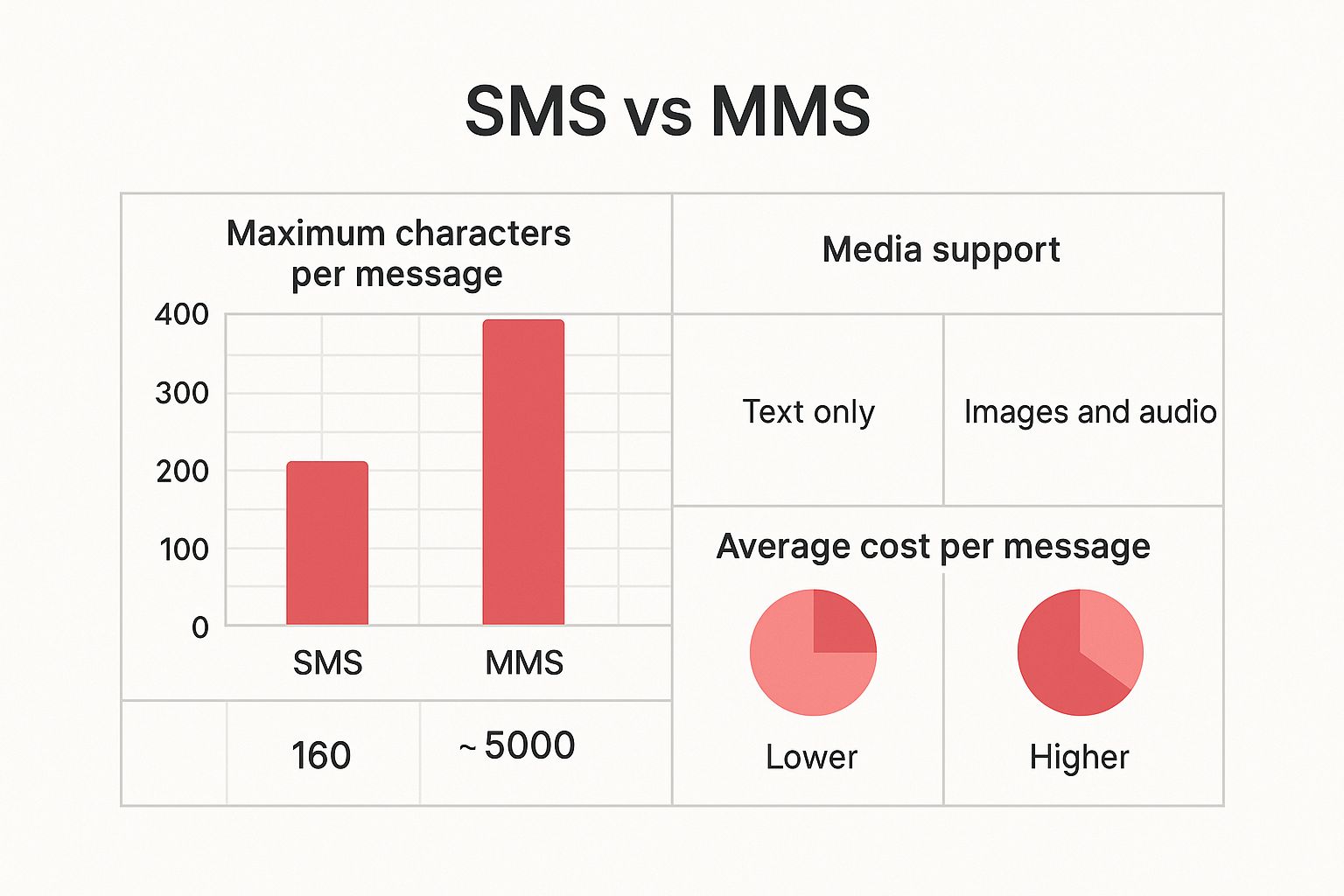
As you can see, the trade-off is pretty straightforward. MMS gives you way more creative freedom but costs more, while SMS is a leaner, more budget-friendly channel.
Character Limits And Message Concatenation
The most famous limitation of SMS is its strict 160-character limit. This isn’t just some random number; it’s a core part of the protocol designed for maximum efficiency. When you need to send a longer message, a process called concatenation kicks in.
Here’s a quick rundown of how that works:
- Your longer message gets split into multiple 153-character chunks.
- The other seven characters in each chunk are used for data that tells the receiving phone how to piece them back together.
- The customer’s phone then reassembles the segments into one, seamless message.
The important thing to remember is that you get billed for each segment. That means a single 350-character message will actually be charged as three separate SMS sends. If you aren’t careful, this can quickly eat into your campaign budget.
MMS completely sidesteps this problem. It lets you write much longer messages—typically up to 1,600 characters—on top of adding your media. This makes it perfect for detailed product descriptions or telling a more complete story without worrying about getting split up and charged extra. While both are powerful, it’s interesting to see how they compare to other channels. You can learn more by checking out our guide on SMS marketing vs email marketing.
Media Support And File Size Restrictions
This is the biggest difference between SMS and MMS. SMS is strictly text. You can include links, but the media itself has to live online somewhere else.
MMS, however, can handle a bunch of media formats right inside the message:
- Images: JPG, PNG
- Animated GIFs: Great for adding some eye-catching motion.
- Audio Clips: Short MP3 soundbites.
- Short Videos: MP4s for quick demos or announcements.
But there’s a big string attached: file size. Most mobile carriers cap MMS file sizes, usually somewhere between 300 KB and 1 MB. If your file is too big, the message will fail to send. This means you have to get good at optimizing your images and videos so they look great but stay small enough to get through every network.
Expert Insight: To play it safe and maximize deliverability, always compress your MMS media to be under 500 KB. This helps you avoid getting blocked by stricter carriers without sacrificing too much visual quality.
Deliverability And Carrier Filtering
SMS has an almost perfect track record when it comes to deliverability. Because the messages are just simple text using a universal protocol, they almost never get blocked by carriers. This rock-solid reliability makes SMS the undisputed king for time-sensitive messages like 2FA codes or urgent shipping updates.
MMS deliverability is also quite high, but it’s a bit more complicated. Since MMS messages carry multimedia files, they go through a much tougher screening process by carriers looking to block spam and malware. Things like the file type, its size, and even the image content itself can sometimes trigger these filters and stop your message. It’s not a common problem when using a reputable platform, but it’s a technical reality you have to account for when planning a visual campaign.
Analyzing The Real Costs and ROI
When you’re comparing SMS and MMS, it’s easy to get fixated on the cost. But the cheapest route isn’t always the most profitable. To make a smart financial decision for your campaigns, you need to look past the sticker price and understand the pricing structures.
The higher cost of MMS isn’t just arbitrary—it’s directly tied to the larger data packets needed to send images, videos, and GIFs through carrier networks.
Messaging providers typically price their services with a credit system. A simple SMS might cost one credit, while an MMS could easily cost three or more. This means sending a visual campaign to 1,000 subscribers might burn through 3,000 credits, whereas a plain-text campaign would only use 1,000.
This upfront cost difference brings up the million-dollar question for every e-commerce brand: is the extra investment in MMS actually worth it?
Calculating Your Potential Return
To figure out the true value, you have to look beyond the initial expense and zoom in on the return on investment (ROI). Before you can really dig into the specifics for SMS vs. MMS, it helps to first understand what return on investment is and how it works in business. This baseline knowledge is key to framing your cost-benefit analysis correctly.
This is where the higher engagement potential of MMS really starts to shine. While an SMS is great for quick, urgent, text-based alerts, a well-designed MMS can create a much stronger emotional connection with your customer and ultimately drive more conversions.
Key Insight: Data consistently shows that MMS campaigns can pull in engagement rates 15-20% higher than their SMS counterparts. The visual punch of an image or GIF just makes the message stickier and more compelling.
A Practical Cost-Benefit Analysis
Think about an abandoned cart recovery campaign. An SMS reminder is a low-cost, effective nudge. Sure. But an MMS that shows the exact product they left in their cart? That’s way more persuasive because it taps directly into the customer’s original desire.
To analyze this properly, you need to weigh a few key factors:
- Cost Per Send: Calculate the total cost of an MMS campaign versus an SMS campaign sent to the same group of people.
- Conversion Rate: Track the percentage of people who actually complete a purchase after getting each type of message.
- Average Order Value (AOV): See if the visual appeal of the MMS leads to a higher AOV compared to the text-only SMS.
Let’s say an MMS campaign costs you $200 more to send but brings in an extra $1,000 in revenue. The ROI is a no-brainer. This data-first approach is absolutely essential. If you’re looking for more ways to tackle this, you might find our guide on how to reduce cart abandonment with smart messaging really helpful.
In the end, the right choice really comes down to your specific goals and your audience. The most reliable way to figure out what works for your brand is to A/B test both formats. That’s how you ensure every dollar you spend on messaging is delivering the biggest possible impact.
Comparing Global Reach And Audience Adoption
Your message’s effectiveness is worthless if no one can receive it. When you’re weighing the difference between SMS and MMS, accessibility is the one factor that can single-handedly make or break your campaign. This is where the almost flawless, universal reach of SMS pulls far ahead of the more conditional nature of MMS.
SMS is the undisputed king of accessibility. It just works. It functions on virtually every mobile phone made in the last two decades, from the most basic flip phone to the newest iPhone. This universal compatibility means you can confidently reach your entire audience, no matter what device they have or where they are. For broad campaigns where hitting the maximum number of people is non-negotiable, SMS is essential.
The Universal Nature Of SMS
The sheer scale of SMS adoption is hard to wrap your head around. Because it uses standard cellular networks and doesn’t need an internet connection or a special app, its reach is almost absolute. About 65% of the world’s population uses it, which works out to roughly 5 billion people. It became the default communication standard simply because it’s easy and cheap, making it the perfect tool for businesses that need to connect with a diverse, global audience.
MMS, on the other hand, reaches a more fragmented audience. For an MMS to land successfully, two things need to happen: the recipient needs a smartphone that can handle multimedia, and they need an active mobile data plan or a Wi-Fi connection. While smartphones are common in many places, they’re far from universal, especially in developing regions or among older demographics.
Key Consideration: If your target audience includes people with older phones, limited data plans, or in areas with spotty internet, SMS is your only reliable bet. An MMS message might not get delivered at all, or it could show up as a clunky web link, which ruins the experience.
How Demographics Influence The Choice
The choice between SMS and MMS really boils down to knowing who you’re talking to. Running a campaign for a hot new product targeting tech-savvy millennials? MMS is a perfect fit for that visually driven launch. But if you’re sending appointment reminders for a healthcare clinic with a diverse patient base, the guaranteed delivery of SMS is the safer, more inclusive option.
Understanding these details is critical for talking to your customers effectively, a topic we dive into deeper in our analysis of SMS marketing statistics consumers choose.
Ultimately, a winning strategy means accepting the trade-off between reach and richness. SMS gives you unmatched access to everyone, while MMS lets you create deeper engagement with a more specific slice of your audience. The smartest brands don’t pick one over the other; they use both. They’ll deploy SMS for critical alerts and save MMS for targeted, visually-rich promotions where they’re confident the audience has the right tech to see it.
Strategic Use Cases For E-commerce Brands
Knowing the technical difference between SMS and MMS is one thing, but actually using that knowledge to get real-world results is what really matters. For any e-commerce brand, picking the right format at the right time can be the difference between a message that gets ignored and one that drives a sale. It all comes down to mapping the message type to a specific goal in your customer’s journey.
SMS is your go-to when speed and certainty are everything. Its nearly perfect deliverability makes it the best choice for high-urgency, transactional messages that customers not only want but expect to get instantly. Think of it as your direct line for critical information that doesn’t need any visual fluff.
MMS, on the other hand, is your tool for persuasion. When you need to grab someone’s attention, create desire, or make a product feel real, the visual power of an image or GIF is unbeatable. This is where you move beyond simple alerts and start creating a richer, more engaging brand experience.

When To Deploy SMS For Maximum Impact
The real power of SMS is in its simplicity and reliability. You want to use it for communications that are functional, time-sensitive, and need an immediate look from the recipient.
These are some of the most common high-impact uses for SMS:
- Order and Shipping Confirmations: Give your customers instant peace of mind with real-time updates on their purchase and delivery status.
- Flash Sale Alerts: Drive immediate traffic with urgent, can’t-miss deals. The sky-high open rates of SMS ensure your message gets seen before the sale is over.
- Customer Service Updates: Quickly resolve issues by confirming a support ticket was received or letting a customer know an agent has replied.
These scenarios play right into the core strengths of SMS—speed, reach, and cost-effectiveness—to get essential information out efficiently. A solid SMS strategy is a must for any online store, and you can dig into more ideas in our guide to SMS marketing for ecommerce.
Unlocking Higher Conversions With MMS
When your goal switches from just informing to actually influencing a purchase, MMS becomes your most valuable player. The ability to add media transforms a basic notification into a compelling marketing message that can seriously lift your conversion rates.
For e-commerce, a picture isn’t just worth a thousand words—it’s worth measurable revenue. An MMS showing the exact product a customer abandoned in their cart is far more persuasive than a text-only reminder.
Here are the perfect moments to send an MMS:
- Abandoned Cart Recovery: Send a crisp, clear image of the item they left behind, maybe paired with a special offer, to reignite that initial spark of interest.
- New Product Launches: Announce your latest collection with a stunning product photo, a slick GIF showing off the features, or even a short video clip.
- Exclusive Visual Coupons: Instead of just sending a discount code, send a beautifully designed graphic or a QR code that feels like a premium, tangible offer.
The smartest brands don’t pick one over the other; they use both strategically. They build a balanced communication flow, using SMS for the critical alerts and MMS for those high-value marketing moments. This ensures every single message is perfectly suited for its purpose.
SMS vs. MMS: Your Questions Answered
Even after you’ve got the basics down, real-world questions always pop up when it’s time to build a campaign. Nailing these details is what separates a good strategy from a great one, ensuring you pick the right tool for the job without blowing your budget or hurting deliverability.
Let’s dive into the most common questions marketers have when they start using SMS and MMS. Getting these right is key to avoiding simple mistakes that can sink your campaign.
What Happens If I Send An MMS To A Phone That Can’t Receive It?
This is a big one, especially if you have a wide, diverse audience. What happens if you send that beautiful MMS to an older flip phone or a smartphone with mobile data turned off?
Luckily, the carriers have a pretty smart fallback system. Instead of the message just failing, the carrier will usually convert it into a plain SMS that includes a web link. Your customer can click that link and see the image or GIF in their phone’s browser. It works, but it’s not exactly a seamless experience—it adds an extra step for the user.
Key Takeaway: While the web link fallback is a decent safety net, it does weaken the immediate visual punch that makes MMS so powerful in the first place. It’s always a good idea to consider your audience’s tech before going all-in on an MMS-heavy campaign.
How Do Long SMS Messages Work (And How Am I Billed)?
A single, standard SMS is capped at 160 characters. So what happens when you type out a longer message? Your messaging platform uses a neat trick called “concatenation” to automatically break your message into smaller, linked chunks.
Each chunk is actually a bit shorter—usually 153 characters—to leave room for invisible data that tells the receiving phone how to stitch them back together. To your customer, it just looks like one long, normal message. But on the backend, you get billed for each individual segment. A 350-character text will be charged as three separate SMS messages. Keep that in mind when budgeting!
Which One Is Better For Abandoned Cart Recovery?
Ah, the million-dollar question. The honest answer? It completely depends on your product and your strategy. Each format has a unique strength when it comes to winning back those almost-sales.
- SMS is built for speed and urgency. A quick, text-only reminder with a link straight to the checkout and a discount code is super cost-effective. It plays on the high open rates of SMS to get immediate action. Simple. Fast. Effective.
- MMS shines with visual persuasion. Imagine sending a crisp image of the exact item the shopper left in their cart. It’s way more compelling and creates an emotional tug that text alone can’t match. This works wonders for visually appealing products like fashion, home decor, or high-end electronics.
The smartest brands often A/B test both approaches to see what their specific audience responds to. More often than not, a strategic mix of both SMS and MMS is the winning ticket.
Ready to turn those abandoned carts into your biggest revenue stream? With CartBoss, you can use the power of both SMS and MMS to automatically recover lost sales and boost your revenue by up to 50%. Start recovering sales today!