


Let’s get straight to it: No, standard SMS is not end-to-end encrypted.
Think of a text message less like a sealed letter and more like a postcard. Anyone who handles it along its journey can easily read what’s written on it. While your mobile carrier throws in some basic protection while it’s in transit, the message itself is essentially traveling in the open.
Why Your Text Messages Are Not Secure
Traditional SMS (Short Message Service) is one of the least secure ways we communicate today, especially when you compare it to modern messaging apps. Every single day, over 5.5 billion people send text messages, yet most of this content can be intercepted by carriers, government agencies, or hackers simply because it travels as plain text.
This glaring vulnerability comes from the fact that SMS was built on older cellular network protocols that were never designed with privacy in mind. Unlike encrypted apps that create a secure, private “tunnel” between you and the person you’re messaging, an SMS bounces from cell tower to cell tower, completely exposed.
The real problem is the total lack of end-to-end encryption. Without it, there’s simply no guarantee that only you and the intended recipient can actually read the message.
This is a huge deal, especially for businesses that send texts to customers. Knowing the ins and outs of a reliable SMS sender API becomes critical for any company trying to balance massive reach with basic responsibility. SMS gets your message to virtually any phone on the planet, but its built-in insecurity means you should never, ever send sensitive information through it.
To put this in perspective, let’s quickly compare standard SMS with the apps most of us use for daily chats.
SMS Security vs Encrypted Messaging Apps at a Glance
This table breaks down the key security differences between a standard text message and what you get with apps like Signal or WhatsApp.
| Feature | Standard SMS | Encrypted Messaging Apps (e.g., Signal, WhatsApp) |
|---|---|---|
| End-to-End Encryption | No. Messages are sent as plain text. | Yes. Only the sender and receiver can read the message content. |
| Carrier Access | Yes. Your carrier can see message content. | No. The carrier only sees that data is being sent, not the content. |
| Interception Risk | High. Vulnerable to “man-in-the-middle” attacks. | Low. Encryption makes intercepted data unreadable. |
| Data Storage | Often stored unencrypted on carrier servers. | Messages are encrypted on device and often not stored on servers. |
| Privacy Focus | None. Designed for delivery, not privacy. | Core Feature. Built from the ground up for user privacy. |
The takeaway here is pretty clear. While SMS is incredibly convenient for simple, non-sensitive communication, it’s just not built for privacy. For any conversation that needs to stay between you and the recipient, switching to an end-to-end encrypted app is the only way to go.
How Text Messages Travel and Where They Are Vulnerable
To really get why the answer to “is SMS encrypted” is a hard “no,” you have to follow the journey a text message takes. Think of it less like a securely sealed package and more like a postcard passed through a bunch of different hands. Your message never goes directly from your phone to your friend’s.
Instead, it first zips over to your mobile carrier’s Short Message Service Center (SMSC). From there, the SMSC finds the recipient’s carrier, shoots the message over to their SMSC, and only then does it finally land on their phone. This whole system runs on a protocol called SS7 that’s been around for decades—it was built for reliability, not for keeping secrets.
This process is what makes SMS so wide open. The message might be secure on your phone, but once it hits the carrier network, it’s basically an open postcard for anyone with the right access to read.
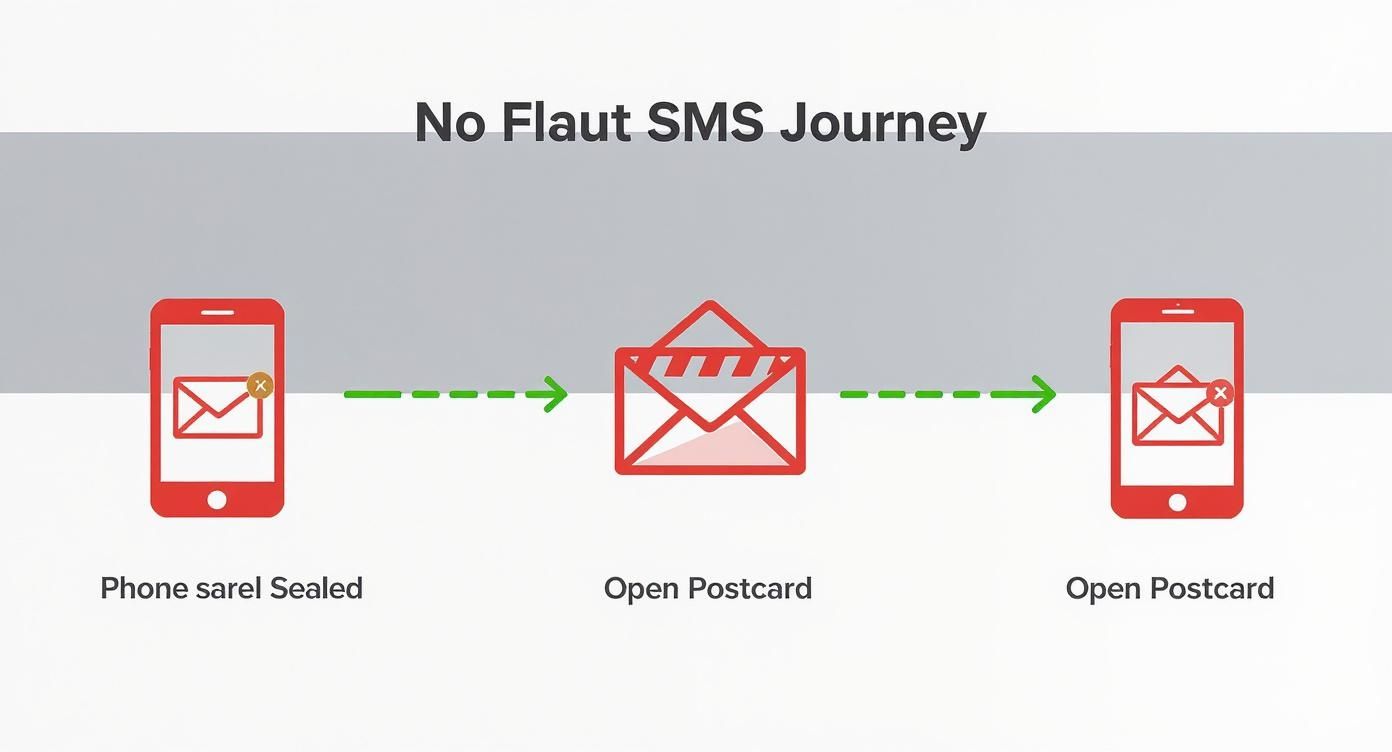
As you can see, the message content is completely visible to the carriers sitting in the middle of the exchange. That’s the core vulnerability right there.
Key Points of Weakness in the SMS Journey
This journey exposes your data at multiple points along the way. Since standard SMS has no end-to-end encryption, the message is readable at almost every single step after it leaves your device.
Here are the main weak spots:
- At the Carrier’s SMSC: Your messages are stored as plain text on your carrier’s servers. This means they can be accessed by employees or handed over to government agencies without much fuss.
- During Transmission: The SS7 protocol itself is notoriously insecure. Attackers who manage to get into the SS7 network can intercept, reroute, or just plain read text messages while they’re in transit. It’s a well-known security hole.
- On the Recipient’s Device: Even if the trip was perfectly secure, malware lurking on the recipient’s phone could easily grab and read messages the moment they arrive.
Because the message travels as plain text between networks, it can be intercepted. Think of it as shouting a message across a crowded room instead of whispering it directly to the person.
This fundamental lack of security is why so many organizations, from banks to modern businesses, are rethinking how they communicate. Even services that use older tech, like various email to SMS gateways, run on this same inherently open system, making them a bad choice for sending anything sensitive. Each “hop” your message makes is another chance for it to be intercepted.
The Real-World Consequences of Unencrypted Texts
It’s one thing to talk about the theory of an unencrypted SMS being a risk, but it’s the real-world impact where things get scary. When hackers find and exploit these weak spots, the consequences can range from a minor headache to a full-blown financial disaster. The simple fact that SMS isn’t encrypted makes it a perfect target for all sorts of attacks.
One of the most common ways this plays out is with two-factor authentication (2FA). Think about it—banks, social media, and other online services often text you a one-time code to prove it’s really you. But through an attack called SIM swapping, a hacker can trick your mobile provider into switching your phone number over to their own device. Just like that, they start getting your 2FA codes.
With those little codes, they can waltz right into your most important accounts, reset your passwords, and take control of everything from your bank account to your email. It’s a harsh reminder that even a security measure can turn into a huge vulnerability when it’s sent through an insecure channel.
It’s Not Just About Money
Financial theft is bad enough, but the damage doesn’t stop there. The personal and business fallout from exposed conversations can be just as devastating, which is why understanding the security of SMS is so critical for our day-to-day privacy.
Just imagine a few common scenarios:
- Identity Theft: A hacker could sift through your texts, pulling out bits and pieces of personal information to build a profile and steal your identity.
- Business Data Leaks: An employee casually discussing sensitive company details over text could accidentally leak confidential information if those messages are intercepted.
- Reputation Damage: Private conversations, if they ever got out, could cause serious harm to your personal life or career.
The global messaging security market is on track to hit an incredible $27.67 billion by 2033. This huge growth is being pushed by regulations like GDPR, which hand out massive fines for mishandling data. It shows a clear shift toward communication channels that are secure and can be audited. You can dig deeper into this trend on Grand View Research.
Knowing these risks is the first step, but you also need to know your rights. The legal side of data privacy can be a tangled mess, which makes getting a handle on personal text message privacy laws a must-do for anyone trying to stay safe in our connected world.
Choosing a Truly Secure Messaging Alternative
Realizing that your standard text messages are basically open postcards is the first big step. The solution? Switching to a messaging platform that was actually built with privacy in mind from day one. These apps use something called end-to-end encryption (E2EE).
Think of it this way: E2EE is like sending your message in a locked box. Only you have one key, and the person you’re sending it to has the other. No one in between—not even the company that runs the app—can peek inside. This completely flips the script compared to SMS, where your carrier can see everything.
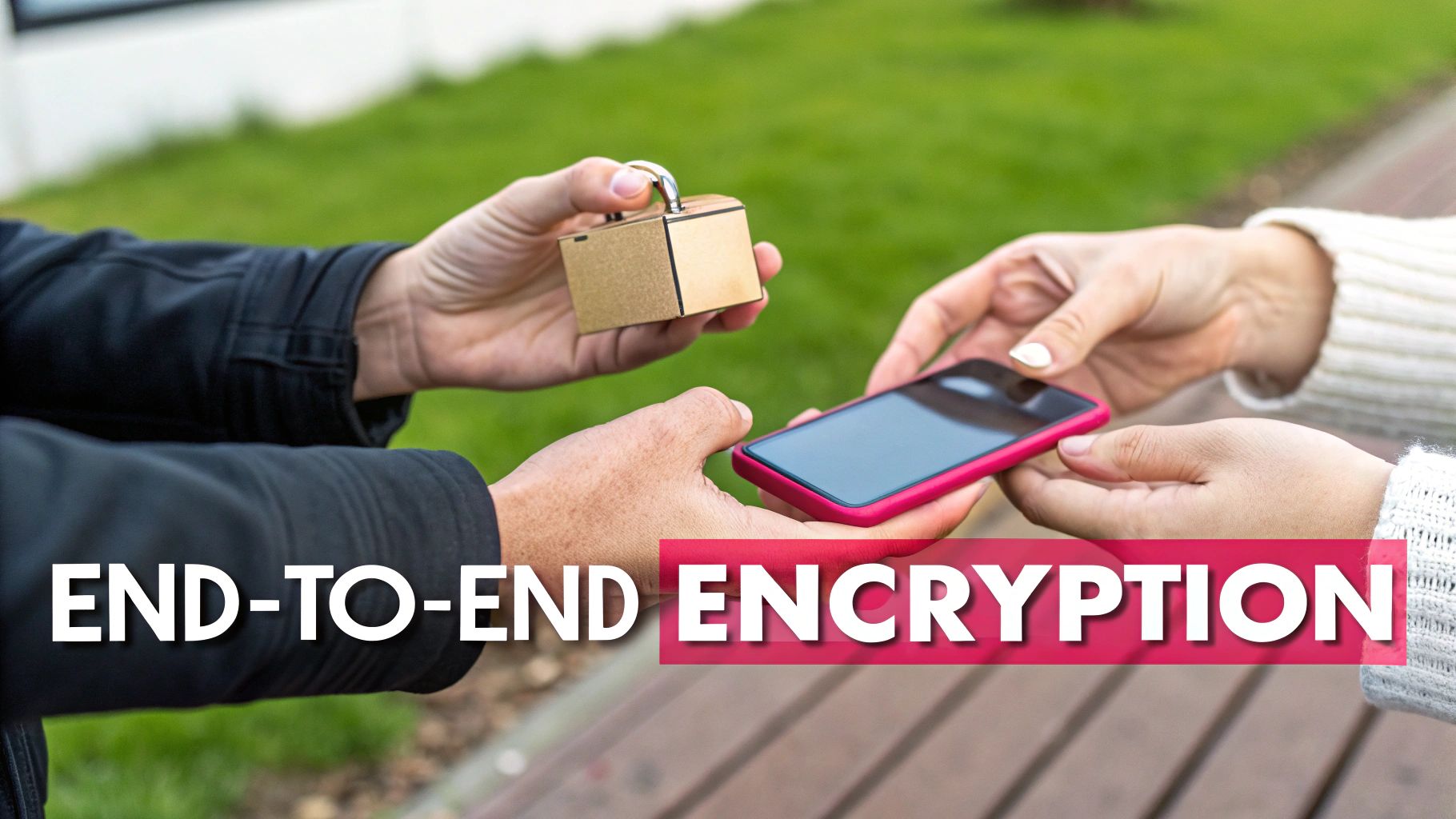
This level of powerful security is the default setting in several popular messaging apps, though each one strikes a different balance between privacy, features, and convenience. As you look at different options, it helps to understand the role of military-grade encryption in secure communication and why it’s so critical.
Comparing Popular Secure Messaging Apps
When you start looking for a better option, a few names always pop up: Signal, WhatsApp, and Telegram. While they’re all a massive improvement over SMS, they handle your privacy and data in very different ways. Knowing the difference is key to actually protecting your digital conversations.
To make it easier, here’s a quick breakdown of how the big three stack up.
| App | Default Encryption | Data Collected | Key Features |
|---|---|---|---|
| Signal | Yes (Always On) | Just the essentials, like your sign-up date. That’s it. | Open-source, focused solely on privacy, disappearing messages, no user data stored. |
| Yes (Always On) | A good amount of metadata (contacts, location, usage patterns). | Owned by Meta, huge user base, group chats, status updates. | |
| Telegram | No (Opt-In) | Lots of metadata, contact lists, and unencrypted cloud chats. | You have to manually enable “Secret Chats” for E2EE. Known for channels and large file sharing. |
As you can see, Signal is widely considered the gold standard for private communication. Its encryption is always on by default, and it’s designed to collect almost no data about you. For businesses trying to set up secure communication channels, these details really matter. You can dive deeper into this in our enterprise messaging solutions guide for modern communication.
The Rise of RCS Messaging
There’s another player entering the field: Rich Communication Services (RCS). Google is pushing it as the modern replacement for SMS, and you’ll find it in their Messages app on Android. The good news is that RCS supports E2EE for one-on-one chats, which you’ll see marked with a little lock icon.
But here’s the catch: RCS encryption isn’t guaranteed. It only works if both people in the conversation have RCS turned on. If one person doesn’t, the entire chat automatically falls back to old-school, unencrypted SMS, leaving your data wide open again.
So, while RCS is definitely a step in the right direction, it’s not a foolproof solution. If you want to be sure your conversations are consistently protected, sticking with a dedicated E2EE app like Signal is still your most reliable bet.
Why Businesses Still Use SMS Despite the Risks
If you know the answer to “is SMS encrypted?” is a hard “no,” you might be scratching your head. Why does my bank, my favorite online store, and pretty much every other company still use it? The truth is, it’s a calculated trade-off. Businesses are weighing the undeniable security risks against a handful of powerful advantages that no other channel can really touch.
The biggest reason is its sheer, universal reach. SMS just works. It works on every single mobile phone out there—from the latest iPhone to that old flip phone your grandpa refuses to give up. There’s no app to download and no internet connection needed. For reaching the widest possible audience in an instant, that kind of accessibility is a massive win.
Weighing the Pros and Cons
Then there’s the engagement factor, which is just off the charts. SMS messages have an almost unbelievable open rate, often hitting as high as 98%, with most people reading them within minutes of delivery. When you’re sending out time-sensitive alerts, flash sale promotions, or abandoned cart reminders, you simply can’t beat that level of attention. If a message absolutely, positively has to be seen, SMS is the way to go.
This reality leads most companies to a practical, risk-based game plan:
- Low-Risk Communication: They use SMS for the everyday stuff like marketing blasts, shipping notifications, and general alerts where the information isn’t sensitive.
- High-Risk Communication: For anything involving personal data or financial details, they switch to more secure channels like encrypted in-app messages or email with extra layers of authentication.
This simple separation allows businesses to get all the benefits of SMS’s incredible reach without putting critical customer information on the line. And while people are getting smarter about security, the raw effectiveness of SMS means it’s not going anywhere. In fact, data shows that 84% of consumers have opted-in to receive texts from businesses, proving it’s still a dominant force in communication. You can find more on these trends from recent marketing statistics.
For any business, the key isn’t to ditch SMS, but to use it wisely. It’s absolutely critical to understand the rules and regulations around texting customers. That’s why having a solid SMS compliance checklist is a must-have resource before you send your first message.
Answering Your Key Questions About SMS Security
Even after getting the basics down, you probably still have a few questions buzzing around your head about how SMS security—or its absence—impacts the apps and services you rely on daily. Let’s clear up some of the most common points of confusion so you can make smarter, safer choices about how you communicate.
Getting these details right is important because the lines between different messaging types can feel pretty blurry.
Are iMessage and Android Messages Encrypted Like SMS?
Sometimes, but you can’t count on it. Apple’s iMessage is famous for its powerful end-to-end encryption, which protects the “blue bubble” chats between people using Apple devices. The moment you send a text to an Android user, however, iMessage falls back to the old, insecure SMS standard. Your bubbles turn “green,” and all that privacy protection vanishes.
It’s a similar story with Google’s Messages app. It uses end-to-end encryption for modern RCS chats—you’ll often see a little lock icon next to the send button. But just like iMessage, if you text someone whose phone or carrier doesn’t support RCS, it defaults back to plain, unencrypted SMS. This on-again, off-again security is exactly why dedicated apps like Signal are recommended for anyone who needs guaranteed privacy.
Can My Mobile Carrier Read My Text Messages?
Yes. Without a doubt. Because standard SMS messages aren’t end-to-end encrypted, your mobile carrier has full access to the content of every text you send and receive. These messages sit on their servers in a readable format, which means authorized employees could potentially view them.
This is a massive privacy difference. With a truly encrypted service like Signal, the company that runs it can’t read your messages even if they were legally ordered to. With SMS, your carrier holds the keys to the kingdom.
Is SMS Safe for Two-Factor Authentication (2FA)?
Using SMS for 2FA is definitely better than nothing, but it’s by far the least secure method available. Security experts have been warning against it for years, and for good reason: the one-time codes sent via SMS are surprisingly easy for criminals to intercept.
The most common tactic is a SIM swapping attack, where a hacker tricks your mobile carrier into transferring your phone number to a SIM card they control. Once they have your number, they get your 2FA codes sent directly to them.
For any account with sensitive financial or personal information, you should absolutely switch to stronger 2FA methods. Good options include:
- An authenticator app like Google Authenticator or Authy
- A physical security key (like a YubiKey)
These methods aren’t vulnerable to SIM swapping and provide a much higher level of security.
Ready to turn those abandoned carts into guaranteed sales? CartBoss uses the unmatched power of SMS to re-engage your customers and recover lost revenue automatically. With pre-written, translated messages and an easy setup, you can boost your profits in under 60 seconds. Learn more at https://www.cartboss.io.
