



Sending a text message seems simple enough, right? You type, you hit send. But for businesses, it’s a whole different ball game, governed by a maze of regulations all built to protect consumers. The big idea behind all personal text message privacy laws is that a person’s phone number is their private turf. You need a clear invitation before you start sending marketing messages.
Ignoring these rules isn’t just a slap on the wrist. We’re talking serious financial penalties and, maybe worse, completely shattering the trust you have with your customers.
Why You Can’t Afford to Ignore Text Message Privacy Laws
A customer’s phone is probably their most personal piece of tech. An unexpected marketing text can feel way more invasive than a promotional email ever could. That’s exactly why the rules for SMS marketing are so strict. Think of these laws as digital “No Trespassing” signs that every business has to respect.
Getting a handle on these regulations isn’t just about dodging lawsuits; it’s about building a solid foundation of trust. When a customer gives you their number and says “yes” to your messages, they’re inviting you into a very personal space. If you abuse that by spamming them, you’re not just losing a sale—you’re damaging your brand’s reputation for good.
The Real Goal Behind SMS Regulations
When you boil it all down, personal text message privacy laws are trying to do two main things:
- Protect Customer Privacy: They put people in the driver’s seat, letting them decide who gets to text them and why. No one wants an endless stream of junk messages.
- Demand Clear Consent: These laws require businesses to get a crystal-clear “okay” before sending anything. Customers need to know exactly what they’re signing up for.
This whole system is built on a few key laws you absolutely need to know. The big players we’ll break down are the Telephone Consumer Protection Act (TCPA) in the U.S., the General Data Protection Regulation (GDPR) in Europe, and state-level rules like the California Consumer Privacy Act (CCPA).
These laws aren’t just hoops to jump through. They’re a roadmap for communicating respectfully and effectively. When you make consent and transparency your top priorities, you’re aligning your marketing with what people actually want.
Breaking Down the Key Legal Frameworks
Each of these laws approaches privacy a bit differently, but they all share one common thread: putting the consumer first. The TCPA, for example, is laser-focused on getting consent for any automated messages. Mess this up, and you could be looking at fines up to $1,500 for a single text message.
Over in Europe, the GDPR sets the gold standard for data protection, demanding a specific and informed opt-in before you can use someone’s phone number for marketing. And in California, the CCPA gives residents the right to know what data you’ve collected on them and to tell you to stop selling it. Mastering these rules is your first step to building an SMS strategy that’s not only compliant but actually works.
Understanding TCPA and US Federal Regulations

In the United States, if you’re sending text messages, you need to know about the Telephone Consumer Protection Act (TCPA). It’s the big one. Even though it was written long before SMS marketing was even a thing, this federal law is the digital shield protecting consumers from a barrage of unwanted calls and, most importantly for us, automated texts.
Think of the TCPA as the rulebook for having a polite conversation. It doesn’t stop you from texting your customers; it just makes sure you ask for their permission first. This simple rule ensures a person’s phone stays a private space, not a free-for-all billboard. For any business using SMS, getting to know the TCPA isn’t just a good idea—it’s step one for building a compliant, trustworthy marketing program.
The Pillar of Express Written Consent
The absolute heart of the TCPA is a concept called express written consent. This is the single most critical requirement for sending any promotional or marketing text using automation. It’s basically the digital version of a signed permission slip, where a customer clearly and explicitly says “yes” to receiving marketing texts from your brand.
So, what does that look like in practice? Picture a customer on your website, ready to buy. Just below the “Complete Order” button, you have a checkbox that says: “Yes, I would love to receive exclusive deals and updates via text message.” By actively ticking that box, they’ve given you clear, undeniable permission.
That simple action is what makes the consent legit. The language has to be direct, and the customer has to take that action themselves. Ambiguous language or pre-checked boxes? Those don’t fly under TCPA rules. For a much deeper dive, our guide on getting express written consent is a must-read.
What Does Not Qualify as Consent
It’s just as important to know what doesn’t count as consent, because this is where a lot of businesses get into hot water. It’s easy to make assumptions that lead to very expensive mistakes.
Here are a few common traps that do not count as express written consent for marketing texts:
- Pre-checked Boxes: If that consent box is already ticked when the page loads, it’s invalid. The user has to be the one to check it.
- Vague Language: Burying a line like, “By entering your number, you agree to our terms” in a long privacy policy isn’t going to cut it. The disclosure has to spell out that they are agreeing to get marketing text messages.
- Providing a Number for Other Reasons: A customer giving you their phone number for a delivery update or a password reset is not an invitation to market to them. Consent has to be specific to the purpose.
The TCPA is crystal clear on this: the burden of proof is on the business. You must be able to show, with solid records, that every single subscriber gave you explicit permission to send them marketing messages.
The Myth of the Established Business Relationship
Here’s a piece of misinformation that trips up a lot of people: the “Established Business Relationship” (EBR) exception. Many assume that if someone bought something from them in the past, they have a green light to send them marketing texts forever. This is a dangerous, and false, assumption.
While an EBR might offer some leeway for certain types of phone calls, it absolutely does not apply to autodialed marketing texts. When it comes to SMS marketing, the rule is simple and strict: you need express written consent, no matter how many times they’ve bought from you. A past purchase does not equal permission to text.
The Steep Cost of Non-Compliance
Let’s be blunt: ignoring TCPA rules can be a business-ending mistake. The penalties aren’t just a slap on the wrist; they are calculated on a per-message basis.
Violations can rack up fines from $500 to $1,500 for every single text sent without proper consent. Imagine sending one promotional blast to a list of 1,000 people who didn’t give you proper consent. In a worst-case scenario, that one campaign could put you on the hook for $1.5 million in damages. Those numbers alone should make it obvious why following personal text message privacy laws isn’t just best practice—it’s essential for survival.
Navigating State-Level Laws Like CCPA

While federal rules like the TCPA set the national standard, individual states are jumping into the privacy game, adding their own layers of protection. This creates a more complicated puzzle for businesses, and nowhere is that more obvious than in California, which has been leading the charge for years.
Think of California’s laws as handing consumers a remote control for their personal data. They get to decide how businesses collect, use, and share information like their phone numbers. It’s a fundamental power shift that gives people more say over their own digital lives.
The Impact of CCPA and CPRA on SMS
The California Consumer Privacy Act (CCPA) and its even stronger successor, the California Privacy Rights Act (CPRA), are massive steps in data regulation. These aren’t just minor tweaks; they give California residents specific, legally-backed rights over their personal information.
This directly affects your SMS marketing because a phone number is considered personal information under these laws. So, if you have customers in California, you have to be ready to respect several key rights.
These rights include:
- The Right to Know: People can ask you to show them exactly what personal information you’ve collected on them.
- The Right to Delete: They can tell you to erase their personal data, which means scrubbing their phone number from your marketing lists.
- The Right to Opt-Out: This is a big one. Consumers have the right to stop you from selling or sharing their personal information with anyone else.
For SMS marketers, this means you absolutely need systems to track data, handle deletion requests, and ensure you aren’t sharing phone numbers without explicit consent and a clear way to opt out.
These state-level personal text message privacy laws are setting a new bar. The California Privacy Protection Agency is actively enforcing these rules, and messing up can cost you—with fines climbing up to $7,500 per intentional violation.
The CCPA and CPRA have seriously raised the stakes on transparency. You’re now required to tell consumers what categories of personal data you’re collecting and why. This is especially important for SMS programs where phone numbers are the main asset. Figuring out how to handle this data is critical, particularly for common e-commerce tactics. For a real-world look at this, check out our guide on CCPA and abandoned cart recovery.
What This Looks Like in the Real World
Let’s make this less abstract. Imagine someone from California lands on your e-commerce store. Under CCPA/CPRA, your website needs to have a clear and easy-to-find link on its homepage, usually labeled “Do Not Sell or Share My Personal Information.”
If a visitor clicks that link, they’re exercising their right to opt out. Your business must immediately stop sharing their data—including their phone number—with any third-party marketing partners or data brokers. You have to honor this request without forcing them to create an account or jump through a bunch of hoops. It’s a simple but powerful tool that puts control right back in the consumer’s hands, making compliance a non-negotiable part of your business.
Meeting the Global Standard of GDPR
Let’s hop across the Atlantic to Europe, where the General Data Protection Regulation (GDPR) has completely changed the game. It’s often called the world’s privacy ‘gold standard’ for a good reason. GDPR isn’t just another rulebook; it’s a foundational shift in how businesses must handle personal data, and yes, that absolutely includes phone numbers.
Think of it as a digital bill of rights. It sets an incredibly high bar for protecting the information of anyone residing in the EU. And here’s the kicker: it doesn’t matter where your business is located. If you’re marketing to customers in the European Union, you have to play by GDPR’s rules.
The Power of Unambiguous Consent
The biggest impact GDPR has on personal text message privacy laws comes down to one crucial concept: unambiguous opt-in consent. This is a much tougher standard than you might find elsewhere. It means a user’s permission to receive your marketing texts must be a crystal-clear, positive action.
So, what does that look like in practice? A European visitor on your site can’t be shown a pre-checked box to get SMS updates. Not a chance. They have to physically tick an empty box themselves. And right at that point, you need simple, plain-language text explaining exactly what they’re signing up for and how you’ll use their number.
Under GDPR, consent has to be freely given, specific, informed, and unambiguous. Silence, pre-ticked boxes, or just failing to opt out doesn’t count. This puts all the power right back where it belongs: in the consumer’s hands.
This strict approach is the bedrock of the EU’s consumer protection strategy. It’s a powerful combination of the ePrivacy Directive (which targets electronic communications like SMS) and GDPR (which covers all personal data). Together, they form a serious defense against unwanted marketing.
Comparing US and EU Text Message Consent
Navigating these different legal waters can be tricky. While both US and EU laws aim to protect consumers, their approaches to consent are quite different. The US focuses on “express consent,” which can sometimes be implied, while the EU demands a much more explicit, active opt-in.
This table breaks down the key distinctions:
| Feature | TCPA (United States) | GDPR & ePrivacy (European Union) |
|---|---|---|
| Consent Standard | “Prior express written consent” for marketing messages. Can sometimes be captured through a single action. | “Unambiguous,” “freely given, specific, informed” consent. Requires a clear, affirmative action (like ticking a box). |
| Pre-Checked Boxes | Generally discouraged but not explicitly banned in all contexts. | Strictly forbidden. Consent must be an active opt-in, not a failure to opt out. |
| Clarity of Purpose | Must be clear and conspicuous, but language can be more generalized. | Requires highly specific information on exactly how the data will be used. |
| Withdrawing Consent | Must provide a clear and easy way to opt out (e.g., “STOP”). | Withdrawal of consent must be as easy as giving it. A simple “STOP” reply is a must. |
Ultimately, the GDPR standard is the highest bar to clear. For businesses operating globally, adopting the EU model for all your subscribers is often the safest and simplest path forward.
Key Rights Every User Has
GDPR doesn’t just stop at consent. It gives EU residents a powerful set of rights over their data, which directly affects how you run your SMS marketing. You need to be ready to handle these requests.
Key GDPR rights include:
- The Right to Be Forgotten: A user can ask you to delete all their personal data—phone number, message history, everything—and you have to do it promptly.
- The Right to Object: People have an absolute right to say “no” to their data being used for direct marketing at any time.
- The Right to Access: Your subscribers can request a full copy of all the personal data you have on them.
- The Right to Withdraw Consent: It must be just as easy to opt out as it was to opt in. A simple “STOP” reply has to work instantly.
Making sure your SMS platform can handle these requests isn’t just good customer service; it’s a legal requirement. For e-commerce stores, getting this right is essential for building trust with your European customers. You can dive deeper with our guide on ensuring GDPR compliance in e-commerce SMS marketing for some practical steps.
The chart below shows just how serious regulators are getting about enforcing these privacy laws.
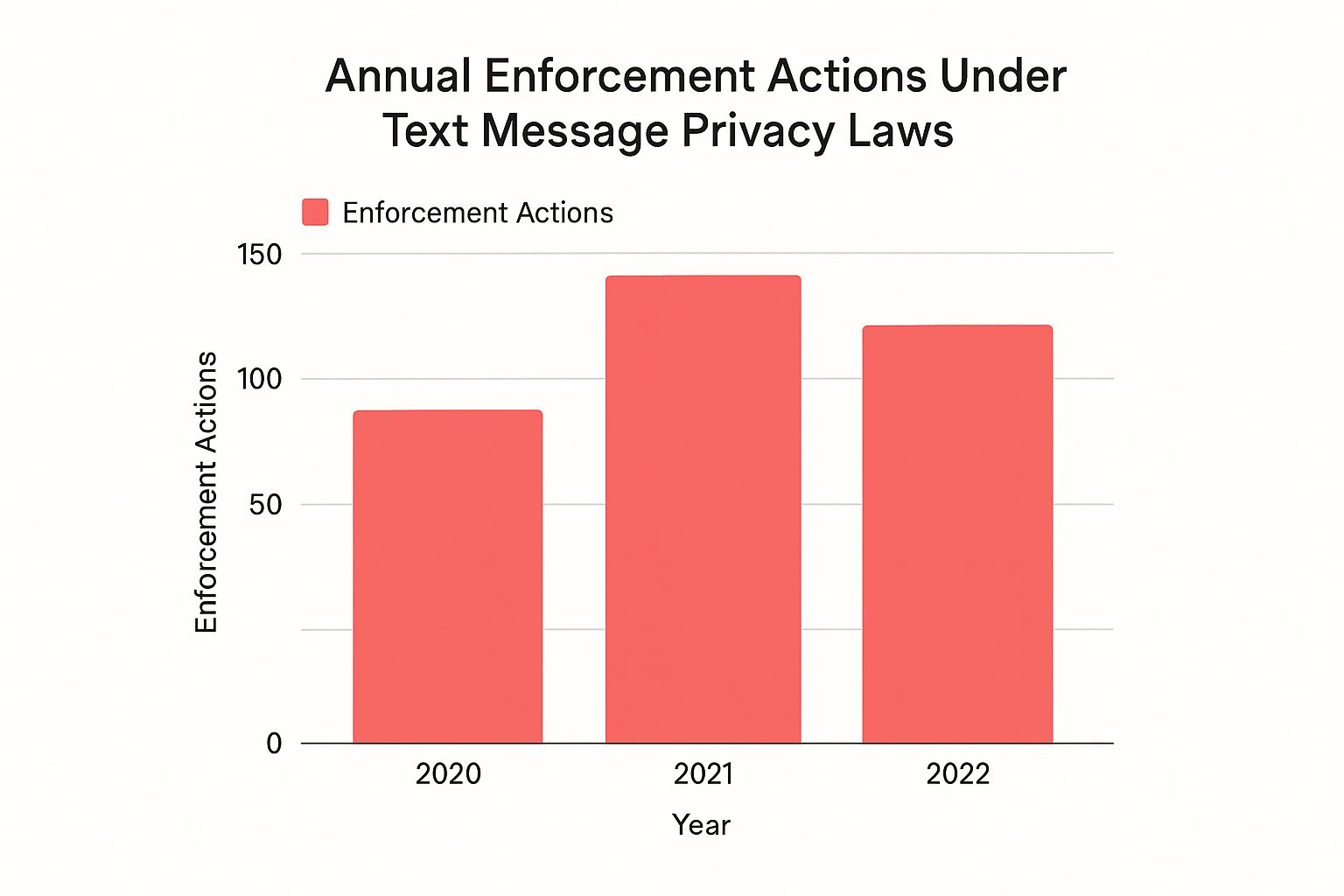
This trend line is unmistakable. Regulatory bodies are watching closely and are not shy about handing out penalties for non-compliance. Ignoring GDPR can be a costly mistake. Just look at the fines: British Airways was hit with a £20 million penalty, and Marriott International was fined nearly £100 million for data breaches. It’s clear that this regulation has serious teeth.
Your Action Plan for SMS Marketing Compliance
Knowing the rules around personal text message privacy laws is one thing. Putting that knowledge into action is a whole different ballgame. A compliant SMS program isn’t about memorizing legal jargon—it’s about creating a system built on trust with your customers, right from the very first text.
Think of compliance as the foundation of your house. If that foundation is weak, everything you build on top of it is at risk of crumbling. Each step, from getting consent to handling opt-outs, is a critical piece of that structure.
Secure Clear and Explicit Consent
The absolute cornerstone of any SMS strategy is consent. This isn’t just a friendly suggestion; it’s a non-negotiable requirement under laws like the TCPA and GDPR. Your goal is to get permission that is clear, specific, and leaves zero room for doubt.
Here’s what a solid opt-in process looks like:
- Active User Action: Never, ever use pre-checked boxes. Customers have to actively tick a box or text a keyword to join your list. That clear action is your proof of consent.
- Unambiguous Language: Your sign-up form needs to explicitly say the user is agreeing to get recurring automated marketing text messages from your brand. Ditch vague terms like “updates” or “communications.”
- Clear Disclosures: Right where they sign up, you have to include the essentials. This means stating that consent isn’t a condition of purchase and mentioning that message and data rates may apply.
A great example of compliant language for a website form would be: “By checking this box and entering your phone number, you agree to receive recurring automated marketing text messages from [Your Brand Name] at the number provided. Consent is not a condition of purchase. Msg & data rates may apply. Reply HELP for help and STOP to cancel.”
Maintain Meticulous Records
Getting consent is only half the battle. You also have to prove you got it. Regulators and courts put the burden of proof squarely on you, the business. That means keeping detailed, organized records of every single opt-in is non-negotiable.
Your consent records should be like a detailed receipt for every subscriber. To be effective, they need to capture a few key data points.
What to Record for Every Subscriber
- Timestamp: The exact date and time the customer gave consent.
- Source: Where did the consent come from? A website checkout form, an in-store sign-up, a keyword text-in?
- IP Address: The IP address tied to the online sign-up for digital verification.
- Specific Language: A copy of the exact disclosure language the customer saw and agreed to.
Keeping these records organized is your best defense against risk. If a complaint ever comes up, this documentation is your first and most powerful line of defense, showing you’ve done your due diligence with personal text message privacy laws.
Implement Messaging Best Practices
Once you have a list of subscribers who have opted in, your job shifts to sending messages that are both respectful and compliant. Every text you send should reinforce the trust you’ve worked to build.
First off, always identify your brand in every single message. Your subscribers get texts from lots of people; they shouldn’t have to play detective to figure out who you are. A simple “[Your Brand Name]:” at the start of each text solves this instantly.
Next, you absolutely must provide a simple and clear way to opt-out. The industry standard is allowing users to reply with keywords like “STOP,” “END,” or “UNSUBSCRIBE.” This needs to be an automated process. Once a user opts out, you can’t send them any more marketing messages unless they decide to opt back in.
Finally, respect quiet hours. TCPA rules say you can’t send messages before 8 a.m. or after 9 p.m. in the recipient’s local time zone. Texting outside these hours is not only a compliance risk but also a fantastic way to annoy your customers and get them to unsubscribe. A detailed SMS compliance checklist can be a lifesaver here, making sure you don’t miss a single step.
Uphold Transparency with a Clear Privacy Policy
Your privacy policy is a crucial part of your compliance puzzle. It should be easy to find on your website and linked directly from your SMS sign-up forms. This document needs to clearly explain how you collect, use, and protect your customers’ phone numbers.
Write your policy in plain English that anyone can understand—no dense legal jargon. It needs to specifically detail your SMS program, explain the kinds of messages customers can expect, and remind them how they can opt out at any time. This kind of transparency shows you respect your customers’ data and empowers them to make informed choices, which is the key to a trustworthy and legally sound SMS marketing program.
Common Questions About Text Privacy Laws

Even with a solid game plan, the world of personal text message privacy laws can feel like a maze. It’s packed with “what-ifs” and tricky edge cases that can trip up even experienced marketers. When the stakes are this high, having questions is not only normal—it’s smart.
Think of this section as your rapid-fire guide to clearing up the most common points of confusion. We’ll tackle the questions we hear all the time, giving you direct, practical answers to help you move from theory to confident, real-world action.
Can I Text Customers Who Gave Me Their Number for Delivery Alerts?
This is a classic—and critical—question. The answer is a firm no.
Under laws like the TCPA, consent has to be specific. When a customer hands over their number for a transactional reason, like a shipping update or an appointment reminder, that permission doesn’t automatically carry over to your marketing campaigns. It’s a one-way street.
To send promotional texts, you need separate express written consent specifically for marketing. It’s like a customer giving you a key to drop off a package; that key doesn’t give you permission to come back later and redecorate their living room. Confusing these two types of consent is one of the fastest ways to break trust and land in hot water.
The core idea here is purpose limitation. A phone number should only be used for the exact reason it was collected. Sending marketing blasts under the cover of transactional consent is a direct violation of this principle.
For a deeper dive into the legal details, our comprehensive guide on TCPA and text messages breaks down everything you need to know.
What Is the Real Difference Between Opt-In and Opt-Out?
Getting this right is fundamental to compliance. Opt-in and opt-out represent two completely different approaches to consent, and for SMS marketing, only one is the right way to go.
- Opt-In (The Correct Way): This is where a user takes a clear, positive action to say “yes.” They might check an empty box or text a keyword to your shortcode. It’s an active, enthusiastic signal that they want to hear from you.
- Opt-Out (The Risky Way): This model assumes you already have permission until a user tells you to stop, like by unchecking a pre-filled box. This is not considered valid consent for marketing texts under the TCPA or GDPR.
Regulators want to see explicit, user-initiated consent. The opt-in model leaves no doubt about what the user wants. On the other hand, relying on an opt-out framework is legally dangerous and can lead to massive penalties because it puts the burden on the consumer to say no.
Do These Privacy Laws Apply to Non-Profits or Political Texts?
Yes, they do—but with some important nuances. While non-profit and political campaigns aren’t completely off the hook, they often operate under slightly different rules than commercial businesses. The TCPA, for example, has specific carve-outs and provisions for these types of messages.
However, they still face strict rules on using autodialers to text people without the right kind of consent. It’s a huge mistake for these organizations to assume they have a free pass. Every organization, regardless of its tax status, needs to understand the specific regulations that apply to its communications to steer clear of violations.
What Should I Do if I Receive an Unwanted Marketing Text?
As a consumer, you have clear rights and simple tools to stop unwanted texts. Taking action is easy and helps protect everyone from spam.
The first and most effective step is to reply directly to the message with one simple word: “STOP.” Legitimate businesses are required by law to honor this request immediately and remove you from their list. Don’t engage further or reply with angry messages—just “STOP” will do the trick.
If the texts keep coming after you’ve sent the “STOP” command, you can take it a step further:
- Report it to your carrier: Forward the spam message to the number 7726 (which spells SPAM on the keypad). This helps mobile carriers identify and block shady senders.
- File a complaint: You can file an official complaint with the Federal Communications Commission (FCC) in the U.S. or your local data protection authority.
These actions don’t just protect you; they help build a cleaner and safer messaging space for everyone.
At CartBoss, we know that navigating personal text message privacy laws can be a headache. That’s why our platform is built with compliance at its core, letting you recover abandoned carts and boost sales with total confidence. Turn your lost visitors into loyal customers on autopilot, knowing your SMS strategy is both powerful and legally sound. Discover how CartBoss can transform your e-commerce revenue today.
