


At its core, a TCPA violation happens when a business texts or calls a consumer using any kind of automated system without getting their express written consent first. Think of this federal law as a legally binding “Do Not Disturb” sign for your customers’ phones. Ignore it, and you’re looking at some seriously painful financial penalties for every single message you send.
The Anatomy of a TCPA Violation
Imagine the Telephone Consumer Protection Act (TCPA) as the rulebook for being a welcome guest in someone’s digital life. A violation isn’t a small mistake; it’s like barging into a private conversation uninvited. The law was built from the ground up to protect people from the endless stream of unwanted, automated marketing calls and texts.
Fundamentally, the TCPA puts guardrails around how businesses can use technology to reach out. Getting a handle on these key pieces is the first step to building a communication strategy that’s both effective and lawsuit-proof.
What Counts as an “Autodialer”?
The word “autodialer” probably makes you think of some clunky, old-school robocalling machine from a 90s movie. But the legal definition is way broader and has been fiercely debated for years.
In TCPA terms, an autodialer, or an Automatic Telephone Dialing System (ATDS), is any piece of gear that can store or create phone numbers to call using a random or sequential number generator, and then dial those numbers.
This definition is a huge deal because a lot of modern marketing software—including many SMS marketing platforms—could technically fit the bill. If the system you’re using can fire off texts or calls without a human hitting “send” each time, it’s very likely considered an autodialer in the eyes of the law. That’s a major trigger for TCPA rules.
Prerecorded Voice Messages
Another common tripwire for a TCPA violation is using prerecorded or artificial voice messages. This isn’t just for mobile phones; it applies to landlines, too.
If your game plan involves dropping a promotional voicemail with a recorded voice, you absolutely must have prior express written consent from the person you’re calling. This rule is designed to stop companies from blasting out impersonal, generic marketing messages to people who never asked for them.
Express Written Consent: Your Golden Ticket
If there’s one thing you need to burn into your brain about TCPA compliance, it’s express written consent. This is your non-negotiable permission slip from a customer, giving you the green light to send them automated marketing messages. Without it, pretty much any automated outreach is a potential violation waiting to happen.
An uninvited marketing text is more than just an annoyance; it’s a potential liability. The TCPA gives consumers the power to sue, making consent not just a “nice-to-have” but a core business requirement.
So what does real, legally-sound consent look like? It’s not a sneaky checkbox buried deep in your terms of service. To be valid, consent has to be:
- In Writing: This can be digital. A signature on a form, an email confirmation, a website opt-in box, or even a text reply all count.
- Unambiguous: The customer has to know exactly what they’re signing up for—that they’re agreeing to get marketing messages from your brand.
- Conspicuous: The opt-in language must be clear, easy to spot, and not hidden in tiny print. Crucially, it must also state that agreeing to receive messages is not a condition of making a purchase.
Forgetting to lock down this level of consent before you hit “send” on a campaign is the fastest way to find yourself in hot water with the TCPA. To see how these rules apply specifically to SMS marketing, check out our deep dive on the TCPA and text messages, which covers the must-know details for e-commerce brands. Proper consent isn’t just a box to check; it’s your best defense.
The Most Common Ways Businesses Violate the TCPA

Knowing the TCPA rules in theory is one thing, but a violation of tcpa usually happens in the middle of day-to-day business—sometimes without anyone even realizing it. These aren’t always complex legal schemes; more often, they’re simple mistakes that can snowball into incredibly expensive lawsuits.
Let’s walk through the most common traps businesses fall into, turning those abstract legal rules into a practical checklist of what not to do.
Texting Without the Right Consent
By far, the most frequent misstep is contacting customers without getting the proper permission first. A lot of businesses think that if someone is on their email list or bought something in the past, they’ve got a green light to send marketing texts. That’s a dangerous assumption.
For any promotional message sent with an autodialer, the TCPA demands express written consent. This isn’t just a suggestion—it’s the law.
This consent has to be crystal clear and unmistakable. Just having a customer’s phone number isn’t nearly enough. You can learn more about how to do this correctly in our guide on getting SMS opt-in, which is essential for building a list that won’t get you into trouble.
Ignoring the National Do Not Call Registry
Another huge pitfall is forgetting to check the National Do Not Call (DNC) Registry. This is a federal list of people who have explicitly said they don’t want telemarketing calls. Hitting a number on this list is a cut-and-dry violation.
Many businesses mistakenly believe the DNC list only applies to old-school cold calling. But the rules can absolutely extend to text message campaigns, which makes checking it a non-negotiable step for any outbound marketing.
You’re required to scrub your contact lists against the DNC Registry at least once every 31 days. If you don’t, you’re looking at major fines, even if it was an honest mistake.
Disregarding Opt-Out Requests
The moment a customer texts back “STOP,” “UNSUBSCRIBE,” or something similar, you’re on the clock. The TCPA mandates that you honor these opt-out requests immediately and automatically. Any delay, no matter how short, can count as a violation.
This isn’t a friendly recommendation; it’s a legal requirement. Your system has to be set up to instantly add that number to a suppression list so no future automated texts can go through.
The law is clear: a consumer’s request to opt out is not a negotiation. It’s an order that must be followed without fail. Failing to have a reliable, automated system for processing these requests is one of the easiest ways to incur a violation of tcpa.
Ignoring these requests can be catastrophic for your business. Every single message you send after an opt-out request is a brand-new, separate violation, which means the penalties can stack up at an alarming rate.
Violating the “Quiet Hours” Rule
One of the most straightforward TCPA rules is all about timing. The law created “quiet hours” to make sure consumers aren’t being bothered at ridiculous times of the day.
Legally, you are not allowed to send automated texts or make calls before 8 a.m. or after 9 p.m. in the recipient’s local time zone. That last part is what trips up so many businesses that operate nationwide.
For example, a marketing text sent from New York at 8 p.m. EST will land in California at 5 p.m. PST—no problem there. But if you send a campaign at 9 a.m. EST, it’s going to hit phones in California at 6 a.m., resulting in a massive, widespread violation.
Understanding the Steep Financial Penalties
When it comes to a violation of tcpa, we’re not talking about a simple slap on the wrist. The financial penalties are intentionally severe—designed to be a major deterrent for any business that cuts corners. This isn’t a one-time fine. The law assigns a specific dollar amount to every single unsolicited call or text message.
Think about that for a second. The liability multiplies at a terrifying speed, especially if you’re communicating with customers at scale.
Imagine a single misconfigured SMS campaign sent to a list of 10,000 customers. That could trigger 10,000 individual violations, each with its own hefty price tag. This per-violation structure is exactly what makes TCPA non-compliance one of the biggest financial risks a modern business can face.
The Cost of a Single Mistake
The Telephone Consumer Protection Act outlines two tiers of penalties. The main difference between them boils down to one simple question: was the violation an accident, or did the business knowingly break the rules?
- Negligent Violations: For an accidental or unintentional mistake, the penalty is a flat $500 per call or text. This is the baseline fine, even if it was just a simple oversight.
- Willful Violations: If a court finds that the violation was done knowingly or willfully, the penalties can be tripled to an eye-watering $1,500 per call or text. This higher penalty usually comes into play if a business kept sending messages after being warned or deliberately ignored opt-out requests.
This framework means “I didn’t know” is not a valid excuse. Even an “oops” moment can lead to a massive financial judgment. Effective SMS marketing compliance isn’t just about avoiding willful violations; it’s about building solid systems to prevent those negligent mistakes from ever happening in the first place.
The TCPA’s real power is in its per-violation penalty structure. A $500 fine for one text seems manageable. But when you multiply that by thousands of recipients in a class-action lawsuit, it transforms into a catastrophic, business-ending liability.
To put these numbers into context, let’s look at how the penalties are officially defined.
Statutory Penalties for a Violation of TCPA
This table breaks down the specific fines a business can face for each individual violation under the TCPA.
| Violation Type | Penalty Per Violation | Notes |
|---|---|---|
| Negligent | $500 | This applies to unintentional errors, like system glitches or genuine mistakes. |
| Willful or Knowing | Up to $1,500 | This higher penalty is for businesses that intentionally ignored TCPA rules or failed to act after being notified of a problem. |
As you can see, the law doesn’t give a free pass for ignorance. Every single text or call that breaks the rules carries a significant financial risk.
From Small Fines to Massive Settlements
The real danger of a TCPA violation kicks in when these individual penalties get bundled into a class-action lawsuit. All it takes is one person to represent thousands of others who received the same illegal message, and suddenly a minor issue explodes into a multi-million dollar legal nightmare.
The history of TCPA litigation is littered with cautionary tales of major brands that learned this lesson the hard way.
These aren’t just hypothetical scenarios. They are real-world outcomes that show just how serious the law is. For instance, National Grid agreed to a $38.5 million settlement, Dish Network was hit with a staggering $210 million judgment, and HSBC settled a TCPA case for nearly $40 million. A quick search for high-profile TCPA lawsuits will show you just how quickly these penalties can spiral out of control.
This is why understanding and respecting TCPA regulations is more than just a legal best practice—it’s a critical part of financial risk management. The cost of getting compliance right is always, always a fraction of the cost of a single, widespread violation.
Why TCPA Lawsuits Are on the Rise
If you think a TCPA violation is some rare, obscure legal problem, it’s time to think again. TCPA litigation isn’t just a passing trend—it’s a growing threat that has absolutely exploded in recent years. This isn’t just a handful of extra lawsuits; it’s a complete shift in the legal landscape for any business that talks to its customers.
Figuring out why this is happening is the first step to protecting your business. This surge in lawsuits isn’t random. It’s fueled by a perfect storm of smarter consumers, powerful technology, and a very motivated legal industry.
The Rise of Consumer Awareness
Today’s consumers are more clued-in than ever. They know their rights, and they’re quickly learning that those unwanted automated texts aren’t just annoying—they’re a potential legal violation.
This awareness means customers are far more likely to spot a potential TCPA violation and do something about it. A quick Google search connects them with law firms that live and breathe this stuff, turning one person’s complaint into a serious legal headache for a business.
Technology as a Double-Edged Sword
The same automated marketing tools that let businesses reach thousands of customers are also making it incredibly easy to commit widespread violations. A single misconfigured campaign can blast out thousands of non-compliant messages in a flash, creating a huge group of potential plaintiffs overnight.
At the same time, technology is also empowering consumers and their lawyers. It’s never been easier to document and track unwanted calls and texts, building a rock-solid case against a company that isn’t playing by the rules.
The Class-Action Lawsuit Multiplier
The single biggest reason the stakes are so high is the class-action lawsuit. Instead of one person suing for a $500 penalty, a class action lets a single individual sue on behalf of thousands—or even hundreds of thousands—of people who all got the same message.
This is where the financial risk goes through the roof. A tiny compliance mistake suddenly balloons into a multi-million dollar liability. In fact, a shocking 80% of current TCPA lawsuits are filed as class actions. This creates an environment where being proactive about compliance is the only way to survive.
A modern TCPA lawsuit is rarely a one-on-one fight. It’s a numbers game, where a single mistake gets multiplied by thousands of plaintiffs, turning a small oversight into a financial catastrophe.
This infographic shows just how fast the penalties for a TCPA violation can spiral from a single mistake into a massive class-action payout.
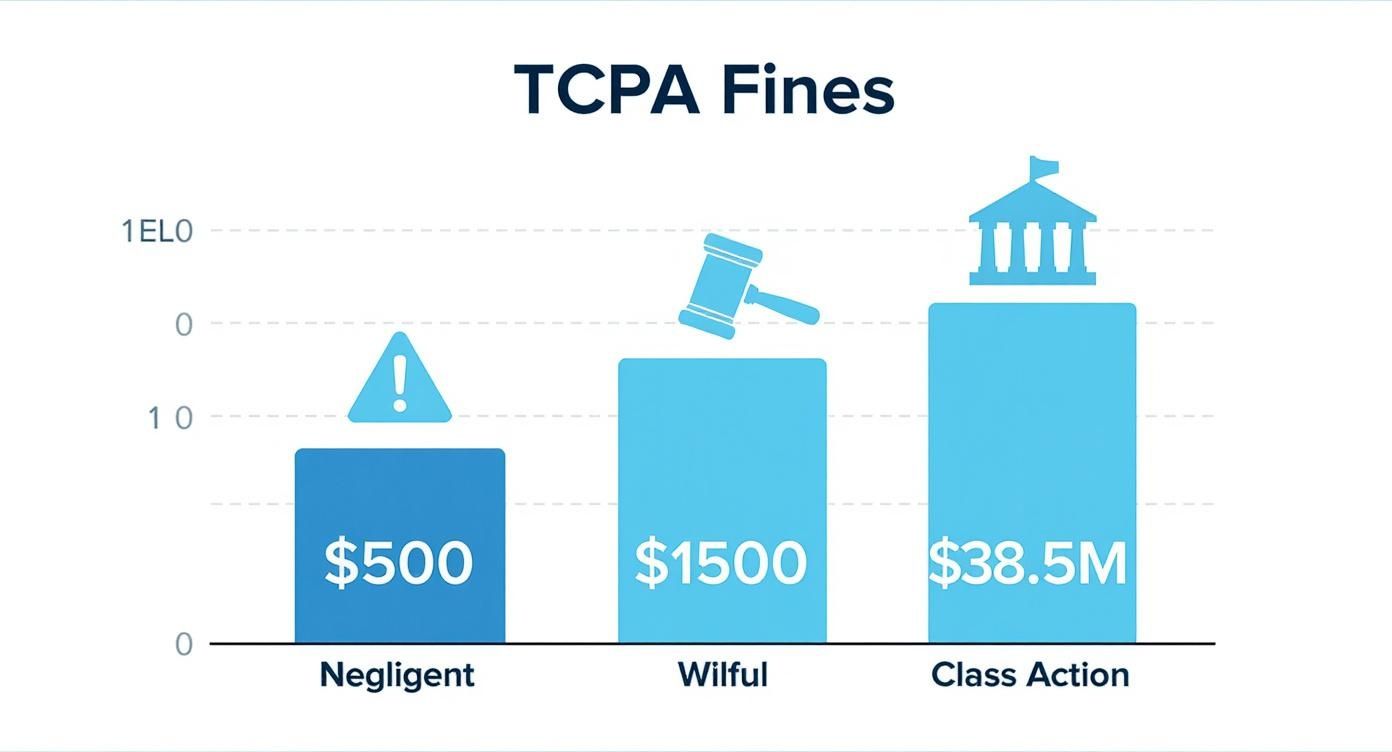
You can see how the financial risk just keeps compounding. It’s a clear illustration of why a solid compliance strategy isn’t just important—it’s essential.
The Role of Specialized Law Firms
The final piece of the puzzle is the rise of plaintiff’s law firms that do nothing but TCPA litigation. These firms have built incredibly efficient systems for finding potential violations and recruiting people to join class-action suits.
Their expertise means they can go after businesses of all sizes, and they play to win. For them, it’s a numbers game, and the potential for massive settlements makes TCPA a very lucrative field. To get a better handle on the laws protecting consumers, our article on personal text message privacy laws offers some crucial background. This legal climate makes it absolutely critical for every business to treat TCPA compliance as a core part of how they operate.
Your Action Plan for TCPA Compliance

Knowing the risks of a TCPA violation is one thing, but building a real-world strategy to prevent it is what actually protects your business. It’s time to move from theory to action. This is your practical playbook for creating a communication plan that’s both powerful and perfectly legal.
A solid TCPA compliance plan isn’t some dusty legal document; it’s a set of clear, repeatable habits that become second nature to your team. It all comes down to getting the right permissions, keeping your contact lists clean, and genuinely respecting your customers’ choices.
Master the Art of Express Written Consent
The absolute bedrock of any compliant marketing program is consent. Without it, every single automated message you send is a lawsuit waiting to happen. Securing express written consent isn’t just a suggestion—it’s non-negotiable, and you have to get it right.
This means your opt-in process must be impossible to misunderstand. A customer has to knowingly and actively agree to get marketing messages from you. Make sure you document and store this consent securely; it’s your number one defense if a complaint ever surfaces.
To get it right, your opt-in needs a few key things:
- Clear Disclosures: Be upfront about what they’re signing up for. Tell them the kinds of messages they’ll get and roughly how often. No surprises.
- Affirmative Action: The user has to do something specific, like checking a box or texting a keyword, to subscribe. Pre-checked boxes are a big no-no.
- Separate from Purchase: This one is crucial. You must state clearly that agreeing to marketing texts is not a condition of buying anything from you.
Nailing your consent framework is everything. For a much deeper dive, our guide on how to get express written consent provides actionable steps for business compliance is a fantastic resource.
Diligently Manage Your Contact Lists
Getting that initial opt-in is just the start. Keeping your lists clean and up-to-date is an ongoing job that’s vital for avoiding a TCPA violation. This really boils down to two things: honoring opt-outs instantly and scrubbing against do-not-call lists.
Your system needs to process opt-out requests like “STOP” or “UNSUBSCRIBE” immediately and automatically. Sending even one more message after someone has opted out is a clear-cut violation. Automation here is your best friend, as it removes the risk of human error.
On top of that, you are legally required to scrub your calling lists against the National Do Not Call (DNC) Registry at least once every 31 days. Forgetting to do this can lead to massive fines, even for calls made to numbers you thought had opted in.
Think of your contact list as a living, breathing thing. It needs constant care—from instantly honoring opt-outs to regular DNC scrubbing—to stay healthy, compliant, and effective.
Navigating State-Level Mini-TCPA Laws
While the federal TCPA sets the baseline for the whole country, many states have passed their own telemarketing laws, often called “mini-TCPAs.” And sometimes, these state laws are even stricter than the federal version.
For instance, some states have different “quiet hours” for sending messages or more detailed rules for what counts as valid consent. If you do business nationwide, you have to play by the rules in every single state where you contact customers.
Keeping up with these ever-changing rules is a must. Businesses need to stay on top of new regulations like new AI voice call laws, which can completely change the game. Pleading ignorance of a state law won’t get you very far in court.
Your TCPA Compliance Checklist
To give you a hand in auditing your own practices, we’ve put together a quick-reference checklist. Think of it as a simple way to compare what you should be doing against common mistakes that can lead to a costly TCPA violation.
| Compliance Area | Compliant Practice (Do This) | Common Violation (Avoid This) |
|---|---|---|
| Consent | Obtain express written consent with clear disclosures before sending any automated marketing messages. | Assuming consent from an email list or past purchase without a specific SMS opt-in. |
| Opt-Outs | Use an automated system to honor “STOP” requests instantly and add the number to a suppression list. | Manually processing opt-outs, leading to delays and sending messages after a request was made. |
| DNC Registry | Scrub all contact lists against the National Do Not Call Registry at least every 31 days. | Forgetting to scrub lists or only checking them once a year. |
| Quiet Hours | Send messages only between 8 a.m. and 9 p.m. in the recipient’s local time zone. | Sending a campaign based on your business’s time zone, hitting customers too early or too late. |
| Documentation | Keep detailed, time-stamped records of every customer’s consent and opt-out status. | Having no reliable system to prove when and how a customer gave their consent. |
Use this table as a starting point to review your workflows. A few small adjustments today can save you from major legal headaches down the road.
Answers to Your Top TCPA Questions
Even when you feel like you’ve got the rules down, some situations can still leave you scratching your head. Let’s tackle some of the most common (and sometimes tricky) questions businesses run into. My goal here is to give you clear, practical answers so you can handle these compliance gray areas with confidence.
What Does “Express Written Consent” Actually Look Like for Texts?
This one trips up a lot of people. “Express written consent” is the absolute foundation of TCPA compliance for texting, but the “written” part feels a little vague in a digital world. Don’t think of it as a physical signature. Instead, think of it as getting a clear, documented “yes” from a customer showing they know exactly what they’re signing up for.
To be legally solid, that “yes” needs to meet a few key requirements. It has to be a recorded agreement that explicitly allows you to send marketing messages using an autodialer. Critically, it must also state that the customer is not required to agree to these texts just to buy something from you.
So what does this look like in the real world? Here are a few examples:
- A website form checkbox. This is the classic. A user has to actively click a box next to language like, “I agree to receive automated marketing text messages from [Your Brand] at the number provided.”
- A text-to-join campaign. When a customer texts a keyword like “JOIN” to your short code after seeing a clear call-to-action, that counts.
- An electronic form. Think of a signup sheet on a tablet at a trade show or in your brick-and-mortar store.
The common thread here is that the customer has to take a deliberate, positive action. They know what they’re agreeing to, and you have a record of it.
Do TCPA Rules Apply to B2B Marketing?
This is a fantastic question because the answer isn’t a simple yes or no. The TCPA was originally built to protect regular people from unwanted calls at home, but its rules absolutely can—and often do—apply to B2B communications. This is especially true when you’re contacting a business number that’s a cell phone.
The rules restricting autodialers and prerecorded messages for calls and texts to wireless numbers apply no matter who owns the phone or what it’s used for. So, blasting unsolicited, automated marketing texts to a business cell phone can still land you in hot water with a TCPA violation.
Where it gets a little different is with rules like the National Do Not Call Registry, which is more focused on residential phone lines. The safest bet? Just assume TCPA rules apply to any wireless number, B2B or B2C. Always get that prior express consent before you start sending automated marketing messages.
How Fast Do We Have to Process an Opt-Out Request?
Immediately. There’s no gray area and zero grace period here. The second a person replies with “STOP,” “CANCEL,” or any other common opt-out keyword, your system needs to add their number to your do-not-text list.
The law assumes your opt-out process is automated and instant. Any delay, whether it’s because you’re manually updating a spreadsheet or your system is slow, opens you up to violations. Every single text sent after that “STOP” request is another potential fine.
This is exactly why trying to manage opt-outs by hand is a recipe for disaster. You need a robust, automated platform that handles it instantly without you ever having to think about it.
We Got a TCPA Demand Letter. What’s the First Thing We Should Do?
Getting a letter from a lawyer alleging a TCPA violation is stressful, to say the least. But how you react in those first few hours is critical. Don’t panic. Take a breath and follow these steps.
- Do Not Respond. Your first instinct will be to call or email to explain your side. Resist that urge. Anything you say can and will be used against you.
- Preserve Everything. Immediately lock down all your records related to the person who sent the letter. This means contact lists, consent records, campaign data, and any opt-out requests. Deleting anything at this stage, even accidentally, looks incredibly bad.
- Call an Experienced TCPA Lawyer. This is the most important step. TCPA litigation is a niche, complex area of law. You don’t want a general business lawyer; you need an expert who lives and breathes this stuff. They’ll know how to evaluate the claim and guide you on the best path forward.
Acting fast and getting an expert involved early can make a world of difference. It could mean the difference between a manageable settlement and a full-blown, incredibly expensive class-action lawsuit.
Ready to turn abandoned carts into revenue without worrying about compliance? CartBoss offers automated SMS campaigns with built-in compliance features like automatic do-not-disturb mode and seamless opt-out management. Start recovering lost sales effortlessly today!
