



What Opt-In Text Really Means
Opt-in text isn’t just about collecting phone numbers—it’s the foundational handshake where a customer explicitly agrees to get your marketing messages via SMS. That clear yes means you stay compliant and set expectations from the very first message.
Getting this right isn’t optional. A well-worded ask keeps your list engaged; a muddled one leads to unsubscribes and flat engagement.
Why Effective Opt-In Text Is Your SMS Secret Weapon
Picture your SMS program as a house. Your products are the rooms. Your campaigns are the décor. But the foundation—the critical element—is your opt-in text.
- Clear Permission: Spell out exactly what subscribers will receive (early access, exclusive deals).
- Compliance Covered: Meet TCPA, GDPR, and CCPA basics without burying the value proposition.
- Immediate Value: Show why handing over their number is worth it from day one.
A shaky invite builds a poor-quality list. Nail this messaging, and you’ll attract people who actually want to read your texts.
SMS Engagement vs Other Channels
Here’s a quick look at how SMS stacks up against other direct channels:
| Channel | Average Open Rate | Average Click-Through Rate | Time to Read |
|---|---|---|---|
| SMS | 98% | 35% | 3 Minutes |
| 20% | 2% | 90 Minutes | |
| Push Notifications | 50% | 7% | 8 Minutes |
As you can see, once someone opts in to your SMS list, your messages are almost guaranteed to be seen—and quickly.
The Impact On Subscriber Quality And Engagement
Your goal isn’t volume—it’s quality. A vague opt-in form might spike your count, but it often results in low engagement and high opt-out rates. Aim for clarity:
- Highlight specific benefits (“VIP flash sales,” “insider product drops”).
- Keep language simple—no legalese or confusing jargon.
- Tie permission to immediate value.
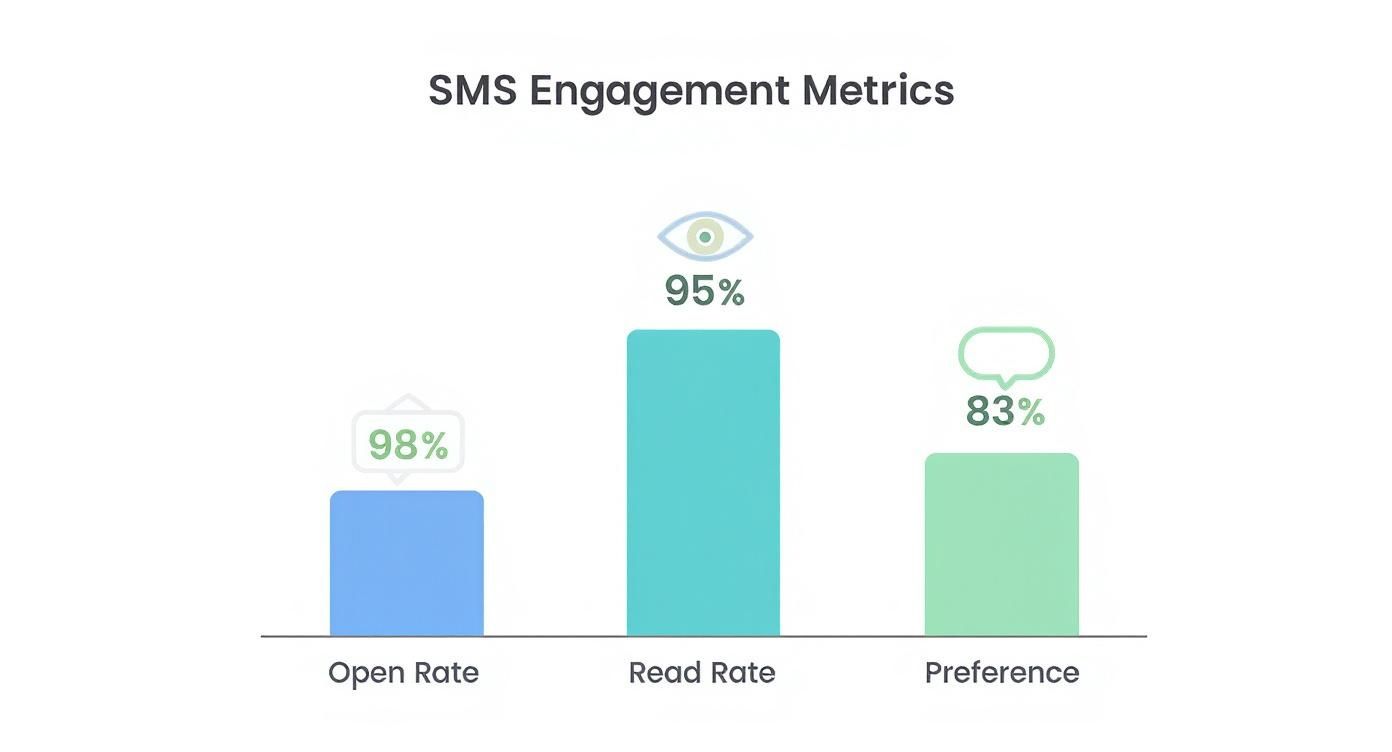
By 2025, SMS will boast a 98% open rate, with 95% read within three minutes. Plus, 83% of consumers around the globe prefer texting for business updates. Those numbers show people want this fast, direct connection.
Your opt-in text is the gatekeeper to this highly personal marketing channel. It’s your one chance to make a great first impression and promise value, ensuring your messages are welcomed rather than viewed as spam.
Turning Phone Numbers Into Revenue
An opt-in isn’t just a checkbox—it’s a high-intent lead. When you combine transparent, benefit-driven copy with a smooth sign-up, every new subscriber becomes a conversion opportunity.
For more on boosting conversions, explore proven conversion rate optimization strategies. And dive deeper into consumer behavior with our insights on SMS marketing statistics.
Start strong with your opt-in text, and you’ll set the stage for unmatched deliverability, click-throughs, and revenue growth.
Staying Compliant in the World of SMS Marketing
Let’s talk about the legal side of SMS marketing. I know, it can feel like a minefield, but getting this right is non-negotiable if you want to build a business that lasts. Getting consent from your customers isn’t just good manners—it’s a legal requirement that protects you from some seriously scary penalties.
The main idea is simple: you need explicit, undeniable permission before you send a single marketing text.
But this isn’t just about dodging fines, which can be absolutely staggering. Solid compliance is all about building trust. When a customer knows you respect their privacy and won’t spam them, they’re much more likely to actually engage with your messages and stick around as a loyal subscriber.
Demystifying the Key Regulations
A few major laws govern SMS marketing, and you need to get familiar with the basics. They differ a bit by region, but they all boil down to two things: consumer consent and total transparency. You don’t need a law degree, but you absolutely need to know the rules of the road.
Here are the big ones you need to have on your radar:
- Telephone Consumer Protection Act (TCPA): This is the big kahuna of SMS compliance in the United States. It requires you to get express written consent before sending automated marketing texts. A simple, un-checked checkbox is the go-to method for this.
- General Data Protection Regulation (GDPR): If you have any customers in the European Union, GDPR is your rulebook. It sets a very high bar for consent, demanding a “freely given, specific, informed, and unambiguous” agreement from the user.
- California Consumer Privacy Act (CCPA): This law gives California residents significant control over their personal data, including the right to know how it’s being used and to opt out of its sale.
These regulations work together to put consumers firmly in control of their inboxes. Messing this up is a costly mistake. Violations under the TCPA alone can hit you with penalties of up to $1,500 per message. For a deeper dive, check out our detailed guide on SMS marketing compliance.
The Must-Haves in Your Opt-In Text
To create a compliant opt in text, you’ve got to include a few key disclosures. Think of it as a mini-contract where you lay out all the terms, clearly and simply, right at the signup point. Don’t even think about burying these details in a separate “Terms of Service” page—that won’t cut it.
Your opt-in language has to spell out:
- Program Purpose: What are you sending? Be specific. “Marketing alerts,” “exclusive offers,” or “new product drops” all work.
- Business Identity: Who’s sending the messages? State your brand name clearly.
- Message Frequency: Give them a reasonable idea of how often you’ll text, like “up to 4 msgs/month.”
- “Msg & Data Rates May Apply” Clause: This is a standard, required disclosure. No way around it.
- Opt-Out Instructions: Tell people how to leave. The standard is texting “STOP.”
- Help Instructions: Give them a keyword for help, usually “HELP.”
A compliant opt-in isn’t just a legal shield; it’s a transparency tool. By being upfront about what subscribers can expect, you filter for a more engaged audience and drastically reduce the likelihood of spam complaints and opt-outs.
The demand for this channel is undeniable. Nearly 50 million people have opted in to receive business texts, and SMS marketing spend in the US is on track to hit $12.6 billion by 2025. You can find more SMS marketing stats on Notifyre.com. This crazy growth just proves that when you do it right, customers are more than happy to connect with brands via text.
Writing Opt-In Text People Actually Want to Say Yes To
Now that we’ve covered the legal guardrails, it’s time for the fun part: writing persuasive opt-in text that makes people want to subscribe. This isn’t just about grabbing a phone number. It’s about kicking off a relationship on the right foot by proving your value from the get-go.
At the heart of any great opt-in is a powerful and instantly clear value proposition. Your potential subscriber is always thinking, “What’s in it for me?” Your copy needs to answer that question in a heartbeat.
Nail the Value Proposition
Forget the generic promises. Vague offers like “Sign up for updates” are dead on arrival. You need to get specific about the benefits. What exclusive perks are they really going to get by joining your SMS list?
Think in terms of tangible, desirable outcomes for your customers.
- Exclusive Discounts: Frame this as a VIP perk. “Get 20% off your first order” is a classic for a reason—it just works.
- Early Access: Make them feel like insiders. “Be the first to shop our new collection before anyone else.”
- VIP Content: Offer them something they can’t get anywhere else. “Get exclusive style tips & behind-the-scenes content.”
The goal is to make the decision to opt-in an easy, immediate “yes.” The numbers back this up. Consumer interaction with SMS is sky-high, with average click-through rates hitting between 20-35%—dwarfing email. Around 70% of consumers will happily opt in to receive texts when they see a clear benefit, and 42% of U.S. mobile users subscribe specifically for the discounts.
A powerful value proposition isn’t just a statement—it’s a promise. It clearly communicates the tangible benefit a subscriber gets in exchange for their permission, making the opt-in feel less like a transaction and more like joining an exclusive club.
Craft a Clear Call to Action
Once you’ve dangled the carrot, you need to tell them exactly what to do next. Your Call to Action (CTA) has to be direct, urgent, and impossible to misunderstand. Leave zero room for guesswork.
Ditch the passive language. Instead, use strong, action-oriented verbs that create momentum and tell people precisely how to get the goods.
- “Text JOIN to 12345 to get your 20% off code now!”
- “Enter your number below for instant access.”
- “Sign up for texts & never miss a deal again.”
The language you choose should feel natural and match your brand’s voice. If your brand is playful, your CTA can be too. If you’re more straightforward, keep the copy clean and direct. For a dose of inspiration, you can look at successful standout email marketing campaign examples, which often rely on similar psychological triggers to drive action.
Remember, every character counts in SMS. Keep your language tight and concise to stay within that standard 160-character limit. For a deeper dive into what works, our guide on proven sales text message examples is packed with more templates and strategies you can adapt. Your opt-in text is your first, and best, chance to turn a casual visitor into a loyal subscriber.
Finding the Perfect Moment to Ask for the Opt In

Crafting the perfect opt-in text is only half the battle. Knowing when and where to present that ask is just as crucial for getting a “yes.” The context of your request can make all the difference.
Ask at the right time, and it feels like a helpful, valuable offer. Ask at the wrong time, and you’re just another annoying interruption. The secret is to align your request with moments of high customer engagement. When a shopper is already leaning in and showing interest, they’re far more open to an invitation for a deeper connection.
The Checkout Page Power Play
The checkout page is, without a doubt, the single best place to ask for an SMS opt-in. Think about it: at this point, your customer has already shown huge purchase intent. They’ve added items to their cart, clicked “checkout,” and are about to give you their payment details.
Their trust is at its peak. Asking for a phone number here doesn’t feel like a big leap; it feels like a natural next step in the process, especially when you frame it as a benefit to them.
Here’s a simple, effective way to phrase it:
- Offer: “Get shipping updates & a 15% off coupon for your next order via text!”
- Legal Text: “By checking this box, you agree to receive recurring automated marketing messages from [Your Brand]. Consent is not a condition of purchase. Msg & data rates may apply. Reply STOP to cancel. View Terms & Privacy.”
This placement taps into the customer’s existing momentum, making it one of the highest-converting spots on your entire site.
Pop-Ups That Convert, Not Annoy
We’ve all been there—a pop-up smacks you in the face the second you land on a site. It’s an instant turn-off. But when used intelligently, pop-ups can be incredibly effective for list growth. The key is timing.
Instead of an immediate, aggressive pop-up, use smart triggers to show your offer to people who are genuinely interested.
Consider these strategic moments:
- On Exit-Intent: The user’s cursor moves toward the back button or to close the tab. This is your last chance to grab their attention with a compelling offer to stay in touch.
- After Time on Page: Trigger the pop-up only after a visitor has spent 30-60 seconds on a specific product or category page. This signals real interest, not just a casual glance.
- After Scrolling: Show the pop-up once someone has scrolled 50-70% of the way down a page. They’re clearly engaged with what you have to say.
The goal is to capture interest, not demand attention. A well-timed pop-up meets the customer at their peak curiosity instead of just blocking their path.
Understanding these moments is just as important as knowing the best time to send your SMS marketing campaigns once they’ve actually subscribed.
Beyond the Website: Creative Placements
Don’t just box yourself into your website. The real world offers some fantastic, often overlooked, opportunities to grow your SMS list with an audience that’s already warm.
An in-store QR code is a perfect example. Place one at the point of sale with a simple, irresistible offer: “Scan to get 10% off your purchase today!” This provides instant gratification and smoothly turns a physical interaction into a lasting digital one.
Another great tactic is to include an opt-in flyer or a QR code on your packing slips. You’ll catch customers right when they are most excited—the moment they unbox their new purchase.
Proven Opt-In Text Templates for Any Scenario
Knowing the theory behind SMS compliance is one thing, but having battle-tested templates makes getting your SMS program off the ground so much faster. The real key to a great opt-in text is matching your message to the context—where is the customer in their journey, and what do they want in that exact moment?
Here are some proven, compliant templates you can tweak for different situations. Each one strikes that crucial balance between a clear, valuable offer and the required legal text, making it a no-brainer for customers to say yes.
For Website Pop-Ups
Pop-ups have to work fast. They need to grab attention and offer instant value before a visitor has a chance to click away. The goal here is simple: turn a casual browser into a subscriber by dangling an irresistible, immediate incentive.
Template:
“Join the VIP Club! Get 15% OFF your first order + early access to new drops. Enter your number to get your code now.”
Compliance Text:
“By entering your phone number and submitting this form, you consent to receive marketing text messages from [Your Brand] at the number provided. Consent is not a condition of any purchase. Msg & data rates may apply. Reply HELP for help or STOP to cancel.”
Why It Works: This template leads with the strongest hook—a discount. But it goes a step further. Using a phrase like “VIP Club” adds a touch of exclusivity, making subscribers feel like they’re getting inside access, not just another marketing message. It’s a powerful mix of instant gratification and long-term perks.
At the Checkout Page
The checkout page is your highest-intent real estate. Your customer is already sold on the product, so the opt-in feels less like an ask and more like a helpful add-on to their purchase. Frame it as a way to enhance their experience, with a little something extra for their next visit. A simple checkbox is perfect here.
Template:
“☑️ Get order updates & exclusive offers via text! We’ll send your tracking info and a special discount for next time.”
Compliance Text (linked nearby):
“By checking the box, you agree to receive recurring automated marketing & transactional messages from [Your Brand]. Consent is not a condition of purchase. Msg & data rates may apply. View T&Cs & Privacy Policy.”
Pro-Tip: Here’s a conversion booster we’ve seen work wonders. When a customer clicks a link in one of your texts, make sure your checkout form is pre-filled with their information. It slashes friction and gets them across the finish line with minimal effort.
For Keyword & In-Store Campaigns
Sometimes you need the customer to start the conversation. A keyword campaign is the perfect tool for this, whether it’s on in-store signage, your social media bio, or even a packaging insert. The call to action needs to be dead simple and easy to remember.
Template:
“Text SAVE20 to 12345 to get 20% off your entire purchase today!”
Automated Reply:
“Welcome to [Your Brand]! Thanks for signing up. Show this text for 20% off. You agree to receive recurring automated marketing msgs. Msg frequency varies. Msg & data rates may apply. Reply HELP for help, STOP to cancel.”
This two-step flow is essentially a double opt-in. It’s fantastic for confirming genuine consent and helps you build a high-quality list of subscribers who are truly engaged.
To help you quickly reference these strategies, here’s a breakdown of how each template works and where it fits best.
Opt-In Template Breakdown
| Template Type | Core Value Proposition | Example CTA | Best Placement |
|---|---|---|---|
| Pop-Up | Instant Discount & Exclusivity | “Get Your Code Now” | Website pop-up modal |
| Checkout | Order Updates & Future Savings | Checkbox with descriptive text | Checkout page |
| Keyword | Immediate In-Store Discount | “Text SAVE20 to 12345″ | In-store signs, packaging |
These templates give you a rock-solid foundation, but remember, the absolute best opt-in text is one that sounds like your brand and speaks directly to your customers’ desires.
If you’re looking for even more inspiration, check out our massive list of SMS templates for marketing, which covers just about any campaign goal you can think of.
Got Questions About SMS Opt-Ins? We’ve Got Answers.
Even with the best templates in hand, you’re bound to run into some specific questions when you start building out your SMS strategy. That’s perfectly normal. Let’s tackle some of the most common ones that come up.
Getting these details right is what separates a healthy, high-ROI subscriber list from a list that just costs you money.
Single Opt-In vs. Double Opt-In: What’s the Big Deal?
This is easily one of the most common questions, and for good reason—it directly impacts your compliance and the quality of your list.
- Single Opt-In: A customer gives you their number (say, by checking a box at checkout), and boom, they’re on the list. It’s fast and frictionless.
- Double Opt-In: This is a two-step dance. After giving you their number, they get a text and have to reply with something like “YES” to confirm they really, truly want your messages.
While single opt-in gets you more subscribers faster, double opt-in is the gold standard for compliance, especially under the watchful eye of the TCPA. It gives you bulletproof proof of consent and weeds out typos and fake numbers.
We always, always recommend double opt-in. You’ll deal with fewer wrong numbers, see lower unsubscribe rates, and build an audience that actually wants to hear from you. It’s a quality-over-quantity game.
How Often Should I Actually Be Texting People?
Finding the right message frequency is a classic balancing act. There’s no single magic number, as it depends on your brand and what your audience considers valuable. The one non-negotiable? Be transparent from the very beginning.
Your opt-in language has to set the expectation clearly. Something like, “Get up to 4 messages per month,” works perfectly. For most e-commerce stores, 2-4 promotional texts a month is a solid starting point. This doesn’t include transactional messages like shipping updates, which are in a separate category.
Just remember, the #1 reason people unsubscribe is because brands text them too much. Don’t be that brand.
Can I Text Customers Who Gave Me Their Number for Shipping?
Let me be crystal clear on this one: absolutely not. This is a critical mistake I see people make.
When a customer gives you their phone number for shipping alerts, that’s all they’ve consented to. They have NOT given you the “express written consent” required to send them marketing texts.
To stay on the right side of the law (and your customers), you need a completely separate and explicit opt-in for marketing messages. Trying to blur the lines between transactional and promotional consent is a shortcut to hefty fines and a trashed reputation.
Ready to turn those abandoned carts into your biggest revenue stream? CartBoss uses powerful, automated SMS campaigns to bring shoppers back and recover sales you thought were lost. Start recovering more sales today.