


If your sales have hit a wall, the temptation is to start guessing. Maybe it’s the ads? The pricing? The product photos? But guessing is expensive and rarely works.
Instead of throwing things at the wall to see what sticks, you need to start with a data-driven diagnosis. The goal is to figure out exactly where you’re losing customers by looking at critical metrics like your add-to-cart rates and checkout abandonment rates. This approach cuts through the noise and shows you the biggest opportunities for a quick win.
Pinpointing Leaks in Your Sales Funnel
Before you can fix the leaks, you have to find them. Think of yourself as a detective for a minute. Your online store is constantly generating a massive amount of data, and hidden inside are the clues explaining why would-be customers are leaving empty-handed.
The real goal isn’t just to get more traffic; it’s to convert the traffic you already have more effectively. This all starts with a practical sales funnel audit. You’re basically mapping out the customer journey—from the moment they land on your site to the final “thank you” page—and finding the steps where they’re dropping off.
Moving Beyond Vanity Metrics
It’s easy to get sidetracked by vanity metrics like total site visitors or how many likes your latest Instagram post got. They feel good, but they don’t actually tell you much about the health of your business.
To make real improvements, you need to zero in on the Key Performance Indicators (KPIs) that directly impact your bottom line.
Here are the metrics that truly matter:
- Add-to-Cart Rate: This is the percentage of visitors who add at least one item to their cart. If this number is low, it’s a huge red flag. It could mean your product pages aren’t compelling enough, maybe the descriptions are weak, the images are low-quality, or the pricing is just plain confusing.
- Checkout Initiation Rate: This tracks how many people who added something to their cart actually take the next step and start the checkout process. A big drop-off here often points to a problem with the cart page itself.
- Checkout Abandonment Rate: This is the big one—the percentage of people who start checking out but never finish. Globally, this number hovers around a staggering 70%. The usual suspects? Unexpected shipping costs, a long and complicated checkout form, or a lack of trust signals like security badges.
By tracking each of these funnel stages, you stop dealing with vague problems and start identifying specific, solvable challenges. You’re no longer guessing; you’re making smart decisions based on what your customers are actually doing.
Using Analytics to Find Drop-Off Points
Your analytics platform, like Google Analytics, is your best friend here. Setting up a conversion funnel visualization is the easiest way to see the entire customer journey laid out in a clear, step-by-step format.
It gives you a visual report that highlights exactly where people are bailing, showing you the precise percentage of drop-offs between each step—from viewing a product to adding it to their cart, and all the way through checkout.
For example, you might look at your report and see that your add-to-cart rate is actually pretty good, but a shocking 50% of users disappear the second they hit the shipping information page. That’s not a guess; that’s a massive clue.
It tells you exactly where to focus your energy. You need to take a hard look at your shipping policies, your costs, and how clearly you’re presenting that information on that specific page. This data-first approach gives you a roadmap to your biggest opportunities.
To really dig in and turn these numbers into a solid game plan, check out our complete guide on conversion funnel optimization.
Optimizing Your Website to Convert Visitors
So, you’ve figured out where visitors are bailing. Now comes the real work: fixing the on-site problems that are pushing them away. Think of your website as your best salesperson and your digital storefront all rolled into one. Even tiny points of friction—a confusing menu, a slow-loading product image—can be enough to tank a sale before it even gets going.
Improving your website isn’t about a massive, expensive overhaul. It’s about making smart, targeted changes that tear down barriers and build trust. The goal is to make the journey from casual browser to happy customer as smooth and intuitive as possible.
Crafting Product Pages That Truly Sell
Your product page is the final battleground where the “add to cart” decision is won or lost. This is your chance to shine, and a bland list of specs just won’t do the trick. A high-converting product page has to anticipate questions, spark desire, and crush any lingering doubts.
The secret? Sell the benefits, not just the features. Don’t just say a jacket is “made with Gore-Tex.” Instead, explain that it’s “built with waterproof Gore-Tex to keep you bone-dry during a surprise downpour, so your adventure never has to stop.” You’re selling the outcome, not the material.
To get your product pages working harder for you, nail these three elements:
- High-Quality Visuals: Use crystal-clear images from every angle, a zoom function, and lifestyle shots showing your product in the real world. A short video demo can often be the final nudge a shopper needs.
- Persuasive Copy: Your descriptions should tell a story. Use bullet points for easy-to-scan key benefits and adopt a tone that really connects with your ideal customer.
- Authentic Social Proof: Make customer reviews and star ratings impossible to miss. User-generated content, like photos from happy customers, is pure gold because it offers real-world validation.
Enhancing the User Experience
A clunky, frustrating user experience (UX) is a surefire way to bleed sales. If people can’t find what they’re looking for fast, they’ll just leave. A great UX, on the other hand, feels effortless and gently guides visitors where they want to go.
Start with your site navigation. Your menus should be clean and logical, with categories that make sense to your customers. A powerful on-site search is also non-negotiable, especially if you have a big catalog. Make sure your search can handle typos, returns relevant results, and offers useful filters.
A seamless user experience isn’t just a “nice-to-have” feature; it’s a fundamental part of building trust. When a site works well, customers subconsciously feel that the company behind it is reliable and competent.
If you’re looking to dive deeper into this, our guide on proven conversion rate optimization tips has more practical strategies to polish your site’s performance.
Embracing a Mobile-First Design
Optimizing for mobile isn’t just a good idea anymore—it’s the core of modern e-commerce. Honestly, one of the most impactful ways to improve ecommerce sales is to perfect the shopping experience on a small screen. By 2025, mobile commerce is expected to make up over 72% of all global e-commerce sales. It’s no surprise that brands who invest in mobile-friendly design, faster load times, and simple mobile checkouts see a 20-30% lift in completed sales.
A true mobile-first approach means you’re designing for the thumb, not the mouse.
- Buttons should be big and easy to tap.
- Forms need to be short and simple.
- Text has to be readable without pinching to zoom.
- Images must be optimized for lightning-fast load speeds.
Every extra second a mobile user waits for a page to load dramatically increases the odds they’ll bounce. Use a tool like Google’s PageSpeed Insights to find out where you can speed things up. A fast, easy-to-use mobile site is absolutely critical for capturing sales from customers on the move.
To really unlock your store’s potential, you should explore more effective strategies to improve ecommerce conversion rates and start turning more of those visitors into repeat customers.
Using Personalization to Drive More Purchases

The days of one-size-fits-all marketing are long gone. Today’s shoppers have come to expect experiences that feel like they were built just for them. If your store isn’t delivering, you’re getting left behind.
Personalization isn’t just a fancy feature for big-box retailers anymore; it’s a core strategy for growing sales and building real customer loyalty. And it goes way beyond just dropping a customer’s first name in an email.
True personalization is about using the data you have to create a unique, relevant, and genuinely helpful shopping journey for every person who lands on your site. It’s about making them feel seen and understood.
The data backs this up. A massive 80% of consumers are more likely to buy from brands that offer personalized experiences. What’s more, 72% say they only engage with marketing that’s tailored to their interests. Relevance isn’t just nice to have—it’s everything.
Leverage Customer Data for Smarter Recommendations
Your most powerful tool for personalization is the data your customers are already giving you. Every click, search, and purchase tells a story about what they want and need. When you tap into this, you can stop showing generic suggestions and start offering hyper-relevant product recommendations that actually help them shop.
Let’s say a customer has been looking at your hiking boots. Instead of just showing them your general “bestsellers” list, a smart personalization engine can show them:
- Complementary Gear: High-quality wool socks, waterproof pants, or daypacks designed for hiking.
- Similar Options: Boots from other brands or at slightly different price points that match their interest.
- “Frequently Bought Together” Bundles: A pre-packaged kit with the boots, socks, and a cleaning kit offered at a small discount.
This kind of proactive approach doesn’t just bump up the average order value. It makes the entire shopping experience feel less like a cold transaction and more like a helpful consultation.
Segment Your Audience for Targeted Campaigns
Blasting the same email offer to your entire list is a surefire way to get ignored. The real magic happens when you slice your audience into smaller, more focused groups based on their behavior. This lets you send messages that are incredibly relevant and much more likely to convert.
You can create some seriously powerful segments based on criteria like:
- Purchase History: Group customers who bought running shoes and send them an alert when new models drop.
- Browsing Behavior: Target shoppers who viewed a product a few times but didn’t buy. Maybe follow up with an email featuring customer reviews for that exact item.
- Customer Value: Create a VIP segment for your top spenders and give them exclusive early access to new products or sales.
This level of targeting ensures the right message hits the right person at the right time. For a deeper look into this strategy, check out our guide on the power of personalization in digital marketing.
Personalization is about more than just data; it’s about empathy. It’s about using what you know about your customers to serve them better, anticipate their needs, and make their lives easier. When you get that right, the sales will follow.
Use Dynamic Content for a Custom Experience
Dynamic content takes personalization a step further by changing what a visitor sees on your site in real-time, based on who they are. Instead of everyone seeing the same static homepage, you can display different banners, offers, and product carousels tailored to individual users.
For example, a first-time visitor might see a homepage banner with a 10% welcome discount. But a returning customer from a colder climate? They could be shown a banner featuring your new winter coat collection.
This simple switch ensures the most relevant content is always front and center, making your site feel alive and responsive to each person’s context. It’s a small change that can make a huge difference in your conversion rates.
Creating Pricing and Promotions That Convert
Price is one of the most powerful levers you can pull to boost e-commerce sales, but it’s also one of the most dangerous. A constant race to the bottom isn’t a strategy; it’s a fast track to eroding your brand’s value and killing your profit margins. The real art is using pricing and promotions thoughtfully to influence buyer behavior without giving away the farm.
Effective pricing is about more than just covering your costs—it’s about customer psychology. For instance, the tiny difference between pricing an item at $10.00 versus $9.99 can have a surprisingly large impact on sales. This classic tactic, known as charm pricing, just makes the price feel significantly lower than it really is.
Building a Smart Promotional Calendar
Running random discounts whenever sales dip is a reactive—and usually unprofitable—approach. Instead, you need a well-planned promotional calendar that aligns your offers with business goals, seasonal trends, and your customers’ buying habits. This lets you build genuine excitement rather than training your customers to just wait for the next sale.
Think about creating promotions that do more than just slash prices. Your goal should be to increase the average order value (AOV) or clear out old inventory.
Consider these powerful promotional tactics:
- Product Bundles: Group complementary items together for a single, slightly discounted price. A classic example is a “starter kit” for a new hobby, which nudges customers to buy more than they initially intended.
- Tiered Discounts: This model rewards customers for spending more. You could offer 10% off orders over $50, 15% off over $75, and 20% off over $100. It provides a clear, gamified incentive for shoppers to add just one more item to their cart.
- Flash Sales: Create a powerful sense of urgency with a short-term, high-value offer. Limiting a sale to just 24 hours can trigger a fear of missing out (FOMO) and drive a huge spike in immediate sales.
A well-structured promotion isn’t just about a discount; it’s a strategic tool. It should either increase the perceived value of the purchase, create a compelling reason to buy now, or encourage a larger overall spend.
To help visualize how different promotions can work for your store, here’s a quick breakdown of some common strategies and where they shine.
Effective Ecommerce Promotion Strategies
| Promotion Type | Primary Goal | Best Use Case | Potential Impact |
|---|---|---|---|
| Percentage Off | Drive Conversions | Broad appeal for site-wide sales or specific categories. | High conversion lift, but can attract one-time bargain hunters if overused. |
| Fixed Amount Off | Drive Conversions | Best for higher-priced items where a dollar amount feels more substantial. | Simple and effective; can feel more tangible to customers than a percentage. |
| Free Shipping | Reduce Cart Abandonment | Always-on offer or for orders above a certain threshold. | Removes a major friction point; often the #1 reason for cart abandonment. |
| Buy One, Get One (BOGO) | Increase AOV / Move Inventory | Clearing out slow-moving stock or promoting new product lines. | High perceived value; encourages customers to buy more than they planned. |
| Product Bundling | Increase AOV | Grouping related items together, like a “skincare essentials” kit. | Introduces customers to more products and increases the overall order value. |
| Tiered Discounts | Increase AOV | Encouraging larger purchases (e.g., 10% off $50, 15% off $75). | Motivates shoppers to add more items to their cart to reach the next discount level. |
Choosing the right promotion depends entirely on your goal. Are you trying to clear out last season’s stock, or are you hoping to get customers to spend a little more on each order? Match the tactic to the objective.
Testing and Refining Your Offers
You can’t know what truly motivates your specific audience until you test it. What works for one brand might completely flop for another. The key is to set up simple A/B tests to see which types of promotions actually resonate with your customers.
For instance, you could test a “20% Off” offer against a “$15 Off” coupon for the same product. You might be surprised to find that a fixed dollar amount feels more tangible and compelling to your shoppers, even if the percentage discount is mathematically similar on certain order values.
For more ideas, you can explore the impact of discounts and promotions on cart recovery and learn how different offers can bring hesitant customers back to complete their purchase.
Ultimately, your pricing and promotional strategies should feel like a natural extension of your brand experience—fair, compelling, and valuable. By moving away from random price cuts and toward a more deliberate, psychologically-informed approach, you can create offers that not only convert but also build a healthier, more profitable business.
Recovering Lost Sales from Abandoned Carts
Think about it this way: a customer walks into your store, fills a shopping cart, gets to the checkout line… and then just walks out, leaving everything. It sounds crazy, but in e-commerce, it’s the norm. In fact, nearly 7 out of every 10 shoppers will ditch their online cart before paying.
That’s not just a lost sale; it’s a huge opportunity staring you in the face. These were high-intent shoppers. They liked your stuff enough to add it to their cart. With the right recovery strategy, you can bring a good chunk of them back to finish the job—it’s one of the highest-return activities you can possibly focus on for a quick sales lift.
Building Your Automated Recovery Engine
The key to winning these sales back is automation. You can’t possibly chase down every lost cart by hand, but you can build a smart, multi-channel engine that works for you 24/7. A really solid strategy uses a mix of email, SMS, and even on-site tactics to give shoppers a persistent but helpful nudge.
Your recovery sequence shouldn’t be a single, desperate plea. It needs to be a timed series of reminders that slowly build in value and urgency.
- The First Nudge (1 Hour): The first message—whether it’s email or SMS—should be a simple, helpful reminder. Frame it like good customer service: “Did something go wrong?” or “We saved your items for you.”
- The Follow-Up (24 Hours): If they still haven’t come back, the next message can introduce a little social proof or urgency. Mentioning that their items are popular and might sell out can work wonders.
- The Final Offer (48-72 Hours): For the most stubborn abandoners, a small incentive is often the final push they need. A modest discount like 10% off or free shipping can often seal the deal without cheapening your brand.
For a complete walkthrough on setting all this up, our guide to recovering abandoned cart sales breaks down the entire playbook.
Why SMS is Your Secret Weapon
Email has been the go-to recovery tool for years, but its power is fading thanks to cluttered inboxes and aggressive spam filters. This is exactly where SMS marketing comes in. With an open rate of over 98%, text messages are almost guaranteed to be seen, making them incredibly effective for time-sensitive recovery efforts.
Texts just feel more personal and immediate than emails. A short, friendly message saying, “Hey, you left something behind! Here’s a direct link back to your cart,” cuts through the digital noise and drives instant action. Tools like CartBoss are built specifically for this, sending automated, pre-translated SMS reminders that make recovery a breeze.
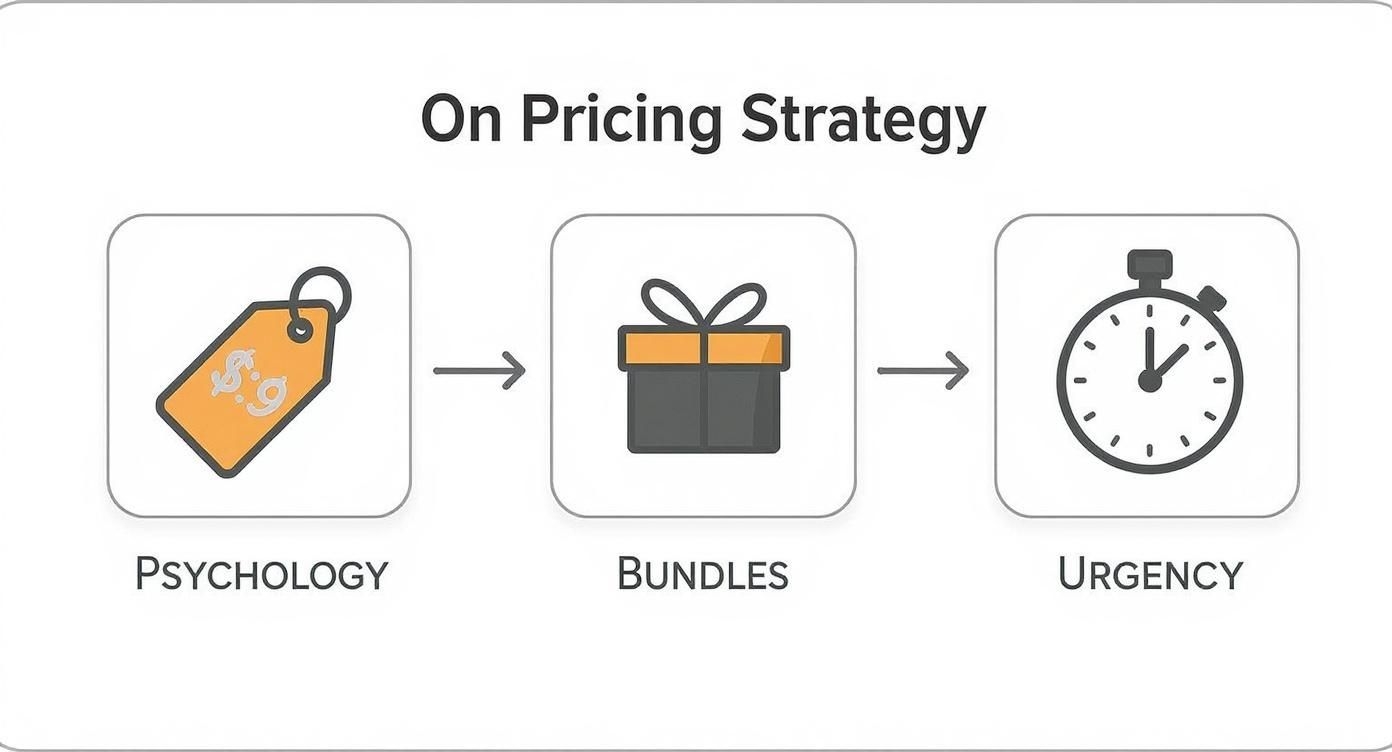
This process shows how you can pull different tactical levers in your recovery campaigns. Using psychological pricing, bundling products, or adding a touch of urgency can make your offer far more compelling.
Don’t Forget On-Site Prevention
Of course, the best way to deal with an abandoned cart is to stop it from happening in the first place. That’s where exit-intent popups are brilliant. These popups can tell when a user is about to leave your checkout page and present a last-minute offer to convince them to stick around.
An exit-intent offer isn’t just about a discount. It’s your last chance to solve a problem. Maybe they were shocked by the shipping costs. A popup that says, “Get free shipping on this order!” can instantly remove that barrier and save the sale.
Finally, integrating proactive customer support can dramatically cut down on abandonment. Offering live chat, for instance, has been shown to boost conversion rates by 30-40%. In the U.S., retailers using AI-powered support tools saw a 25% reduction in cart abandonment simply because shoppers could get instant answers to their questions. When you make it easy for people to get help, you remove the friction and uncertainty that so often leads to a lost sale.
Common Questions About Improving Ecommerce Sales
As you start rolling out new sales strategies, questions are bound to pop up. It’s only natural. Once you get into the weeds of website optimization, personalization, and customer retention, concerns about timelines, budgets, and what to tackle first always come to the surface.
This section is designed to give you direct, no-fluff answers to the questions we hear most often from store owners who are getting serious about growth. Think of it as your quick-reference guide for the road ahead.
How Quickly Can I Expect to See Results?
The honest answer? It really depends on what you’re doing. Some tactics can give you a near-instant lift, while others are more of a long game—a solid investment in your brand’s future.
- Quick Wins (A Few Weeks): Changes to your technical Conversion Rate Optimization (CRO) almost always deliver the fastest results. Things like simplifying your checkout form, boosting site speed, or smoothing out the mobile experience can produce a noticeable bump in conversions in just a few weeks. Why? Because you’re knocking down the most obvious barriers standing between a shopper and a sale.
- Steady Growth (A Few Months): Bigger projects, like launching a subscription model or setting up AI-powered personalization, take more time to really pay off. You might see some initial engagement, but the real impact on your revenue and customer lifetime value (CLV) usually becomes clear over a three-to-six-month period. This gives you enough time to gather data and really dial in your approach.
How to Prioritize Improvements on a Tight Budget
When your resources are stretched thin, you have to focus on the highest-leverage activities first. Your best bet is to double down on Conversion Rate Optimization (CRO). It’s such a powerful approach because it’s all about maximizing the value of the traffic you already have, instead of just paying for more visitors.
Plenty of high-impact CRO tactics are low-cost or even free. They just require your time and attention. Start by rewriting your product descriptions to focus on benefits, not just features. A/B test your call-to-action buttons. Add social proof like customer reviews and testimonials to your product pages.
By making your existing website more persuasive, every single dollar you spend on marketing suddenly becomes more effective. It’s the most efficient way to improve ecommerce sales without having to crank up your ad spend.
What Role Should Paid Advertising Play?
Think of paid advertising as an accelerator, not the foundation of your business. It’s most effective when you use it to scale what’s already working well. Pouring money into ads before you’ve optimized your website is like trying to fill a leaky bucket—you’ll just waste cash.
First, get your house in order. Make sure your site converts visitors efficiently and that you have a solid plan for keeping customers coming back. Once those pieces are in place, paid ads become an incredibly powerful tool for attracting new, targeted audiences to a store that’s ready to turn them into loyal fans. For a deeper dive into boosting your digital revenue, check out this guide on how to increase online sales.
Ready to stop losing sales to abandoned carts? CartBoss uses the power of automated SMS to bring high-intent shoppers back to your store and recover lost revenue on autopilot. See how it works at https://www.cartboss.io.