


In today’s competitive eCommerce landscape, the right promotional message at the right time is the difference between a sale and a lost customer. Generic blasts no longer cut it. Consumers expect personalized, timely, and valuable communication, especially on intimate channels like SMS. This guide breaks down the science and strategy behind high-converting promotional messages, moving beyond theory to provide actionable templates you can implement immediately.
We will explore 10 battle-tested templates, complete with strategic analysis, actionable takeaways, and real-world examples. Whether you’re recovering an abandoned cart, announcing a flash sale, or nurturing a VIP customer, you’ll find a replicable promotional message example here to drive immediate results. Each example is designed not just to be copied, but to be understood, showing you the “why” behind every word choice and call to action.
Our focus is on SMS-first strategies, showcasing how modern tools leverage automation and deep personalization to turn abandoned carts into a consistent revenue stream. The ultimate objective of any promotional message strategy is to effectively measure marketing performance and prove its tangible value. By mastering these techniques, you’ll see a clear impact on your key metrics. Get ready to transform your marketing communication from a simple notification into a powerful conversion engine. This collection provides the specific tactics needed to craft messages that resonate with customers and deliver a measurable return on investment.
1. Abandoned Cart Reminder with Time-Sensitive Urgency
The abandoned cart reminder is a cornerstone of e-commerce recovery strategies. This promotional message example works by sending a timely SMS or email to a customer who added items to their cart but left without completing the purchase. Its effectiveness hinges on combining a gentle nudge with a compelling reason to act now, such as a limited-time offer or a low-stock alert.

This tactic directly addresses the high cart abandonment rates that plague online stores. By intervening within a critical window, you can recapture a significant portion of what would have been lost revenue. The key is making the customer’s return to their cart as frictionless as possible while introducing urgency.
Strategic Breakdown
- Timing is Critical: The most effective reminders are sent within 1-3 hours of abandonment. This timing capitalizes on the customer’s fresh interest before they move on to a competitor or forget about their cart entirely.
- Urgency as a Motivator: Phrases like “Your items are almost gone” or “Offer expires in 12 hours” create a sense of scarcity or a fear of missing out (FOMO). This psychological trigger is a powerful motivator for immediate action. To dive deeper into this concept, you can learn more about how urgency and FOMO drive conversions.
- Personalization and Value: Including the customer’s name (
[FirstName]) and the total cart value ([$CartValue]) makes the message feel personal and reminds them of their intended purchase. Adding a small incentive, like free shipping or a dynamic discount, can provide the final push needed to convert. To further refine your approach, exploring comprehensive strategies to reduce cart abandonment and win back sales can provide deeper insights.
Actionable Takeaways
- Implement a 1-Hour Rule: Set up an automated SMS workflow to trigger exactly one hour after a cart is abandoned.
- Use Dynamic Content: Personalize messages with the customer’s name and specific cart details.
- A/B Test Your Offers: Experiment with different incentives, such as “10% off” versus “Free Shipping,” to see which resonates best with your audience and protects your margins.
2. Multi-Language Localized Cart Recovery Message
For businesses with an international customer base, a standard English-only abandoned cart message can be a major conversion blocker. A multi-language localized cart recovery message tackles this challenge by automatically detecting a shopper’s language and sending them a reminder in their native tongue. This approach dramatically increases relevance and reduces friction, making customers feel understood and valued.
This sophisticated promotional message example moves beyond basic personalization. By speaking the customer’s language, you eliminate comprehension barriers and build immediate trust. Tools that automate this process can significantly boost recovery rates in global markets, turning what was once a missed opportunity into a powerful revenue stream. The impact is often immediate, with some brands seeing a 25-40% lift in conversions from international segments.
Strategic Breakdown
- Automatic Language Detection: The core of this strategy is technology that identifies the customer’s browser language or country. This ensures the correct, pre-translated message is sent without any manual segmentation, making the process highly scalable and efficient.
- Cultural Nuance and Trust: Localization is more than just direct translation. It involves adapting messaging, currency symbols (
€vs.$), and even offers to align with cultural expectations. This attention to detail demonstrates a deeper commitment to the customer, fostering greater brand loyalty. For a deeper understanding, exploring top localization strategy examples for global growth can provide valuable insights. - Reduced Friction, Higher Engagement: A message in a customer’s own language is easier to understand and act upon. This clarity significantly increases open rates, click-through rates, and ultimately, conversions. It removes the mental effort required to translate a foreign message, making the path back to the cart seamless.
Actionable Takeaways
- Leverage Automated Tools: Implement a solution like CartBoss that offers automatic language detection and translation to handle localization effortlessly across dozens of languages.
- Schedule by Time Zone: Ensure your promotional messages are sent at optimal times based on the customer’s local time zone, not your own. A 10 AM reminder in New York is an inconvenient 4 PM message in Paris.
- Review and Refine Translations: While automation is key, periodically review translations with native speakers to ensure they are culturally appropriate and free of awkward phrasing. Pay close attention to idioms and promotional language.
3. Discount-First Recovery with Dynamic Offer Stacking
The discount-first recovery method is an aggressive promotional message example designed to recapture sales by immediately presenting a compelling financial incentive. Unlike a simple reminder, this approach leads with a clear offer, such as a percentage discount, to overcome price sensitivity, which is a common reason for cart abandonment. Its power is amplified through dynamic offer stacking, where incentives are layered based on specific criteria like cart value.
This strategy is particularly effective for price-conscious consumers who may be on the fence about a purchase. By proactively offering a discount, brands like Gap and Sephora remove a significant barrier to conversion and create a strong sense of urgency. The goal is to make the offer too good to refuse, transforming hesitation into a completed sale.
Strategic Breakdown
- Lead with Value: The primary message immediately highlights the discount (“15% off,” “Get $10 off your order”). This captures attention instantly and frames the interaction around a clear benefit for the customer, rather than just a reminder to complete their purchase.
- Dynamic and Tiered Offers: Advanced systems can apply discounts dynamically. For instance, a small cart might get 10% off, while a larger cart triggers a 15% discount plus free shipping. This protects profit margins on smaller orders while incentivizing higher average order values (AOV).
- Urgency Through Scarcity: The offer should always be time-bound. Phrases like “offer valid for 24 hours” or “your code expires tonight” add a layer of urgency that compels immediate action. This prevents the customer from saving the discount for later and potentially forgetting about it. To explore this further, you can read about the impact of discounts and promotions on cart recovery.
Actionable Takeaways
- A/B Test Discount Tiers: Test different offers (e.g., 10%, 15%, 20%) to identify the “sweet spot” that maximizes conversions without excessively eroding your margins.
- Set Minimum Thresholds: Implement minimum cart value requirements to qualify for discounts. This ensures the promotion remains profitable and can help increase the overall transaction value.
- Stack Value-Adds: Combine a percentage discount with a secondary incentive like “free shipping” for orders over a certain amount. This significantly increases the perceived value of the offer at a relatively low cost.
4. Social Proof and Stock Scarcity Recovery Message
This promotional message example leverages powerful psychological triggers to drive immediate action. It combines social proof, which shows that a product is popular, with stock scarcity, which highlights limited availability. This dual-pronged approach creates a strong sense of FOMO (fear of missing out), making it a highly effective tactic for converting hesitant buyers, especially for trending or low-inventory items.
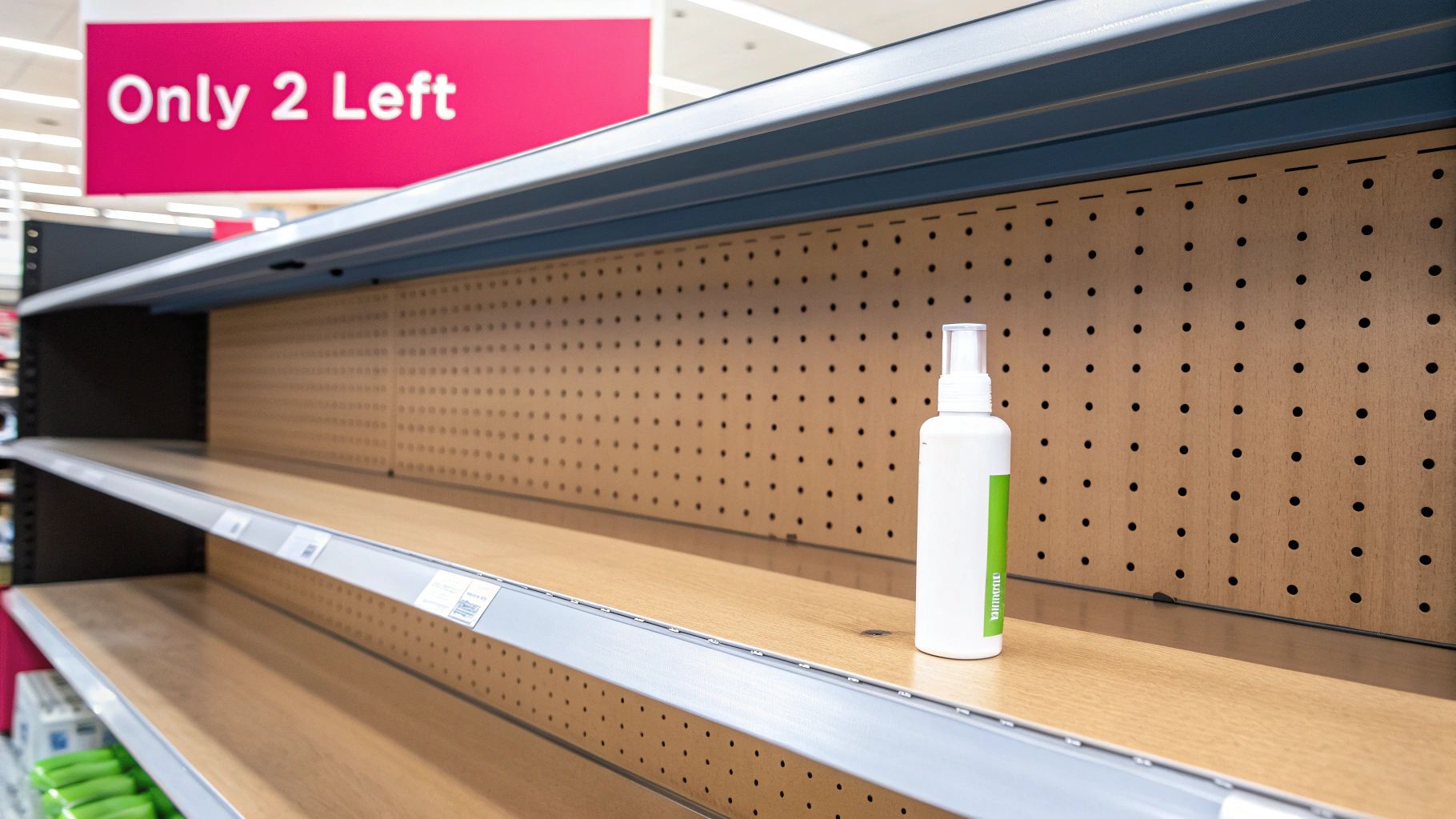
The message works by validating the customer’s choice (“others want this too”) while simultaneously introducing the risk of loss (“it might sell out”). This strategy is particularly potent for abandoned cart recovery, as it interrupts the customer’s hesitation with a compelling reason to complete their purchase right away. The key is to present this information authentically to maintain customer trust.
Strategic Breakdown
- Behavioral Psychology: This tactic is rooted in two core principles: social proof (the tendency to follow the actions of others) and scarcity (the perception that limited items are more valuable). When combined, they create a powerful conversion driver. For a deeper understanding, you can explore how to create urgency in sales with these methods.
- Authenticity is Paramount: The power of this message is completely undermined by dishonesty. Only use scarcity alerts when inventory is genuinely low. Real-time inventory tracking is crucial for credibility and avoiding customer frustration.
- Dynamic and Specific Messaging: Vague claims are less effective. Use specific numbers like, “Only 3 left in stock!” or “15 other people are viewing this item.” This specificity makes the claim more believable and impactful, turning an abstract idea into a tangible threat of missing out.
Actionable Takeaways
- Integrate Real-Time Data: Connect your messaging platform to your inventory management system to automatically trigger alerts based on actual stock levels and live visitor data.
- Be Truthful: Never fabricate scarcity or social proof numbers. Losing customer trust is far more damaging than losing a single sale.
- Test Different Triggers: Experiment with various combinations. For some products, “Only 2 left!” might be the most effective, while for others, “25 people bought this today” could drive more conversions.
5. Post-Browse Customer Value Proposition Message
Not every recovery attempt needs a discount. The post-browse value proposition message is a sophisticated promotional message example designed for brands that prioritize brand integrity over aggressive sales tactics. Instead of offering a coupon, this message reminds the customer why they were interested in the first place, focusing on product quality, unique benefits, and brand values.
This approach is particularly effective for premium, luxury, or mission-driven brands where price is not the primary purchase driver. It reinforces the brand’s unique selling proposition (USP) and builds a relationship based on shared values or a desire for quality, gently guiding the customer back to complete their purchase by highlighting what makes the product special.
Strategic Breakdown
- Focus on “Why,” Not “How Much”: This strategy shifts the conversation from price to intrinsic value. Messages like “Your eco-conscious choice awaits. Ethically made, sustainably delivered” or “Premium Italian leather crafted for lifetime wear” reconnect the customer with their original motivation.
- Build Confidence and Trust: Highlighting elements like a “30-day satisfaction guarantee,” positive customer testimonials, or star ratings reduces purchase anxiety. It reassures the customer that they are making a wise, low-risk investment in a quality product, not just an impulse buy.
- Maintain Brand Perception: For luxury or ethical brands, frequent discounting can devalue the product and erode brand equity. This value-focused promotional message example protects your brand’s premium positioning while still effectively engaging in browse recovery. For a deeper dive into this, a strategic playbook for browse abandonment can offer more advanced techniques.
Actionable Takeaways
- Segment Your Audience: Use this tactic for first-time browsers or on high-value items where a discount might hurt margins and brand perception.
- Highlight Your Top USP: Identify the single most compelling reason a customer should buy your product (e.g., sustainable materials, handcrafted quality, innovative technology) and make it the core of your message.
- Incorporate Social Proof: If possible, dynamically insert a high-star rating or a short, powerful customer testimonial into your automated message to add a layer of authentic validation.
6. Cross-Sell and Upsell Bundle Recovery Message
This advanced recovery tactic transforms an abandoned cart from a lost sale into an opportunity to increase average order value (AOV). Instead of simply reminding a customer about their items, this promotional message example intelligently suggests complementary products (cross-sells) or premium upgrades (upsells). It works by analyzing cart contents and triggering an automated SMS or email with a relevant, value-added offer.

This strategy is highly effective because it adds genuine value to the customer’s original purchase intent. By presenting a logical and appealing bundle, you not only recover the initial sale but also boost revenue per customer. This method is particularly powerful for stores with product catalogs that have clear pairing opportunities, such as electronics and accessories or beauty and skincare.
Strategic Breakdown
- Relevance is Paramount: The success of this message hinges on the relevance of the recommendation. Suggesting a phone case to someone who abandoned a smartphone is a natural fit; suggesting a random product is not. Use purchase history and cart data to make intelligent, automated suggestions.
- Incentivize the Bundle: The offer must be compelling enough to encourage the add-on. Phrases like “Bundle & save 15%” or “Add pillows & get free shipping” frame the additional purchase as a smart, money-saving decision rather than a simple upsell.
- Simplicity in Messaging: Especially in SMS, the offer must be clear and concise. Overwhelming the customer with too many choices can lead to decision paralysis. Focus on one or two highly relevant product recommendations to keep the message clean and actionable.
Actionable Takeaways
- Create Logical Product Pairings: Proactively define product bundles within your e-commerce platform (e.g., phone + case, moisturizer + serum). This makes triggering automated recommendations seamless.
- Limit Recommendations: In your SMS automation, configure the message to suggest only the single most relevant cross-sell or upsell to maintain focus and maximize conversion.
- Monitor Bundle Performance: Track the conversion rates of your bundled offers separately from standard cart recovery messages to understand which pairings are most effective and profitable.
7. Win-Back VIP or Loyalty Rewards Reinstatement Message
This sophisticated recovery message targets high-value, repeat customers who have abandoned a cart. Instead of a generic discount, it leverages their existing relationship with your brand by reminding them of their VIP status, accumulated loyalty points, or exclusive member benefits. This promotional message example is highly effective for businesses with established loyalty programs, as it frames the purchase as an opportunity to maximize value and status.
The strategy here is to transform the abandoned cart from a simple transaction into a rewarding experience. By highlighting what they stand to gain as a member, you reinforce the customer’s smart decision to join your program and create a powerful incentive to complete the purchase, thereby increasing customer lifetime value.
Strategic Breakdown
- Reinforce Exclusivity: This message reminds customers they are part of a special group. Phrases like “VIP Member,” “Platinum exclusive,” or “Just for you, [FirstName]” make the offer feel personal and valuable, distinguishing it from mass-market promotions.
- Tangible Value Proposition: Unlike a simple percentage off, loyalty points are a currency the customer has already earned. Showing them the exact points available for use (e.g., “You have 500 points to spend”) or how close they are to the next reward tier gamifies the purchase and provides a clear, quantifiable reason to act.
- Segment by Loyalty Tier: Not all VIPs are the same. A new loyalty member might respond to a message about earning their first reward, while a top-tier member might be motivated by early access to new products. Tailoring the message to their specific tier and benefits significantly increases relevance and conversion rates.
Actionable Takeaways
- Integrate Loyalty Data: Ensure your SMS or email platform can pull dynamic data like a customer’s current point balance or loyalty tier.
- Gamify the Journey: Send messages that highlight progress, such as “You’re just [$Amount] away from reaching Gold status! Complete your order to get there.”
- Tier-Specific Offers: Create separate automated workflows for different loyalty tiers. Offer your best perks, like free shipping upgrades or exclusive gifts with purchase, to your most valuable customers.
8. Worry-Free Guarantee and Objection-Handling Message
Hesitation is a major sales killer, especially for new customers or those considering a high-value purchase. This promotional message example tackles this challenge head-on by proactively addressing common objections. It sends a reassurance-focused message that highlights your guarantees, easy return policies, and customer support, effectively building trust and reducing purchase anxiety.
This tactic is particularly powerful for abandoned carts where the customer’s friction point isn’t price but uncertainty. By reminding them of the safety nets you have in place, like a “30-day money-back guarantee,” you lower the perceived risk of the purchase and give them the confidence needed to complete the order. It’s about removing doubt from the equation.
Strategic Breakdown
- Address Specific Objections: Different products create different anxieties. For tech, it might be setup support or warranty; for apparel, it’s fit and returns. Tailor your message to counter the most likely hesitation. Phrases like “Free returns, no questions asked” for fashion or “24/7 tech support included” for electronics directly dismantle these barriers.
- Leverage Trust Signals: Explicitly mentioning security measures like “Secure checkout protected by SSL” or satisfaction policies like “100% satisfaction guaranteed” acts as a powerful trust-building mechanism. These are not just words; they are commitments that reduce the customer’s perceived risk.
- Timing for Reassurance: Unlike urgency-based messages, this type of message works well when sent slightly later in an abandoned cart sequence, perhaps 6-24 hours after abandonment. This timing gives the customer space to consider the purchase and allows your message to arrive as a helpful solution to their lingering doubts, rather than a high-pressure sales tactic.
Actionable Takeaways
- Segment Your Audience: Send guarantee-focused messages specifically to new customers or those who have abandoned high-ticket items, as they are most likely to have purchase anxiety.
- Highlight Your Best Guarantee: Identify the single most compelling guarantee you offer (e.g., lifetime warranty, free returns, price-match promise) and make it the hero of your message for maximum impact.
- Link Directly to Policy Pages: Include a direct link to your returns or FAQ page within the message. This provides transparent, detailed information for customers who want to learn more, further reinforcing their trust in your brand.
9. Seasonal and Contextual Holiday Recovery Message
The seasonal and contextual holiday recovery message is a highly effective tactic that aligns cart abandonment reminders with peak shopping periods. This promotional message example leverages the heightened purchase intent during events like Black Friday, Christmas, or back-to-school season. It works by sending event-specific reminders to customers who abandoned carts, tying the incentive directly to the ongoing holiday promotion.
This strategy capitalizes on the urgency inherent in seasonal sales. Consumers are already in a buying mindset and are more receptive to offers, but they are also bombarded with messages. A targeted recovery message cuts through the noise by reminding them of specific items they considered, framed within the context of a limited-time holiday deal they are about to miss.
Strategic Breakdown
- Event-Driven Urgency: The holiday itself provides a powerful, natural deadline. Messaging like “Order by Dec 20 for holiday delivery” or “Black Friday savings end TONIGHT” creates a legitimate and compelling reason for immediate action that feels less like a marketing gimmick and more like helpful advice.
- Contextual Relevance: Tailoring the language and visuals to the specific holiday (e.g., using snowflake emojis for Christmas or backpack emojis for back-to-school) makes the message more engaging and relevant. This shows the customer that the communication is timely and not just a generic automated alert.
- Campaign Planning: Unlike standard recovery flows, seasonal campaigns require advance planning. To maximize impact, you should map out your messaging strategy, including reminder cadences and shipping cutoffs, at least 30-60 days before a major holiday to ensure all systems are ready for the surge in traffic and sales.
Actionable Takeaways
- Set Up Holiday-Specific Automations: Create separate cart recovery workflows for major holidays like Black Friday/Cyber Monday, Christmas, and Mother’s Day with unique copy and offers.
- Highlight Shipping Deadlines: For gift-giving holidays, make shipping cutoff dates the central point of your final recovery messages to drive conversions from last-minute shoppers.
- Use Countdown Timers: Implement a multi-message sequence as the holiday deadline approaches. For example, send reminders at 72 hours, 24 hours, and 6 hours before the sale ends to steadily increase the pressure to complete the purchase.
10. Re-Engagement and Win-Back Campaign for Inactive Customers
A win-back campaign is a targeted marketing effort designed to reactivate customers who have become inactive. This promotional message example is sent to users who haven’t made a purchase or engaged with the brand in a significant period, typically 30-90 days. Its purpose is to re-spark their interest by combining a personal, emotional appeal with a compelling, exclusive offer.
This strategy is far more cost-effective than acquiring new customers. It leverages existing customer data to deliver a highly relevant message that acknowledges the past relationship and provides a strong reason to return. The key is to make dormant customers feel valued and remind them of what they loved about your brand in the first place.
Strategic Breakdown
- Strategic Timing and Segmentation: Sending this message too early can feel pushy; too late, and the customer may have forgotten your brand. Segmenting your audience based on their last purchase date (e.g., 30, 60, or 90 days of inactivity) allows you to tailor the offer’s value and the message’s tone for maximum impact.
- Emotional Connection: Using phrases like “We’ve missed you!” or “It’s been a while” creates a personal connection that corporate language cannot achieve. This human-centric approach makes the customer feel like an individual, not just a number in a database, making them more receptive to the offer.
- Valuable Incentive: A standard 10% discount may not be enough to re-engage someone who has mentally moved on. The “we miss you” offer needs to be genuinely valuable, such as a higher-than-usual discount (e.g., 25% off) or an exclusive gift. This justifies the outreach and demonstrates a real commitment to winning them back.
Actionable Takeaways
- Create Inactive Segments: Set up automated workflows that trigger for customers who haven’t purchased in 30, 60, and 90 days.
- Highlight What’s New: Mention new best-sellers, site improvements, or collection launches since their last visit to give them a fresh reason to browse.
- Craft a Curiosity-Driven Subject Line: For email, use a subject line like “A Special Offer Just For You,
[FirstName]” to pique interest and ensure your message gets opened. For SMS, keep it concise and personal.
10 Promotional Recovery Messages Compared
| Template | 🔄 Implementation Complexity | 💡 Resource Requirements | 📊 Expected Outcomes | Ideal Use Cases | ⭐ Key Advantages |
|---|---|---|---|---|---|
| Abandoned Cart Reminder with Time-Sensitive Urgency | Low — simple SMS + timing rules | Low — SMS platform, one-click checkout link | High opens (>98%); conversion lift 8–15% ⚡ | Impulse purchases, limited-stock items | Fast to deploy; high conversion via urgency ⚡ |
| Multi-Language Localized Cart Recovery Message | Medium-High — language detection + scheduling 🔄 | High — translation QA, localization tooling | Better international engagement; +25–40% for intl segments 📊 | Global retailers, multi-country markets | Improves trust and relevance for non-English customers |
| Discount-First Recovery with Dynamic Offer Stacking | Medium — dynamic discount rules & tiering | Medium-High — discount engine, ROI tracking 💡 | Conversion lift 15–25%; can boost AOV 📊 | Price-sensitive shoppers, promotional periods | Very effective for price-sensitive segments; automated discounts |
| Social Proof and Stock Scarcity Recovery Message | Medium — real-time inventory + social metrics 🔄 | Medium — inventory feeds, real-time updates | Conversion lift 20–35% for limited inventory 📊 | Trending items, low-stock or seasonal SKUs | Strong FOMO and credibility when data is accurate ⭐ |
| Post-Browse Customer Value Proposition Message | Low-Medium — content and storytelling focus | Medium — brand content, testimonials | Lower immediate lifts; improves LTV over time 📊 | Premium/luxury brands, value-driven buyers | Preserves brand value and builds emotional loyalty ⭐ |
| Cross-Sell and Upsell Bundle Recovery Message | Medium-High — AI recommendations & catalog integration 🔄 | High — product catalog, recommendation engine 💡 | Conversion lift 10–20%; AOV +20–40% 📊 | Categories with clear pairings (electronics, beauty) | Increases AOV with relevant add-ons; enhances customer value |
| Win-Back VIP or Loyalty Rewards Reinstatement Message | Medium — loyalty data integration & personalization | Medium — loyalty platform, segmentation data 💡 | Very high conversion (25–40%) for members 📊 | Repeat customers, loyalty program members | Highly profitable reactivation; strengthens retention ⭐ |
| Worry-Free Guarantee and Objection-Handling Message | Low — reassurance-focused content | Low-Medium — policy clarity, trust badges | Conversion lift 12–18%; reduces hesitation 📊 | New customers, high-ticket purchases | Builds trust and lowers purchase anxiety ⭐ |
| Seasonal and Contextual Holiday Recovery Message | Medium — campaign timing + inventory coordination 🔄 | Medium-High — planning, creative, shipping deadlines | Large seasonal lift 30–50% during peaks 📊 | Holiday campaigns (Black Friday, Xmas, etc.) | Capitalizes on peak buying intent; time-limited urgency ⭐ |
| Re-Engagement and Win-Back Campaign for Inactive Customers | Medium — segmentation and delayed timing rules | Medium — historical data, creative offers 💡 | Conversion lift 15–25% for dormant segments; lower opens | Dormant customers, churn reduction efforts | Cost-effective reactivation; boosts long-term CLV ⭐ |
Putting These Examples into Action: Your Next Steps
We’ve journeyed through a comprehensive playbook of high-impact promotional message examples, from time-sensitive cart recovery tactics to sophisticated VIP win-back campaigns. The core lesson is clear: a truly effective promotional message is never just a generic blast. It is a carefully crafted, strategic communication designed to resonate with a specific customer at a precise moment in their journey.
The power of any promotional message example lies not in the template itself, but in the strategy behind it. Success is a formula combining three critical elements: personalization, timing, and automation. Simply copying and pasting a message will yield mediocre results. The real growth comes from adapting these frameworks to your unique brand voice, segmenting your audience intelligently, and understanding your product catalog’s strengths.
Key Strategic Pillars to Remember
To transform this knowledge into tangible revenue, focus on these foundational principles:
- Context is King: The most effective messages feel less like promotions and more like helpful reminders. A flash sale announcement has a different context than a message addressing a shopper’s specific abandoned item. Always tailor the content to the customer’s recent actions.
- Value Over Discounts: While discounts are powerful, your message’s primary goal should be to communicate value. This could be through social proof, highlighting product benefits, reinforcing your guarantee, or reminding a VIP of their exclusive status. The discount is often just the final nudge.
- Automation Unlocks Scalability: Manually sending personalized, timed messages is impossible at scale. Leveraging automation is non-negotiable for implementing advanced strategies like dynamic offer stacking, localized messaging, and multi-step recovery sequences.
Your Actionable Roadmap to Higher Conversions
Reading about a great promotional message example is one thing; implementing it is another. Here is a practical, step-by-step plan to get started immediately and begin seeing results.
- Audit and Prioritize: Review the 10 examples covered in this article. Don’t try to implement them all at once. Identify the top 2-3 that address your biggest pain points. For most e-commerce stores, this means starting with the Discount-First Recovery and the Social Proof and Scarcity messages.
- Segment Your Audience: Begin with simple segmentation. Create distinct lists for first-time cart abandoners, repeat customers, and inactive VIPs. This allows you to tailor the tone and offer for maximum impact.
- Implement and A/B Test: Set up your chosen campaigns using your marketing platform. Crucially, create two versions of each message. Test one key variable at a time: the headline, the discount percentage, the call-to-action button text, or the timing.
- Analyze and Iterate: Let your tests run until you have statistically significant data. Analyze the results. Which version had a higher open rate? Which one generated more revenue? Double down on the winner and start a new test. This continuous cycle of improvement is the secret to a high-performing promotional strategy.
By systematically applying these principles, you will move beyond simply sending messages and start building an automated, revenue-generating engine. You will transform your promotional efforts from a potential cost center into one of your most profitable and reliable marketing channels, fostering customer loyalty and driving sustainable growth.
Ready to automate these powerful strategies without the manual effort? CartBoss is designed to implement every advanced promotional message example discussed here, from multi-language SMS recovery to dynamic, pre-filled checkouts. Stop leaving money on the table and see how our platform can turn abandoned carts into your biggest revenue stream by visiting CartBoss today.