


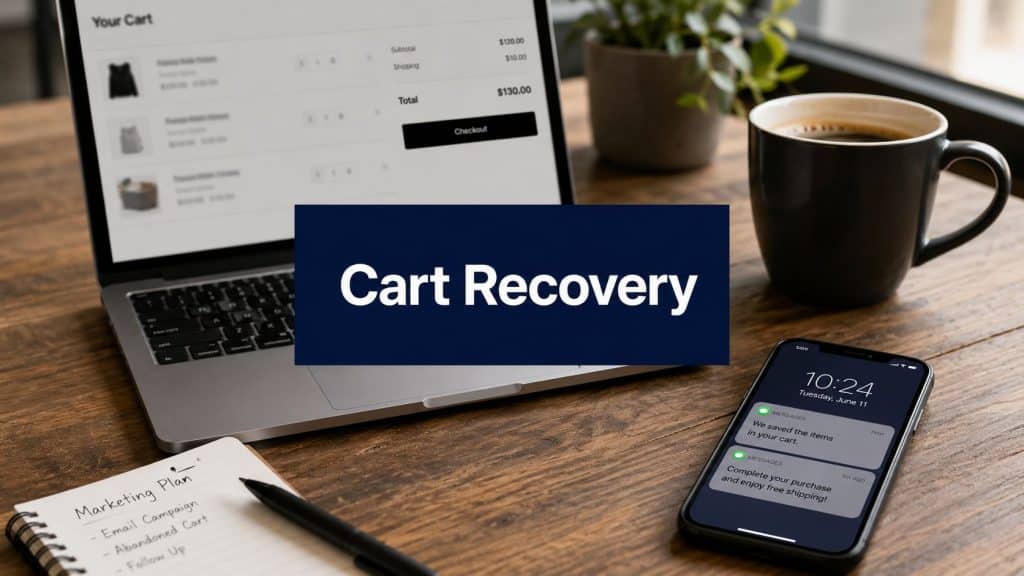
Most Shopify stores don’t have a traffic problem. They have a recovery problem.
Independent 2026 ecommerce research reports a global average cart abandonment rate of 70.2%, with a Shopify-specific average of 69.8%, which means roughly 7 out of every 10 shoppers who add items to cart leave without buying. On mobile, abandonment climbs to 76.8% (easyappsecom.com). If you run a Shopify store, that leak is usually one of the biggest profit opportunities you already have.
An abandoned cart recovery Shopify app is the system that tries to bring those shoppers back automatically. But most merchants start in the wrong place. They compare app lists, screenshots, and pricing pages before they decide how they want to recover carts.
That usually leads to mediocre results.
A stronger approach is simpler. Decide your channel, your timing, and your offer first. Then choose the app that can execute that plan cleanly. The same strategy-first mindset shows up in adjacent ecommerce tooling too. For fashion brands, for example, this guide to WearView on AI tools for fashion is useful because it starts with operational problems before it gets into software choices.
Why Your Shopify Store Leaks Revenue

Cart abandonment isn’t a sign that your store is broken. It’s normal buyer behavior. People compare prices, get distracted, switch devices, hesitate on shipping, or run out of time.
The problem is scale. When nearly seven out of ten carts don’t convert, abandoned carts stop being a minor annoyance and become a core revenue issue. Mobile makes that worse. Shoppers browse fast, get interrupted often, and ignore crowded inboxes more easily.
That’s why a recovery app matters. A good one doesn’t just send a reminder. It captures intent while it still exists and turns follow-up into an automated revenue stream.
Where the leak usually starts
Most stores lose sales in a few predictable places:
- Mobile friction: Typing billing and shipping details on a phone creates drop-off.
- Delayed follow-up: Waiting too long makes the cart feel irrelevant.
- Wrong channel: Email often gets buried, especially for mobile-first shoppers.
- Weak offers: Generic “you left something behind” messages don’t resolve objections.
If you want a broader benchmark for how serious this issue is across ecommerce, CartBoss has a useful breakdown of the shopping cart abandonment rate.
What an abandoned cart recovery app really does
Think of it as an automated closer. It watches for checkout drop-off, identifies who can be reached, triggers a sequence, and gives the shopper a low-friction path back to purchase.
Practical rule: Recovery works best when it feels like customer assistance, not repeated chasing.
That distinction matters. Shoppers don’t need more reminders. They need the right reminder, in the right channel, at the right time, with a clear path back to checkout.
An app is only the delivery system. The strategy is what determines whether those reminders feel helpful or forgettable.
Understanding the Recovery Automation Engine
A recovery app works like a sales assistant who notices when someone walks out of the store with products still in hand, then follows up later with a useful prompt and a direct route back to the register.

The mechanics are straightforward, but the execution details matter.
How the workflow actually runs
In most setups, the engine has five jobs:
-
Detect abandonment
The system identifies when a shopper leaves before completing checkout. -
Capture usable contact data
Recovery only works if the customer has shared an email address, phone number, or another reachable identifier during the session. -
Apply logic
Better tools segment by factors like cart value, returning vs. first-time buyer status, or market. -
Trigger the sequence
The app sends messages according to your rules, not as one generic blast. -
Return the shopper to checkout
The shorter the path back, the better the chance of conversion.
For merchants building broader lifecycle flows, this overview of a marketing automation workflow is a helpful companion.
Why Shopify’s native recovery isn’t enough for many stores
Shopify’s built-in abandoned checkout recovery is useful as a basic starting point, but it has clear limits. Shopify states that native abandoned checkout recovery is limited to the Online Store and Buy Button sales channels, and that the original cart contents are not saved. Recovery uses an abandoned checkout record with a direct checkout link rather than the original cart snapshot (Shopify help on abandoned checkouts).
That creates two practical issues.
First, native recovery is narrower in channel coverage. If your strategy depends on SMS, WhatsApp, Messenger, or other touchpoints, you need a tool built for that.
Second, cart reconstruction can be less straightforward than merchants expect. If your offer, message, or user experience depends on restoring the exact context of abandonment, specialized apps are often necessary.
Native recovery is a reminder tool. A dedicated app is a recovery system.
That’s an important difference. Basic tools can send follow-ups. Strong tools can reduce friction, personalize the path back, and handle the operational realities that affect conversion.
What better apps add
The stronger abandoned cart recovery Shopify app setups usually add:
- More channels: Email, SMS, push, WhatsApp, or Messenger.
- Better timing controls: You decide when and how often follow-ups happen.
- Segmentation: High-intent carts and low-intent carts don’t get the same treatment.
- Smarter checkout return paths: The fewer steps a shopper repeats, the better.
Once you understand the engine, app selection gets easier. You stop asking which app has the longest feature list and start asking which one matches your recovery design.
Email vs SMS Recovery Which Channel Wins Sales
Most merchants still treat cart recovery as an email decision. That’s outdated.
Shopify’s default email recovery typically recovers less than 5 to 7% of lost sales, while stores using multi-channel flows including SMS often reach 15 to 25% recovery (Shopify Community discussion on cart recovery rate). That gap is the reason channel choice matters so much.
Email vs. SMS Recovery at a Glance
| Metric | Email Recovery | SMS Recovery |
|---|---|---|
| Reach model | Works when a shopper shared an email and checks their inbox | Works when a shopper shared a phone number and consent allows messaging |
| Typical role | Good for longer-form reminders, product details, and final incentive messages | Good for urgency, fast reminders, and mobile-first follow-up |
| Speed of attention | Often delayed because inboxes are crowded | Usually seen faster on mobile devices |
| Message length | Better for richer content and brand storytelling | Better for short, direct action-focused copy |
| Compliance pressure | Requires list hygiene and deliverability discipline | Requires strict consent and do-not-disturb handling |
| Best use case | Lower-pressure nurture and backup recovery | Immediate checkout recovery and time-sensitive nudges |
For a broader look at channel behavior in ecommerce, CartBoss also covers the trade-offs in email vs SMS marketing.
Why SMS often wins the first recovery moment
SMS has one structural advantage. It meets the shopper on the same device where abandonment often happens.
If mobile abandonment is the highest-friction environment, then mobile-native recovery usually makes more sense than waiting for a customer to revisit their inbox later. That doesn’t mean email is obsolete. It means email is often stronger as part of the sequence than as the whole sequence.
When email is still the better move
Email still earns its place in several situations:
- Complex products: You may need room to answer objections or reinforce value.
- Lower urgency carts: Some buyers need time, not pressure.
- Content-rich offers: Bundles, product comparisons, or education fit better in email.
- Lower average order value stores: If margins are tight, free or native email automation may be enough.
When SMS deserves priority
SMS becomes much more attractive when your store has these traits:
- Mobile-first traffic
- Repeat buyers who respond to direct prompts
- High-intent carts that don’t need much education
- International or multilingual audiences where inbox fatigue is a real issue
The strongest strategy is usually not email versus SMS. It’s deciding what each channel should do.
Use email to explain. Use SMS to prompt action.
That framework prevents one of the most common mistakes. Merchants often try to make every channel do everything. Then the sequence gets bloated, repetitive, and easy to ignore.
A practical channel stack
A simple recovery stack often works better than an elaborate one:
- First touch: Short reminder in the fastest-response channel
- Second touch: Follow-up in a complementary channel
- Final touch: Incentive only if the cart still hasn’t converted
That’s more disciplined than blasting three nearly identical messages through every available platform. The highest-performing abandoned cart recovery Shopify app setups usually aren’t the loudest. They’re the most deliberate.
Core Features Your Recovery App Must Have
A recovery strategy falls apart fast when the app can’t execute the basics cleanly.
You don’t need every feature in the app store. You need the features that remove friction, support your chosen channel mix, and let you improve the sequence over time. Recent coverage of Shopify recovery tools points in the same direction: the decision has shifted from generic email automation toward a broader channel-stack approach, including SMS, WhatsApp, and Messenger for mobile-first markets (Wisepops on Shopify cart abandonment apps).

Automation and segmentation
Basic automation sends the same reminder to everyone. That’s rarely good enough.
Your app should let you vary recovery logic by customer type, cart value, or purchase history. First-time shoppers usually need reassurance. Repeat buyers often respond better to speed and convenience. High-value carts may justify a stronger follow-up sequence than low-margin carts.
A tool with segmentation also helps you avoid over-messaging. Not every abandoned cart deserves the same pressure.
Frictionless return to checkout
This feature matters more than merchants think.
If your reminder brings people back but forces them to rebuild effort, the sequence underperforms. A good recovery app should make the return path feel direct and simple. That includes durable checkout links, clean mobile flows, and as little re-entry as possible.
Smart discounts and incentive control
Discounts can recover revenue. They can also train shoppers to wait.
Your app should let you control when incentives appear, who gets them, and what kind of offer is shown. Free shipping can work well as a lighter nudge. A discount can make sense later in the flow if margin allows it.
Avoid tools that treat incentives as all-or-nothing. You want control, not a coupon cannon.
A useful reference here is CartBoss’s guide to choosing an SMS autoresponder app, because it highlights how automation settings affect real campaign behavior.
Here’s a quick walkthrough worth watching before you shortlist tools:
Analytics that show revenue, not just activity
Plenty of apps report opens, clicks, and sends. That’s useful, but it’s not enough.
You need reporting that tells you:
- Which sequence recovered actual orders
- Which offers produced margin-friendly conversions
- Which segments respond well
- Where unsubscribes or drop-off increase
If the dashboard can’t tie recovery actions back to revenue, optimization becomes guesswork.
Compliance controls you won’t regret later
This is essential for SMS and still important for email.
Look for built-in consent handling, unsubscribe logic, quiet-hour controls, and regional safeguards. These aren’t “nice to have” features. They protect deliverability, reduce customer frustration, and help the program stay sustainable.
One app worth noting in this category is CartBoss, which focuses on automated SMS cart recovery and includes features such as language detection, pre-filled checkout forms, dynamic discount application, analytics, and compliance controls. Whether that’s the right fit depends on your channel strategy and whether SMS is central to your recovery plan.
A Step-by-Step App Implementation Plan
A recovery app only pays off when the sequence is designed properly. Independent guidance on Shopify cart recovery increasingly emphasizes that campaign design matters more than app installation, and that structured sequences with timing logic and segmentation outperform aggressive generic flows, especially in regulated or multilingual markets (Recapture on Shopify abandoned cart recovery).

1. Define the job of the sequence
Start with one clear goal. Recover carts without training customers to expect discounts.
That changes how you build the flow. If margin is tight, convenience should do most of the work. If your store sells considered purchases, your messages may need more reassurance and less urgency.
2. Pick the channel stack before the app
At this point, most merchants go backward.
Choose the primary channel based on customer behavior, consent, and product type. Then add a secondary channel only if it serves a distinct role. If you’re mapping automation across a larger stack, this overview of integrating Hyperleap AI with Shopify is useful for thinking through how tools connect operationally.
3. Build the sequence logic
A simple sequence usually beats an overbuilt one.
Use this structure:
- Early reminder: Fast, direct, no discount.
- Second follow-up: Re-engage with context, support, or urgency.
- Final message: Add a light incentive only if needed.
The exact timing should match your market, product, and consent boundaries. Don’t copy another brand’s cadence blindly.
The best recovery flow feels intentional. The worst one feels automated in the bad sense.
4. Write copy that removes hesitation
Good recovery copy doesn’t sound clever. It sounds useful.
Use messages that do one of these jobs:
- Remind: “You left items in your checkout.”
- Reduce friction: “Return to checkout with your details ready.”
- Resolve doubt: “Your cart is still available.”
- Offer a final nudge: “Complete your order with free shipping.”
Keep SMS short and direct. Let email carry the longer explanation if you’re using both.
5. Launch, review, and tighten
After launch, review recovered orders, opt-outs, and message timing together. Don’t optimize for vanity metrics alone.
If unsubscribes rise, the issue may be timing or frequency. If clicks happen without conversions, the issue is likely the checkout experience or the offer. If nothing moves, revisit channel choice first.
Common Recovery Mistakes That Cost You Sales
Most recovery underperformance comes from a few repeat mistakes. The good news is that they’re fixable.
Sending too many messages
More touchpoints don’t automatically mean more revenue. They can create fatigue fast, especially in SMS.
The fix is restraint. Keep each message accountable to a specific purpose. If two messages say the same thing, one of them probably shouldn’t exist.
Leading with discounts too early
A lot of stores jump straight to “10% off” style recovery. That can pull forward conversions, but it can also teach shoppers to abandon on purpose.
Start with convenience and reminder-based recovery. Save incentives for the final step or for segments where hesitation is clearly price-related.
Writing generic copy
“Did you forget something?” is harmless, but it’s weak.
Stronger copy acknowledges the situation and gives the shopper one clear action. It should sound like a useful prompt, not a template. Product relevance, timing, and checkout convenience matter more than clever phrasing.
Ignoring deliverability and compliance
Recovery can fail long before the message reaches the shopper. If your emails land in spam, the sequence looks ineffective when the problem is inbox placement. This practical guide on how to check if emails are going to spam is worth using if your email reminders underperform unexpectedly.
For SMS, the equivalent issue is consent and quiet-hour handling. If you ignore those rules, performance declines and complaints rise.
Treat compliance as conversion infrastructure, not legal housekeeping.
Measuring the wrong thing
Open rates and clicks can hide a weak recovery program.
Watch recovered revenue, conversion after click, opt-out patterns, and whether incentives are eroding margin. The point isn’t to generate activity. The point is to recover profitable orders.
How CartBoss Delivers Your Recovery Strategy
If your recovery strategy depends on SMS, low-friction checkout return, and multilingual support, the tool you choose has to execute those details reliably.
CartBoss fits that model because it’s built around automated SMS cart recovery rather than generic email-first workflows. It supports pre-written and translated messages, automatic language detection, pre-filled checkout forms, dynamic discount application, analytics, and compliance-related controls such as do-not-disturb handling. Those features line up with the strategy choices that matter most in recovery: channel fit, timing discipline, and reduced checkout friction.
It’s also useful for merchants who don’t want to stitch together several separate tools just to run one recovery sequence. If you’re evaluating setup complexity, CartBoss has a practical guide to its set-up wizard, which shows how the implementation is structured.
The bigger point is this. The best abandoned cart recovery Shopify app isn’t the one with the longest feature list. It’s the one that supports the strategy you need.
If your buyers are mobile-first, inbox-fatigued, or spread across multiple languages, SMS-centered recovery deserves serious consideration. If your store needs only a light email sequence, a simpler tool may be enough. But if you want abandoned carts to become a predictable profit center, your app has to do more than send reminders. It has to recover intent efficiently and consistently.
CartBoss helps Shopify stores turn abandoned carts into revenue with automated SMS recovery, pre-filled checkout links, dynamic discounts, and compliance-aware messaging. If you want to put a strategy-first recovery system in place instead of relying on generic reminders, try CartBoss.