


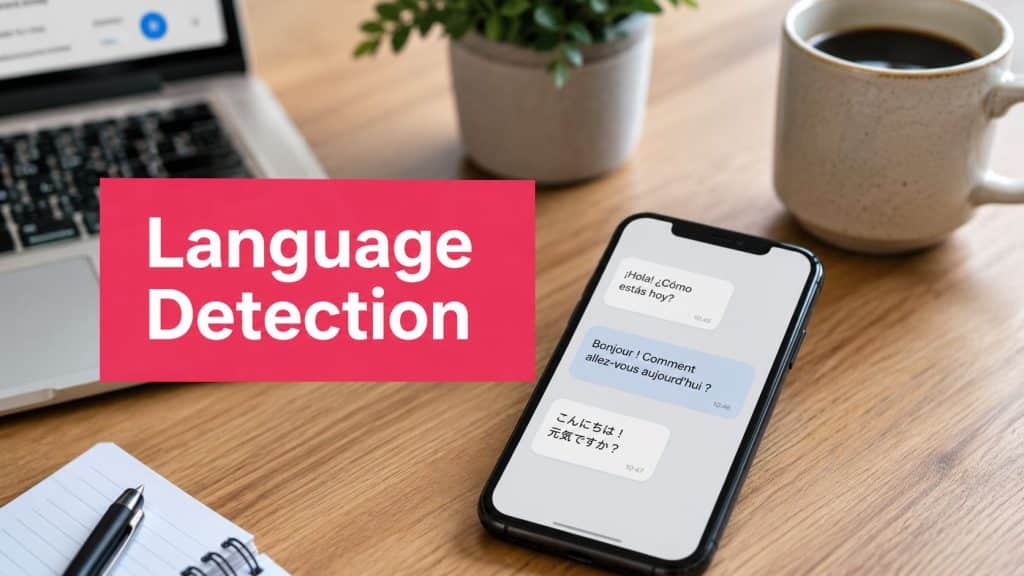
Your store starts getting traction outside your home market. Orders come in from France, Germany, Brazil, and a few countries you didn’t even target yet. That feels like growth until your recovery messages go out in one language, use the wrong tone, and send shoppers back to checkout with friction instead of confidence.
That’s where many stores leak revenue. The product is right. The timing is right. The channel is right. But the message lands in the wrong language, so the customer ignores it, hesitates, or drops off for good.
Automatic language detection matters because SMS cart recovery only works when the message feels native, immediate, and trustworthy.
The Global Sales Challenge You Did Not Expect
A familiar pattern shows up when a store expands internationally. Traffic grows first. Then abandoned carts grow with it. Teams usually react by adding more messages, more discounts, or more flows. The underlying issue is often simpler. The customer doesn’t feel like the message was written for them.
A shopper in Brazil abandons checkout. Minutes later, they receive an English SMS with a generic reminder and a checkout link. The message isn’t necessarily wrong. It’s just not comfortable. On a small screen, with little attention to spare, even minor language friction can kill the return visit.
Why SMS raises the stakes
SMS is powerful because it reaches people fast and gets seen. SMS marketing campaigns achieve an average opt-in rate of 99% and can help e-commerce stores recover up to 50% of abandoned cart revenue, which is why it’s such an important recovery channel for stores that want to win back lost buyers quickly (research reference).
That creates a high standard. If nearly every opted-in customer sees the message, then the quality of that message matters more. Wrong language means you’re wasting one of the highest-attention moments in your funnel.
Practical rule: If a customer reads your SMS and has to mentally translate it, your recovery flow is already weaker than it should be.
Localization is not optional once sales go global
Most stores don’t need a massive localization program on day one. They do need a reliable way to avoid sending the wrong language at the worst possible moment. That starts with knowing what language the customer is most likely to respond to.
A strong localization strategy for e-commerce messaging turns language from a growth obstacle into a conversion lever. It helps you stop treating international shoppers like edge cases and start treating them like customers who are ready to buy, if checkout feels easy.
The hard part isn’t realizing localization matters. The hard part is doing it instantly, at scale, and without adding manual work to every abandoned cart.
What Is Automatic Language Detection
Automatic language detection is the process of identifying which language a piece of text or speech is written or spoken in. Its job is classification, not translation.
The concept is akin to a hyper-efficient librarian. You hand over a single sentence, and instead of reading the full book, the librarian immediately says, “This is Spanish,” or “This is French.” That label then tells the next system what to do.

What it does and what it doesn’t
This distinction matters because many store owners lump several tasks together.
- Detection identifies the language. It answers, “What language is this customer using?”
- Translation rewrites the content. It answers, “How do I say this in another language?”
- Localization adapts the message. It answers, “How should this message sound for this shopper and market?”
If detection fails, the rest of the chain starts on the wrong foot. A translated message in the wrong target language is still the wrong message.
Why marketers should care
For marketers, language detection is a routing decision. It decides which message template, language version, and checkout path the customer should receive.
That’s especially important in global SMS recovery because the interaction is short. You don’t have room to explain, recover, or clarify. The message has to feel right at first glance.
A useful way to think about it is this:
- A customer leaves the cart
- The system identifies the likely language
- The platform selects the matching message
- The shopper gets a localized prompt with a clear next step
That’s why language detection sits upstream from every other personalization choice. If you want a grounded overview of the broader localization side, CartBoss has a helpful article on what language localization means in practice.
A localized message doesn’t start with translation. It starts with identifying the right language fast enough to act on it.
How a Machine Learns to Read Languages
A shopper abandons a cart in Spanish, but your recovery text goes out in English. That miss costs clicks, trust, and often the order. Language detection exists to prevent that split-second mismatch, and it has to work fast enough that the message is still relevant when it lands.

The old-school pattern method
One common method looks for recurring character sequences and word fragments, often called n-grams.
The idea is straightforward. English tends to contain patterns like “the” and “tion.” French, German, Portuguese, and other languages produce their own repeatable combinations. The detector compares a message against those known patterns and picks the closest match.
That approach is fast and useful, especially on longer, clean text. It gets weaker on the kind of content e-commerce teams deal with in SMS: short replies, typos, slang, mixed languages, and emojis.
The machine learning method
Modern detection systems learn from large sets of labeled examples instead of relying only on predefined rules. They pick up signals such as spelling tendencies, word order, punctuation habits, and the probability that certain terms appear together in a given language.
If you want the broader AI context in plain English, Up North Media explains how natural language processing works without getting buried in developer terminology.
In practice, the workflow is simple:
- A message comes in
- The system turns that text into measurable features
- A model scores the most likely languages
- The highest-confidence result routes the shopper into the right SMS flow
For marketers, the important part is not the model type. It is the decision quality. A good detector helps the platform choose the right template before the send happens, which is exactly what an integrated recovery system should do.
What speed looks like in a live system
Detection only matters if it fits inside a live recovery flow. Research from Google on compact multilingual models shows that language identification can be designed for production use with low latency across many languages, which is why real-time routing is practical for messaging use cases (Google’s CLD3 language identification overview).
That matters in SMS because timing affects conversion. If your setup relies on separate tools stitched together through an SMS sender API for recovery workflows, every extra processing step adds another place for delays or mismatches. CartBoss handles detection and message routing inside the same recovery flow, which reduces that operational drag.
The shopper does not care how the model works. The shopper notices whether the message feels like it was meant for them.
What still causes mistakes
Short text is still the hardest case. A reply like “si,” “ok,” “ja,” or a product name plus an emoji gives the model very little context. Mixed-language behavior makes it harder. So does borrowed vocabulary, which is common in retail and fashion.
Reliable systems do not depend on text alone. They also use context signals such as country code, store language, checkout data, and prior customer behavior to reduce uncertainty. That blend is what separates a lab demo from a revenue tool.
For a store owner, that is what matters. Automatic language detection is not about teaching a machine linguistics. It is about sending the right cart recovery message, in the right language, fast enough to recover the sale.
Choosing Your Implementation Method
Store owners usually have three ways to add language detection to an SMS recovery workflow. Build it yourself with libraries, connect to a cloud API, or use a platform where detection is part of the recovery product.
Each option can work. The right choice depends on how much technical ownership you want and how critical short-text performance is for your business.
The practical trade-offs
For SMS, the challenge isn’t just language detection in general. It’s detection on tiny text snippets, with regional variation, and no room for delay. For short texts like SMS, a hybrid approach combining probabilistic models with geolocation heuristics improves accuracy from 75% to over 88% for common local languages, which is why integrated systems often outperform basic single-method setups in this use case (short-text language detection analysis).
That hybrid logic sounds straightforward until you have to maintain it. You need fallbacks, language mapping, testing, template management, and routing logic on top of the raw detection.
Language Detection Implementation Options
| Method | Ease of Use | Cost | Best For |
|---|---|---|---|
| Standalone client library | Lower. Requires setup, testing, and maintenance | Often low upfront, but internal time cost is real | Teams with developers who want full control |
| Cloud language API | Moderate. Faster to start, but still needs integration work | Usage-based and operationally variable | Stores with technical resources and custom workflows |
| Integrated recovery platform | Higher. Detection is built into the workflow | Bundled into the broader recovery stack | Stores that want fast deployment and minimal maintenance |
When DIY makes sense and when it doesn’t
A DIY setup can be reasonable if your team already manages custom messaging infrastructure and you’re comfortable owning every edge case. That includes template versioning, regional logic, delivery handling, and QA.
A cloud API is a middle ground. You get managed infrastructure, but the business logic still lands on your team. You still have to decide what happens when confidence is low, what default language to use, and how to keep messages aligned with your offers.
An integrated path is usually the cleaner option when your goal is revenue recovery, not model management. If you want to see what the message-delivery side of that stack looks like, CartBoss covers some of the operational side in its guide to the SMS sender API.
Use this filter when deciding:
- Choose libraries if your advantage is engineering customization.
- Choose APIs if you need flexibility and already have workflow infrastructure.
- Choose an integrated platform if your priority is getting localized recovery live without building the plumbing yourself.
Best Practices for SMS Cart Recovery
Good detection alone won’t save a weak recovery program. The message still has to arrive quickly, use the right tone, stay compliant, and push the customer back into a low-friction checkout.

Build for the miss, not just the hit
No detection system is perfect, so your flow needs a fallback.
- Set a default language: Pick a safe fallback for each market so low-confidence detections don’t break the journey.
- Use verified templates: Keep pre-approved message versions ready in each supported language instead of improvising copy on the fly.
- Define confidence rules: When the system isn’t confident, route to a broader-market default rather than risking a niche language mismatch.
A lot of stores focus only on the ideal path. The stronger approach is to design the backup path first.
Respect tone, not just vocabulary
A message can be technically translated and still feel off. That’s common in sales recovery because urgency, discounts, and reminders depend on nuance.
A blunt phrase in one market may feel normal. In another, it may feel pushy or spam-like. That’s why localized templates usually outperform raw translations in practice. The copy should reflect how people respond to reminders in that language.
If you’re refining message strategy, this guide on personalizing SMS campaigns for stronger cart recovery is worth reviewing alongside your language workflow.
Field note: In SMS, small wording mistakes matter more because the channel is so compressed. You don’t get a second paragraph to fix the first sentence.
Keep privacy and compliance inside the flow
Language preference can become part of personal data handling, especially when paired with phone numbers, location signals, or behavioral triggers. That means your recovery setup needs clean consent, clear unsubscribe handling, and strong data discipline.
Use a simple checklist:
- Collect consent clearly
- Store only what you need
- Respect do-not-disturb preferences
- Make opt-out easy
- Review regional privacy rules before launch
The legal details vary by market, but the operating principle stays the same. Don’t treat language as a harmless metadata field if it affects targeting.
Speed wins only when it’s accurate enough
In live cart recovery, you’re balancing two things that often fight each other. Faster systems respond sooner. More complex systems may make better decisions but take longer.
There’s a critical trade-off between detection accuracy and speed. While complex models can be more accurate, they may introduce latency. For cart recovery, which must happen in seconds, a system that balances good-enough accuracy with ultra-low latency is often superior to a slower, more precise one (latency and prompting trade-off discussion).
That matters because the customer’s buying intent fades quickly. If your workflow waits too long to decide on language, your “perfect” message may arrive after the moment is gone.
A practical operating checklist
- Send fast: Don’t let model complexity delay the recovery trigger.
- Keep links frictionless: Use checkout links that minimize extra steps.
- Align discount logic: Make sure offer copy matches the customer’s language version.
- Test by market: Review results by country and language group, not only in aggregate.
- Audit edge cases: Check what happens with slang, mixed-language text, and very short replies.
Evaluating Detection Accuracy and Performance
A customer in Belgium abandons a cart, replies with three words, and mixes French with English product terms. That is the kind of test that matters. If your language detector gets that wrong, the recovery SMS feels careless, and conversion drops for a reason that rarely shows up in a dashboard.
Accuracy needs to be judged in the same conditions where revenue is won or lost. For e-commerce, that means short replies, spelling mistakes, borrowed words, regional phrasing, and customers who switch languages mid-message.
What accuracy actually means
Vendor accuracy numbers often come from cleaner datasets than anything a store sees in live SMS flows. A model can perform well on long, formal text and still struggle with cart recovery traffic. Marketers should ask for results on message-length inputs, not only broad averages across polished samples.
Coverage matters too. A detector that handles English, German, and Spanish well may still perform unevenly on less represented languages or dialect-heavy markets. If those shoppers are part of your growth plan, average scores hide the risk.
Research benchmarks on multilingual speech and language tasks show the same pattern. Performance drops as language diversity increases, especially in low-resource settings, according to OpenAI’s FLEURS dataset paper. The practical takeaway is simple. Do not buy based on a headline accuracy claim. Buy based on how the system behaves on the language mix your store encounters.
What to test before you trust it
A useful review process looks at the recovery workflow, not only the model.
- Short input handling: Test one-word replies, slang, abbreviations, and product names.
- Low-confidence behavior: Check whether the system falls back to a default language, asks for clarification, or suppresses the send.
- Mixed-language messages: Review how it handles customers who combine two languages in one SMS.
- Market context: Confirm whether it uses signals like country, storefront language, or prior session behavior to improve routing.
- End-to-end speed: Measure whether detection slows the send enough to hurt recovery timing.
I also look for operational control. CartBoss is a strong example because detection is tied directly to prepared and translated text messages for cart recovery, so the decision does not stop at identifying a language. The message, compliance logic, and send flow still need to work correctly.
Teams comparing vendors may also want a broader view of how these decisions fit into automation strategy. This comprehensive AI automation guide covers the wider workflow context.
The right question is not whether detection is perfect. It is whether it is accurate enough, fast enough, and controlled enough to recover more carts across more markets without creating avoidable mistakes.
Automate Your Global Growth with CartBoss
At this point, the pattern is clear. Automatic language detection isn’t a novelty feature. It’s part of the infrastructure that lets a store recover international carts without adding manual complexity to every campaign.
For most merchants, the primary decision isn’t whether language detection matters. It’s whether they want to assemble detection, localization, compliance, and message timing from separate components, or use a system where those pieces already work together. If you want a broader view of how businesses are applying automation across workflows, this comprehensive AI automation guide offers useful context.

One practical option is CartBoss, which combines automatic language detection with pre-written localized SMS, compliance features, and abandoned cart recovery workflows inside one product. That matters because stores don’t just need detection. They need the next step to happen correctly, with the right copy, at the right time, and without extra setup across multiple tools.
If you want to see how the messaging side is handled, CartBoss also details its prepared and translated text messages. That’s the operational layer many stores underestimate until they try to manage multilingual recovery manually.
The business case is straightforward. SMS remains a high-attention channel. International growth adds language friction. Recovery performance improves when shoppers receive messages that feel local, clear, and immediate. When that process runs automatically, your team gets scalability instead of more campaign maintenance.
Cart recovery gets harder as your store grows across borders, but it doesn’t have to get more complicated. CartBoss helps stores recover abandoned carts with automated SMS, localized messaging, and automatic language detection built into the workflow so you can turn more lost checkouts into completed orders.