



The Real Cost of Abandoned Carts: Beyond the Numbers
The 70% average cart abandonment rate can be a discouraging statistic for e-commerce businesses. However, this number also presents a substantial opportunity to boost revenue. Think about it: for every 10 shoppers adding items to their cart, 7 leave without purchasing. Even minor improvements in your abandoned cart recovery rate can significantly impact your bottom line.
Improving your recovery rate by just 5%, for example, could lead to a double-digit revenue increase. This underscores why abandoned cart recovery isn’t just a tactical fix, but a core strategy for any online retailer.
The Revenue Leakage You Can’t Afford to Ignore
Understanding the real cost of abandoned carts requires calculating your revenue leakage. This involves figuring out the average value of abandoned carts and multiplying it by your abandonment rate. This calculation reveals the potential revenue you’re missing.
Imagine your average abandoned cart value is $50 with a 70% abandonment rate. Out of 100 potential customers, you’re losing $3500 in potential sales. Addressing this leakage is critical for sustainable business growth. For more insights, read: How to master abandoned cart recovery with text messages.
Industry Benchmarks and Your Recovery Approach
The global average cart abandonment rate has hovered around 70.19% in recent years (2023, 2024, and 2025). This consistent challenge highlights the difficulty e-commerce businesses face in turning browsing into buying. Despite these high rates, there’s significant room for recovery. Research shows that well-executed communication strategies, like recovery emails, can greatly improve the chances of customers completing their purchases. You can find more detailed statistics here.
Some industries naturally experience higher abandonment rates. Fashion, for example, often sees higher rates due to issues like sizing and rapidly changing trends. Understanding your industry’s specific challenges will help you craft a more effective recovery strategy. You might find this helpful: How to master the psychology behind cart abandonment.
Turning a Challenge into an Opportunity
Smart businesses are shifting from reactive to proactive abandoned cart recovery. It’s not just about recouping lost sales; it’s about building stronger customer relationships. By using personalized messages and targeted incentives, they’re turning abandoned carts into opportunities to show they care and build brand loyalty.
This proactive strategy not only boosts immediate revenue but also cultivates long-term customer value. Successful abandoned cart recovery isn’t simply about winning back one sale; it’s about creating loyal customers who return time and time again.
Customer Exit Points: Identifying When and Why They Leave
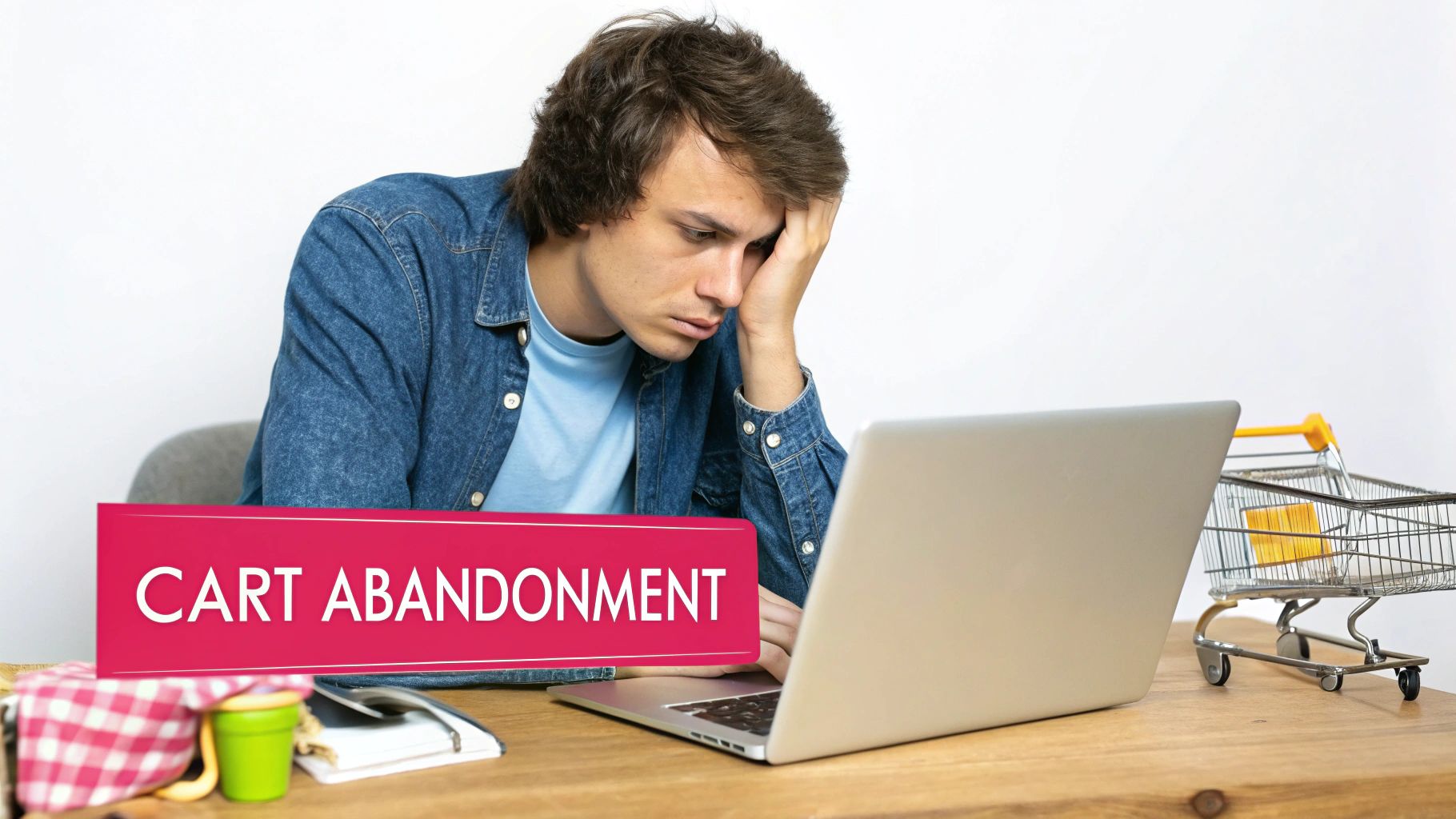
Before you can start recovering abandoned carts, you need to understand why customers abandon them. This means analyzing customer behavior and figuring out what drives their decisions. Identifying these exit points helps you implement preventative measures along with your recovery strategy.
Friction Points in the Checkout Process
Little things can sometimes stop a purchase in its tracks. These friction points might include a confusing checkout process, surprise shipping costs, or worries about website security. A long registration process or asking for too much information can be a deterrent. Unexpected costs appearing late in checkout are another major reason for abandonment. This emphasizes the importance of transparency throughout the entire shopping journey.
Using Analytics to Pinpoint Abandonment Patterns
Analytics tools like heat mapping give you valuable clues about where customers hesitate or leave during checkout. These tools monitor mouse movements, clicks, and how far down the page people scroll. You can see precisely where customers run into trouble. This data lets you identify specific areas to improve, such as streamlining checkout or making shipping details clearer. Check out this helpful guide: How to reduce checkout abandonment.
Psychological Triggers Behind Abandonment
Knowing the psychology behind abandonment is crucial for effective recovery strategies. Trust concerns, like unclear security measures or a confusing return policy, can cause cart abandonment. Sometimes, though, reasons are simply situational. A customer might be “just browsing” or get sidetracked. This highlights the importance of timely reminders and personalized messages in your recovery strategy.
To understand why shoppers abandon their carts, let’s look at some common reasons:
This table summarizes some of the leading causes of cart abandonment and offers potential solutions to address them.
Top Reasons for Cart Abandonment
This table presents the most common reasons customers abandon their shopping carts based on recent e-commerce research.
| Abandonment Reason | Percentage of Shoppers | Potential Solution |
|---|---|---|
| High shipping costs | 48% | Offer free shipping or clearly display shipping costs upfront |
| Required account creation | 24% | Offer guest checkout options |
| Complicated checkout process | 17% | Streamline the checkout process with fewer steps |
| Website security concerns | 19% | Display security badges and trust signals prominently |
| Just browsing / not ready to buy | 40% | Offer price alerts or wish lists to save items for later |
| Found a better price elsewhere | 9% | Implement price matching or offer exclusive discounts |
| Lack of payment options | 8% | Offer a variety of payment methods |
These statistics highlight the importance of optimizing the checkout experience and building trust with your customers. By addressing these key issues, you can significantly reduce cart abandonment and increase sales.
Addressing Abandonment Before It Happens
High-performing stores address potential abandonment issues before they occur. They provide clear, upfront shipping costs, display security badges, and offer a smooth checkout experience. This proactive approach reduces the need for recovery by creating a more positive shopping experience that builds trust.
Conducting Your Own Abandonment Analysis
By doing your own abandonment analysis, you’ll gather data specific to your store and customers. This involves analyzing your website analytics, running customer surveys, and A/B testing checkout elements. This targeted approach lets you create prevention and recovery strategies optimized for your specific business. For more tips on minimizing cart abandonment, take a look at this guide: How to reduce checkout abandonment. Understanding why customers abandon their carts is the first step towards improving conversions and boosting sales.
Email Recovery Sequences That Actually Convert
Email remains essential for abandoned cart recovery. But a single reminder email isn’t enough. Effective recovery requires an email recovery sequence: a series of timed emails designed to re-engage customers and encourage them to complete their purchase.
Timing Is Everything: The Abandoned Cart Email Sequence
The timing of your emails is key. Send the first email within one hour of cart abandonment, while the customer’s interest is still piqued. This initial email should gently remind them of the items left in their cart. Follow-up emails can be sent at increasing intervals, offering incentives and addressing potential hesitations.
A typical three-part sequence might look like this:
- Email 1 (1 hour after abandonment): A friendly reminder with a clear product image and a direct link back to the cart.
- Email 2 (24 hours after abandonment): A follow-up offering free shipping or a small discount.
- Email 3 (72 hours after abandonment): A final attempt, perhaps showcasing customer testimonials or product benefits. Suggesting alternative products is also a good strategy. For more on abandoned cart recovery, check out this article: How to master abandoned cart recovery with text messages.
Crafting Compelling Content: Subject Lines and Messaging
Subject lines should be concise, engaging, and personalized. Using the customer’s name or mentioning a specific product can dramatically improve open rates. The email body should reiterate the product’s value and address any potential customer concerns.
Personalization and Incentives: The Key to Conversion
Personalization is crucial. Tailor emails to specific customer segments based on their purchase history and cart value. Targeted incentives, such as free shipping or exclusive discounts, can significantly improve conversions. Email marketing is highly effective for recovering abandoned carts. Abandoned cart emails boast impressive results: an open rate of 41.18%, a click-through rate (CTR) of 21%, and a conversion rate of 50%. These figures highlight customer responsiveness to personalized purchase reminders. Well-timed and relevant email campaigns can significantly increase sales revenue by prompting customers to revisit and complete transactions. Optimizing these emails to address common abandonment reasons (like high shipping costs or complex checkout processes) can further improve recovery rates. For detailed statistics, see this resource.
A/B Testing: Continuously Improving Your Performance
Experiment with different subject lines, email copy, and incentives. A/B testing lets you compare different email versions to see what resonates best with your audience. This data-driven approach ensures continuous optimization for maximum impact. Analyze key metrics like open rates, click-through rates, and conversion rates to gain insights into your strategies’ effectiveness. This process of constant improvement keeps your recovery efforts aligned with customer behavior and preferences. By implementing these strategies, you can turn abandoned carts into a valuable revenue source.
Mobile Recovery: Tackling the Highest Abandonment Channel

Mobile commerce presents a significant opportunity for online retailers. It also comes with a unique set of challenges. While mobile drives a large portion of traffic, it suffers from high abandonment rates. Optimizing the mobile experience is key for recovering those lost sales.
Why Conventional Recovery Fails on Mobile
Traditional abandoned cart recovery methods, effective on desktop, don’t always translate well to mobile. Smaller screens, different user behaviors, and the on-the-go nature of mobile shopping demand a new approach. Long emails and complicated checkouts can be especially frustrating on a mobile device.
Mobile users are also more susceptible to distractions. A short notification or a timely SMS message might be more effective than a detailed email. This requires a focus on streamlined processes and concise messaging, emphasizing the importance of understanding the mobile user experience.
UX Optimizations for Mobile Recovery
Optimizing your mobile UX is a crucial first step in reducing cart abandonment. A straightforward and intuitive checkout process is paramount. Consider one-click purchasing and offering mobile payment options like Apple Pay or Google Pay.
Make sure your website is responsive and loads quickly on mobile devices. Slow loading times are a major reason for cart abandonment. A seamless mobile experience, with user-friendly navigation and clear product details, keeps customers engaged and progressing toward checkout.
Mobile devices now dominate online shopping, generating approximately 68% of e-commerce traffic. However, this popularity is coupled with a higher cart abandonment rate, nearing 83.2% on mobile. This underscores the need for optimized mobile interfaces and simplified checkout procedures. Improving the mobile checkout experience directly addresses a leading cause of abandonment – complicated checkout processes. You can find more statistics here. A better mobile UX also paves the way for more effective recovery tactics.
Mobile Recovery Tactics That Work
Specific recovery tactics, in addition to UX improvements, can successfully bring back mobile shoppers. SMS recovery campaigns are highly effective. The immediacy and high open rates of SMS messages make them perfect for quick reminders and time-sensitive promotions. Mobile-optimized emails are equally important.
Keep emails concise, visually engaging, and easy to read on small screens. A clear and prominent call to action encourages immediate engagement. For users with your app, leverage app notifications. These serve as personalized reminders and a channel for exclusive deals. Optimizing your email subject lines is key for boosting open rates. You can find more helpful tips on creating catchy email subject lines.
Cross-Device Recovery Strategies
Recognize that customers often switch between devices. Implement cross-device recovery strategies to track cart activity across platforms. This creates a consistent experience and allows you to reach customers on any device, maximizing recovery chances by meeting them where they are.
Retargeting Beyond Basics: Multi-Channel Recovery Tactics
Effective abandoned cart recovery hinges on connecting with customers wherever they are. This extends beyond simple email reminders. Leading e-commerce brands employ multi-channel retargeting, interacting with customers on social media platforms, display networks like the Google Display Network, and even through search engines.
Sequential Messaging Across Channels
Building a sequential messaging strategy is paramount for multi-channel success. This means delivering the right message at the opportune moment, using the most effective platform. For example, an initial SMS message could offer a quick reminder and a direct link back to the abandoned cart. This could be followed by a targeted Facebook ad showcasing the product’s benefits, and finally, a follow-up email with a small incentive. This orchestrated approach keeps abandoned carts at the forefront of the customer’s mind without feeling overwhelming. You might be interested in: Why are SMS marketing costs worth it?.
Overcoming Banner Blindness: Creative Retargeting
Banner blindness poses a significant hurdle in online advertising. Customers unconsciously ignore ads they encounter repeatedly. Counteract this by regularly refreshing your ad creatives and employing dynamic retargeting. Dynamic retargeting showcases ads featuring the specific products left in the cart, making them far more appealing than generic advertisements.
Consider incorporating interactive ad formats like polls or quizzes to re-engage potential customers in a non-intrusive manner. This requires thoughtful planning and rigorous testing, but it can substantially improve your click-through rates.
Analyzing Platform Performance for Maximum ROI
Not all retargeting platforms yield the same results. Data analysis is essential for achieving the highest ROI. Social media may prove effective for impulse buys, while search engine retargeting might be more suitable for high-value items. This necessitates understanding your target demographic and customizing your strategy accordingly. The following infographic illustrates how incentives affect cart recovery rates.

As the infographic demonstrates, offering a discount yields a more significant uplift compared to offering free shipping. Simply reminding the customer (without an incentive) isn’t as effective. Choosing the right incentive hinges on your profit margins and typical customer behavior.
To further explore different retargeting strategies, the following table provides a comparison:
Comparison of Retargeting Platforms for Cart Recovery
This table compares the effectiveness, cost, and best use cases for different retargeting channels.
| Platform | Average ROAS | Best Timing | Ideal Audience | Key Considerations |
|---|---|---|---|---|
| Varies widely (20-40x common) | Immediately after abandonment, then 24-72 hours later | All segments, especially loyal customers | Personalization, segmentation, clear call to action | |
| SMS | Can be very high (50x+) | Within minutes of abandonment | Customers who provided phone numbers, good for urgent reminders | Concise messaging, clear opt-out, cost per message |
| Social Media (Facebook, Instagram) | Varies, generally lower than email/SMS | Peak usage times | Younger demographics, impulse buyers | Engaging visuals, retargeting based on interests |
| Display Network | Moderate ROAS, good for reach | Throughout the day, frequency capping is important | Broader audience targeting, brand awareness | Compelling visuals, avoiding banner blindness |
| Search Retargeting | Can be high for high-value items | When customers search for related products | Customers actively researching, high purchase intent | Keyword targeting, bidding strategies |
This table showcases the diverse strengths of each platform. Email remains a reliable workhorse, while SMS offers immediacy. Social media excels at engaging specific demographics, while display networks broaden your reach. Search retargeting captures high-intent customers.
Budget Allocation and Timing Strategies
Distribute your retargeting budget wisely, concentrating on platforms that yield the best results for your specific products. Carefully plan the timing of your messages. For example, displaying retargeting ads on social media during peak usage hours can substantially increase visibility.
Privacy and Cohesive Messaging
Ensure your tracking methods comply with privacy regulations. Respect user data and provide clear opt-out mechanisms. Above all, coordinate messaging across all channels. The customer journey is rarely linear. A consistent experience makes your abandoned cart recovery efforts appear helpful rather than intrusive. This bolsters your brand image and fosters trust with your customer base. By prioritizing transparency and respecting customer privacy, you create a positive and dependable brand experience.
Strategic Incentives: Recovery Without Sacrificing Margins

While discounts can be effective for abandoned cart recovery, relying too heavily on them can impact your bottom line. Finding the right balance between attracting customers and preserving profit is crucial. Successful e-commerce brands employ strategic incentive programs to recover carts without encouraging customers to abandon them intentionally. This requires understanding what motivates customers and how to target them efficiently.
Segmentation: The Key to Targeted Incentives
Every customer is different. Some are driven by price more than others. Segmentation allows you to customize offers based on specific factors like past purchases, cart value, and how often they abandon their carts. For example, a first-time abandoner with a high-value cart might respond well to a small discount or free shipping. A repeat abandoner, on the other hand, might require a more attractive offer, such as a limited-time discount or a bonus item.
Creative Alternatives to Percentage Discounts
Percentage discounts can quickly eat into your profit margins. Fortunately, there are other effective alternatives. Consider offering free shipping for orders above a certain amount. This not only recovers the sale but encourages customers to add more to their cart to qualify. Bundle offers, combining related products at a reduced price, are another powerful incentive. Bundles increase the average order value and introduce customers to complementary items.
Loyalty programs are also a great way to encourage purchases without resorting to direct discounts. Awarding loyalty points for completed orders, which can later be redeemed for discounts or exclusive perks, builds customer loyalty and encourages repeat business. Limited-time incentives, such as flash sales or early access to new products, create a sense of urgency and drive conversions without conditioning customers to expect constant discounts. For more tips, check out this guide on abandoned cart email best practices.
Calculating Optimal Incentive Levels
Finding the right balance is essential. Too small an incentive might not be enough to encourage a purchase, while too large an incentive can make it unprofitable. Data-driven decisions are key here. Use A/B testing to experiment with different incentive levels and monitor their performance. For example, compare a 5% discount against free shipping to see which offer leads to a higher conversion rate while maintaining acceptable profit margins. Continuous testing and refinement are essential to optimizing your strategy. For a broader perspective on marketing strategies to enhance growth, take a look at this article on ecommerce marketing strategies.
Testing Methodologies for Continuous Improvement
Don’t just set your incentive strategy and forget about it. Continuous testing and refinement are crucial. Analyze the recovery rate, conversion rate, and average order value for each incentive type and customer segment. This data provides valuable insights into which incentives are most effective for different customer groups. Regularly optimizing your incentives allows you to maximize recovery while minimizing the impact on your profit margins. This iterative approach ensures your strategy remains effective and adaptable in the dynamic e-commerce environment.
Measuring What Matters: Recovery Metrics Beyond Basics
Recovering abandoned carts isn’t just about sending a few hopeful emails. Truly successful programs use data-driven approaches, digging deeper than simple recovery rates to understand the full impact of their strategies. This means analyzing key performance indicators (KPIs) and using attribution models to accurately gauge success.
Beyond Surface-Level Conversions: The Metrics That Matter
The cart recovery rate (the percentage of abandoned carts recovered) is a good starting point, but it’s not the whole picture. Other metrics offer a more complete understanding of your recovery efforts. For example, influenced revenue tracks how much revenue your recovery campaign generated, even if the customer didn’t click a recovery email.
Channel-specific ROI is vital for understanding which recovery channels (email, SMS, retargeting ads) provide the best return. This data helps allocate your budget effectively, maximizing impact. Consider also the long-term customer value of recovered carts. Recovered customers may become loyal, repeat buyers, significantly contributing to your business over time.
Attribution Models: Giving Credit Where Credit Is Due
Measuring recovery efforts across multiple touchpoints requires the right attribution model. A last-click attribution model only credits the final interaction before purchase. However, a customer might interact with several recovery messages before converting.
A multi-touch attribution model, such as linear or time decay attribution, distributes credit across all touchpoints. This gives a more complete view of campaign impact and helps identify the most influential touchpoints for driving conversions.
Testing and Optimization: Continuous Improvement for Recovery Success
Continuous improvement is essential. Establish testing protocols to refine every campaign aspect, from email subject lines and body copy to incentive types and timing. A/B testing different email subject lines can reveal which generate higher open rates.
Experiment with incentive structures (free shipping versus percentage discounts, for example) to determine what resonates best with your audience. Constant testing and iteration consistently improves recovery performance.
Platform Considerations: Implementing Recovery on Your E-commerce Platform
Implementing abandoned cart recovery depends on your e-commerce platform. Popular platforms like Shopify, WooCommerce, and Magento offer extensions and integrations to automate recovery efforts. These tools often integrate directly with your store’s data, enabling personalized and automated recovery campaigns. Explore your platform’s features for seamless implementation and optimal performance.
Ready to transform abandoned carts into recovered revenue? CartBoss offers a powerful, automated SMS marketing solution that recovers lost sales and builds customer loyalty. Start recovering your abandoned carts with CartBoss today!