


Think of an auto SMS responder as your automated sales recovery agent. It’s a system that automatically fires off a pre-written text message when a specific event happens—like a shopper leaving your site with a full cart. For any e-commerce store, this is an incredibly powerful way to re-engage distracted shoppers and pull back lost sales, all without you lifting a finger.
Why an Auto SMS Responder Is Your Secret Weapon
We’ve all seen it happen. A customer finds the perfect items, meticulously fills their cart, and then… life gets in the way. A phone call, a crying baby, a sudden distraction—and the purchase is forgotten. This isn’t a lost cause; it’s just an interrupted sale. This exact moment is where an auto SMS responder completely changes the game for your business.
For years, email was the standard for cart recovery, but its power is fading fast. Inboxes are a mess, and you’re lucky if your email open rates even break 20%.
SMS, on the other hand, just works. It cuts right through the noise. Text messages have near-perfect open rates, usually within just a few minutes of being sent. That immediacy is everything when a customer’s intent to buy is still fresh.
SMS vs. Email for Cart Recovery
While email still has its place, for the immediate, high-impact world of cart recovery, SMS often has a clear edge. Here’s a quick breakdown of why.
| Metric | SMS Auto Responder | Email Follow-up |
|---|---|---|
| Open Rate | 98% on average | Around 20% on average |
| Time to Open | Within 3 minutes for most | 90 minutes or more |
| Click-Through Rate | Often exceeds 30% | Typically 2-3% |
| Immediacy | Instant, personal nudge | Can get lost in a cluttered inbox |
As you can see, when you need to grab someone’s attention right now, nothing beats a text.
The Power of a Direct Connection
An automated text is so much more than a simple reminder. It’s a personal tap on the shoulder, delivered straight to the one device people never leave behind. This direct line feels more urgent and personal than any promotional email buried under a mountain of spam.
With this approach, you can:
- Instantly Re-engage: Grab a customer’s attention just moments after they’ve clicked away from your site.
- Boost Conversion Rates: Turn those abandoned carts into completed sales with a timely, relevant offer.
- Automate Revenue Recovery: Set it up once, and let it work around the clock, recovering sales while you sleep.
This isn’t just a niche tactic; it’s a massive shift in how businesses communicate. The SMS marketing industry is projected to skyrocket to a global valuation of $92 billion by 2025. That kind of growth tells you just how many businesses are turning to automated texts to connect with their customers more effectively.
If you want to dive deeper into the consumer mindset, check out our guide on the latest SMS marketing statistics.
From Lost Carts to Loyal Customers
Ultimately, a perfectly timed text does more than just save a sale. It shows your customer you’re paying attention and that you value their business. By sending a friendly reminder—maybe even with a little discount—you turn a moment of friction into a positive, helpful brand interaction.
By automating this crucial follow-up, you’re not just plugging a revenue leak. You’re building a systematic process for turning fleeting interest into tangible sales and fostering customer loyalty.
Tools like CartBoss handle this whole process on autopilot. The system spots an abandoned cart, sends out a pre-written message you’ve already approved, and includes a direct link that takes the customer right back to their pre-filled checkout. It’s a completely seamless experience, making it incredibly easy for them to finish what they started and for you to boost your bottom line.
Getting Started with CartBoss for SMS Recovery
Jumping into a new tool can sometimes feel like a chore, but getting your CartBoss auto SMS responder up and running is genuinely a quick win. The whole platform is built to take a potentially complicated process and make it dead simple, getting you from signup to sending texts in just a few minutes.
First things first: you’ll need a CartBoss account. It’s a standard, no-fuss signup process.
Once you’re in, the dashboard will guide you to connect your eCommerce store. CartBoss has some really slick integrations, especially for Shopify and WooCommerce, which cover a massive chunk of online stores. Just follow the prompts to install the app or plugin. This securely links your store’s data to CartBoss, which is how the system instantly knows when a shopper ditches their cart.
Your Initial Configuration
With your store connected, the next move is sorting out your sender details. This is a small step that makes a huge difference in brand recognition and trust. You’ll set up a branded Sender ID, which means your texts will come from your company name instead of some random number. It immediately looks more legit and drastically improves open rates.
The goal here is to get you live as fast as possible. This simple flow map shows just how streamlined it is.
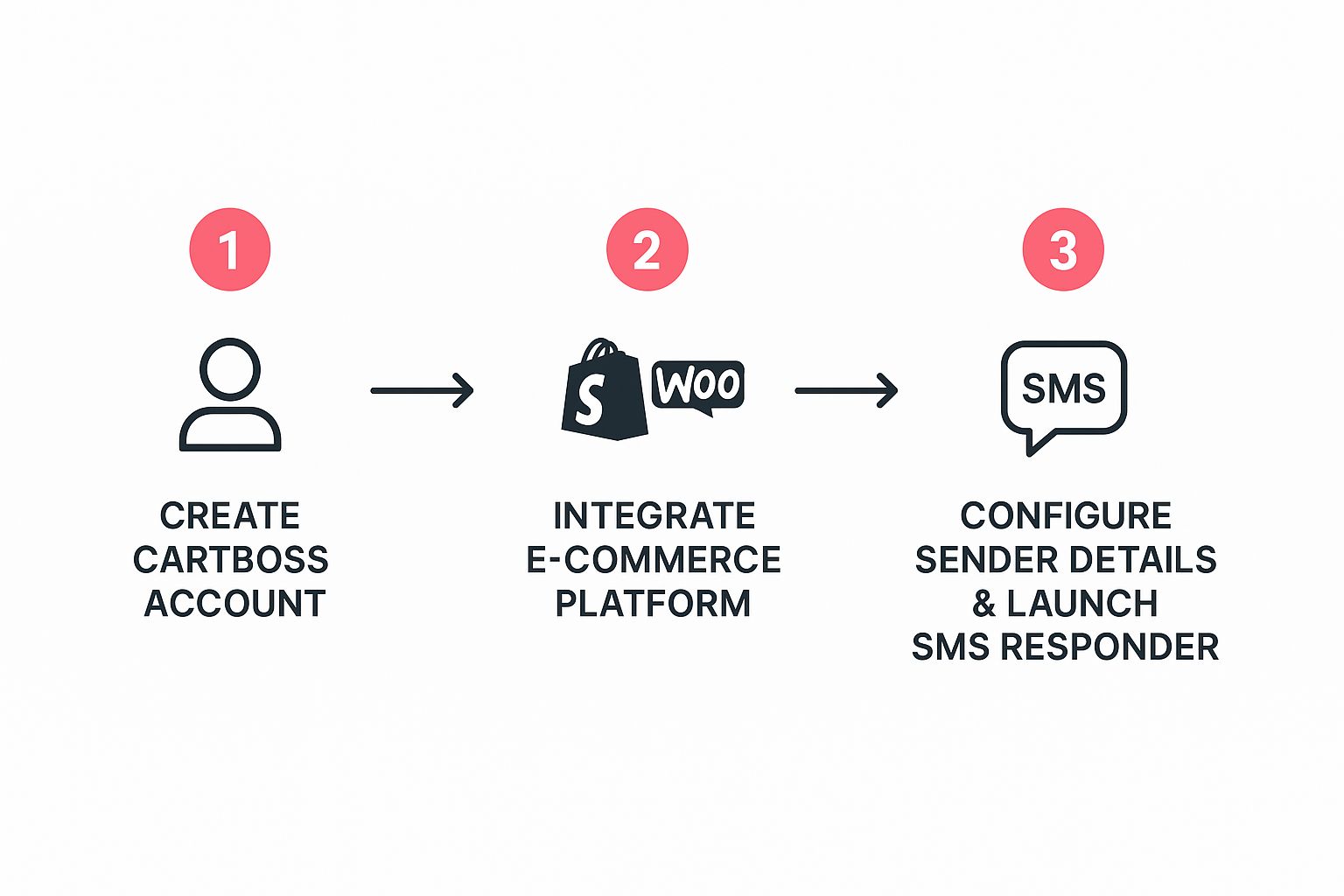
As you can see, the core setup is just three basic actions. We’ve removed the technical headaches so you can focus on your recovery strategy right away. Now, you’re ready to flip the switch on your first campaign.
Launching Your First Campaign
One of the best parts about CartBoss is that it comes loaded with pre-written and pre-translated message templates. You don’t have to stare at a blank screen wondering what to write. These templates have been optimized based on data from thousands of stores, so you’re starting with a proven formula. You can literally activate a campaign with a single click.
The goal isn’t just to send a text; it’s to create a frictionless path back to purchase. CartBoss automates this by including a link in the SMS that directs customers to a pre-filled checkout page with their original items.
That immediate, helpful nudge is often all it takes to turn an almost-sale into a done deal. And while these templates work great right out of the box, you can always customize them later to better match your brand’s unique voice. When you’re ready to explore what else is out there, looking into other powerful shopping cart abandonment solutions can give you a wider perspective on the whole recovery game.
Once you get comfortable, you can start digging into the more advanced settings. For a deeper dive, our guide on how to set up an SMS auto respond system covers extra strategies and tips.
But for now, that’s it. Completing these first few steps gets your automated recovery engine humming, ready to start capturing revenue you would have otherwise lost.
Crafting SMS Messages That Actually Convert
Just blasting out “Hey, you left something!” isn’t going to cut it. Let’s be real, that’s lazy and it doesn’t work. Effective cart recovery, especially with an auto sms responder, is more of an art. It’s a mix of smart psychology, perfect timing, and staying true to your brand’s voice.
The goal here isn’t just to send a notification. It’s to start a conversation that gets them to immediately finish their purchase. Think about it from their perspective: they were interested enough to add products to their cart. Something pulled them away. Your job is to gently reel them back in, not shove a sales pitch down their throat.
The Anatomy of a High-Converting Text
The best recovery texts I’ve seen are always short, personal, and have a crystal-clear call to action. They don’t just state the obvious (“your cart is waiting”). Instead, they create a little urgency or dangle a real reason to come back right now.
A winning message almost always has these four ingredients:
- A Personal Touch: Use their name. “Hi, Sarah!” feels a world away from a generic, faceless greeting. It shows you see them as a person.
- Clear Context: A quick mention of your brand name and what they left behind jogs their memory instantly.
- A Compelling Reason to Return: This is your hook. It could be a small discount, a heads-up about low stock, or the promise of free shipping.
- A Direct Link: This is non-negotiable. The link must take them straight back to their pre-filled cart. One click, and they’re ready to pay. Anything else is just adding friction.
Personalization Beyond Just a Name
Look, using a first name is table stakes. Real personalization goes way deeper. A powerful tool like CartBoss can tap into shopping data to make your messages incredibly relevant. And relevance is what drives conversions.
For instance, you can set up completely different message flows based on the cart’s value. A customer with a high-value cart might get a more generous offer, like a 15% discount. Someone with a smaller cart? Maybe a simple nudge about hitting the free shipping threshold is all they need. This kind of segmentation makes sure your offers are both effective and profitable.
A personalized experience makes the customer feel valued, not just another number on a marketing list. It’s the difference between a generic blast and a helpful reminder from a brand that gets them.
Getting these details right is crucial. With SMS marketing campaigns hitting an insane 98% open rate and driving 21-30% of online revenue for tons of stores, every character matters. It’s no wonder over 67% of companies are upping their SMS budgets. The proof is in the results. You can find more stats on the rise of SMS marketing on SimpleTexting.com.
Timing and Incentives That Work
Sending the right message at the right moment is everything. Fire it off too quickly, and you seem pushy. Wait too long, and that initial buying impulse is gone forever.
Based on what we’ve seen work for thousands of stores, here’s a sequence that consistently performs well:
- First Message (30-60 minutes after abandonment): This one is a gentle, helpful nudge. No discount needed just yet. Something like, “Hey [Name], still thinking about it? Your items at [Brand Name] are waiting for you. Complete your order here: [Link]” works wonders.
- Second Message (24 hours later): If the first message didn’t do the trick, it’s time to sweeten the deal. This is where you create some urgency. Try this: “Hi [Name], your cart at [Brand Name] is about to expire! Use code SAVE10 for 10% off for the next 3 hours. Finish checkout: [Link]”
This tiered approach gives the customer space but strategically ramps up the motivation to act. If you’re looking for more ideas, we’ve put together a list of 5 SMS templates for recovering abandoned carts that are proven to get results.
Optimizing Your Auto Responder Campaigns
Getting your auto SMS responder up and running is a huge first step. But the real money is made in the fine-tuning that comes next. Launching a campaign is just the beginning; optimization is how you turn a good strategy into a revenue-generating machine.
This isn’t about guesswork. It’s about diving into the data and letting your customers’ behavior tell you exactly what they want. The analytics inside CartBoss give you clear, actionable answers without needing complex spreadsheets or confusing charts. You just need to track a few core metrics to see how your messages are performing and where you can make small tweaks for a much bigger return.
Key Metrics to Watch in CartBoss
To really dial things in, you need to know which numbers matter. Your CartBoss dashboard cuts through the noise and focuses on the metrics that directly impact your bottom line.
Here are the three big ones to keep an eye on:
- Delivery Rate: This is simple: what percentage of your texts actually landed on your customers’ phones? A low number could mean bad phone data, but CartBoss’s built-in validation works hard to keep this rate high from the get-go.
- Click-Through Rate (CTR): This tells you the percentage of people who clicked the recovery link in your text. A strong CTR is a great sign that your message copy and your offer are hitting the mark and grabbing attention.
- Conversion Rate: This is the ultimate goal—the percentage of shoppers who not only clicked the link but went on to complete their purchase. This number tells you if your entire funnel, from the SMS all the way to the final checkout click, is working as it should.
Watching these numbers helps you diagnose problems quickly. For instance, if you have a killer CTR but a disappointing conversion rate, the issue probably isn’t your text message. It’s likely something on your checkout page that’s causing friction.
The Power of A/B Testing
Once you have a baseline from your metrics, the fun begins. It’s time to start experimenting with A/B testing. This is just a simple way of testing one small change at a time to see what your audience responds to best. It’s a game of inches that can lead to some massive wins.
A great place to start is your message copy. Pit two different versions of your first recovery text against each other. Maybe one version is super friendly and casual, while the other creates a bit more urgency. Send each version to 50% of your abandoned cart audience and let the data tell you which one pulls in a higher click-through and conversion rate.
Don’t just stop with the copy. You can A/B test almost anything—the size of the discount, the time of day you send the message, or even the call to action. I’ve seen a tiny tweak in timing lead to a significant lift in recovered sales.
And this stuff is only getting more important. With a predicted 5.9 billion people using text messaging by 2025, smart automation is no longer optional. The best systems can now deliver texts in under 7 seconds, which is critical when you’re sending a time-sensitive discount.
Segmenting for Smarter Messaging
Finally, it’s time to move beyond one-size-fits-all campaigns by segmenting your audience. Let’s be honest, not all abandoned carts are created equal. A customer who walks away from a $500 cart has a much different intent than someone who leaves a $50 item behind.
You can easily create segments in CartBoss to send more targeted, relevant messages. For a deeper look into the tools and processes for this, you can explore some comprehensive automated lead nurturing strategies.
Think about starting with a few simple but powerful segments:
- By Cart Value: Offer a bigger discount (like 15% off) to high-value carts to nudge them over the line, and a smaller one (maybe 5% off or free shipping) to the lower-value ones.
- By Customer Type: Your messaging for a first-time shopper should probably be different from how you talk to a loyal, repeat customer.
- By Product Category: If someone abandons a specific type of product, you could tailor the SMS to highlight a key benefit or feature of that item they were considering.
This kind of targeted approach makes your messages feel personal and relevant, not like a generic marketing blast. That’s the key to truly effective communication. To see how all these pieces fit into a broader strategy, check out our complete guide to SMS marketing automation.
Common Mistakes to Avoid with Your SMS Responder
Putting an auto SMS responder in place is a huge step, but it’s surprisingly easy to get it wrong. A few missteps can quickly annoy customers and, even worse, get you into some serious legal hot water. You have to treat SMS for what it is: a personal, direct line to your customer. Respecting that space isn’t just polite—it’s the foundation of a successful strategy.
One of the biggest blunders we see is ignoring compliance. Rules like the TCPA (Telephone Consumer Protection Act) aren’t just suggestions; they carry the force of law. Sending messages to anyone who hasn’t explicitly opted in can lead to eye-watering fines. Make absolutely sure you have clear consent before a single text goes out.
Another classic mistake is causing message fatigue. Just because you can send a message doesn’t always mean you should. Firing off multiple texts in a short window is the quickest way to get an “STOP” reply. A well-timed, thoughtful sequence is effective. An aggressive barrage is just spam.
Forgetting the Call to Action
Probably the most frustrating error from a customer’s perspective is getting a text with no clear next step. A message saying, “Your cart is waiting!” is pretty useless without a direct link to the checkout. This just creates friction and forces them to do the work. The whole point is to make it dead simple for them to finish their purchase.
Every single text you send needs one clear, compelling call to action (CTA). For cart recovery, this is almost always a direct link that drops them right back into their pre-filled cart. Anything less is a wasted opportunity.
Your auto SMS responder should be a helpful guide, not a confusing dead end. Every text must answer the customer’s unspoken question: “What do you want me to do next?”
Making It Hard to Leave
Finally, you have to give people an easy way out. The phrase “Reply STOP to unsubscribe” is standard for a reason. Hiding the opt-out or making it a complicated process is a terrible look for your brand. It completely erodes trust and, you guessed it, violates compliance rules.
Making the unsubscribe process simple shows you respect your customer’s choice. It also keeps your contact list healthy with people who actually want to hear from you.
By steering clear of these common pitfalls, you can build an SMS strategy that creates positive relationships instead of burning bridges. For a deeper dive, check out our guide on other common mistakes in SMS cart recovery and how to avoid them.
Got Questions? We’ve Got Answers
Even with a tool as straightforward as an auto SMS responder, you probably have a few questions floating around. That’s completely normal. Let’s walk through some of the most common ones we hear from store owners, covering everything from legal stuff to how customers really feel about getting these texts.
A big one that comes up right away is consent. Do you need explicit permission to send these messages? The short answer is yes, but it’s usually handled seamlessly during checkout. When a customer pops their phone number into the order form, they’re giving implied consent for you to send transactional updates about that specific order—and that includes a friendly follow-up about their cart.
How Many Messages Is Too Many?
This is where the art and science of cart recovery meet. You want to be persistent, not pushy. From what we’ve seen, sending more than two messages for a single abandoned cart starts to feel a bit aggressive.
A two-step sequence is the sweet spot for most stores:
- A gentle reminder about an hour after they leave.
- A follow-up with a small offer 24 hours later if they still haven’t come back.
This gives shoppers a fair chance to complete the purchase on their own before you sweeten the deal.
The goal here isn’t to blast them with sales pitches. Think of your auto SMS responder as a helpful customer service nudge. It’s a timely reminder that shows you’re paying attention, which is exactly how you build trust and keep customers coming back.
Do Auto-Replies Work for International Customers?
They absolutely do, as long as your platform is built for it. This is one of the standout features of a tool like CartBoss. It automatically detects the customer’s browser language and sends a pre-translated message to match.
It might seem like a small detail, but it’s a total game-changer. A customer from Germany gets a message in German. A shopper in Spain gets one in Spanish. It feels native, personal, and instantly removes any language barrier. This kind of automated localization is key to boosting conversion rates when you’re selling worldwide.
What if a Customer Replies to the SMS?
That’s fantastic news! A reply turns a one-way notification into a two-way conversation. While the first message is automated, any replies from the customer can be routed straight to your support team’s inbox or a dedicated dashboard.
This is your chance to step in, answer their questions, and provide that human touch that seals the deal. Maybe they were confused about shipping, or had a question about sizing. A quick, helpful response can easily save the sale and create a loyal customer.
Ready to stop watching sales walk out the door? CartBoss makes it dead simple to launch your own powerful auto SMS responder and start winning back that lost revenue automatically. See the difference for yourself and get started today.