


Think of the customer journey as the entire story of a customer’s relationship with your brand. It starts the very first time they hear about you and, ideally, ends with them becoming a loyal fan who tells everyone they know how great you are. It’s less of a single transaction and more like a road trip they take with your business, full of different stops and experiences.
A Roadmap to Understanding Your Customer
So, what does that mean in practice? The customer journey isn’t just about the moment someone clicks “buy.” It’s a complete map of every single interaction—every touchpoint—a person has with your company. That includes everything from seeing one of your ads on social media, to browsing your website, to asking your support team a question, and even leaving a review after their purchase.
Understanding this path is crucial because it forces you to see your business through your customers’ eyes. It uncovers what motivates them, where they get stuck, and what makes them happy. By mapping this out, you can pinpoint exactly where people might be dropping off or getting frustrated, and more importantly, where you have the best opportunities to make their experience better. To get a deeper dive into the nuts and bolts of this process, check out this great guide on What Is Customer Journey Mapping.
The 5 Stages of the Customer Journey
While every customer’s path is a little different, most follow a predictable pattern. These five stages represent the key phases of their relationship with you.
Let’s take a quick look at each of the five core stages. This table breaks down what the customer is trying to do and what your main goal should be at each step.
The Five Core Stages of the Customer Journey
| Stage | Customer’s Goal | Business’s Goal |
|---|---|---|
| Awareness | “I have a problem or a need.” | “Show them we have a solution.” |
| Consideration | “What are my options?” | “Prove we’re the best option.” |
| Decision | “I’m ready to buy.” | “Make the purchase easy and seamless.” |
| Retention | “Did I make the right choice?” | “Deliver an amazing post-purchase experience.” |
| Advocacy | “I love this brand!” | “Turn happy customers into vocal supporters.” |
This progression from a stranger to a brand advocate is what every business is aiming for. The infographic below gives a great visual of how this flow works.
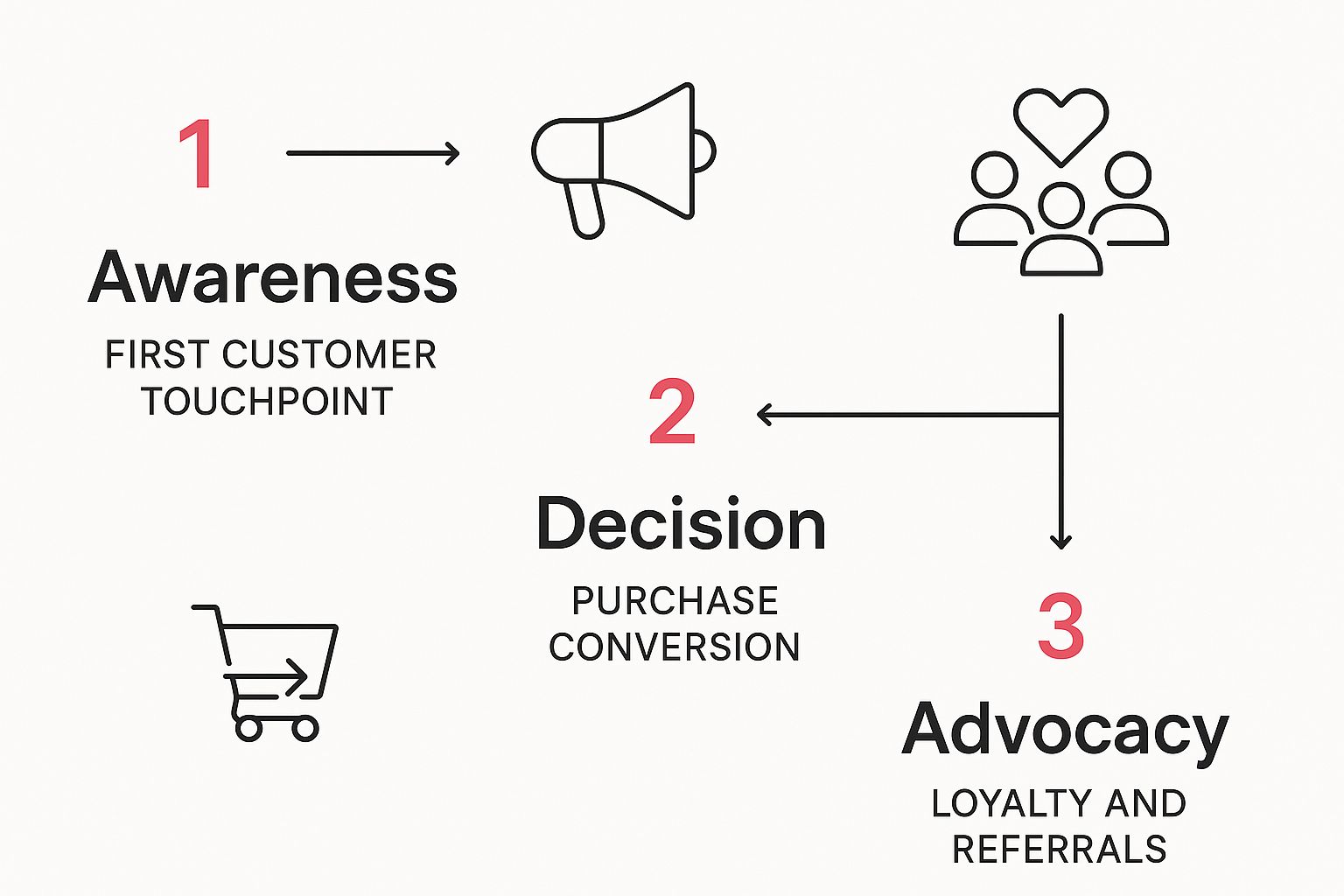
As you can see, it’s a natural progression. A great experience at one stage builds the momentum needed to move to the next, which is how you turn first-time buyers into lifelong fans.
A customer journey isn’t linear or predictable. It’s a complex, multi-threaded path that spans different teams, tools, and touchpoints. No two journeys are identical, and no single department sees the full picture.
Now that we’ve got the big picture, we can start digging into what each of these phases really looks like and how you can optimize every single step.
Navigating the Five Stages of the Customer Journey
Understanding the customer journey in theory is one thing, but seeing it in action is where you find the real gold. Each stage represents a completely different mindset for the customer—they have unique questions, hang out on different channels, and are looking for different things from you.
By breaking this path down, you can meet them exactly where they are and give them the right information at the perfect time.
Let’s walk through the five core stages of this journey, from the moment someone first hears about you to when they become a loyal fan.
Stage 1: Awareness
This is the “aha!” moment. A potential customer realizes they have a problem or a need, and your brand pops onto their radar as a possible solution. They aren’t anywhere near ready to buy; they’re just gathering info and figuring out their options. Their main question is simple: “How do I solve this problem?”
Think of them as browsing, not shopping. Your job here is to be a helpful guide, not a pushy salesperson.
- Customer Mindset: “I’ve got this issue and I need to learn more about it.”
- Common Channels: Blog posts, social media, SEO, podcasts, and online ads.
- Business Goal: Educate and inform. You want to build that initial flicker of trust and brand recognition by offering valuable content, no strings attached.
Stage 2: Consideration
Okay, they’ve identified their problem. Now they’re actively on the hunt for the best solution. This is where they start comparing different products, services, and brands head-to-head. They’ve moved from broad questions to specific ones, like “Which product has the features I need?” or “Which one gives me the best bang for my buck?”
This is your chance to stand out from the crowd. You need to show them not just that you have a solution, but that you have the right one for them.
The Consideration stage is where you make your case. Things like customer stories, detailed product guides, and comparison charts are incredibly powerful here. They give shoppers the proof they need to feel confident moving forward.
For instance, someone looking for new running shoes might read blog posts during the Awareness stage. But now, they’re deep-diving into video reviews, comparing technical specs, and scouring customer testimonials.
Stage 3: Decision
Showtime. The customer is ready to pull the trigger. They’ve whittled down their options and are just looking for that final nudge to click “buy.” Their focus shifts to the practical stuff and minimizing risk. They’re thinking, “Is this a good deal?” and “Can I trust this company with my credit card?”
This entire stage is about making the transaction as smooth and painless as possible. Any friction or doubt can send them straight to a competitor.
- Key Elements: Clear pricing, social proof (reviews are huge), a dead-simple checkout process, and trust signals like security badges are non-negotiable.
- A Critical Moment: Cart abandonment is the big monster hiding under the bed here. A customer adds a product to their cart, but then life happens—they get distracted, have second thoughts, or see an unexpected shipping fee. This is a make-or-break moment where a timely intervention, like an automated SMS from CartBoss, can swoop in to recover the sale with a gentle reminder or a small discount.
Stage 4: Retention
The purchase is done, but the journey is far from over. Now, the customer’s attention turns to their post-purchase experience. They’re asking themselves, “Did I make the right choice?” Your goal is to scream “YES!” by validating their decision and turning them into a repeat customer.
This is the phase that separates good businesses from great ones. It’s way, way cheaper to keep a customer than to find a new one. In fact, a tiny 5% increase in customer retention can boost your profitability by a staggering 25% to 95%.
Exceptional customer service, helpful follow-up emails, and loyalty programs are your best friends here. It’s also a perfect opportunity for smart communication. Using a tool like CartBoss, you can send a post-purchase SMS to ask for feedback or offer a special discount on their next order, which works wonders for strengthening that relationship. This is where you can use our guide on customer segmentation techniques to really personalize those follow-ups.
Stage 5: Advocacy
This is the holy grail. Your customer is so thrilled with their entire experience that they become a walking, talking billboard for your brand. They’re not just buying again; they’re actively telling their friends, leaving glowing reviews, and shouting you out on social media.
Advocacy isn’t something you can buy; it’s earned by consistently delivering excellent experiences across all the previous stages. It turns your customer base into a powerful, organic marketing force. It’s less about a specific action you take here and more about the ripple effect of everything you’ve already done right.
Today, 70% of customers pick brands based on the promise of a great experience. Delivering on that is everything.
Why Mapping the Customer Journey Drives Growth
Knowing the stages of the customer journey is one thing, but the real power is unlocked when you actually map them out. Think of a journey map less like a drawing and more like a diagnostic tool for your entire business. It’s an X-ray that reveals all the hidden fractures in your customer experience—those small frustrations, confusing steps, or missed opportunities that make people click away.
Mapping takes you from assuming what your customers want to knowing what they actually experience. This shift is crucial for growth because it means you can stop guessing and start solving real problems. It’s the difference between a business that just reacts to complaints and one that proactively builds a smooth, enjoyable path for every single visitor.
Uncover Hidden Pain Points
Customers rarely send you an email when they’re slightly annoyed. They just leave. A journey map helps you find these silent frustrations before they start costing you sales. You might discover that your shipping costs are a nasty surprise at the final checkout step, or that your mobile site is a pain to navigate.
These “pain points” are friction, and friction is the ultimate conversion killer. By visualizing the whole process—from the first ad a customer sees to the moment they unbox their order—you can pinpoint exactly where things get clunky.
For instance, a map might show you that customers who watch a product video are 50% more likely to buy, but that video is buried on some hard-to-find page. Suddenly, moving that video front and center becomes an obvious, data-driven decision to boost sales.
By putting yourself in your customer’s shoes, you gain a unique perspective on their experience. You start to see your business not just as a seller of products, but as a facilitator of solutions, which is a much more powerful position to be in.
This empathetic view is a core benefit of the whole mapping process. It forces every team, from marketing to customer support, to get on the same page with a single, shared understanding of the customer.
Identify Personalization Opportunities
A generic experience is a forgettable one. Journey mapping shines a light on those key moments where a little personalization can make a huge impact. It shows you what a customer has done, what they’re trying to do, and what they might need next.
This insight lets you deliver the right message at the perfect time.
- Segmented Follow-ups: Instead of sending the same old post-purchase email to everyone, you can tailor it based on what they bought. Someone who grabbed a new pair of running shoes might get a follow-up with tips on marathon training.
- Proactive Support: If you notice a lot of users getting stuck on a particular feature, you can set up a pop-up tutorial or a helpful guide right at that touchpoint.
- Targeted Offers: Mapping reveals buying patterns. If a customer consistently buys a certain type of product, you can send them exclusive early access to new arrivals in that category.
These small, personalized actions build a much stronger emotional connection, turning one-time buyers into loyal fans. Effective customer journey management isn’t about a single campaign; it’s about orchestrating these moments across the entire customer lifecycle. You can dig into more strategies by checking out our guide on how to master customer journey management.
Boost Customer Lifetime Value
At the end of the day, the goal of understanding the customer journey is to build lasting relationships. A well-mapped and optimized journey doesn’t just focus on getting that first sale; it’s designed to bring people back again and again.
When you get rid of pain points, you reduce churn. When you personalize the experience, you increase engagement and make customers feel seen and valued. This combination directly pumps up your Customer Lifetime Value (CLV), one of the most important metrics for sustainable growth. A happy customer who feels understood is far more likely to return, spend more over time, and tell their friends about you.
How to Build Your First Customer Journey Map
Knowing the stages of the customer journey is one thing, but the real power comes from actually seeing it laid out. Creating a customer journey map might sound like some complex task reserved for data scientists, but it’s something any business owner can—and should—do.
It’s all about putting yourself in your customer’s shoes and charting their course, step by step. This process turns abstract data into a clear story, helping you see your business from the only perspective that truly matters: the customer’s. A map shows you where your experience shines and, more importantly, where it’s falling short.
Let’s break down how to create your first map in a few simple steps.
Define Your Goal and Scope
Before you start drawing lines on a whiteboard, you need to know why you’re doing it. Are you trying to figure out why so many people are ditching their carts? Or maybe you want to beef up the post-purchase experience to get more repeat business? Setting a clear goal keeps your map focused and ensures you get actionable insights.
Once you have a goal, define the scope. You could map the entire experience from the first ad they see to the day they become a loyal fan, or you could zoom in on one specific piece, like the checkout process. For your first map, I’d recommend starting with a smaller, high-impact area. It’s much more manageable.
Build Your Customer Persona
You can’t map a journey without knowing who’s taking it. A customer persona is essentially a fictional character you create to represent your ideal customer, pieced together from real data and research. This isn’t just about demographics; it’s a detailed profile covering their goals, what drives them, and what drives them crazy.
- Goals: What is this person trying to achieve? (e.g., “Find a high-quality, eco-friendly water bottle.”)
- Motivations: What’s pushing their decisions? (e.g., “They value sustainability and are willing to pay a little more for it.”)
- Pain Points: What frustrates them when they’re trying to shop? (e.g., “They absolutely hate being surprised by high shipping fees at the last second.”)
A solid persona makes the whole process tangible. You’re no longer mapping for “a generic customer,” you’re mapping for “Sustainable Sarah,” a 32-year-old who really cares about a brand’s ethics.
List All Customer Touchpoints
Now, it’s time to walk in your persona’s shoes. A touchpoint is any point where a customer interacts with your brand. Brainstorm every single interaction they might have, from the very beginning to the very end of the specific journey you’re mapping.
Seriously, don’t leave anything out. Your list could include things like:
- Seeing one of your social media ads
- Reading a blog post on your site
- Browsing different product pages
- Adding an item to the cart
- Getting the order confirmation email
- Reaching out to customer support
- The unboxing experience itself
This list is the backbone of your map. It’s the sequence of events you’ll analyze to piece together the entire customer experience.
The image below from Miro gives you a good idea of how these touchpoints and stages can be laid out visually.
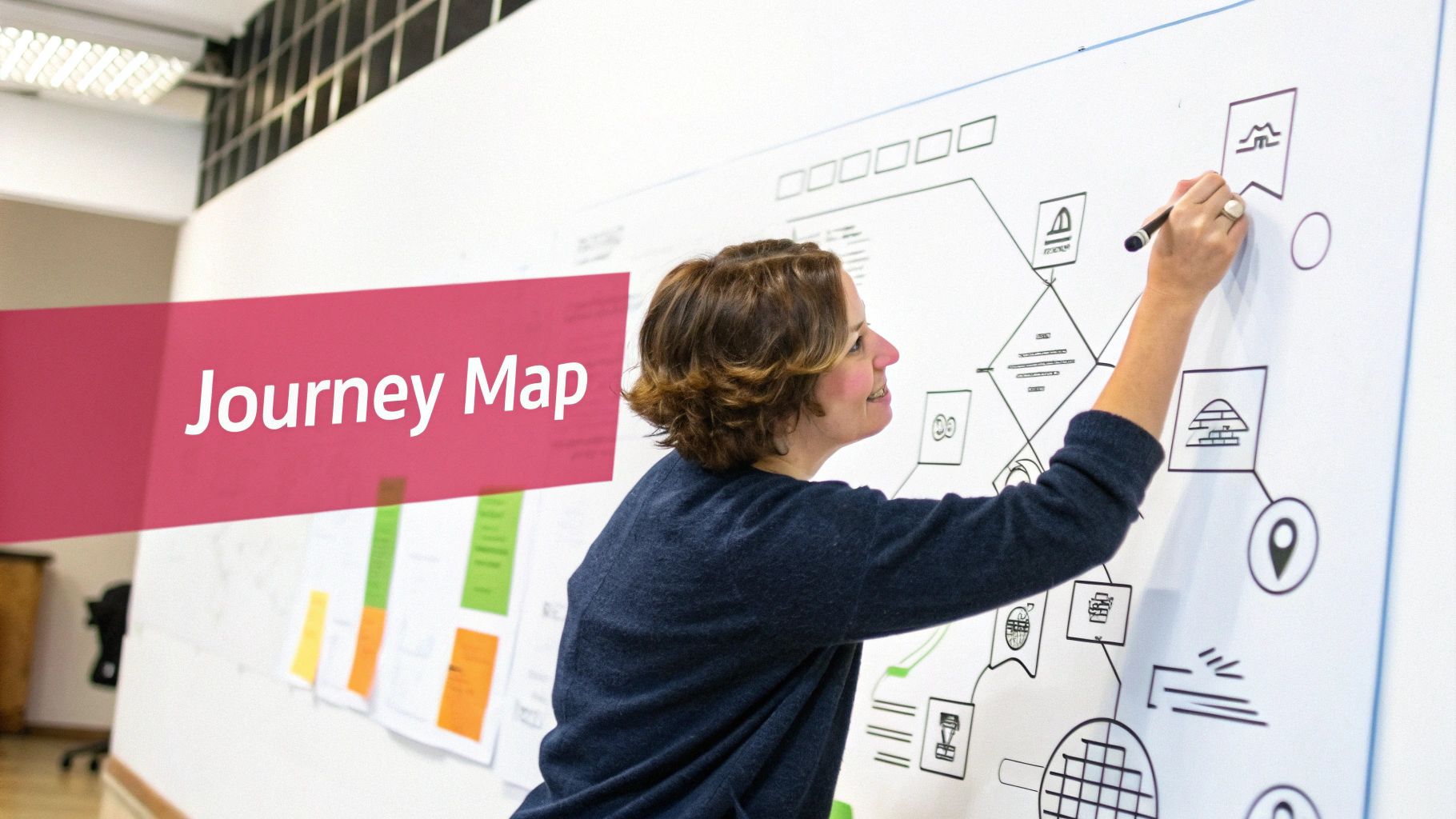
This kind of visual framework helps you organize actions, thoughts, and feelings at each stage, making it way easier to spot patterns and problems.
Chart Emotions and Pinpoint Friction
This is where your map really comes to life. For each touchpoint you’ve listed, think about what the customer is thinking and feeling. Are they excited when they first find your product? Confused by the checkout options? Delighted by the fast shipping?
The emotional journey is just as important as the logistical one. A smooth process can still fail if it leaves the customer feeling anxious or undervalued. Charting these emotional highs and lows helps you identify key “moments of truth.”
This is also where you’ll find friction points—those annoying roadblocks and frustrations that cause customers to give up and leave. A friction point could be a slow-loading page, a confusing navigation menu, or an unexpected cost that pops up at the end.
Identifying these issues is the whole point of mapping, because each one is a direct opportunity for you to make things better. For even more guidance and examples, check out our detailed customer journey mapping template guide to help you get started.
Optimizing the Moments That Matter Most
Mapping out the entire customer journey is great for getting the big picture, but the real magic happens when you zoom in on the critical moments—those specific touchpoints where a customer’s experience can either make or break their relationship with your brand. Think of them as high-stakes interactions where even a small improvement can lead to a massive boost in sales and loyalty.
This is where smart technology comes in. It allows you to transform these potential friction points into smooth, positive experiences. By zeroing in on these “moments of truth,” you can apply targeted solutions that deliver immediate, measurable results, turning potential losses into major wins.
Turning Friction into Revenue at Checkout
Let’s talk about the checkout process. This happens during the Decision stage, and it’s arguably the most crucial moment of truth you have. A customer has browsed, compared their options, and finally decided to buy from you. They’re excited. They add items to their cart, ready to pull the trigger.
Then, life happens. A distraction, a confusing form, an unexpected shipping fee—and just like that, they’re gone. The cart is abandoned.
This is a huge point of friction for every e-commerce store, but it’s also a golden opportunity. Instead of just writing it off as a lost sale, you can step in and change the outcome.
This is precisely where a tool like CartBoss shines. It automatically sends a timely SMS reminder to a shopper who has just left their cart behind, gently nudging them back to complete their purchase. This simple, automated text transforms a moment of hesitation into a recovered sale, directly impacting your bottom line.
Building Lasting Relationships After the Sale
Another critical moment happens right after the purchase, kicking off the Retention stage. The customer has committed their money, and now they’re wondering if they made the right call. A generic “thank you” email is fine, but you can do so much more to solidify the relationship and set the stage for their next purchase.
The post-purchase period is your chance to validate the customer’s choice and lay the groundwork for long-term loyalty. It’s not the end of one journey but the beginning of the next.
This is the perfect time to use that same powerful SMS channel to keep them engaged. Think about sending strategic follow-ups like these:
- Asking for Feedback: A simple text asking for a review shows you value their opinion and helps you collect valuable social proof.
- Providing More Value: Did they buy a specific product? Send them a link to a helpful guide or a quick “how-to” video. This enhances their experience with their new item.
- Encouraging Repeat Business: A week or two later, send an exclusive discount for their next order as a little thank you for their business.
These targeted messages make customers feel valued, not just like another order number. And as customer journey marketing evolves, so do customer expectations. By 2025, a staggering 72% of customers will expect immediate service, and 64% are willing to spend more for a great experience.
Optimizing these key moments with personal, timely communication is how you meet—and exceed—those expectations. It creates a cycle of repeat business and turns happy customers into your most vocal brand advocates. To learn more about this approach, explore our guide on effective customer journey marketing.
The Future of Customer Journey Analytics
The whole idea of a “customer journey” is changing, and fast. We’re moving away from static maps that just show us where customers have been. The future is all about predicting where they’re going next.
Think of it less like a historical report and more like a forward-looking strategy guide. This shift is all thanks to artificial intelligence and machine learning. Instead of just collecting data, these technologies are digging into complex behaviors in real time. They can spot the tiny, subtle patterns that tell you a customer is about to churn or is ripe for an upsell, letting you step in before it’s too late.
The Rise of Predictive Personalization
As the tech gets smarter, so does personalization. We’re not just talking about using a customer’s first name in an email anymore. AI is making it possible to create unique journey paths for every single customer, completely on the fly.
Imagine a website that rearranges itself based on your past browsing habits. Or an email campaign that changes its offers in real time based on what you just clicked. It’s about understanding what a customer wants before they even have to ask. Getting this right means you need a solid handle on the key behavioral signals, which you can dive into in our guide to customer engagement metrics.
Market Growth and Technological Shifts
It’s no surprise that the demand for these kinds of tools is exploding. The customer journey analytics market, valued at USD 20.87 billion in 2025, is on track to hit USD 48.40 billion by 2030. A huge piece of this growth comes from cloud-based solutions, which snagged a 61.4% market share in 2024. Why? Because they’re built to handle massive amounts of real-time data without breaking a sweat. You can get the full scoop by reading the full industry report on Mordor Intelligence.
The future of customer journey analytics isn’t just about mapping the path—it’s about paving it. Predictive insights will let brands smooth out friction points before customers even hit them, creating an experience that just flows.
Navigating Privacy and Trust
Of course, a future this rich in data comes with big responsibilities. With rules like GDPR and CCPA setting a high bar for how data is handled, businesses have to make transparency and consent their top priorities.
The real winners in this new era will be the ones who can balance powerful personalization with a genuine respect for customer privacy. Building trust is going to be just as important as building the tech. Companies that are upfront about how they use data and give customers control will earn the loyalty they need to thrive.
Got a few questions swirling around as you start digging into the customer journey? That’s normal. Getting these details straight from the get-go will help you build a solid strategy and sidestep some common traps that trip people up.
Let’s clear the air on a few of the most frequent ones.
Is a “Customer Journey” the Same as a “User Journey”?
This one trips up a lot of folks. While they sound like the same thing, they’re looking at your business from two different altitudes.
A user journey is zoomed in. It’s all about how someone interacts with a specific thing you’ve built, like your website or an app. Think of it as mapping their clicks and taps from point A to point B within that single product.
A customer journey, on the other hand, is the big picture. It’s the entire saga of their relationship with your brand—from the moment they first see one of your ads on social media, to the unboxing experience, to the day they’re telling their friends about you. It covers every touchpoint, both online and offline.
How Often Should I Update My Journey Map?
A customer journey map isn’t a “set it and forget it” kind of thing. Your customers are always changing, and so are their expectations. Your map needs to keep up.
As a general rule, you should plan to give it a thorough review and update at least once or twice a year.
But, you’ll want to revisit it much sooner if you’re making big moves, like:
- Launching a new product line
- Giving your website a major overhaul
- Expanding into a new market
The single biggest mistake we see businesses make is mapping the journey they think their customers take, instead of the one they actually experience. Don’t fall into the trap of guesswork. Always back up your map with real customer data—analytics, surveys, and actual conversations are your best friends here. Basing your entire strategy on assumptions is the fastest way to create a disconnected experience.
Getting these questions sorted out gives you a much stronger foundation. It ensures your customer journey map is an accurate, living document that actually helps you grow.
Ready to turn those make-or-break moments in the journey into more sales? CartBoss uses the power of SMS to recover abandoned carts and build real customer loyalty, all on autopilot. Start converting more customers today!