



The debate between customer retention vs acquisition cost really boils down to one thing: retention is almost always more cost-effective and profitable for long-term growth. While you absolutely need to acquire new customers to expand your reach, focusing on keeping the ones you already have is the surest way to build a sustainable e-commerce business.
The Core E-commerce Challenge
In the hyper-competitive world of e-commerce, brands are stuck in a constant tug-of-war between two crucial growth strategies: finding new customers and holding onto existing ones. For years, the default move was to just pour more money into ads to attract fresh faces.
But with ad costs skyrocketing and markets getting more crowded, that approach has become a leaky bucket. It’s expensive to fill and even harder to keep full.
A “retention-first” mindset isn’t just a nice-to-have anymore; it’s a financial necessity. The data is crystal clear. Acquiring a new customer costs 5 to 25 times more than keeping an existing one. Over the past five years, these customer acquisition costs (CAC) have shot up by a staggering 222%, hitting an average of $226 in retail from paid channels alone.
Acquisition vs Retention A High-Level Comparison
To really get a feel for the fundamental differences, let’s break down how these two strategies stack up across key business metrics. This table shows exactly why a balanced approach—one that leans heavily into retention—is so critical for profitability.
| Metric | Customer Acquisition | Customer Retention |
|---|---|---|
| Primary Goal | Attract first-time buyers and grow market share. | Nurture existing customers to drive repeat purchases and loyalty. |
| Typical Cost | High, often involving huge ad spend and marketing campaigns. | Low, focused on loyalty programs, support, and engagement. |
| Conversion Rate | Low (typically 1-3% for new prospects). | High (60-70% probability of selling to an existing customer). |
| Return on Investment | Lower and much less predictable. | Higher and more stable over the long term. |
As you can see, the numbers for retention are just in a different league. It’s not about abandoning acquisition, but about understanding where your money works hardest for you.
Why Retention Is Gaining Ground
The big shift toward retention is driven by simple economics. Loyal customers spend more, buy more often, and become brand advocates who provide free word-of-mouth marketing.
Modern tools are also tipping the scales. Automated SMS, for instance, makes it incredibly easy and affordable to re-engage customers at a fraction of the cost of a new ad campaign. You can learn more about this in our essential guide to customer retention practices.
While customer acquisition often gets the spotlight, a deep dive into effective Customer Retention Marketing Tactics can unlock serious long-term profitability and help you solve that core e-commerce challenge for good.
Ultimately, you need a balanced strategy. Acquisition brings new lifeblood into your business, but retention plugs the financial leaks, builds a resilient foundation, and turns one-time buyers into profitable, lifelong fans.
Calculating Your True Cost of Growth
To really get a grip on the whole customer retention vs. acquisition cost debate, you need to move past the theory and get your hands dirty with the numbers. If you don’t calculate these two metrics accurately, you’re basically flying blind—spending money without knowing if you’re driving profitable growth or just expensive activity.
These calculations don’t have to be a headache, but they do demand a hard look at every single related expense. Let’s break down the formulas for both Customer Acquisition Cost (CAC) and Customer Retention Cost (CRC) with some real-world e-commerce examples.
Unpacking Your Customer Acquisition Cost
Customer Acquisition Cost (CAC) is the bottom-line expense to convince a new shopper to make their first purchase. It’s a direct measure of how efficient your top-of-funnel marketing really is.
The formula itself is pretty simple:
CAC = (Total Sales & Marketing Costs) / (Number of New Customers Acquired)
To get this number right, you have to be honest and include all the costs tied to bringing in new customers over a set time, like a month or a quarter. These usually include:
- Ad Spend: All the money you’re pumping into platforms like Google Ads, Meta (Facebook & Instagram), and TikTok.
- Team Salaries: The slice of your marketing and sales team’s paychecks dedicated to acquisition campaigns.
- Creative Costs: What you spend on designing ad visuals, writing copy, and shooting product videos.
- Software Fees: The subscription costs for tools in your acquisition stack, like analytics platforms or SEO software.
Example CAC Calculation (for Q3):
Imagine an online apparel store wants to nail down its CAC for the third quarter.
- Tally Up the Acquisition Costs:
- Paid Social & Search Ads: $20,000
- Marketing Team Salaries (Acquisition Focus): $12,000
- Ad Creative & Software: $3,000
- Total Cost: $35,000
- Count the New Customers: They check their analytics and see they brought in 1,250 brand-new customers during that period.
- Calculate CAC: $35,000 / 1,250 = $28 per new customer.
This tells the brand it spent exactly $28 to get each new buyer in the door. For a more detailed breakdown, check out our complete guide to calculating customer acquisition cost.
Defining Your Customer Retention Cost
On the flip side, Customer Retention Cost (CRC) is the total amount you spend to keep an existing customer happy, engaged, and coming back to buy more. It’s an often-overlooked metric that’s absolutely critical for understanding the true profitability of your loyalty efforts.
The formula looks familiar:
CRC = (Total Retention-Related Costs) / (Number of Active Customers)
Retention costs cover all the activities and tools you use to nurture your current customer base. This can include:
- Loyalty & Rewards Programs: The costs tied to discounts, points, or exclusive perks for your repeat shoppers.
- Customer Support: The salaries and software for your support team that handles existing customer issues.
- Retention Marketing: Your expenses for email marketing platforms, SMS tools like CartBoss, and other engagement software.
Example CRC Calculation (for Q3):
Let’s stick with the same apparel brand to figure out its CRC.
- Tally Up the Retention Costs:
- Email & SMS Platform Fees: $1,500
- Loyalty Program Discounts Redeemed: $4,000
- Customer Support Team Salaries: $10,000
- Total Cost: $15,500
- Count Active Customers: The brand had 5,000 active customers who made a purchase or engaged during Q3.
- Calculate CRC: $15,500 / 5,000 = $3.10 per retained customer.
By running both calculations, the brand gets a crystal-clear picture: it costs them $28 to acquire a new customer but only $3.10 to retain an existing one. That’s nearly a 9x difference, immediately highlighting where their budget could deliver a much better return.
Why Your LTV to CAC Ratio Defines Profitability
Figuring out your acquisition and retention costs is a solid first step, but those numbers don’t tell you the whole story. To really get a grip on your e-commerce store’s financial health and potential, you need to see how they play off each other. This is where the LTV to CAC ratio becomes the single most important metric on your dashboard.
This ratio pits the lifetime value of a customer against what you paid to get them in the first place, giving you a clear verdict on your marketing ROI and whether your business is built to last. It shifts the conversation from, “How much did we spend?” to “Was that spend actually profitable over the long haul?”
Defining Customer Lifetime Value
Before we can get to the ratio, we have to lock down its most important piece: Customer Lifetime Value (LTV), sometimes called CLV. LTV is the total revenue you can realistically expect from a single customer throughout their entire relationship with your brand.
It’s the financial payoff for all your hard work. For a deeper dive, our guide offers a complete walkthrough of the customer lifetime value formula and its importance.
The simplest way to calculate LTV is:
LTV = (Average Purchase Value) x (Average Purchase Frequency) x (Average Customer Lifespan)
A high LTV is a direct result of killer customer retention. When people love your brand and keep coming back, their lifetime value naturally skyrockets. This is exactly why putting effort into retention is so powerful.
Interpreting Your LTV to CAC Ratio
Once you have both your LTV and CAC, you can put them together to get the ratio that really matters. Here’s what the numbers are telling you about your business model:
- 1:1 Ratio (Breaking Even or Losing Money): If your LTV to CAC ratio is 1:1, you’re spending just as much to get a customer as they will ever spend with you. Once you factor in the cost of your products, you’re in the red. This model just isn’t sustainable.
- 3:1 Ratio (The Gold Standard): A 3:1 ratio is widely seen as the benchmark for a healthy, profitable, and scalable e-commerce business. It means for every dollar you put into acquisition, you get three dollars back over that customer’s lifetime. You’re in a great spot.
- 5:1+ Ratio (Highly Efficient): A ratio of 5:1 or higher means you’ve built an incredibly efficient growth engine. Your marketing is pulling in high-value customers for cheap, and your retention game is creating fiercely loyal fans.
This one ratio gives you the context you need for every marketing decision. It tells you whether to pour more money into ads, double down on retention channels like SMS, or go back to the drawing board.
Acquisition gets customers in the door, but retention is what convinces them to stay for dinner. A strong LTV:CAC ratio proves you’re not just attracting visitors—you’re building a profitable business.
Improving this ratio is the key to long-term success, and the most effective lever you have is retention. A simple 5% increase in customer retention can boost profits by 25% to 95%. This happens because loyal customers spend more over time, pushing their LTV up without you spending another dime on acquiring them. You can see more on these findings over at Yotpo’s blog.
Ultimately, a smart retention strategy—powered by tools like automated SMS—doesn’t just make customers happier. It directly pumps up your LTV, strengthens your LTV:CAC ratio, and secures the financial future of your brand.
A Strategic Cost Breakdown by Marketing Channel
Knowing the difference between customer acquisition and retention costs is one thing. Seeing how those costs play out across your marketing channels is where the real strategy begins.
Not all channels are created equal. Some are built to cast a wide net for new shoppers, while others are masters at nurturing the customers you already have. A dollar spent on Google Ads has a totally different goal—and financial outcome—than a dollar invested in an SMS loyalty campaign. To allocate your budget smartly, you need to know the typical cost, purpose, and return of each one.
This is all about making informed decisions that line up with your growth stage and, most importantly, your profitability.
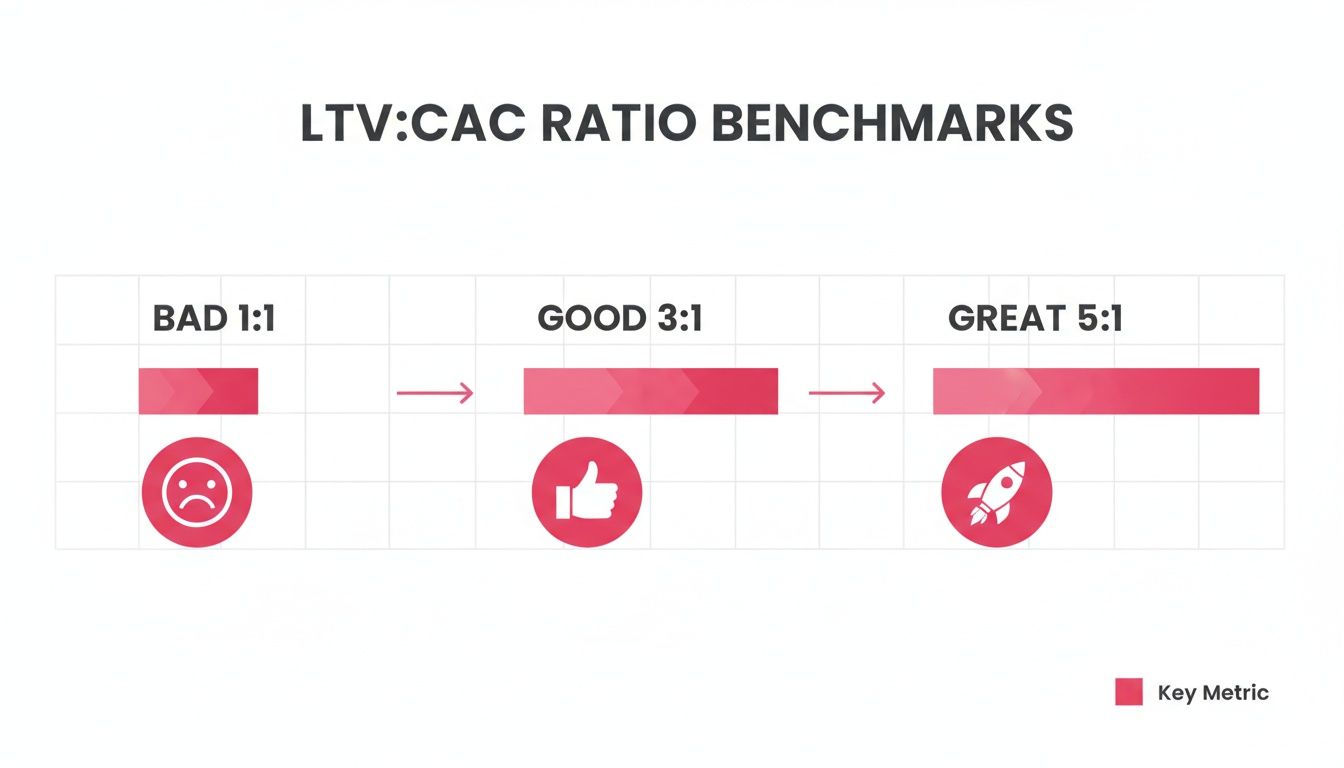
As you can see, the goal is to hit at least a 3:1 ratio. This is the sweet spot that signals a healthy, sustainable business where your customers are worth far more than what you paid to get them.
Acquisition-Focused Channels: The High Cost of a First Impression
Acquisition channels are all about reach and discovery. Think of them as your top-of-funnel activities, introducing your brand to people who might have never heard of you. While they’re absolutely essential for growth, they are almost always the most expensive line item in any marketing budget.
- Google Ads & Social Media Advertising: These are the heavy hitters of acquisition. You’re paying per click (PPC) or per impression (CPM) to get in front of fresh audiences. Depending on how competitive your niche is, your CAC can easily range from $20 to over $100 per customer.
- Influencer Marketing: Working with influencers can feel more authentic, but it still comes with a price tag. Costs can be all over the map, from a few hundred bucks for a micro-influencer to tens of thousands for a major creator. The objective here is to borrow their credibility to drive those crucial first-time purchases.
These channels are non-negotiable for filling your pipeline. But their high costs mean they’re a leaky bucket without a solid back-end strategy to maximize the value of every single customer you bring in.
Retention-Focused Channels: Driving Profitability Through Loyalty
This is where you turn that expensive first-time buyer into a profitable, long-term fan. Retention strategies are almost universally more cost-effective and deliver a much higher ROI because you’re talking to people who already know and trust your brand.
The probability of selling to an existing customer is around 60-70%. For a new prospect? It’s only 5-20%. That massive gap is exactly why retention marketing consistently wins on ROI.
Let’s look at how cost-effective the key retention channels really are:
- Email Marketing: A true cornerstone of retention. Email platforms come with predictable monthly costs, and when you’re marketing to a warm list, the cost to retain a customer (CRC) can be incredibly low—often just a few cents.
- SMS Marketing: Tools like CartBoss run on a performance-based model, which means you often only pay when a text message directly leads to a sale. With SMS open rates hitting an insane 99%, it’s a direct and powerful way to re-engage customers for cart recovery or special offers, keeping CRC minimal and ROI high.
- Loyalty Programs: The cost here is tied directly to the rewards you give out, like discounts or points. While it eats into your margin on a given sale, you’re making a direct investment in encouraging the next purchase, which is a massive driver for Customer Lifetime Value (LTV).
You can dive deeper into structuring your spending with our guide to digital marketing budget allocation.
Comparing Marketing Channel Costs and Effectiveness
To help you visualize where your money should go, here’s a straightforward comparison of these channels, highlighting their main goals and financial realities.
| Channel | Primary Goal | Average Cost (CAC/CRC) | Typical Success Rate |
|---|---|---|---|
| Google/Social Ads | Acquisition | High ($20 – $100+ CAC) | Low (1-3% conversion) |
| Influencer Marketing | Acquisition | Medium to Very High | Varies Greatly |
| Email Marketing | Retention | Very Low ($0.10 – $1 CRC) | High (20-30% open rate) |
| SMS Marketing | Retention | Low (Performance-Based) | Very High (99% open rate) |
| Loyalty Programs | Retention | Low to Medium (Discount-based) | High Engagement from Members |
This table makes the financial case for a balanced strategy crystal clear. Acquisition channels are necessary to bring new people through the door, but your retention channels are where you build a profitable, resilient business for the long haul.
Choosing Your Focus: When to Prioritize Acquisition or Retention
The whole customer retention vs acquisition cost debate isn’t about picking one winner and sticking with it forever. It’s about making the right strategic call for your e-commerce business right now. The game plan for a brand that just launched is worlds apart from what an established store with a massive customer list should be doing.
Your strategy has to be fluid, shifting as your business grows. Smart budget allocation means knowing when to hit the gas on finding new customers and when to double down on taking care of the ones you already have.
Scenario 1: The New Brand Needing Market Entry
If your store is brand new, your mission is simple: get noticed. At this point, you don’t have a customer base to retain, so your focus has to be almost entirely on acquisition. You need to build that initial brand awareness, drive your first wave of traffic, and lock in those all-important early sales.
This is the time to go all-in on top-of-funnel channels.
- Paid Social Media Ads: Use platforms like Instagram and TikTok to put your brand in front of highly targeted audiences.
- Search Engine Marketing: Bid on keywords to catch people who are actively looking for products just like yours.
- Influencer Collaborations: Partner up with creators to borrow their credibility and tap into their loyal following.
A good budget split here might be 80% for acquisition and 20% for retention. That small slice for retention is just for setting up the basic tools—like an SMS cart recovery system—that will pay off big time later on.
Scenario 2: The Established Store with a Leaky Bucket
Maybe your store has been around for a bit. You’re pulling in new customers consistently, but your growth has flatlined. This is a classic “leaky bucket” problem. You’re losing customers almost as fast as you’re bringing them in.
Here, the script flips. Pouring more cash into acquisition is like trying to fill a bucket riddled with holes—it’s expensive and you’ll get nowhere. Your number one goal is to plug those leaks by boosting customer loyalty and increasing lifetime value.
For businesses in this boat, check out these 7 customer retention tips to get your growth back on track. A budget allocation of 70% for retention and 30% for acquisition usually makes the most sense.
This is where automated SMS tools really shine for customer communication and re-engagement. Features like pre-filled checkouts and dynamic discounts are built to remove friction and bring people back, directly fixing the churn that’s holding you back.
Scenario 3: The Mature Business Seeking Scalable Profit
A mature business has a healthy stream of new customers and a solid foundation of repeat buyers. The new challenge is optimizing for maximum profit and scaling up without breaking the bank. This calls for a balanced, data-driven strategy that fine-tunes both acquisition and retention at the same time.
The goal is to crank up your LTV:CAC ratio by attracting higher-value customers and turning them into brand evangelists. You’ll probably land on a 50/50 or 60/40 budget split, constantly tweaking it based on performance data.
Even with the clear financial upside, a shocking 44% of businesses are still planning to prioritize acquisition over retention in 2025. This is a huge mistake, especially since retention is almost always cheaper and acquisition costs have skyrocketed by 222% in recent years. This common blind spot ignores the massive potential sitting in your existing customer base.
An Actionable Playbook for Lowering Costs With SMS
High-level strategy is one thing, but the real wins in the customer retention vs acquisition cost debate come from rolling up your sleeves and getting tactical. This is where automated SMS shines. It’s a direct, high-engagement channel that lets you influence both sides of the cost equation. With open rates often hitting a staggering 99%, text messages cut through the noise in a way email or social media just can’t match.
This playbook breaks down three high-impact SMS strategies you can put to work in your e-commerce store right away to slash costs and pump up lifetime value. Each play targets a critical moment in the customer journey, turning it into a chance to make money by blending smart acquisition with solid retention.
Play 1: Abandoned Cart Recovery
The abandoned cart sits in that gray area right between acquisition and retention. You’ve already paid to get the visitor to your site (that’s an acquisition cost), but they bailed before buying. An automated SMS is your best shot at rescuing that sunk cost and turning a failed acquisition into your newest customer.
The trick is to make it dead simple for them to finish the purchase. Forget generic reminders. Your message needs a direct link that drops the shopper right back into their pre-filled checkout. That one small detail can make a huge difference in your conversion rates.
Sample SMS Template:
- “Hey [Name]! Looks like you left something great behind at [Your Store]. Your cart is saved and waiting for you! Finish your order before it’s gone: [Pre-filled Checkout Link]”
Timing Best Practice: Send the first text 30-60 minutes after they leave. This is the sweet spot—it’s soon enough that the purchase is still fresh in their mind, but not so quick that it feels creepy.
Play 2: Customer Win-Back Campaigns
This one is a pure retention play. The goal is to re-engage customers who’ve gone quiet and haven’t bought from you in a while. It costs a whole lot less to reactivate a past buyer with a targeted text than it does to find a brand new one. A good win-back campaign directly boosts your retention rate and LTV.
You need to remind them why they liked your brand in the first place, usually with an exclusive offer that’s too good to pass up. Personalization is your best friend here.
Sample SMS Template:
- “We miss you, [Name]! It’s been a while. As a thank you for being one of our regulars, here’s 15% OFF your next order at [Your Store]. Use code: COMEBACK15 at checkout: [Link]”
Timing Best Practice: Go after customers who haven’t purchased in 60-90 days. This targets shoppers who are at risk of churning for good, without bugging your more recent buyers. For more ideas, check out our guide on understanding SMS marketing costs and strategies.
A successful win-back campaign does more than just generate a single sale. It restarts the customer lifecycle, pulling a valuable asset back from the brink of churn and significantly boosting their potential lifetime value.
Play 3: Post-Purchase Engagement
The moments right after a customer clicks “buy” are a golden opportunity for retention. They’re excited about their order and highly engaged with your brand. A smart post-purchase SMS sequence can make them feel good about their decision, build trust, and pave the way for their next purchase. You’re basically increasing their LTV from day one.
This isn’t about a hard sell. It’s about making their experience better and building a real relationship that goes beyond just one transaction.
You can use these messages to send order confirmations, shipping updates, and even a quick thank you note with a small discount for their next purchase.
Sample SMS Template:
- “Thanks for your order, [Name]! We’re so excited for you to get your items from [Your Store]. As a small thank you, here’s 10% off your next purchase with us: [Link]”
Timing Best Practice: Send a thank you message within 1-2 hours of the purchase. Follow that up with shipping notifications as they happen to keep the customer in the loop and build excitement.
Answering Your Top Questions
When you start digging into customer retention versus acquisition, a few key questions always pop up. Let’s tackle the most common ones we hear from store owners so you can put these ideas into practice with confidence.
What’s a Good LTV to CAC Ratio for an E-commerce Store?
For a healthy, sustainable e-commerce business, you should aim for an LTV:CAC ratio of 3:1 or higher. In simple terms, this means for every dollar you spend bringing a customer in, you get at least three dollars back over their lifetime.
If your ratio dips below 1:1, you’re officially losing money on every new customer—a clear red flag. On the flip side, a ratio of 5:1 or more is a fantastic sign. It shows you’ve built a highly efficient, scalable business with some serious customer loyalty.
How Can I Improve Customer Retention with a Limited Budget?
You don’t need a massive budget to keep customers coming back. Start with low-cost tactics that deliver a big impact. Your first move should always be prioritizing exceptional customer service; it builds trust and goodwill right from the start.
Another great play is implementing a performance-based SMS cart recovery tool that only charges you when it makes you money. You can also actively collect customer feedback and, more importantly, respond to it. This shows you’re listening and that you value their opinion. Even a simple, personalized email newsletter with exclusive offers for your existing customers can be a powerful, budget-friendly way to keep them engaged.
How Should I Split My Marketing Budget Between Acquisition and Retention?
There’s no magic number here. The right split really depends on where your business is at right now.
- New Stores: You’re in growth mode. Expect to put 80-90% of your budget into acquisition to build brand awareness and get those first customers through the door.
- Growing Stores: Once you have a customer list, it’s time to start shifting. A 60/40 or even 50/50 split between acquisition and retention is a good target.
- Mature Brands: If you have a large, established customer base, you can flip the script. Investing as much as 70-80% in retention is a smart move to maximize profitability from the audience you’ve already built.
Think of your LTV:CAC ratio as your North Star. Let this metric guide your decisions. As you grow, keep an eye on it and adjust your budget allocation to find that sweet spot for profitable, sustainable growth.
Ready to slash your acquisition costs and boost retention without the effort? With CartBoss, you can turn abandoned carts into profit using automated SMS. Our clients see an average 4,500% ROAS with zero subscription fees. Start recovering lost sales today.