



Ever wondered how big brands can text thousands of people at once from a simple 5 or 6-digit number? The secret is the short code registry.
Think of it as the official phone book for high-volume text messaging. It’s the central database that ensures every short code is unique, assigned to a specific company, and playing by the rules set by mobile carriers. This system is the backbone that makes large-scale SMS campaigns—from flash sale alerts to shipping updates—not just possible, but reliable.
What’s the Big Deal With a Short Code Registry?
Imagine the wild west, but for text messages. If any business could just grab a 5-digit number and start blasting out texts, it would be pure chaos. Messages would vanish into thin air, customers would be drowning in spam, and any trust in SMS as a communication channel would evaporate overnight.
The short code registry is the sheriff that keeps the peace. It acts as the official gatekeeper, creating a structured, trustworthy environment for businesses to connect with customers.
In the U.S., this authority is managed by the Cellular Telecommunications Industry Association (CTIA). They are responsible for leasing these short codes to businesses and making sure no two companies can use the same number. Every legitimate marketing text you get from a major brand comes from a number that’s been approved and is tracked by this very system.
Why This Is a Lifeline for E-Commerce Stores
For an online store, this registry isn’t just some technical detail—it’s the foundation of an incredibly powerful marketing channel. It’s what gives you the green light to send thousands of messages at once with rock-solid reliability, which is absolutely critical for time-sensitive campaigns like abandoned cart reminders.
Just how big is the impact? It’s huge.
We all know email is important, but let’s be honest, it doesn’t have the same punch as a text. SMS is immediate, personal, and almost impossible to ignore. A quick look at the numbers shows just how different the playing field is.
Why SMS Is a Game-Changer for E-Commerce
| Metric | SMS Marketing | Email Marketing |
|---|---|---|
| Open Rate | A staggering 98% | Around 20-30% |
| Open Time | 90% opened within 3 minutes | Hours, or even days |
| Click-Through Rate | Often exceeds 35% | Typically 2-3% |
| Customer Engagement | Direct, conversational, and instant | Passive and often lost in a crowded inbox |
These aren’t just vanity metrics; they translate directly into recovered sales and higher revenue. The registry is what makes these powerful results possible.
By ensuring your messages are delivered and compliant with carrier rules, the short code registry transforms a simple text into a reliable revenue-generating machine, especially for high-impact strategies like abandoned cart recovery.
This organized system delivers a few key advantages you just can’t get anywhere else:
- Trust and Legitimacy: A registered short code is like a verified badge for your brand. It tells customers you’re credible and safe to engage with.
- High Throughput: Mobile carriers give priority to traffic from registered short codes. This lets you send thousands of messages per minute without getting flagged as spam.
- Carrier Compliance: The entire registration process is designed to ensure your campaigns meet the strict guidelines set by carriers, drastically reducing the risk of your messages getting blocked.
At the end of the day, the registry is much more than just a database. It’s the bedrock of effective, professional SMS communication. Understanding its role is the first step to truly unlocking the power of a short code text message for your e-commerce business.
Dedicated vs. Shared Short Codes Explained
So, you’re thinking about using short codes. The first big decision is choosing between a dedicated or a shared one. It’s a bit like deciding whether to rent a private office for your business or just grab a desk in a coworking space. Both get the job done, but one gives you way more control, branding power, and security than the other.
Let’s break down the two main paths: leasing a dedicated short code versus using a shared short code.
A dedicated short code is your very own 5- to 6-digit number. It’s exclusive to you. Think of it as your brand’s private, direct line to every customer. When a text comes from that number, it’s instantly recognizable as being from you, which builds trust right away.
On the flip side, a shared short code is a number that multiple businesses use at the same time. Picture an office building with one main street address but tons of different companies inside. To direct traffic, each company uses a unique keyword. A customer might text “PIZZA” to order from a pizzeria or “SHOES” to hear from a retailer, even though both messages go to the same number.
The Power of a Dedicated Number
For any established brand serious about SMS, a dedicated short code is the gold standard. Why? Because you have total control over your sender reputation. You’re the only one using the number, so your message deliverability will never be tanked by some other company’s sketchy marketing tactics.
This exclusivity brings some serious perks:
- Brand Identity: The number becomes part of your brand. Customers start to recognize it, which is huge for recall and trust.
- Unlimited Keywords: You can use any keyword you want for your campaigns. “SALE,” “DEAL,” “JOIN”—they’re all yours. No need to worry if another business already snagged the one you wanted.
- Reputation Control: Your ability to reach customers is entirely in your hands. It all comes down to your own sending practices and compliance.
Of course, all this control comes at a price. Leasing a dedicated short code costs a lot more and involves a pretty lengthy approval process with the mobile carriers. It’s a real investment, but for many, it’s worth it.
A dedicated short code gives you unmatched control over your brand and reputation. But this premium option has higher costs and a more involved setup, making it the best fit for high-volume brands who are all-in on SMS.
The Trade-Offs of a Shared Number
Shared short codes are a much more accessible entry point, especially for smaller businesses or those just dipping their toes into SMS marketing. The biggest draw is the cost—it’s way cheaper because you’re splitting the leasing fees with everyone else using the number. Getting set up is also much faster.
But that convenience comes with some big risks. The main one is the “noisy neighbor” problem. If another company on your shared number starts spamming people, the mobile carriers might flag or even block the entire number. That means your perfectly legitimate, compliant messages could get blocked, and it wouldn’t even be your fault.
You also lose out on branding and keyword options. You’re competing with every other business on that number for the simple, intuitive keywords. While it’s a budget-friendly way to start, the risk of deliverability issues and a watered-down brand identity makes it a shaky foundation for any long-term SMS strategy.
How the Short Code Registration Process Works
Getting a dedicated short code isn’t as simple as grabbing a new phone number; think of it more like applying for a business license. The whole process is designed to be thorough and deliberate, making sure only legitimate, compliant businesses get access to this powerful messaging channel. It takes time, but understanding the steps makes the journey a whole lot clearer.
The entire system is managed through the official short code registry, and it involves a strict review by every single mobile carrier. They will comb through every detail of your planned SMS program to protect their customers and keep their networks clean. This isn’t just about filling out a form—it’s a full-blown application that demands careful prep and total transparency about what you plan to do.
This visual breaks down the core difference between having your own exclusive number versus sharing one with other businesses.
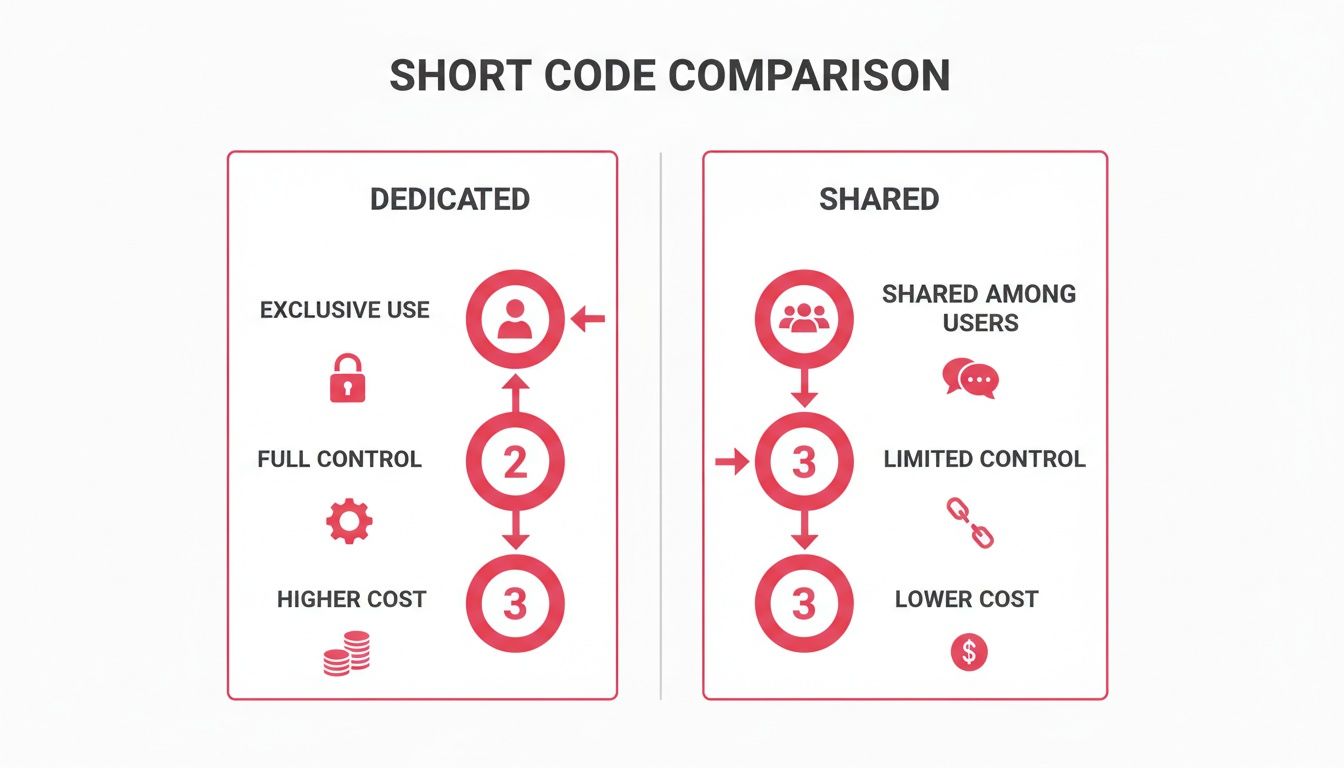
As you can see, a dedicated code gives you complete control over your brand and security—two things that are non-negotiable for the tough registration process ahead.
The Four Core Stages of Registration
The road to getting your short code approved follows a clear, multi-stage path. You should plan for this whole journey to take anywhere from 6 to 12 weeks, since each stage requires coordination between you, your SMS provider, and a handful of different mobile carriers.
-
Leasing the Number and Prepping Your Application
First things first, you’ll need to lease a number from the official registry. You can either get a random number or pay a bit more for a specific “vanity” number that’s easier for customers to remember. At the same time, you’ll start working on a detailed campaign brief, which is hands-down the most important part of your application. -
Crafting the Campaign Brief
This document is essentially the business plan for your short code. It needs to spell out your exact use case (like promotional alerts or abandoned cart reminders), show sample messages, and explain your opt-in and opt-out processes in detail. Carriers want to see precisely how you’ll get consent and what kind of messages you’ll be sending. -
Carrier Submission and Review
Once your brief is locked and loaded, your SMS provider sends it off to all the major mobile carriers for their stamp of approval. Each one—think T-Mobile, Verizon, and AT&T—independently reviews your application to make sure it meets their specific compliance rules and the broader CTIA guidelines. -
Testing and Provisioning
After you get the green light, the carriers will “provision” the short code on their networks. This final step involves a round of testing to make sure messages are sending and receiving correctly before your number officially goes live.
Why Compliance Is Non-Negotiable
The short code registry operates under increasingly tight rules designed to protect consumers. The vetting process is so intense because carriers treat short codes as a trusted channel—they assume the owner has already passed a tough telecom review, making these numbers more permissive than other types. This regulatory pressure means campaign denials for vague or sloppy applications are becoming more common, which really drives home the need to get your application perfect from the start.
Think of your campaign brief as a legal contract with the carriers. It must clearly outline your program name, message frequency, customer care contacts, and links to your privacy policy and terms of service. Any ambiguity can lead to rejection and significant delays.
Ultimately, a successful registration all comes down to a meticulously prepared application that leaves zero room for doubt. For a deeper dive into the specific rules you’ll need to follow, check out our complete guide on SMS marketing compliance.
Comparing Short Codes to 10DLC and Toll-Free Numbers
While a dedicated short code is the heavyweight champion of SMS marketing, it’s not the only contender in the ring. To pick the right tool for your brand, you need to understand the alternatives—namely, 10-Digit Long Codes (10DLC) and Toll-Free numbers. Each one has its own sweet spot in the world of business texting.
Think of it like choosing a vehicle for your business. A short code is the freight train: incredibly powerful and built to move massive volumes at high speed. But it requires a serious upfront investment and a long setup time. It’s the undisputed best choice for national brands that need to send time-sensitive blasts to hundreds of thousands of customers at once.
A 10DLC number, on the other hand, is like a local delivery van. These are just standard 10-digit phone numbers that have been approved for business messaging. They’re perfect for more personal, two-way conversations like customer service chats or appointment reminders. Their throughput is lower, but they feel more natural and are much faster and cheaper to get started with, making them ideal for smaller businesses or localized campaigns.
The Key Differences at a Glance
So where do Toll-Free numbers fit in? They’re the reliable cargo truck of the bunch—a solid middle ground. They can handle higher message volumes than 10DLC and come with built-in brand recognition and trust. While not as lightning-fast as a short code, they provide a great balance of performance, cost, and credibility.
This makes them a go-to for established businesses that need more muscle than 10DLC but aren’t quite ready to commit to a dedicated short code. No matter which number you choose, it’s critical to stay compliant and avoid common TCPA mistakes that can lead to some seriously expensive penalties.
Short Code vs 10DLC vs Toll-Free Number Comparison
To make things clearer, let’s break down how these three options stack up against each other. Each has distinct advantages depending on your goals, from sending massive marketing campaigns to having personal one-on-one chats.
| Feature | Short Code | 10DLC | Toll-Free |
|---|---|---|---|
| Best Use Case | High-volume marketing blasts, urgent alerts, and major promotions. | Two-way conversations, customer support, and appointment reminders. | Verified business messaging, customer service, and marketing campaigns. |
| Throughput | Extremely high (100+ messages per second) | Low (Varies by carrier and campaign registration) | Medium (Higher than 10DLC but lower than short codes) |
| Setup Time | Long (6-12 weeks) | Fast (Days) | Fast (Days to a week) |
| Cost | High ($500-$1,500+ per month lease) | Low (Minimal monthly cost) | Moderate (Slightly more than 10DLC) |
| Brand Recognition | Excellent, seen as highly professional and trustworthy. | Good, feels personal and local. | Excellent, recognized as a legitimate business number. |
This table should give you a clear picture of the trade-offs. It’s all about matching the tool to the job at hand.
Making the Right Choice
Ultimately, your decision comes down to your specific goals, message volume, and budget. For e-commerce stores aiming for maximum reach and impact with their campaigns, a short code’s raw power is simply unmatched. You can learn more about how they drive sales in our deep dive on unlocking e-commerce growth with short codes for SMS.
Your messaging needs will dictate the right choice. For massive, time-sensitive campaigns, short codes are the clear winner. For personal, conversational engagement, 10DLC is perfect. Toll-Free numbers bridge the gap for established businesses needing a blend of volume and trust.
How to Look Up a Short Code and Its Owner
Ever gotten a text from a random 5- or 6-digit number and wondered, “Who is this?” It’s a common question. Whether you’re a savvy shopper trying to verify a promo code text is legit or a marketer checking out what the competition is up to, there’s a simple way to find out who’s behind the message.
Think of it like a public phone book but specifically for these short numbers. The entire SMS world relies on a central directory to keep things transparent, and you can access it, too.
The Official Lookup Tool You Need to Know
In the United States, the go-to resource is the U.S. Short Code Directory. This is the official, free-to-use registry where you can look up any short code. It’s the definitive source for figuring out who has leased a specific number.
Using it is dead simple. Just head over to their website, punch the short code into the search bar, and hit enter. The system will pull up the public record tied to that number in seconds.
Here’s what the search interface looks like on the U.S. Short Code Directory site. It’s clean, simple, and gets straight to the point.

The search results give you the inside scoop, peeling back the curtain on who sent the text and why.
You’ll typically find a few key pieces of information:
- The Company Leasing the Code: This is the big one—it tells you which brand or business registered the number for their campaigns.
- The SMS Provider: This is the tech partner, the company that handles the nuts and bolts of getting the messages from the business to your phone.
- Campaign Details: Often, you’ll see a quick description of what the short code is used for, like “marketing alerts” or “account notifications.”
This kind of transparency is what builds trust in SMS. For you as a consumer, it’s a quick gut check to confirm that a text from your bank is actually from your bank. For businesses, it’s a goldmine of competitive intelligence. You can see exactly what kind of SMS programs others in your space are running.
If you want to see some real-world examples of how major brands put these numbers to work, you can browse this curated short codes list.
The registry lookup tool demystifies the world of A2P messaging. By giving everyone a clear line of sight to the owner of a short code, it empowers both shoppers and businesses to text with confidence.
Choosing the Right SMS Strategy for Your Business
Figuring out the right approach to business SMS can feel a bit overwhelming at first. But really, it all comes down to four things: your messaging volume, budget, branding goals, and how fast you need to get up and running. Your choice here directly shapes how well you can connect with customers and, ultimately, drive sales.
Think about it this way: a national retailer prepping for a massive Black Friday blitz needs the raw power and insane throughput of a dedicated short code. They have to reach hundreds of thousands of customers in a flash. On the flip side, a local startup just dipping its toes into SMS marketing would be much better off with a flexible 10DLC number for more personal, conversational messages.
Finding the E-commerce Sweet Spot
For most e-commerce stores, the real goal is to get all the high-performance perks of a top-tier SMS program without the hefty price tag and long setup times that come with leasing a number from the short code registry. This is exactly where a managed service becomes the perfect fit.
For e-commerce stores, the best strategy is often a managed one. A service like CartBoss provides the power of high-throughput SMS without the complexity and high cost of managing your own number, letting you focus on sales, not carrier compliance.
Platforms like CartBoss take care of all the messy backend stuff—navigating carrier relationships, staying on top of compliance, and managing the numbers—so you don’t have to. You get the rock-solid reliability and deliverability you need for critical campaigns like abandoned cart recovery, but with the ease of a simple plug-and-play tool. This approach lets you make a smart, strategic move for your brand without getting bogged down in the technical details.
The SMS marketing world is absolutely exploding. The U.S. market alone is projected to hit a staggering $18.6 billion by 2030. This incredible growth is powered by a simple fact: 97% of Americans own a phone that can get text messages, giving you nearly universal reach.
Once you have the basics down, you’ll want to make sure your messaging strategy is both effective and compliant. For some great tips on optimizing your campaigns, check out these 10 SMS Marketing Best Practices. And don’t forget, getting proper consent is the cornerstone of any solid strategy. You might find our guide on what counts as expressed written consent for SMS really helpful.
Got a few questions about how short codes work in the real world? Smart. It’s easy to get tangled up in the details, especially when it comes to costs, international use, and what happens if things don’t go as planned. Let’s clear up the most common questions we hear from e-commerce store owners.
How Much Does a Dedicated Short Code Really Cost?
Let’s be upfront: a dedicated short code is a serious financial commitment. You’re not just paying a one-time fee. You’ll have an initial setup charge, plus recurring leasing fees paid directly to the short code registry.
Just to lease the number itself, you’re looking at anywhere from $500 to $1,500 every single month. And that’s before you even factor in what the mobile carriers charge you to use their networks.
This is exactly why most businesses don’t go it alone. It’s far more practical to use a managed service like CartBoss. We absorb all those numbering, compliance, and carrier costs, giving you all the power of a top-tier SMS program without the massive overhead and headaches.
Can I Use the Same Short Code in Different Countries?
This is a big one for international stores, and the answer is a hard no. Short codes are strictly country-specific. Think of them like a local phone number—a U.S. short code won’t send or receive texts in Canada, the UK, or anywhere else.
Each country operates its own registry, has its own set of mobile carriers, and enforces its own unique compliance rules.
If you’re selling internationally, this would mean leasing, managing, and paying for a separate short code in every single country you operate in. As you can imagine, that gets incredibly expensive and complicated, fast. A global SMS platform that handles a whole network of compliant, local numbers is a much smarter, more scalable approach.
Key Takeaway: Short codes don’t roam. If your brand has an international footprint, you need a country-by-country SMS strategy. A managed provider with a global network isn’t just a convenience—it’s a massive operational and financial advantage.
What Happens If My Short Code Application Gets Denied?
It happens. If a carrier rejects your application, they won’t just leave you guessing; they’ll usually tell you why. Most of the time, it comes down to a few common missteps: your use case was too vague, your opt-in or opt-out language wasn’t compliant, or you’re trying to run a campaign for a prohibited industry.
The good news is you can usually fix your application based on their feedback and resubmit it. The bad news? This throws a major wrench in your timeline, causing significant delays.
This is where working with an experienced partner from day one pays off. We help you get your campaign brief and compliance ducks in a row before it ever gets in front of the carriers, which drastically minimizes the risk of a denial.
Ready to unlock the power of SMS for your store, minus the hassle and high costs? CartBoss puts your abandoned cart recovery on autopilot. Start turning lost sales into profit today!
