


Beyond Linear Pathways: Understanding Customer Journey Maps

The traditional ecommerce sales funnel, once a straightforward path from awareness to purchase, now falls short of capturing the nuances of online shopping. Today’s customer journey is more like a winding road, full of unexpected turns and detours. This complexity demands a new approach: the ecommerce customer journey map. This essential tool allows businesses to visualize the customer experience, revealing the various routes shoppers take to conversion.
Why Journey Mapping Matters
E-commerce customer journey maps are crucial in today’s intricate online marketplace. With the rapid growth of e-commerce, the old linear models no longer apply. Customers make countless small decisions on their path from brand discovery to loyalty.
For instance, a customer might find a product on social media, add it to their cart on their phone, and finally purchase it later on their desktop. This non-linear journey shows why website analytics alone aren’t enough. Learn more at Shopify, a leading e-commerce platform. Plus, customers often check multiple sources – reviews, social media, and comparison sites – before buying.
Visualizing the Customer Experience
A good ecommerce customer journey map visually represents the customer’s experience, going beyond basic data. It shows the customer’s touchpoints, actions, motivations, and emotions at each step. This visual approach helps businesses pinpoint moments of truth – the instances where the customer experience can make or break a sale.
Understanding these moments allows businesses to personalize the experience, remove obstacles, and boost conversions. Need help getting started? Check out this helpful guide: How to master customer journey mapping templates.
From Touchpoints to Insights
To understand the customer’s perspective in a physical store, resources like retail customer journey mapping can be invaluable. But online, journey maps help you analyze each touchpoint from the customer’s viewpoint. It’s like walking in their shoes, experiencing their frustrations, and understanding their needs. This provides valuable insights that raw data can’t offer.
Key Components of an Effective Map
An effective ecommerce customer journey map includes these key elements:
- Customer Personas: Representations of your target audience segments.
- Touchpoints: All interactions a customer has with your brand (website visits, social media, emails, customer support).
- Actions: What the customer does at each touchpoint.
- Emotions: How the customer feels at each touchpoint.
- Pain Points: Where customers experience friction or frustration.
- Opportunities: Potential areas to improve the customer experience and drive conversions.
Visualizing these elements gives businesses a deeper understanding of their customers. This allows for data-driven decisions to optimize the entire customer journey, leading to higher conversion rates, greater customer satisfaction, and a more profitable business.
The Bottom-Line Impact of Customer Journey Mapping
Ecommerce customer journey mapping isn’t just a theoretical exercise; it has a direct impact on revenue. By understanding and optimizing the customer journey, businesses can turn insights into tangible growth. This translates to higher conversion rates, increased customer lifetime value, and a smarter use of marketing budgets.
Connecting Journey Mapping to ROI
Successful ecommerce brands link their journey mapping initiatives to specific Key Performance Indicators (KPIs). This promotes accountability and demonstrates a clear Return on Investment (ROI). For example, a business might concentrate on decreasing cart abandonment rates or boosting average order value. Tracking these metrics allows them to directly measure the effect of improvements made through journey mapping.
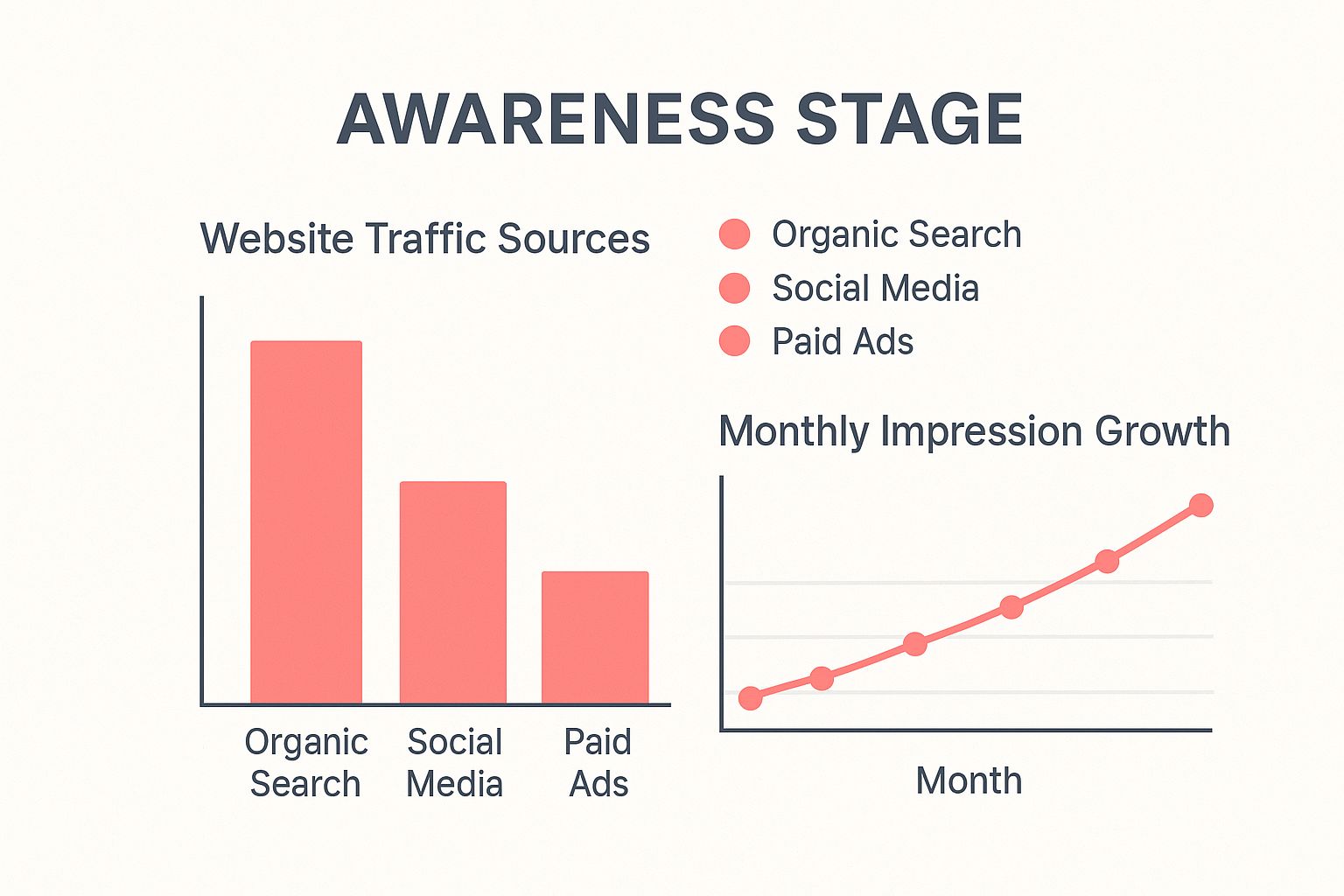
The infographic above visualizes data for the Awareness stage. It illustrates the distribution of website traffic sources (organic search, social media, paid ads) and monthly impression growth over a six-month period. This data shows that organic search delivers the most traffic, but social media impressions are steadily increasing, indicating potential for more traffic from that channel. This knowledge can inform future marketing plans.
Boosting Cross-Sell and Reducing Abandonment
Companies effectively using journey mapping experience considerably higher cross-sell rates. Understanding the customer journey allows businesses to pinpoint cross-selling and upselling opportunities, which leads to higher revenue. For instance, a customer buying running shoes might also be interested in running socks or other athletic wear. Strategically placing these products within the customer journey lets businesses capitalize on these opportunities.
Journey mapping also helps identify and resolve pain points that cause cart abandonment. For proven strategies to optimize your checkout and recover lost sales, see this guide on reducing cart abandonment. Businesses utilizing journey mapping see a 56% increase in cross-sell revenue. With 73% of consumers using multiple channels during their shopping journey, the need for omnichannel experiences is clear. More detailed statistics can be found here.
To further highlight the ROI of journey mapping, let’s take a look at some key performance improvements reported by ecommerce businesses:
Journey Mapping ROI Metrics
| Performance Metric | Average Improvement | Implementation Timeline |
|---|---|---|
| Cross-Sell Revenue | 56% | Within 1 year |
| Cart Abandonment Rate | Reduction of 10-15% | Within 6 months |
| Customer Lifetime Value | Increase of 15-20% | Within 1-2 years |
These statistics showcase the significant impact journey mapping can have on various key metrics. The improvements are substantial and highlight the long-term benefits of investing in journey mapping.
Personalization and Customer Experience
Personalization, guided by journey insights, creates noticeably better customer experiences. For example, a customer who previously bought baby products will likely respond well to targeted offers for toddlers. This tailored approach strengthens customer loyalty and raises customer lifetime value. This is because customers feel valued when businesses cater to their specific needs.
From Insights to Action
By identifying friction points in the customer journey, businesses can implement targeted improvements that directly influence conversion metrics. A confusing checkout process can be simplified to lower cart abandonment. Providing clear product information and customer reviews can resolve customer uncertainties and encourage purchases. For additional help, see this resource on how to master cart abandonment recovery. Addressing these pain points creates a better customer experience, ultimately leading to increased conversions and higher customer satisfaction.
Mapping Decision Points That Drive Conversion

Going beyond the basics of the customer journey, let’s explore the decision points that truly lead to conversions. Forget broad awareness-to-advocacy models. We’re diving into the specific emotional and practical influences on purchasing choices at each step of the ecommerce customer journey map.
Uncovering Motivations and Concerns
Successful ecommerce brands know they need to map customer motivations, concerns, and expectations at every touchpoint. Many use qualitative research methods like customer interviews and surveys. These methods uncover the “why” behind customer behavior. This provides valuable insights that quantitative data just can’t offer. For example, if customers abandon carts because of unexpected shipping costs, you’ve found a key decision point. Offer free shipping or clearly display those costs earlier.
Practical Frameworks for Decision Mapping
Understanding customer motivations allows you to build practical frameworks for documenting the psychology behind their decisions. This encompasses the entire journey, from initial product discovery to post-purchase engagement. You might be interested in: How to master customer retention. Identifying the customer’s emotional state at each stage is crucial. Are they excited? Hesitant? Frustrated? This context informs your messaging and offers.
Addressing Segment Variations
Different customer segments experience these decision points in unique ways, adding complexity to journey mapping. But your ecommerce customer journey map doesn’t need to be overly complex. By focusing on key segments and their motivations, you can create effective maps that address these variations. A first-time buyer might value detailed product information and social proof. A repeat customer might prefer exclusive discounts or personalized recommendations. Creating and implementing these maps requires a structured approach, from initial awareness to post-purchase. Understanding customer actions and emotions at each stage is key. For example, during product research, customers might compare features, read reviews, and experience excitement mixed with uncertainty.
Converting Insights into Action
Want to boost conversion rates? Check out these conversion optimization tips. Accurately mapping decision points allows businesses to strategically place compelling calls to action. Address customer hesitations and smooth the path to purchase. The result? Higher conversion rates, increased customer satisfaction, and improved business performance. This proactive approach also enables anticipatory customer service. Solve potential problems before they happen, building stronger customer loyalty.
Gathering Data That Actually Reveals Customer Truth
Creating a truly effective ecommerce customer journey map requires a solid foundation of data. It’s about understanding the reality of your customer’s interactions, not just relying on assumptions. To achieve this, successful ecommerce businesses use a combination of quantitative data and qualitative insights.
The Power of Quantitative Data
Quantitative data tells the story of what customers are doing on your website. Think of it as the “what” of customer behavior. Tools like Google Analytics provide valuable metrics like bounce rate, time on page, and conversion rates.
For instance, a high bounce rate on a product page could indicate that the page isn’t resonating with customers. This data helps identify patterns and trends, but it doesn’t explain why these trends exist.
Uncovering the “Why” With Qualitative Data
Qualitative data provides the missing piece of the puzzle: the “why” behind customer actions. It explores the motivations and feelings driving customer behavior.
Methods like customer interviews and user testing offer a deeper understanding of experiences. Imagine interviewing customers who abandoned their carts. This can uncover hidden frustrations in the checkout process. Addressing these underlying issues is key to improving the customer journey.
Ethical Data Collection
Collecting data ethically is crucial. Transparency and respect for privacy build customer trust. Clearly communicate your data collection practices and give customers control over their data, including easy opt-out options. This not only strengthens customer relationships but also benefits your business in the long run.
Combining Data Sources for a Holistic View
Combining data sources paints a comprehensive picture of the customer experience. Integrating website analytics with customer feedback and behavioral data provides a holistic view of the entire ecommerce customer journey map.
By connecting the dots between what customers do and why they do it, you unlock valuable insights that inform strategic decisions. Think of it like assembling a puzzle – each piece of data adds a different perspective to reveal the complete image.
Visualizing Data for Actionable Insights
Once you’ve gathered your data, the next step is visualization. Tools like journey mapping software and even spreadsheets can help. A clear visual representation simplifies identifying pain points, prioritizing improvements, and sharing insights across your organization.
Consider tools with features like heat mapping, session recordings, and feedback integration. Services like CartBoss can also automate cart recovery and provide deeper insights into customer behavior at this critical stage.
To illustrate the various data sources available for building an effective customer journey map, take a look at the table below:
Data Sources for Journey Mapping: Comparison of quantitative and qualitative data sources for effective journey mapping
| Data Source | Type | Key Insights Provided | Collection Methods | Implementation Complexity |
|---|---|---|---|---|
| Website Analytics | Quantitative | Traffic sources, conversion rates, bounce rates | Google Analytics, website tracking tools | Low |
| Customer Interviews | Qualitative | Customer motivations, pain points, feedback | One-on-one interviews, focus groups | Medium |
| User Testing | Qualitative | Usability issues, website navigation challenges | User testing platforms, observation | Medium |
| Customer Feedback Surveys | Qualitative | Customer satisfaction, product reviews | Online surveys, email feedback requests | Low |
| Session Recordings | Quantitative/Qualitative | User behavior on website, click patterns | Session recording software | Medium |
This table demonstrates the range of data sources and the insights they provide. By using a mix of these methods, you can create a data-driven ecommerce customer journey map that accurately reflects the customer experience.
Transforming Pain Points Into Profit Opportunities

Every point of friction in the ecommerce customer journey map represents an opportunity for improvement. Leading ecommerce brands actively identify areas where customers struggle, experience confusion, or encounter frustration. They then leverage these pain points to create competitive advantages. This strategic approach goes beyond problem-solving; it cultivates customer loyalty and boosts revenue.
Prioritizing Pain Points for Maximum Impact
Not all pain points are equally impactful. Some affect conversions more significantly than others. A practical approach to prioritization involves balancing conversion impact with implementation complexity. A minor website bug, for instance, might annoy a few customers but be easily resolved. In contrast, a cumbersome checkout process could severely hamper sales while requiring a more extensive overhaul.
Distinguishing Between Cosmetic and Fundamental Issues
Some issues are superficial, while others are fundamental flaws in the customer experience. Successful companies understand this distinction. A slightly slow-loading page might be a minor inconvenience. However, a confusing product description could prevent a purchase altogether. Prioritizing fundamental issues yields the most significant improvements in conversion rates. For more information on optimizing the checkout process, see this helpful guide: How to master checkout optimization.
Turning Pain Points Into Signature Strengths
Savvy brands don’t just fix pain points; they transform them into distinctive strengths. This involves turning a negative into a positive and differentiating themselves from competitors.
- Checkout Complexity: A cumbersome checkout process can be streamlined for speed and ease of use, becoming a compelling selling point.
- Product Uncertainty: Address product concerns with detailed descriptions, high-quality images, customer reviews, and accessible customer support.
- Support Gaps: Inadequate customer support can be transformed into a proactive, helpful service that fosters trust and repeat business.
Measuring the Revenue Impact and Building Momentum
Measuring the revenue impact of each improvement is critical. This means tracking metrics like conversion rates, average order value, and customer lifetime value. Demonstrating a clear return on investment (ROI) fuels further optimization of the ecommerce customer journey map. This creates a cycle of improvement, with addressed pain points leading to increased revenue, which then funds further enhancements to the customer experience.
From Fixing Problems to Creating Delight
By prioritizing the customer experience at every touchpoint, businesses can move beyond fixing problems to create delightful experiences. This might involve a personalized thank you note or a proactive offer based on browsing history. These small gestures can significantly impact customer loyalty and drive long-term growth. This proactive approach fosters strong customer relationships, encouraging repeat business. Focusing on the entire customer journey, not just the sale, creates a sustainable and profitable ecommerce business.
Leveraging Technology Without Losing the Human Touch
Technology plays a crucial role in understanding and optimizing the ecommerce customer journey map. From AI-driven analytics to visual behavior tracking, these tools offer valuable insights into customer behavior. However, it’s essential to use technology strategically, complementing human understanding rather than replacing it.
AI-Powered Analytics: Unveiling Hidden Patterns
AI-powered analytics can process large amounts of data, revealing hidden patterns and correlations in customer behavior. This can highlight unexpected trends and predict future actions. For instance, AI might reveal that customers abandoning carts after browsing certain products are more likely to convert with a targeted discount. This allows businesses to personalize offers and improve conversion rates.
Visual Behavior Mapping: Seeing the Journey Unfold
Tools like heat mapping and session recording visually represent customer interactions on your website. Heat maps show where customers click and scroll, highlighting areas of interest and potential friction points. Session recordings let you replay individual customer sessions, providing a detailed view of their journey. This can reveal usability issues missed by traditional analytics. You might discover, for example, that customers struggle to locate the “Add to Cart” button, leading to higher abandonment rates.
Customer Data Platforms: Creating a Unified View
Customer data platforms (CDPs) consolidate data from various sources, creating a unified view of each customer’s journey. CDPs allow businesses to track customer interactions across multiple touchpoints, from website visits to email campaigns. This comprehensive view enables more effective personalization and targeted marketing. Check out our guide on ecommerce checkout optimization to further enhance the customer journey.
Predictive Capabilities: Anticipating Customer Needs
Predictive analytics, powered by AI, allows businesses to anticipate customer needs. If a customer previously purchased baby products, predictive analytics might suggest they are now interested in toddler items. This allows businesses to proactively offer relevant products and services, improving the customer experience.
Balancing Data and Empathy
While technology offers powerful insights, the human element is vital. Data should inform decisions, not replace empathy and understanding. Customer interviews, surveys, and user testing offer valuable qualitative data that complements quantitative insights from technology. This balanced approach ensures your ecommerce customer journey map accurately reflects both the emotional and practical aspects of the customer experience. You might be interested in: How to master checkout optimization for digital retailers.
Choosing the Right Technologies
Selecting the right technology depends on your business needs and goals. Consider these factors:
- Data integration capabilities: Ensure seamless integration with existing systems.
- Ease of use: Choose user-friendly tools for easy team adoption.
- Scalability: Select a solution that can grow with your business.
- Cost-effectiveness: Evaluate the ROI of each technology.
By carefully selecting and implementing the right technologies, you can understand your customers better and optimize their journey for maximum impact. The goal is not just data collection, but using it to create better experiences, build loyalty, and drive growth.
From Static Document to Dynamic Business Engine
An ecommerce customer journey map shouldn’t be a forgotten file. To truly unlock its potential, it needs to transform from a static document into a dynamic tool that propels your business growth. This means integrating the map into your daily operations and using it to inform decisions across the company.
Securing Buy-In and Establishing Accountability
Getting everyone on the same page is essential. Clear communication is key to securing buy-in across different departments. Explain how the ecommerce customer journey map will benefit each team and contribute to overall business objectives. Assign clear ownership for each stage of the customer journey, ensuring accountability for improvements. This collaborative effort fosters a shared understanding of the customer experience and encourages a united approach to optimization.
Creating Regular Review Cycles
Customer behavior is always evolving. Establish regular review cycles, perhaps monthly or quarterly, to keep your ecommerce customer journey map current. The frequency will depend on how quickly your industry changes. Regularly revisiting the map ensures it remains relevant and accurately reflects current customer behaviors, allowing you to adapt to shifting market trends and customer preferences. For example, seasonal changes in buying habits might necessitate adjustments to your map.
Testing Hypotheses and Measuring Impact
Use your ecommerce customer journey map to develop testable hypotheses about customer behavior. For example, you might theorize that simplifying the checkout process will decrease cart abandonment. Then, A/B test different checkout page versions to see which performs best. Track the impact of every change, measuring its effect on conversion rates and other key metrics. This data-driven methodology ensures that improvements are evidence-based, maximizing the effectiveness of your optimization efforts.
Establishing a Culture of Continuous Journey Optimization
Continuous optimization is vital for success. Foster a culture where journey mapping isn’t a one-time project, but an ongoing process of learning and improvement. Connect specific KPIs to each touchpoint in the journey. This helps measure progress, pinpoint areas for improvement, and demonstrate the value of journey mapping to stakeholders. This creates a valuable feedback loop for future map iterations, contributing to a cycle of continuous improvement.
Knowing When to Revisit Your Map
Certain events should trigger a reevaluation of your ecommerce customer journey map. Major product updates, significant market shifts, or negative customer feedback all indicate a need to revisit and refine your map. Scheduled regular reviews should also be conducted to ensure the map remains relevant and reflects current customer behavior. This proactive approach helps you stay ahead of the curve and adapt to changing market dynamics. Want to recover lost sales and convert abandoned carts into profit? CartBoss is an automated SMS marketing platform that can help you re-engage customers and boost conversions. Learn more about maximizing your revenue with CartBoss at https://www.cartboss.io.