



Building real brand loyalty means moving past just selling stuff. It’s about forging a genuine, emotional connection that makes people feel something for your brand.
When you get this right, customers become advocates. They choose you every time, not because you dangled a discount, but because they trust you. This kind of bond is built on a mix of standout customer experiences, shared values, and simply being consistent and reliable.
The Real Foundation of Customer Loyalty
Lots of businesses hear “loyalty” and immediately jump to points programs and discounts. While those can be useful tools, they aren’t the foundation. You can’t buy true loyalty; you have to earn it.
It’s earned through trust. It’s built on a deep understanding of what your customers actually care about. It’s the reason someone will walk past a cheaper option to buy their favorite brand of coffee. That connection is built one positive interaction at a time, making customers feel good about their entire journey with you.
Before you can even think about repeat business, you need to build a brand people want to be associated with. This requires a complete shift in thinking—from one-off sales to lifelong relationships. Digging into proven strategies to build client loyalty is a great way to start wrapping your head around this long-term approach.
From Transactions to Relationships
Today’s market is noisy. Your customers have endless choices. The only real advantage you have is the relationship you build with them. The best brands know this. They see every touchpoint—from the first ad someone sees to the support ticket they open—as a chance to make that relationship stronger.
This shift is happening everywhere. You can see it in the data: 60% of brands are now focusing on Customer Lifetime Value (CLV) instead of just the immediate sale. Another 38% are working hard to lower customer churn, proving they’re committed to keeping the customers they’ve already won.
The most powerful brands are built on a foundation of trust. Customers stick with companies they can rely on to deliver quality, consistency, and a positive experience every single time. Loyalty is the natural byproduct of that trust.
To help you get started, we’ve put together a quick-reference table that breaks down the foundational concepts for building lasting customer relationships.
Core Pillars of Modern Brand Loyalty
| Pillar | Key Objective | Core Metric |
|---|---|---|
| Trust | Establish credibility and reliability in your products and brand promises. | Net Promoter Score (NPS) |
| Consistency | Deliver a uniform and predictable brand experience across all channels. | Customer Satisfaction (CSAT) |
| Shared Values | Connect with customers on an emotional level by aligning with their beliefs. | Customer Lifetime Value (CLV) |
Focusing on these three core pillars will give your retention strategy a solid base to build upon.
Let’s break them down a bit more:
- Trust: This is the absolute bedrock. Customers must believe in your product’s quality and your company’s integrity. You earn it by being transparent, honest, and consistently delivering on what you promise. No shortcuts here.
- Consistency: Your brand’s voice, values, and customer experience have to be the same everywhere. A consistent experience feels familiar and reliable, which makes customers feel secure in their decision to stick with you.
- Shared Values: People are naturally drawn to brands that reflect their own beliefs. When you’re clear about what your brand stands for—be it sustainability, community, or innovation—you’ll attract customers who share those values. That creates a connection that’s much deeper and harder to break than one based on price alone.
By focusing on these foundational elements, you can create genuine advocacy and sustainable growth. For more detailed steps, check out our guide on how to build customer loyalty, which dives deeper into actionable tactics.
Crafting an Unforgettable Customer Experience
Every single interaction a customer has with your brand—from their first website visit to a post-purchase support email—is a building block of loyalty. It’s true. A single frustrating moment can undo months of hard work. That’s why crafting an unforgettable customer experience isn’t a bonus; it’s a core business function.

This means going beyond just solving problems when they arise. It’s about being proactive, intuitive, and creating a seamless journey that feels completely effortless for the customer. Think about the brands you love. Their success isn’t an accident; it’s the result of meticulously mapping and optimizing every touchpoint to blow expectations out of the water.
Map Your Customer Journey
You can’t improve what you don’t understand. The first step is to literally walk in your customer’s shoes by mapping out their entire journey. This isn’t a theoretical exercise; it’s a practical deep dive into how real people interact with you.
Start by identifying every possible touchpoint:
- Discovery: How do people first find you? Is it through social media, a Google search, or a targeted ad?
- Consideration: What happens when they land on your site or start reading reviews? What’s that first impression like?
- Purchase: How simple and secure is your checkout process? Is it a breeze, or are there annoying hurdles?
- Post-Purchase: What do your confirmation emails, shipping updates, and the unboxing experience feel like?
- Support: If something goes wrong, how easy is it to get help? Is it a pain or a pleasure?
For each stage, document the customer’s actions, feelings, and potential pain points. Where is the friction? Where could you add a little moment of delight? This map becomes your blueprint for building a better experience and figuring out how to build brand loyalty from the ground up.
An exceptional customer experience is the most sustainable competitive advantage you can have. It’s about making the customer feel seen, heard, and valued at every step, transforming a simple transaction into a lasting relationship.
Understanding this journey also uncovers huge opportunities for personalization. And personalization is a massive driver of engagement, with 58% of businesses now investing in tailored approaches. These efforts pay off, too—nearly 70% of brands report seeing higher customer engagement from their loyalty initiatives. You can dig deeper into how loyalty program trends are shaping customer behavior.
Empower Your Team to Create Wow Moments
A great customer experience is ultimately powered by people. Your customer support team is on the front lines, and they need the autonomy to do more than just read from a script. You have to empower them to solve problems on the spot.
Think about the classic Zappos example. They built their entire reputation on world-class customer service. Their agents are famous for being able to do whatever it takes to make a customer happy, from sending flowers to overnighting a new pair of shoes for a wedding. That’s not just good service; it’s legendary.
This kind of empowerment doesn’t just happen. It requires:
- Clear Guidelines, Not Rigid Scripts: Give your team a framework for making decisions, but give them the flexibility to be human and get creative.
- The Right Tools: Equip them with the tech and info they need to resolve issues quickly without escalating every minor problem up the chain.
- A Culture of Trust: Show your team you trust their judgment. When employees feel valued, they pass that feeling right on to your customers.
When your team feels empowered, they can turn a negative experience into a positive one, creating a “wow” moment that a customer will remember and tell their friends about. Never underestimate how far small, unexpected gestures can go.
Proactively Gather and Act on Feedback
Don’t wait for customers to complain to find out what’s broken. Building an unforgettable experience means being proactive and constantly asking for feedback to get better.
Make it incredibly easy for customers to share their thoughts. The best way is to use a mix of methods to gather insights at different stages of their journey.
| Feedback Method | Best For | Example Question |
|---|---|---|
| NPS Surveys | Measuring overall loyalty and satisfaction | “On a scale of 0-10, how likely are you to recommend us?” |
| Post-Purchase Surveys | Getting immediate feedback on the buying experience | “How easy was it to complete your purchase today?” |
| Social Media Listening | Uncovering unsolicited, honest opinions | Monitoring brand mentions and relevant hashtags. |
But here’s the most crucial part: don’t just collect data—act on it. When you get feedback, acknowledge it. And if you make a change based on a customer’s suggestion, let them know! Closing the feedback loop shows customers that you’re actually listening and that their voice matters. That’s one of the most powerful ways to build a fiercely loyal following. By putting these strategies into action, you can seriously boost eCommerce sales and customer retention.
Designing Loyalty Programs People Actually Use
Let’s be honest: a generic “buy ten, get one free” punch card isn’t going to cut it anymore. In today’s market, your loyalty program needs to feel like a genuine reward for your best customers, not just another marketing trick to get them to spend more.
When you get it right, a loyalty program becomes a powerful engine for repeat business. The key is to create something that provides real, tangible value—something that lines up perfectly with what your customers actually want from you. It’s about moving beyond simple discounts and thinking about exclusivity, convenience, or unique experiences that reinforce what’s great about your brand.
Beyond Points and Punches
The first step is to stop seeing your loyalty program as a standalone tactic. It should be a natural extension of your brand’s mission and a core part of the customer experience. A great program makes your customers feel seen and appreciated.
Before you design anything, ask yourself a few critical questions:
- What behavior do we want to reward? Is it just purchases? Or are we also interested in referrals, social media shares, or product reviews?
- What do our most loyal customers actually value? Is it saving money, getting early access to new products, or feeling like a VIP?
- How can we make this effortless? Complicated rules and a clunky redemption process will kill engagement before it even starts.
Answering these questions honestly will point you toward a program that feels authentic to your brand and genuinely appealing to your customers. For a deeper dive, this guide on how to create a customer loyalty program offers a solid framework to get started.
Popular Loyalty Program Models
There’s no single “best” model here. The right choice depends entirely on your business, your products, and your customers. Each structure taps into a different psychological incentive, so it’s important to pick one that aligns with your goals.
Some proven models include:
- Points-Based Systems: The classic model. Customers earn points for every dollar spent. It’s simple, easy to understand, and provides clear value. Think of a coffee shop offering 10 points per dollar, with a free drink at 1,000 points.
- Tiered Programs: This model creates a sense of exclusivity and gamifies the experience. Customers unlock new perks and a higher status as they spend more. Sephora’s Beauty Insider program is a perfect example, offering different benefits for “Insider,” “V.I.P.,” and “Rouge” members.
- Value-Based Programs: Instead of rewarding purchases, these programs align with customer values. Imagine a brand that donates a portion of a member’s purchase to a charity of their choice. This builds a powerful emotional connection that goes way beyond the transaction itself.
No matter which model you choose, consistency is what ties it all together. The following image shows how a structured approach ensures a cohesive brand experience from the ground up.
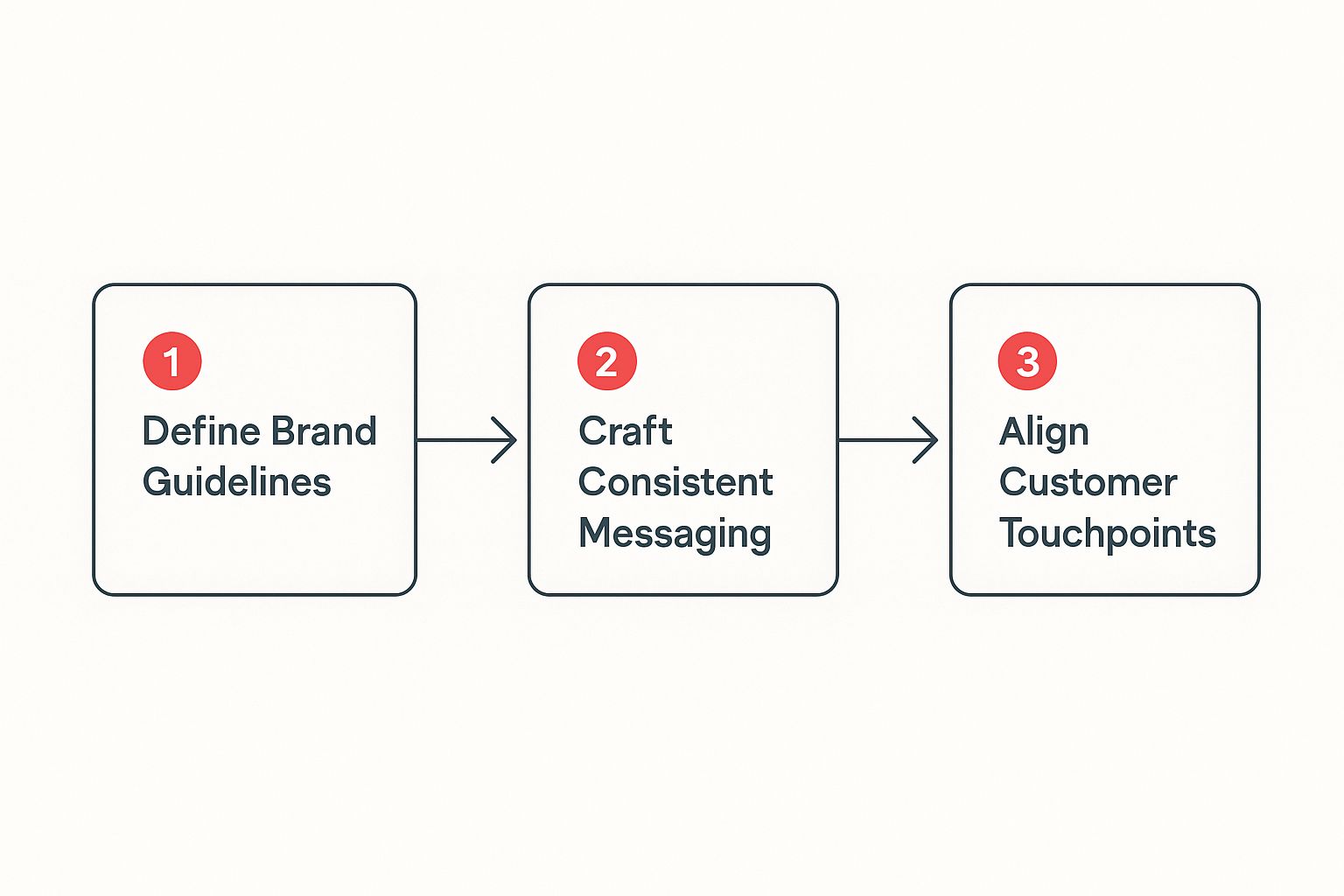
This flow highlights a critical point: you have to define your brand’s core identity before you craft messaging or align touchpoints. This ensures your loyalty program feels like a natural part of your brand, not a tacked-on gimmick.
The Non-Negotiables for Success
Designing the structure is only half the battle. To create a program people actually use and love, the execution has to be flawless. This is where so many businesses stumble, rolling out programs that are confusing, uninspiring, or just not worth the effort.
The best loyalty programs don’t just reward transactions; they deepen relationships. They make customers feel like insiders who are part of an exclusive club, creating an emotional bond that price alone can’t break.
There’s a reason the global loyalty management market is booming—it’s projected to hit $41.21 billion by 2032. Effective programs deliver real results. In fact, 58% of brands see a significant boost in repeat purchases from their loyalty initiatives, while 32% report a meaningful increase in brand advocacy and referrals.
To make sure your program drives this kind of success, focus on these essentials:
- Effortless Redemption: Make it incredibly simple for customers to use their rewards. If they have to jump through hoops, they’ll just give up.
- Clear and Consistent Communication: Keep members updated on their status, new perks, and exclusive offers. Use email and SMS to remind them of the value they’re getting.
- Elements of Surprise and Delight: Go beyond the expected. An occasional surprise gift, a birthday reward, or an unexpected upgrade can create a memorable moment that strengthens their connection to your brand for the long haul.
Building a Community and an Emotional Connection
True brand loyalty blossoms when customers feel like they’re part of something bigger than just a transaction. It’s the difference between a simple customer list and a thriving community. This kind of connection isn’t built on discounts; it’s forged through shared experiences, authentic stories, and a sense of belonging that your competitors just can’t copy.
When people feel a genuine emotional tie to your brand, they don’t just buy from you—they advocate for you. They’ll wear your logo with pride, defend you online, and become your most powerful marketing asset. But getting to that level of dedication requires a real strategy focused on human connection.
Cultivate a Thriving Brand Community
Your most passionate customers don’t just want to connect with you; they want to connect with each other. Give them a space to do that, and you’ll transform individual buyers into a cohesive group united by their love for your brand. This creates a powerful network effect that strengthens loyalty with every new conversation.
Here are a few practical ways to make this happen:
- Exclusive Social Media Groups: A private Facebook group or a dedicated Discord server for your best customers is a great starting point. Use it for sneak peeks, exclusive content, and direct conversations with your team.
- Forums and Online Hubs: A dedicated forum on your website can become a go-to resource where users share tips, ask questions, and help one another out. As a bonus, it provides you with invaluable, unfiltered feedback.
- Real-World or Virtual Events: Host workshops, local meetups, or live Q&A sessions. These events put a human face to your brand and create memorable experiences that build lasting bonds.
The goal is to create a space where your customers feel like valued insiders. These efforts are crucial for long-term success, and you can dig into more ideas in our guide covering proven strategies at https://www.cartboss.io/blog/9-proven-ecommerce-customer-retention-strategies-for-2025/.
Spark Engagement with User-Generated Content
Nothing builds trust faster than seeing real people celebrate your brand. User-generated content (UGC) campaigns are a fantastic way to give your customers a voice and a real stake in your brand’s story. It turns them from passive consumers into active participants.
Try running a contest with a branded hashtag, encouraging customers to share photos or videos of them using your products. Feature the best submissions on your official social media channels. When you showcase their content, you’re not just getting free marketing—you’re validating their choice and making them feel like a celebrated part of your journey.
This is where things like custom promotional giveaways can really shine. Sending a small branded item to a customer whose photo you feature can amplify their excitement and get others eager to participate.
Connect Through Authentic Storytelling and Shared Values
Facts tell, but stories sell. More than that, they build incredible loyalty. People don’t connect with products; they connect with the stories, values, and mission behind them. Your brand’s narrative is your most powerful tool for creating that emotional bond.
Are you a family-owned business? A startup trying to solve a big industry problem? A brand committed to sustainability? Share that story openly and consistently. This kind of authenticity humanizes your brand and attracts customers who share your core beliefs.
An emotional connection is the ultimate economic moat. When customers are loyal to your brand’s values and story, they won’t be swayed by a competitor’s lower price because their relationship with you is about more than just the transaction.
This isn’t just a hunch; it’s a clear trend in consumer behavior. People are actively seeking out local and values-driven brands. Looking ahead to 2025, 47% of global consumers said buying from locally owned companies is important to them. They want to support businesses that reflect their own community values. When customers see themselves in your brand, their loyalty becomes deeply personal and incredibly hard to break.
Using Personalization to Deepen Relationships
In a market flooded with options, making your customer feel uniquely seen and understood is a superpower. But let’s be clear: personalization goes way beyond just dropping their first name into an email subject line.
True personalization is about using what you know to deliver relevant, helpful experiences that genuinely solve problems and make your customer’s life easier.
When you get it right, it reinforces their decision to choose you. It shows you’re paying attention not just to what they buy, but to who they are. This shift from generic, one-size-fits-all messaging to bespoke communication is a cornerstone of modern brand loyalty.
Leverage Data for Smarter Interactions
Every great personalization strategy is built on a foundation of data. Your customers are constantly telling you what they want through their actions—what they browse, what they add to their cart, and what they ultimately purchase. Tapping into this information lets you move from guesswork to informed, helpful engagement.
For example, an online bookstore can use purchase history to recommend new titles from a customer’s favorite author. A skincare brand can track browsing behavior to send targeted content about a specific skin concern, complete with product suggestions. This isn’t just marketing; it’s proactive problem-solving.
This approach requires you to gather and analyze a few key data points:
- Purchase History: The most direct indicator of a customer’s preferences and needs.
- Browsing Behavior: Reveals interests and what products a customer is considering right now.
- Cart Abandonment Data: Shows which products caught their eye but didn’t result in a sale—a perfect opportunity for a personalized follow-up.
- Customer Feedback: Direct input from surveys and reviews tells you exactly what they think and what they want more of.
By connecting these dots, you can create a customer journey that feels less like a sales funnel and more like a helpful conversation.
Go Beyond Basic Segmentation
Grouping customers by broad categories like location or past purchases is a decent start, but real personalization digs deeper. It’s about creating dynamic, one-to-one experiences at scale.
This is where automation tools become absolutely essential, allowing you to deliver the right message to the right person at precisely the right time. Think about how Netflix recommends shows based on your unique viewing habits, not just what’s popular in your country. That’s the level of detail to aim for.
Personalization is the art of making your customer feel like they are your only customer. It transforms a transaction into a relationship by proving you understand their individual needs and are there to meet them.
One of the most effective ways to do this is through automated SMS campaigns. Imagine a customer abandons a cart containing a specific running shoe. An automated tool like CartBoss can send a timely SMS that not only reminds them but also includes a link to a pre-filled checkout to make finishing the purchase effortless.
This is a perfect example of personalization that adds convenience and real value, which directly helps to increase customer lifetime value and solidify loyalty.
Tailor Recommendations and Content
Your personalization efforts shouldn’t stop at product suggestions. The content you create—from blog posts to social media updates—can also be tailored to individual interests. This creates a much richer, more engaging brand experience.
If a customer frequently buys running shoes, sending them an article on “5 Tips to Prepare for Your First Marathon” is far more valuable than a generic weekly newsletter. It shows you understand their lifestyle and are invested in their success, not just their next purchase.
Here’s a quick breakdown of how to tailor different touchpoints:
| Touchpoint | Generic Approach | Personalized Approach |
|---|---|---|
| Email Marketing | A single newsletter sent to all subscribers. | Segmented emails with content based on browsing history or past purchases. |
| Website Experience | A static homepage for all visitors. | A dynamic homepage that shows recently viewed items or tailored product suggestions. |
| SMS Notifications | A generic “Sale happening now!” blast. | A targeted text about a price drop on an item the customer previously viewed. |
By weaving these strategies into your operations, you make every interaction feel relevant and helpful. This thoughtful approach is a powerful way to build brand loyalty, turning casual buyers into dedicated advocates who feel genuinely connected to your brand.
Answering Your Brand Loyalty Questions
Even with a killer strategy in place, building real brand loyalty is going to bring up some tough questions. It’s one thing to get the concepts on a whiteboard, but it’s a completely different ball game when you’re trying to put them into practice, prove they’re working, and keep things fresh month after month.
This section tackles a couple of the most common hurdles we see brands face. We’ll give you straight, no-fluff answers to help you navigate the tricky parts, from justifying the investment to keeping your top customers hooked for the long haul.
How Do I Measure the ROI of My Loyalty Efforts?
This is the big one. Loyalty programs take time and money, so you have to be able to prove they’re worth it. While it might feel a bit abstract, you can absolutely track the return on your investment (ROI) by zeroing in on a few key performance indicators (KPIs). The trick is not to get hung up on a single metric; you need the whole picture to see what’s really happening.
Start by getting a solid handle on these data points:
- Customer Lifetime Value (CLV): This is your north star. Are your loyal customers genuinely spending more with you over their entire relationship compared to one-off buyers? A healthy loyalty program will drive this number up.
- Repeat Purchase Rate: A direct pulse check on loyalty. You need to know the percentage of customers who come back for that second, third, or fourth purchase. This tells you if you’re building habits or just getting lucky.
- Average Order Value (AOV): Do your loyalty members spend more per transaction than non-members? Often, perks and points are just the nudge customers need to add one more item to their cart.
- Customer Retention Cost (CRC): This is simple math. Stack up the cost of running your loyalty program against what it costs to acquire a brand-new customer. Spoiler: keeping a customer is almost always cheaper.
By tracking these KPIs before you launch your loyalty program and watching them closely afterward, you’ll have all the data you need to build a rock-solid financial case for your efforts.
Measuring brand loyalty isn’t just about how many points get redeemed. It’s about seeing a measurable lift in customer lifetime value, more frequent purchases, and a lower cost to keep your best people around.
How Do I Keep My Loyalty Program from Getting Stale?
A loyalty program that never changes is a loyalty program that will eventually be ignored. It’s just human nature. Customers get used to the perks, the initial buzz wears off, and your program fades into the background. To keep it engaging, you’ve got to evolve it over time with new, exciting, and sometimes totally unexpected rewards.
Stagnation is the absolute enemy of engagement. You have to periodically inject new life into your program to remind customers why they signed up in the first place.
Here are a few ways to keep things interesting:
- Introduce Surprise and Delight: Don’t let every reward be predictable. Every so often, drop a surprise gift, a bonus reward, or an exclusive experience that isn’t on the official rewards list. These are the memorable moments that build a real emotional connection.
- Add Experiential Rewards: Think beyond discounts. Offer early access to new products, invites to exclusive virtual events, or even a one-on-one consultation. These non-monetary perks often feel way more valuable than just saving a few bucks.
- Ask for Feedback and Actually Use It: Send out a quick survey to your most loyal members. Ask them straight up: what rewards would they love to see? When you implement their ideas, it proves you’re listening and makes them feel like they have a real stake in your brand’s future.
Ready to turn those common questions into real-world results? CartBoss makes it simple to build loyalty by reaching customers at the perfect moment. Our automated SMS campaigns can help you recover abandoned carts and keep customers coming back for more. Start converting with CartBoss.