


Optimizing a sales funnel is all about methodically working through each stage—from that first flicker of awareness to the post-purchase follow-up—to find and plug the “leaks” where you’re losing customers. It’s about swapping guesswork for data-driven improvements.
Things like refining your ad targeting, making checkout dead simple, or using smart tools like SMS to bring back abandoned carts. This is how you turn a passive customer journey into a high-converting machine.
Your Playbook for Sales Funnel Optimization
Ready to stop guessing and start fixing what’s broken in your sales funnel? This is where we move past the theory and get into a practical framework for spotting the real issues and making changes that actually grow your revenue.
We’re going to walk through every stage of the customer journey, from the very first touchpoint all the way to building loyalty long after the sale is made. You’ll learn how to use your own data to see exactly where people are dropping off and then apply the right tactics to keep them moving forward.
Think of this as your end-to-end plan for turning that leaky funnel into an active, high-converting machine that turns more visitors into brand fans. The principles here work for any e-commerce business, no matter your size or what you sell.
The Anatomy of a High-Performing Funnel
At its core, a sales funnel is just a map of the customer’s journey with your brand. Getting a handle on this path is the first, most crucial step. The goal isn’t just to push people to the end; it’s to make the journey so smooth and compelling that they want to see it through.
A weak funnel is like a leaky bucket. You can keep pouring traffic in the top, but you’ll lose most of it before it ever hits the bottom. Smart optimization is all about plugging those holes to get the most value out of every single visitor you attract.
This diagram lays out the core process, breaking down the primary stages.
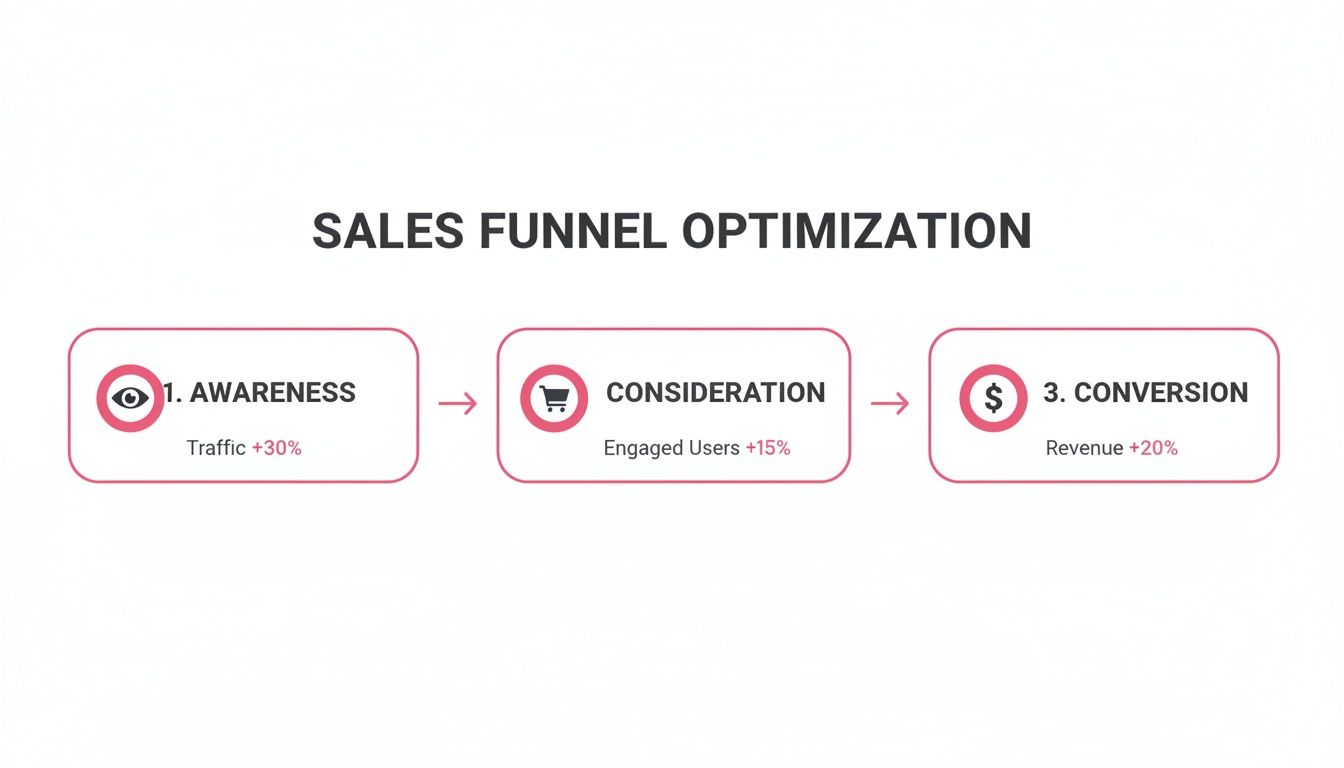
This flow shows how a customer moves from initial awareness to the final sale, highlighting the key transition points where your optimization efforts will have the biggest impact. If you’re looking for a great high-level strategy, this guide explains how to create a sales funnel that converts by effectively guiding customers through each stage.
The most powerful optimizations often come from small, consistent changes. You don’t need to tear down your entire funnel. Instead, focus on finding the single biggest point of friction and fix that first.
Key Pillars of Funnel Optimization
To really nail your sales funnel optimization, you need to be focused on a few key areas. Here’s a quick look at the e-commerce sales funnel stages and the primary goal you should focus on for each.
| Key Sales Funnel Stages and Their Core Goals |
| :— | :— | :— |
| Funnel Stage | Primary Goal | Key Metric to Track |
| Awareness | Attract relevant traffic | Impressions, Reach, CTR |
| Interest | Engage potential customers | Page Views, Time on Site |
| Consideration | Showcase product value | Product Page Views, Add to Carts |
| Conversion | Secure the sale | Conversion Rate, AOV |
| Loyalty | Encourage repeat business | Repeat Purchase Rate, CLV |
| Advocacy | Turn customers into fans | Reviews, Referrals, Social Shares |
Focusing on these distinct goals at each stage helps clarify your strategy and measure success more effectively. To get there, you’ll want to concentrate on these critical areas:
- Dive into the Data: Use your analytics to hunt down the drop-off points. Where are people leaving? A high bounce rate on a landing page or a massive cart abandonment rate are blinking red lights telling you where to look first.
- Obsess Over User Experience (UX): Make sure your site is a breeze to navigate, loads fast, and looks great on a phone. A clunky or confusing checkout process is one of the top killers of sales, period.
- Talk to People at the Right Time: Your messaging needs to match where the customer is in their journey. Awareness content should educate and inform. Consideration content needs to persuade and build trust. And post-purchase communication is all about building a long-term relationship. Our guide on conversion funnel optimization offers a much deeper dive into getting this process just right.
Attracting the Right Audience at the Top of Your Funnel
It’s easy to fall into the trap of thinking that more traffic is the answer to everything. But here’s the hard truth: pouring more visitors into a leaky funnel just burns through your ad spend. The real challenge—and the secret to a killer sales funnel—is attracting the right traffic from the very beginning.
This top-of-funnel (ToFu) stage is your first handshake. It’s where you make a strong impression on people who are actually looking for what you sell. When you get this part right, every other stage of the funnel just works better. The alternative? A sky-high bounce rate and a funnel clogged with people who were never going to buy anyway.
Pinpoint Your High-Value Traffic Sources
Your first job is to put on your detective hat and dig into your analytics. Not all traffic is created equal. A click from a highly targeted Google search ad is worlds away from a random visitor who stumbled onto your site from a viral TikTok.
Start by segmenting your traffic by channel in Google Analytics or whatever platform you’re using. Look past the vanity metric of total visitors. The numbers that really matter are:
- Bounce Rate: Which channels bring people who take one look and leave? That’s a massive red flag for a mismatch between their intent and your landing page.
- Pages per Session: Are visitors from certain sources clicking around and exploring your site? This signals genuine curiosity and interest.
- Average Session Duration: High-quality traffic sticks around. You want to identify the channels that deliver engaged users, not just fleeting clicks.
Once you know which channels bring in the most engaged users, you can reallocate your budget and double down on what’s actually working. For example, if you discover your organic search traffic converts at a much higher rate than paid social, it’s probably time to invest more heavily in your SEO and content strategy.
Align Your Messaging with User Intent
The top of the funnel is a conversation, and you absolutely have to nail the opening line. Your ad copy, headlines, and hero images need to sync up perfectly with the user’s intent—the “why” behind their search or click.
Think about it. Someone searching for “best running shoes for flat feet” is in a completely different headspace than someone typing in “Nike Air Zoom sale.” The first person needs educational, comparison-style content. The second is ready to see a product page with a big, shiny “Buy Now” button.
A classic mistake is sending every visitor to your generic homepage. Don’t do it. Instead, create dedicated landing pages that speak directly to the pain point or desire that brought them there. This one tweak can slash your bounce rates.
If you sell skincare, an ad targeting “acne solutions for sensitive skin” should click through to a page featuring products specifically for that issue, packed with testimonials and ingredients that address sensitivity. This creates instant trust and shows the visitor they’re in the right place.
Implement a Smart A/B Testing Framework
You can’t optimize what you don’t measure. A structured A/B testing framework is non-negotiable for dialing in your ToFu strategy. Stop making changes based on gut feelings and start testing one variable at a time to see what truly moves the needle.
Here are a few high-impact elements to start testing at the top of your funnel:
- Headlines: Try out different angles. Does a benefit-driven headline like “Get Flawless Skin in 30 Days” beat a question like “Struggling with Breakouts?”
- Ad Creative: Pit different images or videos against each other. Does a lifestyle shot of someone loving your product outperform a clean, product-only photo?
- Call to Action (CTA): Experiment with the wording. Does “Shop Now” convert better than “Explore the Collection” for a first-time visitor?
This methodical approach is how you move from guessing to knowing. Over time, these small, data-backed wins compound into a much more efficient funnel. And don’t forget to document everything. Studies show that sales funnels with documented processes can generate 2.3x more ROI than those without.
By getting a deep understanding of your audience, you can sharpen your targeting. Mastering different customer segmentation techniques is a powerful way to make sure your ads and content reach the people most likely to become your best customers, setting a rock-solid foundation for the rest of your funnel.
Turning Browsers Into Buyers in the Mid-Funnel
Once you’ve snagged a visitor’s attention, the real work begins. The middle of the funnel is where that casual curiosity needs to blossom into a genuine desire to buy. This is a delicate dance of persuasion and reassurance, and frankly, it’s where most sales are either won or lost.
If the top of the funnel was about making a great first impression, this stage is all about building a rock-solid case for your products. It’s your shot to show visitors not just what you sell, but why it’s the perfect solution for them. Nailing this part is the key to figuring out how to optimize your sales funnel for real results.
Crafting a Product Page That Actually Sells
Your product page is the heart and soul of your mid-funnel. Think of it less like a catalog entry and more like your best salesperson, working around the clock. To make it pull its weight, you need a killer combo of eye-catching visuals, convincing copy, and undeniable social proof.
- Compelling Visuals: Ditch the boring, static product shots. We’re talking high-resolution images from every conceivable angle, 360-degree views, and quick videos that show the product in action. If you sell clothes, show how the fabric drapes and moves. If it’s a tech gadget, give a quick demo of its coolest features.
- Persuasive Copy: Nobody wants to read dry, technical specs. Your job is to translate those features into tangible benefits. A “lithium-ion battery” becomes “all-day power so you never miss a moment.” Use bullet points to make the good stuff scannable and write a description that tells a story, helping the customer picture the product in their own life.
- Powerful Social Proof: Reviews aren’t just a nice-to-have; they’re non-negotiable. One study found that products with reviews see a 12.5% higher conversion rate. You need to feature a mix of star ratings and written testimonials right there on the page. Even better? User-generated content, like customer photos, adds a layer of authenticity that builds massive trust.
Building Unshakable Trust and Confidence
Hesitation is the ultimate conversion killer. Every single unanswered question or flicker of doubt adds friction that can stop a sale dead in its tracks. You have to get ahead of these concerns and build a fortress of trust around the buying decision.
Put yourself in the shoes of a skeptical buyer. Is this site secure? What if I hate it? Is returning it going to be a nightmare? Answering these questions before they’re even asked can make all the difference.
Don’t make people dig for your shipping and return policies. Slap them right on the product page where they can’t be missed. A transparent, easy return policy isn’t just a safety net; it’s a powerful way of saying, “We stand behind our product.”
Even simple additions like security badges (think McAfee Secure or Norton) near the “Add to Cart” button can instantly calm fears about payment security. It’s a small detail that reassures customers their info is safe with you.
Making Discovery Effortless
If a customer can’t find what they’re looking for fast, they’re gone. It’s that simple. An intuitive site navigation and a smart search function are your best friends in guiding users toward a purchase without them having to think too hard.
Your navigation menu should be dead simple and organized the way your customers actually shop, not based on your internal inventory system. Someone looking for “women’s summer dresses” shouldn’t have to click through a maze of sub-menus to get there.
Your on-site search is equally critical. It needs to handle typos, suggest related terms, and let people filter by size, color, price, or rating. A search bar that spits back “0 results” is a dead end that sends potential buyers running straight to your competitors.
Using Data to Find and Fix Friction Points
Optimizing this part of the funnel isn’t about guesswork; it’s about data. Tools like heatmaps are gold because they show you exactly how people are interacting with your pages. You can see what they’re clicking, how far they’re scrolling, and which parts they’re completely ignoring.
For instance, a heatmap might show you that nobody is clicking your “Product Specs” tab, but tons of people are trying to click a lifestyle photo that isn’t linked. That’s a huge, flashing sign to rethink your page layout and maybe make those popular images clickable or add them to a gallery.
The global e-commerce conversion rate hovers around 3.34%, but the top-tier stores are hitting over 11%. That massive gap is often closed by obsessing over the Add-to-Cart (ATC) stage, which has its own average rate of 7.52%. The stores that win are the ones constantly tweaking their product pages with clear CTAs, amazing images, and trust signals to smoothly guide visitors toward that checkout button. You can find more industry conversion rates on rockingweb.com.au.
By putting these tactics together, you create a mid-funnel experience that doesn’t just show off products—it actively guides, reassures, and persuades browsers to become buyers. To really dig into this, check out our guide on proven conversion rate optimization tips and start turning more of that traffic into revenue.
Closing Sales and Recovering Abandoned Carts

You’ve done it. You guided a potential customer all the way to the finish line—their cart is full, and they’re ready to buy. This final step, the bottom of the funnel (BoFu), is where all your hard work is supposed to pay off.
But it’s also the most fragile part of the entire journey. Even the slightest bit of friction here can make a shopper ditch their purchase, turning a near-certain sale into just another lost opportunity.
At this stage, your job isn’t about persuasion anymore. It’s about creating a frictionless, reassuring experience that makes it as easy as humanly possible for someone to give you their money.
Auditing Your Checkout Flow for Friction
Think of your checkout process as the express lane at the grocery store. Anything that slows a customer down—confusing forms, unexpected costs, or just too many steps—is a roadblock. A thorough audit is your first move to pave over these bumps.
The best way to start? Walk through your own checkout as if you were a brand-new customer. Even better, ask a friend who has never used your site to do it while you watch over their shoulder. Pay close attention to every single click and every form field.
- Guest Checkout is Non-Negotiable: Forcing users to create an account before they can buy is one of the biggest, most well-known conversion killers out there. Always offer a prominent guest checkout option. You can nudge them to create an account on the order confirmation page after the sale is locked in.
- Simplify Your Forms: Does your checkout form look like a tax return? Cut it down to the bare essentials. Do you really need their phone number right now, or is an email enough to get the order through? Every single field you remove makes the process feel faster and less intrusive.
- Be Transparent About Costs: Surprise shipping costs are the #1 reason for cart abandonment. Period. Show all costs, including shipping and taxes, as early as possible. A shipping calculator on the cart page is a fantastic way to build trust and get rid of those nasty last-second surprises.
The Power of Payment Diversity
In today’s market, just offering a credit card field isn’t enough. Customers expect flexibility. They want to use the payment method they trust and know best. Limiting their choices adds unnecessary friction and might just send them running to a competitor.
Your goal is to cater to a wide range of preferences. Beyond the standard Visa and Mastercard, think about integrating popular digital wallets.
- Digital Wallets: Services like PayPal, Apple Pay, and Google Pay are game-changers, especially on mobile, allowing for one-click payments.
- Buy Now, Pay Later (BNPL): Options like Klarna or Afterpay can give your conversions and average order value a serious boost, particularly for higher-ticket items.
- Local Payment Methods: If you sell internationally, take the time to research and offer the preferred payment methods in those specific regions.
Supercharging Revenue with SMS Cart Recovery
Even with a flawless checkout, cart abandonment is going to happen. The average cart abandonment rate still hovers around a staggering 70%. That’s a massive pile of lost revenue just sitting there.
This is where a proactive recovery strategy becomes your most powerful tool. And while email recovery is standard practice, SMS is the high-impact channel that can truly move the needle.
SMS messages have an open rate of over 98%, completely blowing away email’s average of just 20%. When you need to get a message in front of a customer quickly and reliably, nothing beats a text.
This is where a specialized tool becomes a critical part of your funnel optimization. Solutions like CartBoss automate the entire SMS recovery process. The system sends timely, personalized text messages to shoppers who left items behind, giving them a direct link to their pre-filled checkout page. No friction, no hassle.
Crafting the Perfect Recovery Message
The magic of your SMS campaign comes down to timing and messaging. You need to be prompt but not pushy, helpful but not intrusive.
We’ve found a simple, three-part sequence works wonders:
- The Gentle Nudge (30-60 minutes after abandonment): Send a simple reminder. Something like, “Hey [Name]! Looks like you left something behind. Your cart is saved and ready when you are: [Link]”
- The Helpful Offer (24 hours later): If they still haven’t come back, add a small incentive. “Still thinking it over? Complete your order now and get 10% off with code SAVE10. Your cart: [Link]”
- The Final Reminder (3 days later): Now it’s time to create a little urgency. “Last chance, [Name]! Your cart (and your 10% discount) expires soon. Don’t miss out: [Link]”
This kind of disciplined follow-up pays off. Companies that get this right generate 50% more sales-ready leads at a 33% lower cost.
By combining a frictionless checkout with a powerful, automated SMS recovery system, you can plug the biggest leak in your sales funnel. For a much deeper dive, check out our complete guide to recovering abandoned cart sales and start turning those almost-sales into real profit.
Building Lasting Loyalty After the Purchase
This is where so many brands drop the ball. They think the funnel ends the second a payment clears. But that’s a huge mistake. The transaction isn’t the finish line—it’s the starting pistol for building a real relationship.
This is your chance to turn a one-time buyer into a loyal fan who comes back again and again.
Ignoring what happens after the purchase is like spending a fortune to get someone in the door and then immediately showing them the exit. You’re leaving money on the table. The goal here is all about maximizing customer lifetime value (CLV) and creating a predictable revenue stream from the customers you’ve already worked so hard to win over.
Crafting a Memorable Unboxing Experience
The first time a customer physically interacts with your brand is when that box lands on their doorstep. This is your shot to make a real-world impression that a product page or a digital ad just can’t match. A thoughtful unboxing creates a “wow” moment that people remember—and more importantly, share on social media.
You don’t need a massive budget to make it special. It’s the little things that count:
- Branded Packaging: Even something as simple as custom tape or a branded sticker on a plain box makes it feel like a special delivery, not just another generic package.
- A Personal Touch: A handwritten thank-you note or a small, unexpected gift has a massive impact. It’s a reminder that there are real people behind the brand who appreciate their business.
- Clear Instructions: Don’t just include a boring manual. Design a nice-looking insert that explains how to use the product and maybe even shares a bit of your brand’s story.
Setting Up Smart Post-Purchase Automations
Once the package is delivered, the conversation shouldn’t just die out. A well-planned email or SMS follow-up sequence is your best friend for getting feedback, driving repeat purchases, and building a community.
Don’t just blast out a generic “Rate Your Purchase” email. That’s lazy. Instead, create a flow that gives them value first. Send a follow-up with tips on how to get the most out of their new product before you ask them for a review.
This simple shift builds goodwill and makes customers far more likely to respond when you finally make an ask. A solid sequence might look like this:
- Order Confirmation: Get the basics right, but inject some personality and excitement.
- Shipping Notification: Build anticipation and make tracking dead simple.
- Value-Add Content: Send tips, tutorials, or style guides related to what they bought.
- The Ask: Now you can request a review or a user-generated photo. You’ve earned it.
This kind of sequence transforms a simple transaction into the beginning of a real connection.
Turning Happy Customers into Powerful Advocates
Your happiest customers can be your most powerful marketing channel, period. The final piece of the loyalty puzzle is making it incredibly easy for them to spread the word. This usually involves a two-pronged attack that rewards both their loyalty and their advocacy.
First, a good loyalty program gives customers a real reason to shop with you again. Don’t just offer points. Get creative with tiered rewards, early access to new products, or exclusive content. Our guide breaks down exactly how to create a customer loyalty program that people actually want to be a part of.
Second, roll out a referral program that’s a complete no-brainer. Give customers a unique link and reward both them and their friend when a purchase is made. This creates a powerful, self-sustaining loop of new customers driven by your most passionate fans. When you nail these post-purchase strategies, you close the loop on your sales funnel, ensuring it doesn’t just generate sales but builds a thriving community.
Common Questions About Funnel Optimization
Even with the best playbook in hand, you’re going to have questions once you get into the nitty-gritty of funnel optimization. That’s just part of the process. Knowing how to fix your sales funnel is really about asking the right questions and constantly testing what you think you know.
Let’s dive into some of the most common questions I hear from store owners and clear up the confusion with some practical, no-fluff advice.
How Often Should I Analyze My Sales Funnel?
You should be keeping an eye on your key funnel metrics weekly, if not daily. A full-blown, deep-dive audit is fantastic to do every quarter, but your day-to-day operations require more frequent check-ins. It’s like driving a car—you don’t just check your speed once at the start of the trip; you glance at the dashboard constantly to make sure you’re on track.
The real magic happens with a rhythm of continuous, small-scale testing, not massive, infrequent overhauls. Your goal is to get a solid baseline and then consistently track performance against it. This is how you spot trends—both good and bad—the moment they start happening.
What Is a Good Conversion Rate for an Ecommerce Store?
Ah, the million-dollar question. The honest answer? It depends. You’ll see the global average thrown around—somewhere between 2-3%—but that number is almost useless on its own. It changes wildly depending on your industry, where your traffic is coming from, and how much your products cost. A high-ticket furniture store is playing a completely different game than a shop selling novelty phone cases.
A much smarter approach is to stop chasing vague global averages and start benchmarking against your own historical data. A 10% month-over-month improvement for your store is a far more powerful and meaningful goal to shoot for.
Which Part of the Funnel Should I Optimize First?
It’s always tempting to start at the very top of the funnel. More traffic, right? But that’s usually the least efficient place to start. The biggest gains almost always come from working from the bottom up.
Think about it this way: why would you pour more water into a leaky bucket? You plug the holes first.
- Checkout & Cart Recovery: Start here. This is the closest you get to the money. Fixing your checkout flow and setting up a solid cart abandonment strategy (like SMS recovery) offers the quickest and highest return on your effort.
- Product & Category Pages: Once you’ve plugged the biggest leaks at the bottom, move up the funnel. Focus on improving your product descriptions, images, and overall site navigation to make the shopping experience smoother.
- Traffic & Awareness: Now you can confidently spend money on driving more traffic. With a high-converting bottom-of-funnel, you know you’re set up to maximize the value of every single visitor.
If you want to dig deeper into specific funnel challenges and find more practical solutions, it’s always a good idea to explore resources like Branditok’s blog for sales and marketing insights.
Ready to plug the biggest leak in your sales funnel? CartBoss turns abandoned carts into profit on autopilot with powerful SMS campaigns. See how much revenue you can recover. Get started with CartBoss today.