


The ecommerce customer experience is the complete perception a shopper forms about your brand during their entire online journey. It’s every single touchpoint, from the first ad they see and how easy your site is to browse, all the way to the final unboxing of their order.
Put simply, it’s the overall feeling they get when they shop with you.
Why Your Ecommerce Customer Experience Matters
Think about walking into a physical store. If it’s bright, clean, and the staff are helpful, you feel good and you’re more likely to buy something. But if it’s a cluttered, confusing mess and you can’t find anyone to help, you’re walking right back out.
Your online store makes that exact same kind of impression. The quality of that impression is your ecommerce customer experience, and it’s not just some fluffy marketing concept—it’s a critical business driver that hits your bottom line, hard.
In a packed online marketplace, a standout CX isn’t just a “nice-to-have” anymore. It’s the main battleground where customer loyalty is won or lost. When your products and prices are similar to your competitors, the experience becomes the one thing that convinces a customer to choose you and, more importantly, to keep coming back.
The Business Impact of a Great CX
A positive experience builds trust and a real emotional connection, turning one-time buyers into loyal fans. On the flip side, a single moment of frustration—like a page that won’t load or a checkout that’s a pain to use—can send a potential customer straight to your competition in seconds.
The financial results are huge. Brands that focus on CX keep more customers, see a much higher lifetime value, and get the best kind of marketing there is: powerful, free, word-of-mouth recommendations.
A thoughtfully designed ecommerce customer experience does more than just satisfy customers; it creates a memorable journey that fosters loyalty and encourages them to become vocal supporters of your brand.
Personalization Is No Longer Optional
Today’s shoppers don’t just want to buy something; they expect a personal connection. They want brands to actually get them—to understand their needs and what they like. This isn’t just a hunch; the data backs it up.
Globally, a massive 80% of internet consumers say they prefer to buy from brands that offer personalized experiences. You can find more details about this shift in customer expectations in the full report from Invespcro. This trend is even stronger with younger shoppers, making it crystal clear that personalization is the future of online retail.
Creating a smooth, connected journey across all your touchpoints is the foundation. For a deeper dive into unifying these interactions, check out our guide on building an omnichannel customer experience.
The Five Stages of an Unforgettable Online Journey
A fantastic e-commerce customer experience isn’t a single moment; it’s a complete journey. Think of it like a five-act play where each scene builds on the last, turning a curious visitor into a loyal fan. To pull this off, you need to understand every stage and the unique chances it gives you to impress.
Breaking down this path lets you pinpoint exactly where things get clunky and where you can sprinkle in moments of delight. It’s all about seeing how simple interactions grow into meaningful experiences that build lasting loyalty.
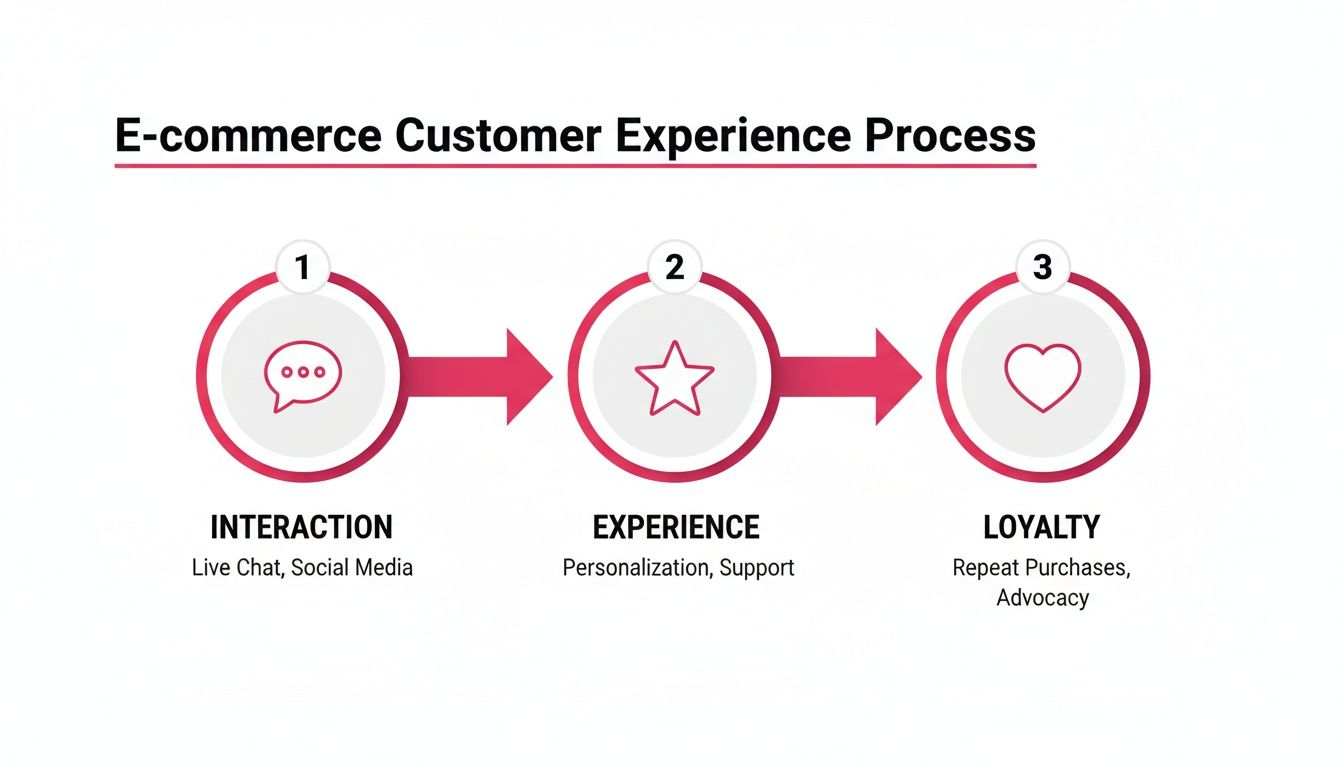
This flow shows that every single touchpoint matters. It all adds up to how the customer feels about your brand, which is why consistency across the entire journey is so important. Let’s walk through the five critical stages that define this online voyage.
Stage 1: Website Usability and Design
Your website is your digital storefront, and you only get one chance to make a first impression. If a customer lands on a page that’s slow, confusing, or looks broken on their phone, they’re gone. They won’t stick around to see how amazing your products are. This first stage is the bedrock of the entire experience.
Getting this right comes down to a few non-negotiables:
- Intuitive Navigation: Can people find what they’re looking for in just a few clicks? You need a clear menu, logical categories, and a search bar that actually works.
- Lightning-Fast Load Times: Every single second counts. A slow site feels unprofessional and is just plain frustrating, causing visitors to bounce immediately.
- A Flawless Mobile View: The world shops on mobile now, period. With the global e-commerce market expected to hit $7.4 trillion by 2025 and mobile devices driving around 60% of sales, you can’t afford to mess this up. A bad mobile interface is a major deal-breaker for 52% of shoppers, making a responsive, mobile-first design absolutely essential.
Stage 2: The Checkout Process
The checkout is where you turn browsing into revenue, but it’s also where most brands lose customers. A clunky, complicated, or sketchy-looking checkout process is the ultimate conversion killer. The goal is to make this step feel almost invisible.
Think of it as the final sprint in a race; you don’t want to trip right at the finish line. Offer a guest checkout option, show off security badges to build trust, and provide multiple payment methods like digital wallets. Every step should be simple, clear, and fast.
Stage 3: Hyper-Personalization
Once a customer is on your site and clicking around, you have a golden opportunity to make their experience feel like it was made just for them. Hyper-personalization uses data to show shoppers that you get them, transforming a generic shopping trip into a one-on-one consultation.
This is way more than just using their first name in an email. It’s about:
- Smart Product Recommendations: Showing items based on their browsing history, past buys, or what other similar customers loved.
- Tailored Offers and Content: Displaying promos or banners that are actually relevant to who they are.
- Personalized Search Results: Bumping up search results based on a user’s favorite brands or price point.
Stage 4: Proactive Customer Support
Even with a perfect website, people will have questions or run into problems. How you handle these moments says everything about your brand. Modern customer support isn’t about sitting back and waiting for things to break; it’s about being proactively helpful.
This means making support easy to find and super efficient. Offer live chat for instant answers, build out a detailed FAQ or knowledge base for self-service, and make sure your team responds quickly on every channel. When customers feel like you’ve got their back, their confidence in your brand skyrockets.
Stage 5: The Post-Purchase Experience
The journey isn’t over once they click “buy.” In fact, the post-purchase phase is where you turn a one-time buyer into a repeat customer for life. This is your chance to make them feel great about their decision and build a real relationship.
A strong post-purchase experience includes clear shipping updates, a no-headache returns process, and follow-up communication that offers value, not just another sales pitch.
Each of these stages is a critical piece of the puzzle. To really see the big picture, it helps to visualize these steps through detailed ecommerce customer journey mapping. By nailing every touchpoint, you create an unforgettable online journey that keeps people coming back for more.
How to Measure Your Ecommerce CX Success
Trying to improve your customer experience without data is like driving blind. You might be moving, but you have no clue if you’re headed in the right direction. To really get a handle on your ecommerce CX, you have to measure it.
The right metrics are what turn vague ideas like “customer happiness” into hard numbers you can actually track and improve upon. They shine a light on friction points, show you what’s working, and most importantly, prove the ROI of your efforts. Think of them as the vital signs for your business—they tell you exactly how healthy your customer relationships are.
Essential Ecommerce CX Metrics and Their Meaning
To get started, you need to know which numbers actually matter. This table breaks down the most critical KPIs, how to calculate them, and what they really tell you about your customer experience.
| Metric (KPI) | How to Measure It | What It Tells You |
|---|---|---|
| Customer Satisfaction (CSAT) | Ask “How satisfied were you with [interaction]?” on a 1-5 scale after a specific event (e.g., checkout, support ticket). | Measures in-the-moment happiness at key touchpoints. High scores mean you’re meeting expectations. |
| Net Promoter Score (NPS) | Ask “How likely are you to recommend us to a friend?” on a 0-10 scale. Subtract % Detractors from % Promoters. | Gauges long-term brand loyalty and customer sentiment. It’s a big-picture health check. |
| Customer Effort Score (CES) | Ask “How easy was it to get your issue resolved?” on a scale from “Very Difficult” to “Very Easy.” | Reveals friction. A low-effort experience is a massive driver of repeat business and loyalty. |
| Customer Lifetime Value (CLV) | (Average Order Value) x (Purchase Frequency) x (Average Customer Lifespan). | Predicts the total revenue you’ll earn from a single customer. Great CX directly increases this number. |
| Cart Abandonment Rate | (1 – [Completed Purchases / Carts Created]) x 100. | Shows the percentage of shoppers who add items to their cart but don’t buy. It’s a direct signal of checkout friction. |
These KPIs give you a powerful dashboard to see where your CX strategy is winning and where it needs work. They take the guesswork out of the equation.
Key Performance Indicators for Customer Experience
Instead of just guessing what customers want, tracking the right Key Performance Indicators (KPIs) gives you direct feedback. This is how you find the opportunities that will have the biggest impact.
There are three classic survey metrics that form the foundation of any good CX measurement plan:
- Customer Satisfaction (CSAT): This is your on-the-spot check-in. You ask customers to rate their satisfaction with a single interaction, like after they talk to support or finish buying something. A high score means you nailed that specific touchpoint.
- Net Promoter Score (NPS): This one is all about long-term loyalty. It’s based on the simple question: “How likely are you to recommend us to a friend?” This score separates your biggest fans from those who might be detractors, giving you a clear view of your overall brand health.
- Customer Effort Score (CES): CES asks, “How easy was it to do business with us?” Customers hate jumping through hoops. A low effort score is one of the strongest predictors of whether they’ll come back.
Tying CX Metrics to Business Outcomes
Satisfaction scores are great, but they become truly powerful when you connect them to real business results. This is how you show everyone, from the marketing team to the CEO, that a great customer experience makes the company more money.
Two of the most important metrics for this are Customer Lifetime Value (CLV) and Cart Abandonment Rate. A higher CLV means your customers are sticking around longer and spending more. Improving CX is one of the most direct ways to boost this number.
A rising Cart Abandonment Rate is a huge red flag. It tells you there’s friction somewhere in your buying process—maybe it’s surprise shipping costs, a clunky form, or a technical bug. These are CX problems that are costing you sales right now.
When you watch these numbers together, you create a feedback loop. For instance, if you see CSAT scores drop after checkout and cart abandonment goes up at the same time, you know exactly where to focus your attention. For a deeper dive, check out this guide on mastering customer retention metrics.
Ultimately, solid measurement turns CX from a fluffy concept into a predictable way to grow revenue. To get the full picture, it’s worth understanding the complete set of ecommerce metrics to track so you can build a comprehensive dashboard for your store.
Actionable Strategies to Elevate Your Customer Experience
Alright, you understand the customer journey and you’re measuring the right things. Now for the fun part: putting those insights into action.
The best e-commerce customer experiences don’t just happen. They’re carefully built with a playbook of proven tactics that solve customer problems before they even start, making every single interaction feel smooth, helpful, and personal. This is where we shift from planning to doing.
Let’s break down the high-impact strategies top brands use to create experiences that customers actually love.
Deploy Proactive and Instant Support
In today’s world, nobody likes to wait. For an online shopper, waiting for customer support is a major deal-breaker, and a short delay is all it takes to send them straight to your competitor.
Expectations have shot through the roof. Nearly one-third of online shoppers expect a response within an hour, and a whopping 38% anticipate immediate support. Offering instant, 24/7 help isn’t just a nice-to-have anymore—it’s absolutely essential. You can see more on this in this detailed eDesk report.
To keep up, smart brands are using a powerful mix of human and automated support:
- Proactive Live Chat: Don’t just sit back and wait for a customer to get stuck. A live chat widget can pop up with a simple, “Have questions about sizing? I’m here to help!” This shows you’re paying attention and can clear up doubts before they turn into an abandoned cart.
- AI-Powered Chatbots: For those late-night questions or common queries, AI chatbots are a lifesaver. They can instantly handle things like order status, return policies, or product details, which frees up your human agents to tackle the trickier problems.
Master the Mobile Shopping Experience
Your website might be a masterpiece on a desktop, but if it’s a clunky, slow mess on a smartphone, you’re kissing a huge chunk of your audience goodbye. The mobile experience isn’t just a shrunken version of your desktop site; for many people, it’s the only way they shop.
This means you need to obsess over every little detail of the mobile journey. Your site has to be lightning-fast, with a responsive design that looks perfect on any screen. Buttons need to be easy to tap, images must load in a flash, and text should be readable without any awkward pinching and zooming.
The gold standard for mobile is a one-handed checkout. If a customer can find a product, add it to their cart, and pay for it using just one thumb, you’ve officially nailed it.
Create Engaging Post-Purchase Journeys
The customer’s journey is far from over when they click “Buy.” In fact, the post-purchase phase is your golden opportunity to build a real relationship and turn a one-time buyer into a loyal fan for life. A boring, generic “Your order has shipped” email is a massive missed opportunity.
Instead, create a branded, exciting experience that keeps the customer hyped about their purchase. Think about things like:
- Branded Tracking Pages: Stop sending customers to a bland UPS or FedEx page. Build your own tracking page that keeps your brand front and center, maybe even suggesting other products or sharing helpful content while they wait.
- Personalized Follow-Up Emails: Send emails that actually add value. This could be a guide on how to get the most out of their new product, some styling tips, or a simple request for feedback that shows you genuinely care what they think.
A solid post-purchase strategy confirms they made the right choice and makes them feel like part of your community. For a closer look at more tangible methods, you can explore these practical strategies to improve ecommerce conversion rates.
Recover Lost Sales with SMS Cart Recovery
One of the most direct and powerful ways to improve both your customer experience and your revenue is by tackling cart abandonment head-on. People leave items in their cart for a million different reasons, but a quick, personal reminder is often all it takes to bring them back to finish the job. This is where SMS really shines.
Email inboxes are a warzone, but text messages cut right through the noise with an insane 98% open rate. That makes SMS an incredibly effective tool for recovering sales that would otherwise just disappear.
Here’s how a smart SMS cart recovery flow works:
- A shopper abandons their cart. Life happens—they get distracted or have second thoughts.
- CartBoss sends an automated SMS. After a strategic delay, a friendly, personalized text lands on their phone.
- The message includes a direct link. This link takes them straight back to their pre-filled checkout, making it ridiculously easy to complete the purchase.
- A little incentive helps. A simple message like, “Still thinking it over? Here’s 10% off to help you decide!” can be the final push they need.
This isn’t just about clawing back revenue; it shows your customer you’re paying attention and that you value their business. For more ideas on how to craft the perfect message, check out these powerful ecommerce personalization examples.
By putting these strategies into play, you can transform your site from just another online store into a place customers trust, love, and keep coming back to.
Your 4-Phase Checklist for a Full CX Overhaul
Alright, you’ve gathered the insights, you know what needs to change… but where do you actually start? Turning a plan into reality can feel like staring up at a mountain. It’s easy to get paralyzed.
This is your blueprint. We’re going to break down a complete customer experience overhaul into a manageable, four-phase process. Think of it as your step-by-step guide from good intentions to real, measurable results.
The four phases are simple: Audit, Strategize, Implement, and Measure.
Phase 1: Audit Your Current Experience
Before you can build anything better, you need a painfully honest look at where you are right now. The audit phase is all about walking in your customer’s shoes through every single touchpoint, from the first ad they see to the follow-up email they get after a purchase.
Your goal is to find every single point of friction.
Start by mapping the real customer journey—not the one you think they follow. Use analytics, heatmaps, and session recordings to see where people actually click, get stuck, and give up.
Your audit should answer a few key questions:
- Website Navigation: Can a first-time visitor figure out how to find what they want? Is the search bar actually helpful, or does it just spit out junk?
- Mobile Usability: How does the site feel on a phone? Can someone actually check out with one hand while holding a coffee?
- Checkout Flow: How many clicks does it take to give you money? Are there nasty surprises like high shipping costs or forced account creation?
- Customer Support: How long does it take to get a real answer from a real person? Is your FAQ page just a wall of text nobody reads?
This process gives you a “friction log”—a concrete, evidence-backed list of problems that are actively hurting your customer experience and costing you money.
Phase 2: Strategize for Maximum Impact
With your friction log in hand, it’s easy to feel overwhelmed. You can’t fix everything at once, and you shouldn’t try. The strategy phase is about being ruthless with your priorities. You want the biggest wins for the least amount of work.
This is where an impact/effort matrix comes in handy. For every problem you found in the audit, ask two simple questions:
- How much impact will fixing this have on the customer and our bottom line?
- How much effort (time, money, people) will it take to fix it?
The goal is to find your “quick wins”—the high-impact, low-effort tasks. For example, clarifying a confusing button in your checkout is often a low-effort fix that can immediately bump up conversions. That’s a much smarter first move than a massive, six-month site redesign.
This helps you build a realistic roadmap. You’ll tackle the quick wins first to get some momentum and immediate results, then you can plan for the bigger projects, like launching a new personalization engine or totally overhauling your returns process.
Phase 3: Implement Key Initiatives
Now it’s time to get your hands dirty and start building. This phase is all about turning your roadmap into reality. Depending on your priorities, this could be anything from a few technical tweaks to launching brand-new marketing campaigns.
A perfect example of a high-impact initiative is setting up an SMS cart recovery flow. This directly attacks one of the biggest friction points for any online store: cart abandonment.
The steps for something like this are pretty straightforward:
- Choose a Tool: Pick an SMS platform that plays nicely with your e-commerce store.
- Craft Your Messages: Write short, friendly reminders that are actually helpful. Always include a direct link back to their pre-filled cart to make it ridiculously easy for them.
- Set Up Automation: Define the timing. When do the messages go out? This is crucial for hitting that sweet spot where a reminder is helpful, not annoying.
- Test and Launch: Run a few tests to make sure the whole thing works flawlessly before you flip the switch for all your customers.
Whether it’s SMS, a new live chat widget, or better product pages, the key is to have a clear, documented process for every initiative you roll out.
Phase 4: Measure and Refine
Finally, you have to close the loop. This is where you connect all your hard work back to the business KPIs we talked about earlier. This is how you prove that the changes you made are actually making a difference.
For every single thing you launched, track the right metrics. If you set up SMS cart recovery, you better be watching your cart abandonment rate and the revenue recovered directly from those texts. If you redesigned product pages, keep an eye on the conversion rate and how long people are spending on the page.
This isn’t about creating a one-time report to pat yourself on the back. It’s an ongoing feedback loop. The data will tell you what to do next. Maybe your SMS messages need different timing, or your new FAQ section needs more articles. Constant measurement and refinement are what turn a one-off project into a true culture of customer-centric improvement.
Got Questions About Ecommerce CX? We’ve Got Answers
Even with a solid plan, improving your customer experience can throw some curveballs your way. Let’s tackle some of the most common questions brands have, with practical answers to help you move forward.
What Is the Single Most Important Aspect of Ecommerce CX?
If you have to pick just one thing, it’s the user experience (UX) of your website. Everything else builds on this foundation. This is especially critical for mobile, where most people are shopping these days.
Think about it: if a visitor can’t easily find what they’re looking for, understand the product details, or figure out your checkout, all your other efforts are for nothing. Your website is the front door to your business. If the door is locked or stuck, it doesn’t matter how great the stuff is inside. A clunky website is the fastest way to lose a sale and a customer.
How Can a Small Business Improve CX on a Tight Budget?
You absolutely don’t need a huge budget to make a big impact. The trick is to focus on low-cost, high-impact activities that show customers you care and make their lives easier.
Here are a few powerful places to start:
- Just Listen: Use simple, free tools like email surveys or polls on social media to ask customers what they really think. Their feedback is a goldmine for finding quick wins.
- Beef Up Your Product Pages: Invest time, not money, in writing clear, benefit-driven product descriptions. Grab your smartphone and take high-quality photos that leave no room for doubt.
- Be Insanely Responsive: A fast, friendly, and helpful reply to an email or social media message can turn a frustrating moment into a loyal fan. Speed and a good attitude cost nothing.
- Simplify Your Checkout: One of the biggest improvements you can make is cutting out unnecessary fields or steps at checkout. A smoother flow directly boosts conversions without costing you a dime.
How Is Personalization Different from Customization?
This one trips a lot of people up, but the difference is actually pretty straightforward.
Customization is when the user is in the driver’s seat. They are actively making choices to tailor their own experience—like picking a T-shirt color or using filters to search by size.
Personalization, on the other hand, is when your system does the work for the user. It automatically and proactively adapts the experience based on their past behavior, essentially anticipating their needs before they even ask.
For example, when a returning visitor lands on your homepage and sees a banner featuring the exact product category they were browsing last time—that’s personalization. It makes the whole experience feel curated and smart, which is a powerful way to drive engagement and sales.
Getting this distinction right is key to building a truly intelligent ecommerce experience. By analyzing shopper behavior, you can create a journey that feels like it was made just for them. To really dig into this, you can learn more about what customer journey analytics is and see how it fuels these powerful strategies.
Ready to turn abandoned carts from a problem into your biggest revenue source? CartBoss uses the power of automated SMS to bring customers back and recover sales on autopilot. Stop losing money and start converting more visitors today. Discover how CartBoss can boost your sales now!