


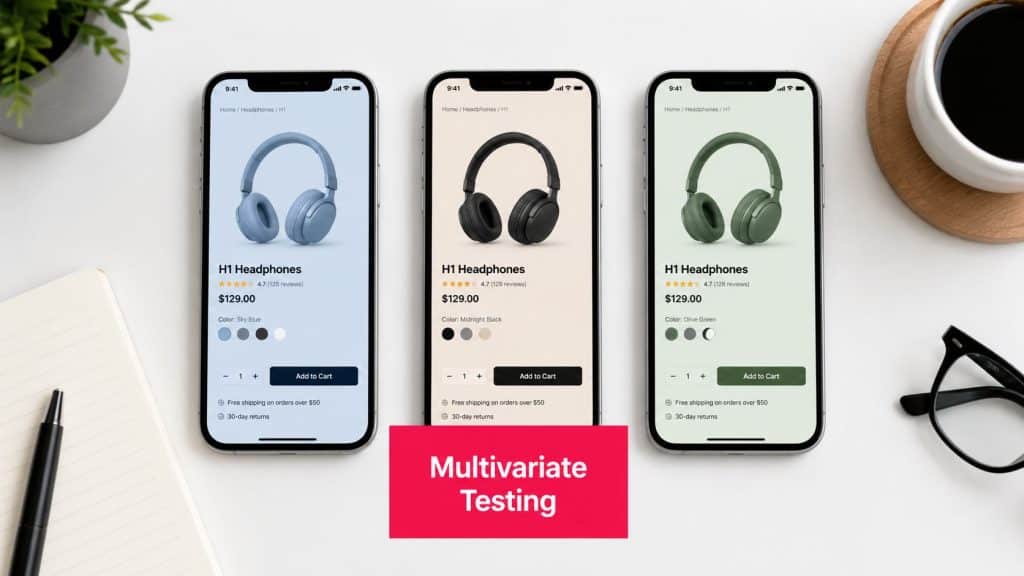
You’ve probably had this happen on a product page or checkout step. You test one change, get a win, then test a second change and the result goes sideways. The obvious conclusion is that the second idea was bad. The less obvious one is that the two changes needed each other.
That’s where many e-commerce teams hit the limit of simple split tests. A headline can work with one offer and fail with another. A discount message can help in email but weaken an SMS if the wording and timing don’t match. The problem isn’t always the element. It’s the combination.
For store owners trying to recover more carts, improve opt-in, and increase revenue from the same traffic, multivariate testing can be the right next step. It’s not beginner mode. It’s not a shortcut. But on the right flow, especially in SMS cart recovery, it can uncover patterns that single-variable tests miss.
Beyond A/B Testing Finding Your Winning Formula
A/B testing is great when you want a clean answer to one question. Should the button say “Complete Order” or “Return to Cart”? Should the first SMS be short or detailed? Should the discount appear in the first message or later?
Those are valid tests. They’re also limited.
When several elements influence the same outcome, running isolated tests can lead you into false confidence. You might keep the best headline from one test and the best CTA from another, then combine them and get a weaker result. That happens because user response is contextual. Buyers don’t experience your message one piece at a time. They experience the full sequence.
Where simple testing breaks down
Multivariate testing is built for that problem. Instead of asking which single change wins, it asks which mix of changes produces the strongest result.
A classic example is a page or message flow with multiple moving parts:
- Headline: One direct option and one benefit-driven option
- Visual or offer cue: Different framing for urgency or value
- CTA: Two ways to ask for the click or purchase
Once you test several variables at once, the math expands fast. If you test three elements with two variations each, you get 2×2×2 = 8 unique combinations, and each combination needs enough traffic to reach significance, as explained in The Decision Lab’s multivariate testing overview.
That’s the trade-off. Better insight, heavier traffic demand.
Practical rule: Use multivariate testing when you suspect elements are interacting, not when you’re still trying to prove a basic idea.
For most stores, the best path is simple. Start with high-impact A/B tests. Clean up the major leaks. Then use multivariate testing on the flows that already matter most, such as cart recovery and checkout. If you need a broader foundation first, this guide to e-commerce conversion rate optimization is a solid place to tighten the basics.
What Is Multivariate Testing Exactly
Think of A/B testing like baking two cakes with one ingredient changed. Same recipe, different flour. You taste both and pick the better one.
Multivariate testing is different. Now you’re testing the flour, the sugar, and the baking time together. You’re not just asking which ingredient is best on its own. You’re trying to find the recipe that produces the best cake.
That’s why multivariate testing is useful for e-commerce. Buyers respond to complete experiences, not isolated pieces.

The three terms that matter
You don’t need heavy statistics language to use MVT well. You need three practical terms:
| Term | What it means in plain English | E-commerce example |
|---|---|---|
| Element | The thing you want to test | Headline, hero image, CTA, send time |
| Variation | One version of that element | “Finish your order” vs “Your cart is waiting” |
| Combination | One complete mix of all selected variations | Headline A + Image B + CTA A |
That last part is where the power sits.
Unlike A/B tests that compare one change against a control, MVT examines all possible combinations of several variables. For example, two headlines, three images, and two call-to-action buttons create 2 × 3 × 2 = 12 page variations, as outlined in VWO’s explanation of multivariate testing.
Why that matters in practice
On a store page, the interaction might be between trust copy, urgency, and button text.
In SMS cart recovery, the interaction could be between:
- Timing: When the first message sends
- Offer framing: Discount, shipping, or no incentive
- CTA wording: Soft reminder versus direct checkout push
A buyer may ignore an urgent message sent too early but respond well to the same urgency later. A helpful tone may work better with no discount, while a stronger CTA may work better when an incentive is present. That’s not random. It’s interaction.
If you want a refresher on the simpler starting point before moving into MVT, CartBoss has a straightforward article on what split testing is.
Multivariate testing isn’t just “more tests at once.” It’s a way to learn whether one choice changes the effect of another.
A/B Testing vs Multivariate Testing When to Choose Each
Most stores don’t need multivariate testing all the time. In many cases, A/B testing is the better tool because it’s faster, cleaner, and easier to trust.
The right question isn’t which method sounds more advanced. It’s which method fits the page, the traffic, and the business goal.

Use A/B testing when you need a direct answer
A/B testing is usually the right move in these situations:
- Low-traffic pages: You don’t have enough sessions or conversions to spread across many combinations.
- Big redesigns: You’re comparing one complete version against another.
- Single strong hypothesis: You believe one major change is doing most of the work.
- Fast decision cycles: You need a clear go or no-go answer without a lot of analysis.
If your team is still building testing discipline, Gorilla’s A/B testing guide is a useful primer because it keeps the process grounded in practical marketing decisions.
Use multivariate testing when interaction matters
MVT earns its place when you’ve already narrowed the problem. The page or flow already works reasonably well. Now you’re tuning the details that influence each other.
That usually applies to:
- Checkout pages
- Cart recovery flows
- Pricing pages
- High-value opt-in steps
Combinations can reveal something that sequential A/B tests miss. Academic and industry experiments have shown that multivariate campaign optimization for online ads yielded up to a 20–30% lift in click-through rates when combinations were tuned jointly, versus sequential A/B tests that altered only one element at a time, according to the summary in Wikipedia’s multivariate statistics entry.
That doesn’t mean every store will see that kind of outcome. It means combination effects are real, and in the right environment they can matter.
A simple decision filter
Use this checklist before choosing your method:
-
Is the goal broad or narrow?
Broad goal, like “try a new page concept,” usually points to A/B. Narrow goal, like “optimize the exact mix of message timing and CTA,” points to MVT. -
Do you have enough traffic?
If traffic is limited, MVT becomes slow and noisy. -
Are the variables likely to influence each other?
Headline plus button text often interacts. So do SMS timing plus offer plus urgency. -
Can your team analyze a more complex result set?
A/B gives a simpler answer. MVT gives a deeper one, but only if someone reads it correctly.
| Situation | Better choice | Why |
|---|---|---|
| Testing one major change | A/B testing | Cleaner result, faster read |
| Tuning a mature checkout | Multivariate testing | Combinations likely matter |
| Low traffic or few conversions | A/B testing | Less traffic split |
| SMS sequence with several interacting variables | Multivariate testing | Timing, offer, and CTA can amplify or weaken each other |
If you’re unsure, default to simplicity. That’s especially true if you haven’t done the traffic math yet. CartBoss has a practical breakdown of sample size determination that helps prevent launching a test that can’t produce a trustworthy answer.
Planning Your First Multivariate Test Step by Step
A bad multivariate test wastes time, traffic, and confidence. A good one starts narrow.
The biggest mistake I see is choosing too many variables because the platform makes it easy. That’s how merchants end up testing everything and learning nothing. Keep the design tight, choose only the most important elements, and define success before launch.
Start with a single business goal
Pick one outcome.
For e-commerce, strong examples include:
- Increase recovered carts
- Improve SMS opt-in completion
- Raise checkout completion rate
- Reduce abandonment after discount reveal
Avoid vague goals like “improve engagement.” A test needs a finish line.
To map the process clearly, use this planning visual:

Build a hypothesis around interaction
Don’t just list random things to try. Write a hypothesis that explains why the elements may work together.
Examples:
- A more urgent CTA may perform better when paired with a time-sensitive discount.
- A helpful tone may work better when the first SMS sends later.
- A shorter message may outperform when the checkout link is prominent.
That gives the test a purpose beyond “let’s see what happens.”
Don’t test everything you can. Test the few variables most likely to change buyer behavior at the same moment.
Limit the number of variables
Here, discipline matters.
A practical first test often includes only:
- Send timing
- Offer framing
- CTA wording
That already produces multiple combinations. And traffic demand climbs quickly. Industry benchmarks indicate that typical MVT designs require 5–10× more traffic per test combination compared to a simple A/B test to achieve acceptable power. If an A/B test needs 10,000 visitors per variant, an 8-combination MVT could require 40,000–80,000 total visitors, based on Mixpanel’s comparison of A/B and multivariate tests.
That’s why most stores should start small.
Pre-flight checklist before launch
Use this short checklist before turning the test on:
- Goal locked: One primary metric only
- Variables trimmed: No vanity elements
- Variations written clearly: Each version should feel intentionally different
- Tracking confirmed: Every combination must map to revenue or recovery outcome
- Traffic reality checked: Make sure the test can finish in a useful timeframe
A short explainer can also help your team get aligned before setup:
What works and what doesn’t
What works
- Testing high-impact variables only
- Using MVT on mature, high-volume flows
- Writing versions that reflect distinct messaging strategies
What doesn’t
- Adding color, layout, tone, timing, and incentive all at once
- Running MVT on low-traffic pages
- Starting a test without a sample-size plan
If your setup still feels shaky, go back and simplify. You’ll get more revenue from one well-scoped test than from a “smart” experiment that never reaches a reliable conclusion.
Analyzing Results and Avoiding Common Pitfalls
A multivariate test can look finished before it’s actually trustworthy. That’s where teams get burned.
You’ll usually see a dashboard with a leading combination. The trap is assuming the top line equals the truth. In multivariate testing, the winning combination matters, but so does the reliability of that win.
What to look at first
When the test ends, analyze results in this order:
-
Winning combination
Which complete mix produced the best business outcome? -
Main effects
Which individual element tended to help across combinations? -
Interaction patterns
Did one variation only work when paired with another?
That third point is the whole reason to run MVT. If the best CTA only wins with a specific offer framing, you’ve found a usable insight.
The three mistakes that break good tests
Here are the most common ways stores ruin the read:
- Peeking too early: You check daily, see a leader, and mentally crown it before the data settles.
- Testing too many combinations: Traffic gets diluted and every result looks shaky.
- Ignoring multiple comparisons: The more combinations you compare, the easier it is to fool yourself with a false winner.
That last point matters more than is commonly understood. To avoid false positives when running an MVT with many combinations, practitioners often apply a Bonferroni correction. For a test with 10 combinations, the significance threshold should be reduced from 0.05 to 0.005 to keep the overall false-positive rate near 5%, as explained in Improvado’s multivariate testing guide.
More combinations mean more chances to be accidentally impressed by noise.
A simple way to think about significance
Treat each comparison like a separate bet. If you place more bets, you need a stricter standard before claiming you’ve found a real winner.
That’s why weakly separated results should make you cautious, not excited.
Use this quick review checklist:
- Did the test run to the planned sample?
- Was the winner stable near the end, not just early?
- Does the result still make sense from a buyer psychology perspective?
- Can you explain why the combination won?
If the answer to most of those is no, don’t ship fast. Re-test or simplify.
For teams that need a better handle on this side of experimentation, CartBoss has a clear primer on statistical significance. It’s worth reviewing before you call any MVT a success.
Real-World Example Testing an SMS Cart Recovery Flow
Most multivariate testing articles stop at webpages. That leaves a major blind spot for stores that recover revenue through text messages.
Existing MVT content often fails to explain how to apply these principles to cart-recovery journeys, where multiple variables like message timing, discount level, and CTA wording interact. This is a critical gap for businesses with high cart abandonment, as noted in Nielsen Norman Group’s article on multivariate testing.
That gap matters because SMS is full of combination effects. The same message can feel helpful, pushy, or irrelevant depending on when it arrives and what it asks the buyer to do.

A practical MVT setup for SMS recovery
Say a clothing store wants to optimize the first recovery text after cart abandonment.
It chooses three elements:
| Element | Variation A | Variation B |
|---|---|---|
| Timing | 30 minutes | 60 minutes |
| Offer | 10% off | Free shipping |
| Tone | Urgent | Helpful |
That creates 8 combinations.
Examples of what those messages might look like:
-
30 min + 10% off + urgent
Your cart is still active. Complete your order now and use your discount before it’s gone. -
30 min + free shipping + helpful
You left something behind. Return to your cart and finish your order with shipping included. -
60 min + 10% off + helpful
Still deciding? Your cart is saved, and your discount is ready when you are. -
60 min + free shipping + urgent
Your items are waiting. Come back now and finish checkout with shipping included.
What this test can reveal
A standard A/B test might tell you that free shipping beats a discount. Useful, but incomplete.
A multivariate test might show something more valuable:
- Free shipping works best with a helpful tone
- A discount works better with urgency
- The earlier send performs well only when the CTA is direct
- The later send reduces friction when the copy feels supportive
That changes how you build the whole recovery sequence.
The best SMS isn’t always the strongest offer. Often it’s the offer, the timing, and the tone lining up with the buyer’s moment.
If you’re working on the broader strategy around text-message recovery, this article on using abandoned cart recovery text messages to optimize checkout adds useful context before you test combinations.
Your Next Steps in Smarter Testing
Multivariate testing is powerful, but it isn’t where most stores should start. It works best after you already know your main conversion path, your tracking is clean, and your cart recovery flow is generating enough data to test combinations with confidence.
If that foundation isn’t in place yet, focus there first. Build a reliable recovery system. Prove the basic message, offer, and timing structure with simple tests. Then graduate to multivariate testing on the flows where every improvement can increase recovered revenue.
For teams that like working from structured worksheets and validation frameworks, Business Model Analyst testing tools can help you document assumptions before you run more advanced experiments.
The smartest path is simple. Get the basics performing first. Then use multivariate testing where interaction effects are likely to pay you back.
If you want to recover more abandoned carts before moving into advanced experimentation, CartBoss gives you a strong foundation with automated SMS cart recovery, detailed analytics, compliance-friendly messaging, and revenue-focused workflows that help turn lost checkouts into completed orders.