


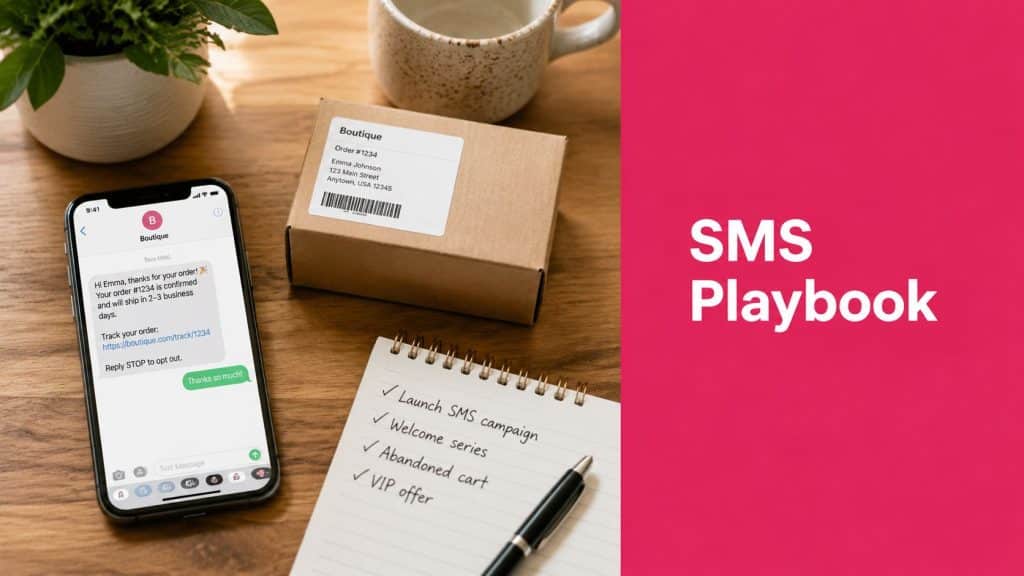
In 2026, 85.6% of consumers were opted in to receive business texts, according to SimpleTexting’s SMS marketing statistics. That changes the SMS list-building question. The challenge isn’t convincing people that business texting exists. It’s acquiring subscribers who understand what they’re joining, stay opted in, click, buy, and remain reachable.
A large list can hide weak acquisition. A smaller audience collected at checkout, after purchase, or during cart recovery often gives you cleaner consent and stronger purchase intent. The operating principle is simple: build an SMS list for downstream value, not vanity volume.
Table of Contents
- Why SMS List Building Matters More in 2026
- On-Site Capture That Converts Without Annoying Visitors
- Off-Site and Offline Channels That Keep Growing Your List
- Choosing Incentives That Attract Buyers Not Freebie Hunters
- Consent Language and Compliance You Can Copy
- Welcome Flows and Cart Recovery That Pay Back the List
- Segmentation Tagging and the Metrics That Matter
Why SMS List Building Matters More in 2026
SMS list building has moved from an experimental growth tactic into a mainstream customer-communication channel. The same industry survey reported that 84% of consumers had opted in to business texts in 2025, compared with 85.6% in 2026, and described the 2026 figure as nearly 40% growth versus 2021 (SimpleTexting). The source also reported rounded figures of 84% in 2025 and 86% in 2026, reinforcing the broader direction: consumer willingness to receive brand texts is expanding rather than plateauing.
That adoption creates a quality problem. Customers may accept SMS, but they still expect a clear reason to subscribe, relevant messages, and an easy way to stop receiving them. Text is highly visible, so vague consent and excessive frequency can damage trust faster than a weak email campaign.
The legal foundation matters too. The U.S. Telephone Consumer Protection Act was enacted in 1991, and its consent framework remains central to promotional text messaging. The practical result is that a phone number collected for shipping updates, receipts, or account support isn’t automatically a marketing subscription. Your program needs explicit, documented permission for promotional SMS.

Measure the list as a funnel
Track each source separately rather than reporting one blended subscriber total.
- Collection: How many shoppers submitted a phone number?
- Consent: How many gave the required marketing permission?
- Engagement: Which subscribers clicked, replied, or used the offer?
- Revenue: Which source produced first orders and repeat purchases?
- Retention: How many subscribers remained active after joining?
A useful acquisition-rate formula is net new SMS subscribers divided by new orders over a 30-day window. In a 2026 ecommerce benchmark set, the median acquisition rate was about 1.06%, the 75th percentile about 2.32%, and the 90th percentile about 5.22%. Newly acquired subscriber retention had a median of 93.1% after 30 days (Postscript).
That benchmark points toward high-intent capture, especially checkout-driven capture. Operators looking for broader channel planning can also review these SMS marketing eCommerce growth strategies, then apply the same quality lens to every acquisition source. For consumer behavior context, see CartBoss SMS marketing statistics.
Practical rule: Stop judging list growth by subscriber count alone. A source that adds fewer people but produces more engaged buyers is doing its job better.
On-Site Capture That Converts Without Annoying Visitors
The best on-site form appears when the shopper has already shown intent. A visitor who has viewed several products, reached checkout, or completed an order needs less persuasion than someone landing on a product page for the first time.
Start with one controlled placement. A delayed mobile popup or exit-intent form can offer a specific benefit, such as sale alerts, replenishment reminders, or a one-time discount. Don’t display it immediately to every visitor, and suppress it for known subscribers and returning customers who have already declined the offer. CartBoss has a useful overview of exit-intent popups if you’re reviewing placement logic.

Build the form in two deliberate steps
A two-step flow reduces the visual burden while keeping consent clear.
- Ask for the phone number. Use a country-aware field, automatic country code, and a clear error message when the number is invalid.
- Explain the subscription. State the brand name, message type, expected frequency, message-and-data-rate disclosure, privacy terms, and STOP/HELP instructions.
- Collect separate permission. Use an unchecked marketing-consent box. Don’t bundle SMS permission with general terms, email consent, or order updates.
- Confirm the subscription. Send a confirmation text before promotional campaigns, particularly when you need stronger proof that the subscriber intended to join.
The promise has to match the placement. A popup can offer an introductory incentive. A product page may work better with restock alerts. A replenishment category can ask whether the shopper wants reminders when they’re likely to need the product again.
Treat checkout and post-purchase differently
At checkout, place marketing consent beside email and order updates, but label each purpose separately. A customer should know whether they’re agreeing to receipts, shipping notifications, promotional texts, or several distinct programs.
Post-purchase capture deserves special attention because the customer has now experienced the buying process and, potentially, the product. A thank-you-page invitation can offer early access, replenishment reminders, or a benefit on a future order. The brief’s recommended timing is 5 to 15 minutes after confirmation for a post-purchase offer, allowing the customer to complete the immediate transaction before seeing the next invitation.
Desktop shoppers can scan a QR code, while mobile visitors should complete signup without leaving the page. Use source-specific welcome links so the automation knows whether the subscriber came from a popup, checkout, or confirmation page. Test one placement at a time against a holdout group. Otherwise, you won’t know whether the form created quality subscribers or just captured people who would have joined elsewhere.
Off-Site and Offline Channels That Keep Growing Your List
Off-site acquisition works when the invitation appears in a context where direct communication already has value. Paid social can promote a keyword such as “TEXT SAVINGS to 12345”, but the landing path still needs the full consent disclosure. The confirmation should explain message frequency, message-and-data rates, privacy terms, and HELP/STOP instructions before promotional messaging begins.
Email is useful for introducing SMS to people who already know the brand. Position texting as the faster channel for sale alerts, restocks, loyalty benefits, or time-sensitive updates. Don’t repeatedly ask every email subscriber to join. Send a focused invitation with one clear reason and a mobile-friendly click-to-text path.
Give each channel a traceable entry point
Use a distinct keyword, link, or QR code for every source.
- Paid social: Connect the ad to a keyword or short mobile form.
- Email: Add an SMS call to action in the newsletter footer and dedicated campaigns.
- Packaging: Place a QR code on inserts with a reason to scan, such as availability alerts or loyalty access.
- Receipts: Separate receipt texts from promotional subscription consent.
- Events: Offer a tablet form and a printed QR alternative. Don’t collect numbers verbally without documented permission.
- Influencers: Give each partner a unique keyword so engagement and revenue remain attributable.
- Retail displays: Pair the code with a specific benefit, not a generic “join our list” request.
A source tag should follow the subscriber into the SMS platform. Record whether the number came from an ad, email, QR code, event, store, or partner. Review each source for confirmed opt-ins, opt-outs, and revenue per subscriber. If an ad produces plenty of numbers but little engagement, pause it rather than celebrating cheap acquisition.
For teams comparing the wider mobile ecosystem, this guide to best CPG mobile marketing tools offers useful context on how SMS fits alongside other mobile tactics.
Consistency improves comprehension. Keep the sender identity, value proposition, and consent terms aligned across ads, packaging, email, and in-store signage. For keyword mechanics and campaign setup, review CartBoss keyword text messaging.
Choosing Incentives That Attract Buyers Not Freebie Hunters
An incentive should attract the customer you want to message later. A discount may create fast signups, but it can also bring people who subscribe only to redeem once and disappear. Early access or useful product information may build a smaller audience with stronger ongoing relevance.
The available survey data gives operators a useful quality lens. 62% of people who join brand text programs do so after a purchase, 59% join for a discount, and 33% join for personalized messaging (DialMyCalls). Those motivations aren’t interchangeable. A post-purchase subscriber has already demonstrated buying intent, while a discount-driven subscriber may still be comparing prices.
| Incentive | Avg Opt-in Rate | Cost Per Subscriber | Downstream LTV Impact |
|---|---|---|---|
| Percentage discount | Qualitatively high | Discount cost plus message cost | Can be weaker when the subscriber joins only to redeem |
| Free shipping | Qualitatively moderate | Fulfillment subsidy plus message cost | May support larger baskets when tied to checkout intent |
| Early access or VIP drops | Qualitatively lower | Access cost and campaign cost | Can support repeat engagement for brand-led stores |
| Content and replenishment alerts | Qualitatively lower | Content and automation cost | Often supports relevance and lower fatigue |
Use percentage discounts at first-touch popups when immediate conversion matters. Use free shipping near checkout, where the incentive can address delivery friction. Reserve early access for products with genuine launch or scarcity appeal. Content incentives work especially well for replenishment categories, where the reminder itself carries value.
A code should be single-use or tied to the subscriber wherever possible. Otherwise, shoppers may stack discounts, share codes, or receive conflicting offers through different channels. For practical coupon structures, see CartBoss text message coupons. The right question isn’t “Which offer gets the most phone numbers?” It’s “Which offer brings in subscribers who still want the next message?”
Consent Language and Compliance You Can Copy
Consent needs to be specific, visible, and documented. In the United States, promotional texts generally require prior express written consent under the TCPA. In the EU and UK, marketing texts require a lawful basis under GDPR and PECR, with SMS permission kept separate from email or other marketing permissions. CartBoss provides a deeper explanation of express written consent.
Every capture surface should identify the program and explain what the customer is agreeing to. Include the approximate frequency, message-and-data-rate language, no-purchase-necessary wording, links to terms and privacy documentation, and an unchecked consent box.
Popup template
Use plain language rather than hiding the important terms in a long policy:
By checking this box, you agree to receive promotional text messages from [Brand Name] about [offers, product updates, and events]. Message frequency varies, for example, 2–4 msgs/mo. Msg & data rates may apply. Reply STOP to opt out or HELP for help. Consent isn’t a condition of purchase. See [Terms] and [Privacy Policy].
The checkbox should be unchecked by default. Don’t place SMS permission inside the general terms-and-conditions acceptance.
Checkout template
Keep transaction messages and marketing messages distinct:
[ ] I agree to receive marketing text messages from [Brand Name] about offers and product updates. Message frequency varies, for example, 2–4 msgs/mo. Msg & data rates may apply. Reply STOP to opt out or HELP for help. Consent isn’t required to purchase. [Terms] and [Privacy Policy].
A phone number used for shipping updates doesn’t become a marketing opt-in just because it appears in the same checkout form. If you collect both permissions, store them as separate records.
Post-purchase template
The confirmation page can make the benefit highly relevant:
[ ] Yes, send me promotional texts from [Brand Name], including early access, replenishment reminders, and offers. Message frequency varies, for example, 2–4 msgs/mo. Msg & data rates may apply. Reply STOP to opt out or HELP for help. Consent isn’t a condition of purchase. [Terms] and [Privacy Policy].
Store the consent timestamp, IP address, source, form version, and exact language shown. Your team should be able to retrieve that record quickly if a customer asks how they subscribed. Enable STOP and HELP keywords, and verify that opt-out confirmations work immediately within your messaging platform. For EU traffic, configure double opt-in when your legal review or risk profile calls for stronger confirmation.
Common failures include pre-checked boxes, bundled email and SMS consent, vague “updates” language, missing frequency disclosures, and importing email subscribers without a separate SMS permission. A fast-growing list with weak records is a liability, not an asset.
Welcome Flows and Cart Recovery That Pay Back the List
A subscriber loses value when the first message arrives too late or says nothing useful. Trigger the welcome flow immediately after opt-in, ideally within 60 seconds, with three jobs: confirm the subscription, deliver the promised benefit, and establish what the customer should expect next.
A practical welcome message might include the brand name, the incentive code, a direct shopping link, and STOP/HELP instructions. Don’t bury the offer behind a maze of pages. The subscriber should understand why the text arrived and what action to take.
Cart recovery needs its own event trigger. The first hour after abandonment is generally the highest-conversion window, and practical playbooks recommend sending the first text about 15 to 30 minutes after abandonment, followed by later messages at roughly 8 to 24 hours if the shopper hasn’t converted (AI Advantage Agency).
Keep the sequence useful
A workable sequence looks like this:
- First cart reminder: Send a one-tap cart link while purchase intent is still warm.
- Follow-up: Address hesitation with product reassurance, support access, or a reminder of what remains in the cart.
- Final message: If the economics support it, use a single-use incentive rather than an open-ended discount.
Don’t promise a specific timed sequence unless your consent disclosure and operational setup support it. Also suppress the subscriber from overlapping email and SMS reminders when one channel has already converted the shopper.
Your platform needs the subscriber record, consent timestamp, and checkout URL. The cart trigger should come from the commerce platform’s abandonment event, not a delayed email webhook. Tools such as Klaviyo SMS, Postscript, Attentive, SMSBump, Yotpo, and CartBoss can fit different store stacks, but the integration test is the same: create a test cart, abandon it, confirm the event, inspect the link, and verify suppression after purchase.
For broader conversion work, these recommendations to boost mattress sales with UX fixes are a useful reminder that messaging can’t repair every checkout problem. If the page is confusing, slow, or missing critical reassurance, SMS only brings the shopper back to the same friction.
Segmentation Tagging and the Metrics That Matter
Segmentation is where acquisition quality becomes operational. Tag each subscriber at collection, not weeks later when the source has disappeared. At minimum, retain the capture source, incentive redeemed, first order channel, and lifecycle stage.
Those tags let you prevent common failures. Suppress a subscriber from an SMS cart reminder after an email conversion. Separate VIP buyers from one-time discount redeemers. Route high-value shoppers into a cadence that reflects their purchase pattern rather than sending every subscriber the same promotion.
Build a source-level scorecard
| Metric | Storewide Popup | Checkout Opt-In | Post-Purchase Opt-In |
|---|---|---|---|
| Opt-in rate | Benchmark 2–5% | Benchmark 15–30% | Track against completed orders |
| Confirmed opt-in rate | Track if double opt-in is enabled | Track by checkout version | Track by thank-you-page offer |
| Opt-out rate per send | Flag above 1.5% | Flag above 1.5% | Flag above 1.5% |
| Revenue per subscriber | Compare after cohort matures | Compare against order source | Compare against first-order channel |
The benchmark ranges above are operating targets from the supplied editorial framework, not universal standards. Use them as starting points, then compare each source against its own cohort behavior. Broader benchmark guidance places unsubscribe rates below 3.5% per send, with well-managed programs typically at 0 to 1.5%, while other 2026 guides report opt-out medians around 0.42% per send (MessageFlow). Treat a rise in opt-outs as a quality signal, not an isolated reporting problem.
SMS visibility is a strength and a risk. Multiple industry sources report about a 98% open rate, with messages often read within minutes (MessageIQ). That immediacy makes relevance and frequency critical. Independent 2026 guidance suggests 1 to 2 promotional texts per week as a practical ceiling, and identifies opt-out rates above 1.5% as a possible over-messaging signal (Sakari).
Review the dashboard weekly and run a cleanup monthly. Identify subscribers who haven’t engaged in 180 days, then suppress or re-permission them before they opt out after another irrelevant message. The source performing below blended revenue per subscriber after a mature cohort is a list-burn signal. Reduce spend, change the offer, or remove the acquisition path.
CartBoss supports ecommerce teams with automated SMS cart recovery, checkout opt-in collection, pre-filled checkout links, consent controls, and analytics for measuring subscriber and recovery performance. If you’re ready to connect high-intent SMS list building with abandoned-cart automation, visit CartBoss and evaluate the setup for your store.