


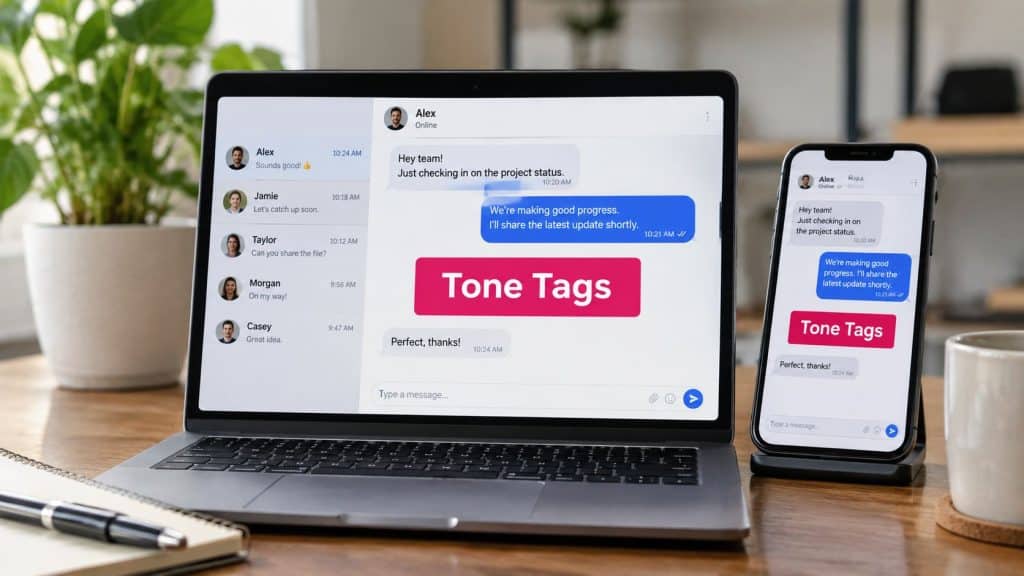
Tone tags are shorthand forms of meta-communication added to text to signal intent, such as /j for joking or /srs for serious. They help replace vocal cues when written words alone could sound rude, sarcastic, or unclear.
You send a short message to a customer, colleague, or friend. The words seem harmless to you, but the reply comes back tense because the reader interpreted your joke as criticism. In a text-only conversation, they couldn’t hear your voice or see your expression, so they had to guess.
That small gap explains what are tone tags and why they matter. A tag gives readers a quick clue about how to interpret the sentence, much like a smile, raised eyebrow, or change in vocal emphasis would do in person.
Introduction to Tone Tags and Why They Matter Today
Tone tags appear in SMS, social media posts, online forums, and emails because these channels remove many of the signals people normally use to understand intent, including facial expression and vocal delivery. A message such as “You finally finished that report” might be friendly teasing, genuine praise, or annoyance. The words stay the same, but the intended meaning changes.
A sender might write:
I can’t believe you bought another notebook /j
The /j tells the reader that the statement is a joke. Without it, the message could sound like a complaint. Tone tags don’t replace considerate wording, but they can reduce guesswork when a sentence has more than one plausible reading.
Why digital ambiguity affects business communication
For e-commerce teams, the risk isn’t limited to personal conversations. A playful SMS about a sale can sound dismissive, an urgent reminder can feel aggressive, and a brief support reply can appear indifferent. Clear wording supports trust, especially when customers are deciding whether to click, ask for help, or complete an order.
Tone tags should be used carefully in customer-facing messages. A tag may help in a familiar community, but it can also confuse recipients who haven’t seen the convention before. For broader guidance on keeping workplace messages clear and constructive, review this effective business communication guide.
What you’ll learn
The useful skill isn’t memorizing every abbreviation. It’s learning to:
- Recognize common tags: Understand the shorthand readers are most likely to encounter.
- Match the audience: Adjust your language for a close online community, a public post, an SMS subscriber, or an email recipient.
- Protect accessibility: Consider how screen readers and unfamiliar readers may process abbreviated markers.
- Choose clarity first: Use a full-word explanation when a symbol could create more confusion than it removes.
Tone tags became especially visible in online communities by the middle of 2020, including spaces such as Reddit and Twitter. Their spread reflects a recurring communication problem, not a failure of readers or writers. When text removes the voice, writers sometimes need another way to provide the missing context.
What Tone Tags Are and How They Work
A tone tag, also called a tone indicator, is a shorthand symbol or abbreviation added to written text to show the intended tone, emotional context, or communicative purpose. It works as meta-communication, meaning the message contains both the main statement and a small clue about how that statement should be read.
Think of a tone tag as a written facial expression. If someone says “Great job” with a warm voice, you hear the praise. If they say it with a sharp voice, you may hear sarcasm. Text usually gives you the words without the delivery, so a tag can provide part of that missing frame.

How the format works
Most common tags begin with a slash and a short abbreviation. Writers usually place the tag at the end of the sentence or immediately after the phrase it qualifies.
- Write the message: “That was a bold choice.”
- Identify the intended reading: Perhaps you mean friendly humor.
- Add the cue: “That was a bold choice /j”
The tag frames the sentence without rewriting it. It doesn’t change the literal words. Instead, it tells the reader which emotional or social meaning you intended.
Compare these versions:
- Without a tag: “You really chose that design.”
- With a joke tag: “You really chose that design /j”
- With a genuine tag: “You really chose that design /gen”
The first sentence leaves the reader to interpret your attitude. The other versions narrow the possibilities. If you post across several social networks, community conventions can vary, so practical platform-specific tone tips can help you avoid assuming that every audience reads tags the same way.
Practical rule: Use a tone tag to clarify an ambiguous intention, not to excuse wording that would otherwise be hurtful or disrespectful.
Tone tags work best when the surrounding sentence is already understandable. A tag can’t repair a vague request, an insulting comment, or a message that lacks important context. It adds one more signal, similar to adding “I mean this sincerely” or “I’m joking” in ordinary conversation.
From Early Punctuation to Modern Internet Language
People have searched for ways to mark tone in writing long before social media. In the 1580s, English printer Henry Denham proposed the percontation point, written as a reversed question mark, ⸮. He intended it to mark rhetorical questions and reduce ambiguity in print.
The symbol later faded from use by the 1700s, but the experiment remains important. It shows that writers and printers have repeatedly faced the same limitation: written language often strips away vocal cues, making sarcasm, humor, and seriousness difficult to identify.

Why online communities revived the idea
Digital communication created a new setting where people write quickly, interact across communities, and often lack a shared history with the reader. Emoticons, emoji, punctuation choices, and eventually tone tags all became ways to restore some of the context carried by face-to-face speech. Readers interested in how visual symbols communicate feeling can also explore this guide to emoji smileys on X explained.
Tone tags became especially visible in online communities by the middle of 2020, with researchers and commentators documenting their spread on platforms such as Reddit and Twitter. Their development resembles language change in any community: repeated needs encourage shorter forms, and frequent forms become easier for members to recognize.
Evidence of a developing vocabulary
A study that collected data over nine months, from November 2022 to mid-2023, identified 282 digital utterances containing 293 tone tags and found 28 unique constructions in its sample. The most frequent tag was /j for joking, which appeared 38 times and represented 19.8% of recorded tokens. /lh for light-hearted represented 15.7%, /gen for genuine represented 12.3%, and /srs for serious and /pos for positive each represented 11.3% (study PDF).
Those findings suggest a recognizable vocabulary rather than random decoration. The broader history of text communication, including the rise of messaging, is covered in this guide to when texting became popular. For marketers, the lesson is simple: conventions can emerge quickly, but recognition still depends on the audience and setting.
Most Common Tone Tags Explained With Practical Examples
You don’t need an exhaustive dictionary to start. A small group of tags covers many everyday situations, especially joking, seriousness, sincerity, and emotional direction.
| Tone Tag | Meaning | Intended Use |
|---|---|---|
| /j | Joking | Signals that the statement is meant as a joke |
| /lh | Light-hearted | Shows that the message is casual or not intended harshly |
| /gen | Genuine | Signals sincere interest, concern, or intent |
| /srs | Serious | Tells the reader to interpret the message seriously |
| /pos | Positive | Indicates a positive meaning or attitude |
| /s | Sarcastic | Marks sarcasm when the wording could be taken literally |
The sample described above found /j most frequently, followed by /lh, /gen, /srs, and /pos, with the cited proportions shown in the research linked in the history section. Frequency doesn’t guarantee universal understanding, though. A customer who rarely uses online community shorthand may recognize none of these forms.
Read the sentence and the tag together
- Joking: “You could open a stationery store with all those pens /j”
- Genuine: “Would you like me to explain that step again /gen”
- Serious: “Please don’t share this customer information /srs”
- Positive: “That product photo looks great /pos”
- Light-hearted: “My inbox is having a dramatic afternoon /lh”
- Sarcastic: “Wonderful, another password reset /s”
The tag should match the actual intent. Adding /j after a message that causes harm doesn’t automatically make the message friendly. If a statement could reasonably upset someone, rewrite it before deciding whether a tag is appropriate.
For commercial messages, plain wording usually travels farther than niche shorthand. A customer SMS such as “Your cart is waiting, and we’d love to help” is easier to understand than a playful line followed by an unfamiliar abbreviation. You can find more ideas for concise customer messaging in these SMS marketing message examples and templates.
A familiar tag can clarify a joke. An unfamiliar tag can become another thing the reader has to decode.
When you aren’t sure whether your audience knows a tag, write the meaning in full. “Just joking” and “I mean this sincerely” take more space, but they remove the need for interpretation.
How Tone Tags Are Used Across Different Platforms
Tone-tag etiquette depends on the community, the audience, and the communication channel. A tag that feels ordinary in a close-knit Discord group may look strange in a formal email or an SMS sent to a broad customer list.

Community platforms
Discord often supports shared shorthand within servers. Members may understand /j, /srs, or similar markers because they see them repeatedly, but a new member may need context.
Reddit contains many communities with different norms. A tag can help in a discussion where irony is common, but moderators and readers may prefer direct language, content warnings, or an explanation in full.
Twitter/X favors short public posts, so abbreviations can save space. Public audiences are also mixed, which makes a full-word clarification safer when a post could be interpreted in more than one way.
Mastodon communities can develop their own conventions and expectations. Check the tone of the local community before assuming that a tag has the same meaning everywhere.
SMS and email
SMS is personal and compact, but recipients may not share your online vocabulary. Email usually carries more formality, especially in support, order, and business contexts. For customer communication, a sentence such as “We’re checking this for you” is normally clearer than /gen, particularly when the recipient may use assistive technology or may not know tone-tag conventions.
The practical differences between these channels are also useful when planning SMS and email communication. Choose the format that gives the reader the least work.
Accessibility deserves a deliberate choice
Screen readers may pronounce slash abbreviations in ways that vary by software, settings, and context. A short tag that looks obvious on screen may sound fragmented or meaningless when read aloud. Newer work also points to concerns about readability and implementation as tone indicators become more varied (CSCW25 paper).
For a wider audience:
- Prefer full words: “Just joking” is more self-explanatory than
/j. - Keep the cue near the sentence: Don’t force readers to search for context.
- Avoid excessive markers: Too many tags can interrupt the natural flow.
- Test important messages aloud: Listen with a screen reader when accessibility matters.
Best Practices for Using Tone Tags Naturally and Respectfully
Tone tags work best as a small clarity tool, not as punctuation added to every message. Before using one, ask whether a reasonable reader could interpret your sentence in a different way. If the answer is yes, a tag or a short explanation may help.
A simple decision checklist
- Use a tag for ambiguity: Add
/jwhen a joke could sound like criticism. - Mark serious requests: Consider
/srswhen a casual conversation includes an important boundary or instruction. - Explain unfamiliar shorthand: Write “just joking” if your audience may not know
/j. - Keep direct statements direct: Skip a tag when your wording already makes the intent obvious.
- Rewrite harmful wording: Don’t rely on
/sor/jto soften an insult. - Respect personal preferences: Some people depend on explicit tone cues for neurodivergent or cross-cultural communication, while others find shorthand distracting.
Make accessibility part of the editing process
For a public post, product announcement, or customer message, write the clearest version first. Then decide whether a tag adds useful information. Full-word formats often provide a safer choice for mixed audiences because they don’t assume knowledge of an online convention.
If you’re preparing social content and need help shaping a consistent voice, an AI LinkedIn viral content generator can support drafting, but a person should still review the wording, audience fit, and tone. Automation can produce a polished sentence while missing the cultural or relationship context that makes a joke appropriate.
Use the same care in commerce. CartBoss provides customizable SMS messages, translations, and sender settings, so store teams can control how outgoing text is presented. Whether you use a tone tag or write the meaning in full, review customer-facing wording in the context of the text message wording guide.

When in doubt, be kind, specific, and easy to understand.
Start with the reader’s experience. If they can identify your intent without decoding a symbol, your message is already doing its job. If not, add a clear cue, preferably one your audience understands and assistive technology can handle comfortably.
CartBoss helps online stores recover abandoned carts through automated SMS messages, with customizable wording that lets you shape the tone of customer reminders. Visit CartBoss to see how you can turn clearer, more considerate follow-ups into a practical part of your sales workflow.