


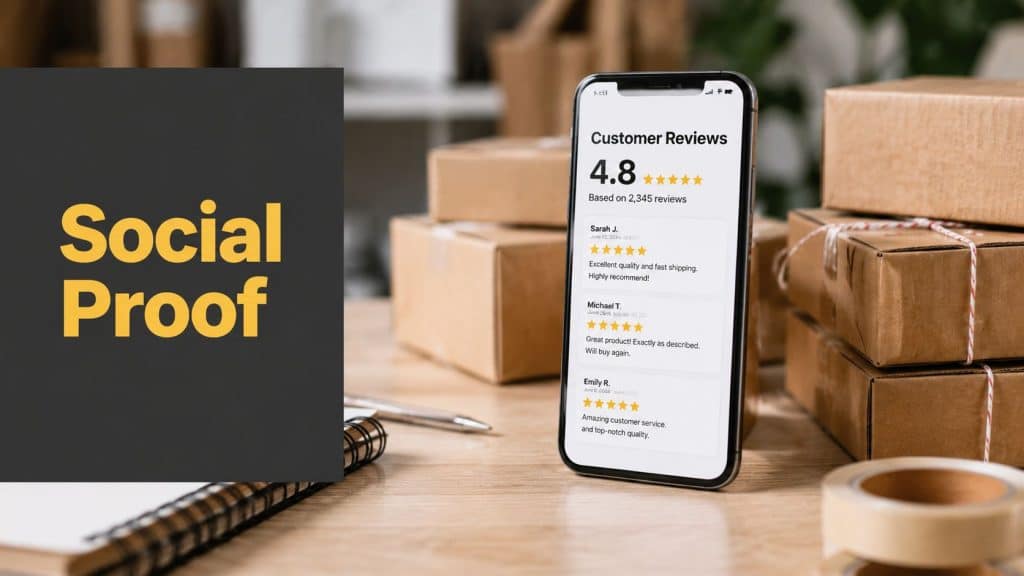
You’ve done the hard work of getting a shopper to your product page. They’ve chosen a product, added it to the cart, and reached checkout. Then they pause. Is the quality reliable? Will the product look like the photos? Do other customers trust this store? A small review, customer photo, or rating near that moment can answer questions your product copy can’t.
That reassurance matters throughout e-commerce, but it matters even more after abandonment. A shopper who leaves may not need another sales pitch. They may need evidence that buying from you is a safe decision. This guide explains what is social proof in marketing, why it works, which formats fit each funnel stage, and how to use customer validation in product pages, checkout, and SMS cart recovery without making your brand sound forced.
You’ll find practical examples, a comparison table, implementation steps, and safeguards for keeping proof current and credible. For broader changes affecting online retail, you can also explore e-commerce trends reshaping the digital marketplace.
Table of Contents
- Introduction to Social Proof in Modern Marketing
- What Social Proof Means for Ecommerce Brands
- The Psychology Behind Why Social Proof Works
- Key Types of Social Proof and When to Use Each
- Why Social Proof Matters for Conversions and Retention
- How to Implement Social Proof to Recover More Sales
- Common Pitfalls and Ethical Rules to Avoid Backfire
Introduction to Social Proof in Modern Marketing
A shopper visits an unfamiliar skincare store and finds a product with attractive packaging, a clear description, and a reasonable price. They add it to the cart, enter their details, then stop before paying. Nothing about the product has necessarily changed. The hesitation comes from uncertainty.
They may wonder whether the formula works for people with similar needs, whether delivery will be dependable, or whether the store will help if something goes wrong. A customer review with a specific experience can reduce that doubt more effectively than another paragraph written by the brand.
This is why social proof belongs in the conversion journey, not just on a homepage. Online shoppers can’t touch a product, inspect its materials, or ask another customer for an opinion in the aisle. They look for visible evidence from people who have already taken the risk.
The checkout hesitation
Consider two abandoned-cart messages:
- “Your items are still waiting. Complete your order now.”
- “Your items are still waiting. Customers describe the fabric as soft and true to size. Complete your order here.”
The second message gives the shopper a reason to reconsider. It connects the product to an experience from another buyer. The proof works best when it answers the exact concern that caused hesitation.
Social proof can support several moments:
- Product discovery: Ratings and customer photos help an unfamiliar product feel easier to evaluate.
- Product consideration: Detailed reviews and demonstrations answer practical questions.
- Checkout: Trust signals reduce anxiety about payment, delivery, returns, and quality.
- Cart recovery: A relevant review can restore confidence after the shopper leaves.
- Retention: Customer stories help buyers feel confident that their purchase was sensible.
The important distinction is that social proof isn’t a decorative strip of logos. It’s a decision aid. When a customer sees credible evidence that people like them have purchased and benefited, the store becomes easier to trust.
What Social Proof Means for Ecommerce Brands
Social proof is evidence that other people have chosen, used, approved, or discussed a product. For an e-commerce brand, that evidence can appear as reviews, star ratings, customer photos, testimonials, user-generated content, expert recommendations, popularity cues, and trust markers.
A busy restaurant offers a simple comparison. You pass two restaurants, one full of diners and one with empty tables. You cannot judge the food yet, but the busy room feels like a safer choice. Other customers’ behavior gives you a shortcut when direct evaluation is difficult.
An online store creates the same shortcut through signals such as:
- Detailed reviews make a product feel less risky than one with no feedback.
- A customer photo shows how an item looks beyond controlled studio images.
- A review from someone with a similar use case answers more relevant questions than a general compliment.
- A recent-purchase or popularity message indicates that other shoppers are choosing the product.

From word of mouth to digital reputation
Social proof started with ordinary word of mouth. People asked friends, watched what neighbors bought, and followed recommendations from trusted communities. By 2007–2008, online reviews had become a dominant decision factor in major markets, and later surveys consistently reported that 88% to 95% of consumers read or trust online reviews before buying (ProveSource’s social proof statistics).
Digital stores made those recommendations visible at scale. Shoppers can scan reviews, compare ratings, view customer images, and find experiences that resemble their own without knowing the reviewer personally.
Missing proof adds friction. One compilation reports that 92% of consumers hesitate to purchase when reviews are missing, while 40% avoid products entirely if no reviews exist. Separate review research emphasizes that buyers look for feedback before committing (NotiProof’s review statistics). The practical lesson is simple: proof should answer the concern a shopper has at that moment, especially when trust is affecting cart recovery. Learn how credibility can reduce cart abandonment.
Practical rule: Treat social proof as part of the product experience. Match the format to the question, then repeat the most relevant proof in a cart reminder or SMS touchpoint. A specific review can restore confidence, while an exaggerated urgency message may make the shopper doubt the store.
The Psychology Behind Why Social Proof Works
Shoppers use social proof as a decision heuristic, meaning they rely on a visible cue to simplify a choice under uncertainty. If a product is unfamiliar, expensive, technical, or difficult to judge online, external validation can carry more weight than a brand’s own claims.
A review doesn’t prove that every customer will have the same experience. It gives the shopper a reference point. They can compare the reviewer’s needs, expectations, and outcome with their own situation.

Uncertainty changes the value of proof
Social proof tends to matter most when shoppers can’t easily evaluate quality for themselves. That includes high-consideration purchases, lesser-known brands, technical products, and items where the wrong decision would feel costly or inconvenient.
A familiar brand may need less explanation because shoppers already carry expectations about it. A new store has to borrow confidence from its customers. This doesn’t mean a new brand needs exaggerated claims. It needs proof that matches the questions buyers are asking.
For example:
- A clothing review can address fit, fabric feel, and sizing accuracy.
- A furniture review can discuss assembly, sturdiness, and room appearance.
- A supplement review can describe taste, routine, and ease of use, without making unsupported health promises.
- A recovery message can answer the reason a shopper might have left, such as shipping uncertainty or product quality.
Format also affects memory. Research summarized by CXL’s social proof study found that photos were more memorable than logos or numbers. That finding supports a practical preference for human-centered proof when the product benefits from visual context.
A customer photo can show scale, fit, texture, or real-world use. A name and role can help a testimonial feel identifiable. A detailed sentence can clarify what changed for the customer. Abstract claims such as “trusted by many” give shoppers less to evaluate.
Watch the video below for a visual introduction to the way social proof influences online decisions.
The strongest proof usually matches the shopper’s uncertainty rather than just praising the brand. Urgency can support a recovery message, but urgency and FOMO in cart abandonment reduction should not replace honest evidence. A countdown may prompt action. A relevant customer experience helps the shopper feel comfortable taking that action.
Key Types of Social Proof and When to Use Each
Different proof formats do different jobs. A star rating offers a quick quality signal. A review explains the experience. A customer photo makes the product tangible. An expert endorsement can establish authority, while a case study shows how a product performs in a specific situation.

Match the format to the question
Use testimonials when the shopper needs an emotional or practical story. Add the customer’s name, image, role, or other identifying context when permission allows. The Press Release Zen testimonial tips offer useful guidance for collecting and presenting customer statements clearly.
Use star ratings and reviews when buyers need fast comparison or technical detail. Place the rating near the product title and review content close to the purchase decision. Store owners working on review credibility can also refer to Google rating guidance from CartBoss.
User counts and popularity cues can communicate adoption, but only when the figure is accurate and meaningful. “Recently purchased” activity can add freshness, while a vague claim about a large customer base may be easy to ignore.
Influencer and expert endorsements work when the person has genuine authority with the audience. A specialist’s explanation can be more useful than a celebrity mention if the product requires expertise.
Social shares and user-generated content show that customers are discussing and using the product. Customer photos, unboxing videos, tagged posts, and styling examples can help shoppers visualize ownership.
Case studies suit products with a longer decision process. They connect a problem, a solution, and an outcome. For consumer products, a concise customer story may perform the same role without the formal structure of a business case study.
Trust badges and approvals can reassure shoppers about payment, delivery, certification, or store policies. Use them to support a specific concern, not to fill empty space.
| Social Proof Type | What It Signals | Best Placement | When It Works Best |
|---|---|---|---|
| Reviews and ratings | Other buyers evaluated the product | Product title, gallery, purchase area | Comparison and quality concerns |
| Customer photos | Real-world appearance or use | Product gallery, review section, SMS landing page | Visual products and fit questions |
| Testimonials | A personal experience and outcome | Landing page, product page, recovery message | Emotional or practical hesitation |
| User-generated content | Customers actively use and discuss the product | Product page, social channels, email | Lifestyle products and community-led brands |
| Expert endorsements | Relevant authority supports the choice | Product detail area, comparison page | Technical or specialized purchases |
| Case studies | A clear problem-to-outcome story | Landing page, email, sales content | Higher-consideration decisions |
| Trust badges | A specific safety or policy signal | Checkout and payment area | Payment, privacy, delivery, or certification concerns |
For cart recovery, don’t send every proof type at once. A shopper worried about sizing needs a fit review. Someone questioning value may respond to a detailed customer outcome. Someone concerned about delivery needs shipping clarity alongside a trust signal.
Why Social Proof Matters for Conversions and Retention
Social proof can influence purchase likelihood because it reduces the perceived risk of choosing an unfamiliar product or store. The effect is often stronger for higher-priced products, where shoppers have more to lose if the purchase disappoints.
Research cited in e-commerce analysis reports that products with five or more reviews are 270% more likely to be purchased than products with no reviews (social proof impact on sales statistics). Another widely cited consumer survey reports that 95% of consumers read online reviews before making a purchase (review statistics from Wisernotify).

Placement and specificity determine impact
A review hidden below a long product description may not help a shopper who hesitates beside the buy button. A short rating summary near the product title can provide immediate reassurance, while detailed reviews lower on the page can handle deeper questions.
Specificity matters just as much. “Great product” gives little usable information. “The shoulder straps stayed comfortable during a full day of travel” gives the shopper something to compare with their own needs.
Recent, audience-matched proof also tends to feel more credible than generic claims. Show reviews from people with similar use cases, locations, roles, or product preferences when your store can do so accurately.
Social proof supports retention as well as first purchases. After an order, customer stories can reinforce the buyer’s confidence, encourage product use, and create a natural reason to request a review. A customer who sees that other buyers solved a similar problem may feel more certain that the purchase was worthwhile.
A missing review isn’t neutral. It can force the shopper to do extra research, postpone the decision, or leave the store entirely.
Audit social proof as a conversion asset:
- Conversion path: Place the most relevant proof near the action it supports.
- Abandonment path: Use proof that answers the likely reason for leaving.
- Retention path: Request feedback after the customer has had a chance to experience the product.
- Measurement path: Compare conversion, recovery, review engagement, and repeat-purchase behavior before and after changes.
How to Implement Social Proof to Recover More Sales
A useful implementation process starts with evidence you already have, then places that evidence at the moments where shoppers hesitate.
Step 1 Build a proof library
Collect approved reviews, customer photos, support messages, social comments, ratings, and testimonials in one working document. Tag each item by product, objection, customer type, date, and permission status.
Useful tags include:
- Fit and quality: “Runs true to size,” “Feels durable,” or “Matches the photos.”
- Delivery: Comments about packaging, arrival, or unboxing.
- Value: Statements about usefulness, longevity, or repeat purchase intent.
- Ease of use: Feedback about setup, instructions, or daily routines.
- Audience match: Reviews from customers with similar needs or buying contexts.
Don’t edit a customer’s words into a claim they didn’t make. Preserve the meaning, keep the context, and obtain permission before using private messages or customer-created content in marketing.
Step 2 Place proof across the store
Add a compact rating summary near the product title. Put detailed reviews near the purchase area, and use customer images where shoppers need help judging appearance, scale, or fit.
At checkout, keep proof focused. A short customer statement about reliability may help more than a full testimonial carousel. Pair it with clear shipping, returns, and payment information so the message addresses the complete concern.
For ongoing reputation work, founders can use this guide to manage online reputation for founders, especially when customer feedback appears across multiple channels.
Step 3 Add proof to the SMS recovery flow
A recovery sequence can use different proof at different moments:
- First reminder: Show the cart and remove friction with a direct checkout link.
- Follow-up reminder: Add a relevant star rating or a concise review tied to the product.
- Final message: Address a remaining objection, such as delivery or returns, and include an honest offer if one is available.
Keep the SMS short. For example:
“Still considering the linen shirt? Customers mention the soft fabric and accurate fit. Your cart is ready: [checkout link]”
A store using CartBoss can include social-proof messaging in an automated SMS cart-recovery flow, alongside features such as dynamic discounts, pre-filled checkout forms, automatic language detection, and compliance controls. See how to recover abandoned carts with text messages for a practical recovery workflow.
Step 4 Test the message, not just the discount
Create variations that change one major element at a time:
- Review versus star rating.
- Product-specific proof versus general store praise.
- Customer photo versus text testimonial.
- Proof near the call to action versus proof earlier in the message.
- No incentive versus a dynamic discount.
Track completed purchases, recovered carts, opt-outs, and revenue per message. A proof message that earns clicks but not purchases may be attracting curiosity without resolving the actual objection.
Common Pitfalls and Ethical Rules to Avoid Backfire
More proof isn’t automatically better. A page crowded with badges, testimonials, review widgets, customer counters, and pop-ups can make the store feel defensive. Shoppers may wonder why the brand is working so hard to prove itself.
Freshness and specificity create two common problems. A 2026 summary reports that 41% of shoppers hesitate when reviews feel generic or outdated, while the same broader coverage reports hesitation when reviews are missing (social proof statistics for 2026). Rotate older content when appropriate, show dates, and avoid presenting a general compliment as evidence for a specific product claim.
Use this audit before publishing proof in a recovery flow:
- Authenticity: Did a real customer provide the statement?
- Permission: Can the store legally use the customer’s words, image, or video?
- Specificity: Does the proof answer a real concern?
- Recency: Is the review still relevant to the current product and policy?
- Disclosure: Are paid or incentivized endorsements identified clearly?
- Privacy: Does the message respect applicable GDPR and CCPA obligations?
- Frequency: Can the recipient opt out, and will do-not-disturb preferences be respected?
- Balance: Are negative or mixed reviews handled transparently rather than hidden through manipulation?
Never invent testimonials, inflate customer counts, suppress legitimate feedback, or imply that one customer’s experience guarantees the same outcome for everyone. In cart recovery, a bland or exaggerated testimonial can increase skepticism precisely when the shopper is already uncertain about price, shipping, or trust.
CartBoss helps online stores place automated SMS reminders and relevant social-proof messages into abandoned-cart recovery flows, with options such as pre-filled checkout, dynamic discounts, language detection, and compliance controls. Visit CartBoss to see how you can turn more abandoned carts into completed purchases while keeping the customer experience direct and credible.