

In 2010, people sent 6.1 trillion SMS messages worldwide, nearly 200,000 texts every second, after volume tripled from an estimated 1.8 trillion in 2007. Those International Telecommunication Union figures are recorded on the GSM Association historical timeline, beside earlier jumps such as 15 billion messages in December 2000. Texting was already a habit before app inboxes existed.
That scale is why cart recovery can’t treat SMS as a novelty, or email as the only serious channel. SMS messaging and email do different jobs inside one sequence. A useful comparison also counts what most charts skip: when the second channel should stop, how many segments a text is billed for, and whether anyone is free to answer the reply.
Table of Contents
- Why Cart Recovery Needs a Channel Decision
- SMS and Email Side by Side
- Open Rates, Clicks and Revenue Per Message Compared
- Which Message Belongs on Which Channel
- Hidden SMS Costs and Reply Risks to Plan For
- How to Sequence SMS and Email After Cart Abandonment
- When to Put SMS First in Cart Recovery
Why Cart Recovery Needs a Channel Decision
Baymard’s compiled benchmark puts the average online shopping-cart abandonment rate at 70.22%. A store that starts 10,000 carts should plan on roughly 7,022 of them never reaching a completed checkout. Treat that as a baseline, then throw it out. Compare your own initiated checkouts with completed orders. Abandonment shifts with device, market, category, shipping cost, and checkout friction, so a mobile fashion store won’t match a high-ticket furniture catalog.
The tidy story says email is the default recovery channel and SMS is the fast alternative. Both claims are partly true. That’s why you need criteria, not a winner. Email can hold the reasons to buy. A text can reach someone while the cart is still warm. Neither fact tells you which message to send, or when to silence the other channel.
The central question is which message belongs on which channel, when the second channel stops, and which numbers you’ll trust.
You’ll use a criteria table, metrics that split campaigns from automated flows, a fit guide by message type, a sequence with suppression rules, the segment and reply costs of SMS, and a situational call. The output is a channel plan for your store and a baseline you can test. Post-purchase loyalty is a different job. Stamp card software for shops from BonusQR is one way to keep a relationship after the order, not a substitute for the recovery message itself. For why carts die in the first place, read why customers abandon their carts.
A baseline tells you the pile is large. Your analytics tell you which pile is yours.
SMS and Email Side by Side
Judge the channels on the job, not on a single rate.
| Criterion | SMS | |
|---|---|---|
| Attention speed | About 98% of SMS opened and about 90% read within 3 minutes (industry summaries) | Opens often near 20% in comparable summaries |
| Content capacity | 160 characters per GSM-7 segment | Product grids, reviews, comparisons, long copy |
| Consent requirement | Explicit opt-in, quiet hours, opt-out keywords | Permission and a working unsubscribe link |
| Cost model | Billed per segment, so encoding affects cost | Usually volume-priced by the provider |
| Reply handling | Two-way; replies need a human or a rule | Inbox replies can be triaged |
| Best role | Time-sensitive nudge | Detailed follow-up and a durable record |
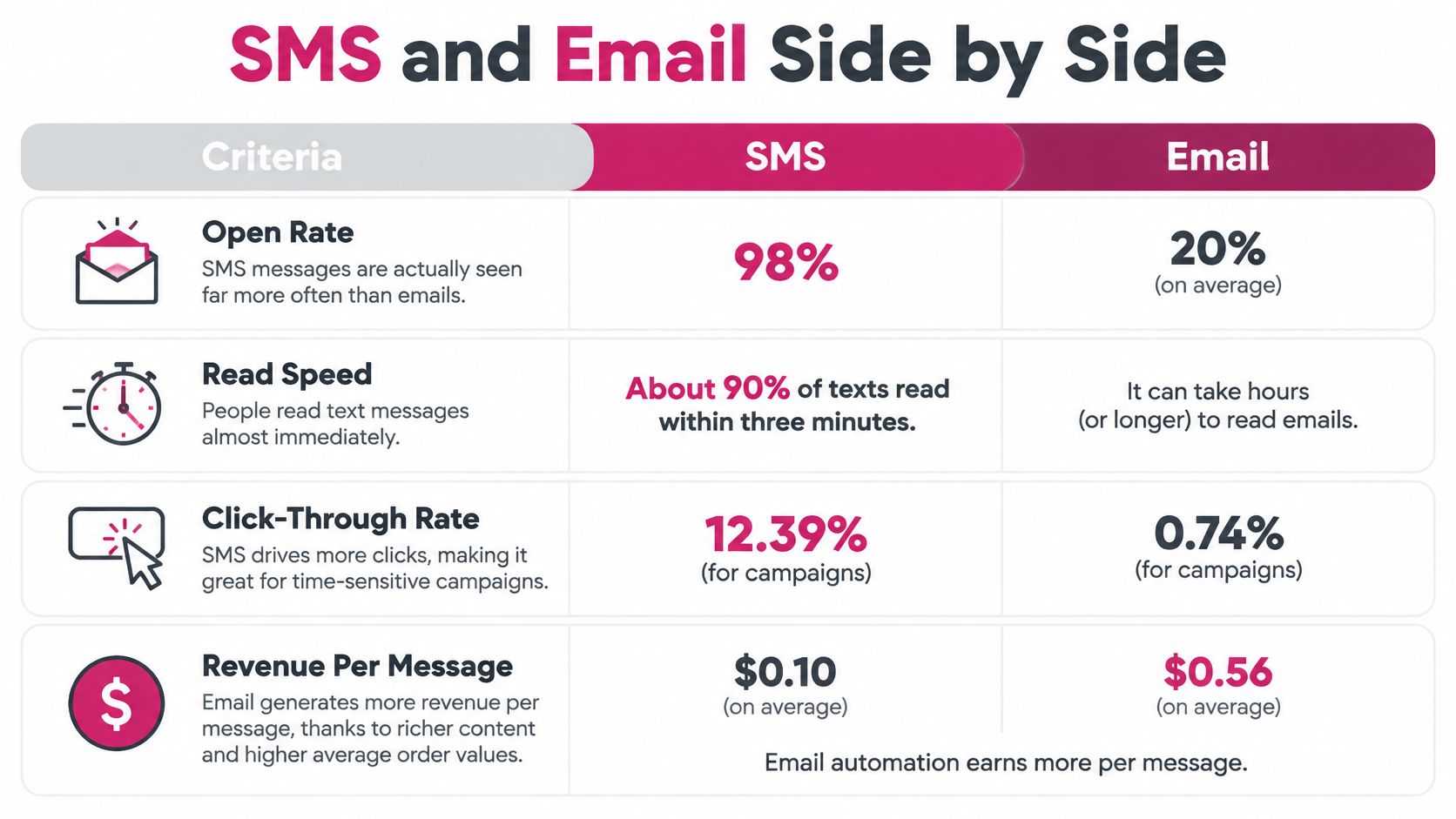
Industry benchmark summaries commonly report those attention figures, as collected in Vonage’s SMS and email comparison. Speed is the row where SMS clearly wins. It doesn’t prove the sale.
Content capacity is the opposite row. One standard text holds a product name, one link, and one ask. Email holds grids, reviews, sizing, and a returns policy. The Radicati Group’s Email Statistics Report projected worldwide email users rising from 4.037 billion in 2020 to 4.481 billion in 2024. That inbox is still where longer commerce lives.
Consent isn’t interchangeable either. SMS needs an explicit opt-in, quiet hours, and a working opt-out keyword. Email needs permission and an unsubscribe that works in practice. Skipping either one turns a recovery program into a complaint program.
Cost follows the pipe. Texts are billed per segment, so an emoji or a curly quote can double the invoice on a line that looked short. Email is usually priced by monthly volume, which is why a long follow-up is cheap to send and expensive only if it trains people to ignore you.
Replies are the row most comparisons omit. A text invites an answer on the same thread. Someone has to route it. An email reply lands in a queue you can batch.
Practical rule: SMS wins attention. Email wins depth and cheaper reach. Neither channel wins every row.
Open Rates, Clicks and Revenue Per Message Compared
SMS leads on clicks. Email automation earns more money per message. Both can be true in the same program.
Omnisend’s 2026 benchmark, built on 246 million SMS sends across more than 27,000 brands in 2025, puts campaign click-through at 12.39% for SMS and 0.74% for email. In automated flows the gap stays wide: 20.34% against 4.66%.
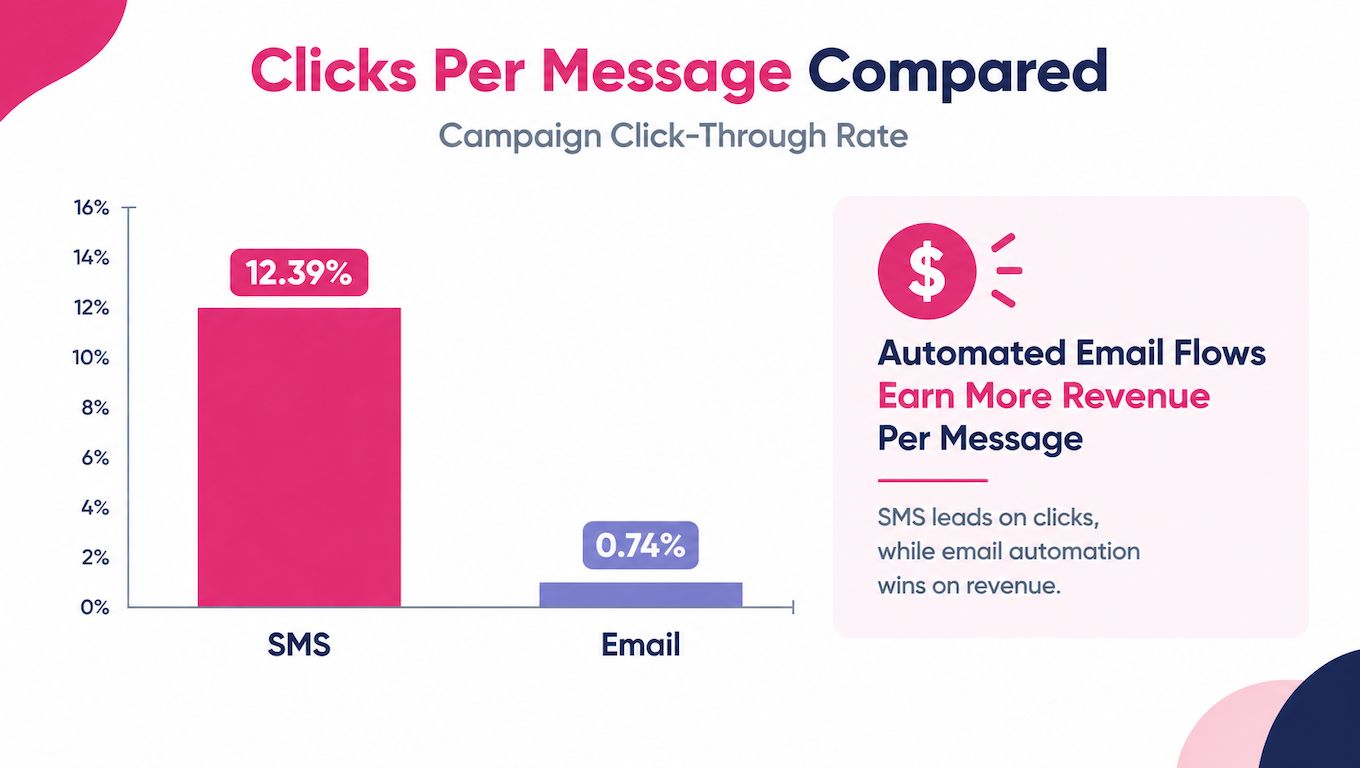
Then the numbers reverse. The same benchmark shows email automation converting at 1.49% versus 0.78% for SMS, and producing $3.41 in revenue per message versus $0.75.
Why the click doesn’t carry the revenue
A text is a short prompt. It earns the tap because there’s almost nothing else to do. The email can hold the photo, the review, the shipping promise, and a fuller offer. A shopper who gets through that page has more reasons to pay. SMS should be built for a fast return to checkout. Email should be built for the shopper who needs convincing, not poking.
Averages hide your store. A $20 accessory and a $400 configurable product won’t share a revenue-per-message figure. Read the benchmark as a shape, then replace every cell with your own sends.
What to track instead of opens
Open rate is a weak secondary signal. Near-universal text opens and much lower email opens mostly describe the medium, not the purchase.
Track these on delivered messages:
- Click rate: Taps divided by messages that reached the recipient, split by campaign and by flow.
- Recovered-order rate: Orders tied to that message, not to the whole week of marketing.
- Revenue per delivered message: Gross sales divided by delivered volume, before you declare a winner.
- Unsubscribe rate: The tax on the next send, by channel.
- Incremental lift: Recovered profit versus a holdout group that got no recovery at all.
Pull the last 90 days. Calculate revenue per delivered message for each channel, then compare it with the holdout. Set the mix only after that. A broader set of benchmarks is collected in abandoned cart recovery statistics. Use them to sanity-check your math, not to replace it.
The operating pattern that matches these figures is simple. Use the text as the time-sensitive first touch. Send email to people who click and don’t buy. Remove anyone who has already paid.
Which Message Belongs on Which Channel
Recent UK research, covered in Attentive’s 2025 UK SMS and email report, found that 70% of consumers believe email and SMS should serve distinct roles, and 84% want to customize the types of brand messages they receive by channel. People are already sorting your program for you. Match them.
| Message type | Better channel | Consumer signal | Cart recovery use |
|---|---|---|---|
| First abandoned-cart reminder | SMS | Time-sensitive intent | Send within the first hour |
| Product detail and comparison | Product previews preferred by email (56%) | Reasons to buy, reviews, sizing | |
| Price change or low stock | SMS | Immediacy matters | Only when the signal is real |
| Shipping update after purchase | SMS | 44% find SMS more relevant | Confirm delivery, don’t upsell |
| Order confirmation | SMS | 37% find SMS more relevant | Short receipt link, email copy as the record |
| Brand news | 55% prefer email | Keep it out of recovery sequences | |
| Final short reminder | SMS | Short and direct | Suppress if the order is complete |
How to assign the cart flow
The first reminder goes by SMS while intent is fresh, inside the first hour, and only to people who opted in. The “why this product” note goes by email, because 56% preferred email for product previews and 55% preferred it for brand news. A real price drop or a verified low-stock flag can go by text. Invented urgency belongs in neither channel.
After the purchase, the job changes. Shipping updates (44% found SMS more relevant) and order confirmations (37%) are service messages. Keep them short. Leave the selling in the email record. Brand news stays out of the recovery track entirely.
A separate global survey in that same Attentive report found email leading promotional channels at nearly 77%, while more than 30% still wanted promotional texts. For informational messages, 24% preferred both email and SMS, against 12% who wanted text only. Promotions can ride SMS, with permission and a light hand.
Anyone who buys through the email link comes off the SMS track immediately. Sending the “still in your cart” text after the charge is how trust dies.
Adding SMS to every email in the sequence can raise contact volume without raising incremental revenue. Fatigue doesn’t show up in a click-rate screenshot. It shows up when the next opt-in gets harder. Assign each line in your flow to one channel and write the reason next to it. For the email side of that flow, abandoned cart email practices cover structure, proof, and the offer.
If you can’t name the job of the second message, don’t send it.
Hidden SMS Costs and Reply Risks to Plan For
A plain text that fits in one bubble isn’t always one billable unit. The screenshot of a short reminder can hide a second segment created by a single character.
What one message actually bills
Twilio’s SMS character-limit glossary sets the rules carriers use. A GSM-7 message holds 160 characters in one segment. Once it splits, each piece carries 153 characters because metadata reassembles the text. One Unicode character, including many emoji, smart quotes, and some non-Latin letters, switches the whole message to UCS-2: 70 characters for one segment, and 67 per segment when it splits. Accounts are charged for each segment sent or received.
| Message type | Encoding | Limit per segment | Example outcome |
|---|---|---|---|
| Single plain-text message | GSM-7 | 160 characters | 1 billable segment |
| Long plain-text message | GSM-7 | 153 characters per segment | 200 characters bill as 2 segments |
| Single message with one Unicode character | UCS-2 | 70 characters | 1 segment up to 70 characters, then it splits |
| Long message with Unicode | UCS-2 | 67 characters per segment | 100 characters bill as 2 segments |
Before a template goes live, run this pass:
- Punctuation: Use straight apostrophes and hyphens. Curly quotes from a doc editor flip the encoding.
- Paste cleanup: Strip formatting from any line copied out of a webpage or a slide.
- Emoji: Test them on purpose. A decorative one can double the segments.
- Dynamic fields: Keep product names and discount values inside a character budget, including the worst-case name.
- Language preview: Check every locale. A translation that looks elegant can blow the segment cap.
Report the share of messages that leave as one segment versus two or more. Cutting segments improves readability and spend without changing the offer. The invoice side of this is laid out in what SMS marketing costs.
The reply you didn’t staff
Delivery isn’t the hard part. The reply is. In a 2025 survey of 1,800 UK consumers published by Textmagic, more than half said they had felt “ghosted” after texting a business. 26% expected a reply within 30 minutes, and another 26% within a few hours. 59% trusted recognizable senders. Distrust came from poor grammar (35%), requests for personal data (26%), and unknown numbers (22%). A related 2025 consumer study in that same briefing found 57% expected a business response within 15 minutes, and 47% used SMS to give feedback.
A cart campaign can create replies faster than a small team can answer them. “Is this still in stock?” and “Did you charge me?” aren’t marketing events. They’re support tickets with a clock on them.
Build the handoff before you raise volume:
- Named sender: Use a sender identity people can recognize, not a random short code with no store name.
- Routing: Send STOP, HELP, stock questions, and payment questions to different owners.
- Hours: Say when a human is reading the thread.
- Language: Cover the languages you send in, or don’t send in them.
- Opt-out: Process the keyword immediately, including on the recovery flow.
- Escalation: Payment and fraud questions leave the marketing queue the same hour.
A lower-volume program with a clear sender and fast reply coverage protects trust better than a blast of reminders nobody can answer.
The same thread is where shoppers decide whether the next text is welcome. This short walkthrough shows how a two-way text conversation looks on the handset:
Reply coverage: A text nobody answers costs more than the extra segment.
How to Sequence SMS and Email After Cart Abandonment
Build the sequence as one system with a kill switch, not as two calendars that never speak.
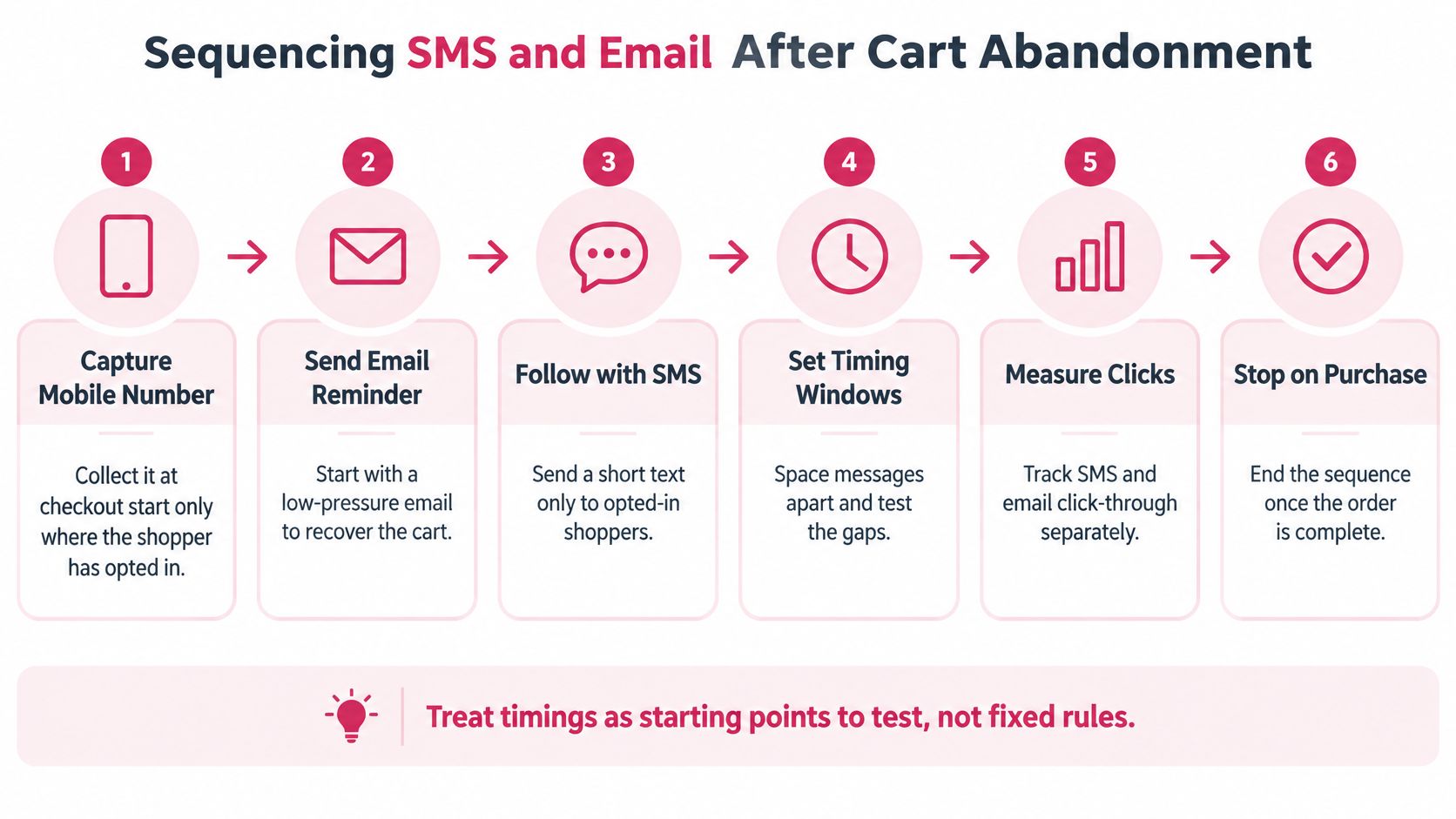
Treat every timing below as a starting point you’ll test. Intent fades quickly, but “quickly” isn’t the same hour for a $30 reorder and a $600 configurable product.
-
Capture the number only with consent. Ask for the mobile number when checkout starts, and only store it for SMS when the shopper has opted in. Log where that consent came from. A number typed into a shipping form isn’t a marketing opt-in. Without the log, you can’t defend the send later.
-
Send the first SMS 15 to 60 minutes after abandonment. The cart is still a live intention, and a short text is the format people see in that window. Example: “Your Trail Jacket (size M) is still in your cart: [link]. Reply STOP to opt out.” The link should open a pre-filled, mobile checkout, not the homepage. Name the item. Skip the essay.
-
Send the email at 2 to 4 hours. This is the depth pass: photo, one review, sizing or variant notes, and a plain line on shipping and returns. Subject example: “The Trail Jacket is still waiting for you.” Don’t repeat the text word for word. If they already tapped the SMS and bounced, answer the objection the text couldn’t hold.
-
Send one final SMS at about 24 hours. Keep it short. Add a discount only when margin allows, and test “no offer” against a modest offer as its own variable. An automatic 15% off on every abandon trains people to leave the cart. If stock or price didn’t change, say something useful or don’t send.
-
Suppress on purchase. The moment the order completes, both channels stop. Also suppress SMS for anyone who bought through the email link, even if the text was already queued. A reminder after the charge is the fastest way to earn an opt-out.
-
Hold out 10% of eligible carts. Those shoppers get no recovery messages. Incremental profit is recovered revenue minus message cost and discount cost, compared with that group. If the sequence only matches what would have converted anyway, you don’t have a program. You have noise.
Checks before you turn it on
Confirm the landing page loads fast on a phone, that language detection matches the storefront the shopper used, and that the deep link returns the exact product and variant. A beautiful text that dumps someone on an empty cart wastes the only tap you’ll get.
CartBoss is one tool that can send that first SMS with pre-written translated messages and a pre-filled checkout, alongside whatever email platform you already run. It isn’t a reason to skip the holdout. Set the timing tests with the guide to abandoned cart message timing, then change one gap at a time so you know which delay paid.
When to Put SMS First in Cart Recovery
The lead channel changes with the cart, the margin, and the inbox you’re able to staff. Use this before you copy a sequence from another store.
| Situation | Lead channel | Why |
|---|---|---|
| Shopper opted in to SMS, cart added within hours | SMS first | Intent fades quickly and a text is the fastest read |
| High-price or variant-heavy product | Email first, SMS at about 24 hours | Detail and comparison need room |
| Verified low stock or a real flash sale | SMS first | A time-bound fact fits a short message |
| No SMS consent | Email only | Consent can’t be assumed or borrowed from checkout fields |
| Thin margin, no affordable discount | SMS reminder without a discount, then email with value content | You stay in touch without giving away the order |
| No one can answer replies within the hour | Email-led, SMS limited to the first touch | Two-way texts need coverage and a clear sender |
Run the test that can change the answer
For two weeks, run three arms against one shared holdout: SMS first, email first, and the combined sequence with suppression. Judge the winner on incremental profit after message cost and discount expense. Click-through will flatter the text almost every time. Profit won’t.
Then do the unglamorous audit. Compare your abandonment rate with the published average, confirm consent records, count segments in every live template, and turn on one SMS touch before you add a second. A store that can’t answer replies should not “fix” that by sending more texts.
On Shopify or WooCommerce, CartBoss is one option for that first touch: a Shopify app and a WooCommerce plugin, GDPR and CCPA controls, and an automatic do-not-disturb mode, so the test doesn’t require a hand-built flow. Keep your email platform as the system of record for the long message. The point of the test is the profit gap, not the logo on the send.
If the holdout wins, stop adding messages. A quieter sequence that people still trust will outlast a louder one that only wins the click chart.
CartBoss sends automated SMS cart reminders for Shopify and WooCommerce stores, with translated templates, pre-filled checkout links, and consent controls that fit the sequence above. If you’re ready to test one opted-in text before the email follow-up, and to suppress it the moment the order lands, start with CartBoss.