


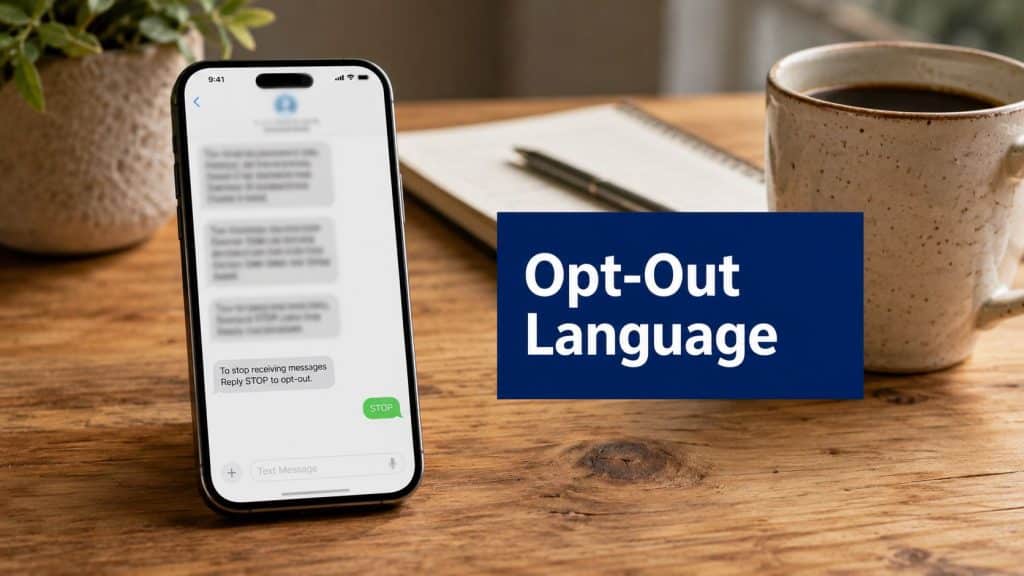
You’ve launched a cart-recovery flow, the first clicks look promising, and then a customer replies, “Please stop texting me.” If your platform only recognizes the exact keyword STOP, the automation may continue sending reminders while your team assumes the number is protected. That gap is where SMS opt out language stops being copywriting and becomes an operational control.
The right wording should be short enough to preserve the offer, clear enough for the customer to understand immediately, and connected to suppression logic across every channel you use. This guide covers compliant wording, timing, multilingual campaigns, nonstandard revocation requests, and the platform checks that keep cart recovery useful without turning it into a source of avoidable risk.
Table of Contents
- Why SMS Opt Out Language Matters for E-commerce
- Legal Requirements for SMS Opt Out Language
- Ready-to-Use SMS Opt Out Templates
- When to Include Opt Out Instructions in Your Messages
- Setting Up Opt Out Handling in Your SMS Platform
- Regional Variations in Opt Out Requirements
- Your SMS Compliance Checklist
Why SMS Opt Out Language Matters for E-commerce
A store owner can build a persuasive abandoned-cart message, personalize the product name, and send it at an effective moment. Yet a missing or buried opt-out path can undermine the entire campaign. Customers need to know who is messaging them, why they’re receiving the text, and how to stop future marketing messages without searching through a privacy policy.
Under the U.S. Telephone Consumer Protection Act, codified at 47 U.S.C. § 227, senders need a working opt-out mechanism, although the statute doesn’t prescribe one exact phrase. Industry practice has therefore converged around direct wording such as “Reply STOP to unsubscribe.” The CTIA Messaging Principles and Best Practices also emphasizes supporting multiple opt-out methods, honoring every opt-out request, and sending only one final confirmation message per campaign.
That language serves two purposes:
- It gives customers control: A recipient can act without contacting support or navigating a form.
- It protects message quality: Clear control reduces the chance that an annoyed subscriber reports a text as spam.
- It supports deliverability: Carriers and messaging ecosystems expect senders to process revocations reliably.
- It improves trust: A transparent message feels like a service customers can manage, not a channel they’re trapped in.
Practical rule: Treat the opt-out instruction as part of the customer experience, not as legal text pasted at the bottom after the message is finished.
The conversion trade-off is real. Long disclosures can crowd out the product, urgency cue, or checkout link. But removing the control path creates a worse experience. The strongest cart flows use compact language, identify the brand early, and connect every recognized reply to a central suppression record.
The rest of the process is straightforward in principle: disclose clearly, repeat at sensible intervals, recognize natural-language requests, send one non-promotional confirmation, and block later marketing sends. The difficult part is making those rules work consistently across campaigns, languages, support channels, and multiple systems.
Legal Requirements for SMS Opt Out Language
The legal baseline starts with the TCPA. It requires a functioning way for recipients to revoke permission, but it doesn’t mandate the exact wording “Reply STOP to unsubscribe.” A clear keyword is useful because it’s easy for customers and software to recognize, yet it shouldn’t become the only route available to someone expressing an obvious desire to stop.
Common machine-recognized terms include STOP, QUIT, END, CANCEL, UNSUBSCRIBE, REVOKE, OPT OUT, STOPALL, and OPTOUT. Platforms should also review common variants and natural-language messages such as “please stop texting me” or “take me off this list,” rather than relying only on exact matching. Guidance on reasonable revocation methods is summarized in this TCPA and text messages compliance overview.
CTIA guidance adds operational expectations. The first message in a recurring program should identify the program, disclose message frequency, include a data-rate notice, and provide a clear STOP or HELP path. Recurring campaigns should repeat opt-out language periodically, commonly at least every 30 days, so customers don’t lose access to the control mechanism after the initial enrollment.
The processing target should be faster than the outside window commonly cited in carrier practice. The suppression engine should act as soon as the request arrives, while the commonly cited maximum is 10 business days or faster under U.S. TCPA/FCC-aligned practice, as described by SMS opt-in regulations guidance.
GDPR and related European privacy rules add a separate consent principle. Withdrawal must be as easy as giving consent, so a customer who joined through a simple form shouldn’t face an unnecessarily difficult removal process. Keep the consent event, the revocation event, the channel, the wording, and the resulting suppression action in an auditable record.
What the rules mean in practice
The following comparison is a working implementation guide, not a substitute for jurisdiction-specific legal advice.
| Regulation | Required Keywords | Response Timeframe | Penalty Range |
|---|---|---|---|
| TCPA | No exact statutory phrase, but STOP, END, CANCEL, UNSUBSCRIBE, QUIT, and natural-language revocations should be honored | As soon as practicable, with 10 business days or faster commonly cited in practice | Varies by claim and enforcement context |
| CTIA guidance | STOP and HELP paths, plus support for multiple opt-out methods | One final confirmation, then suppress future campaign messages | Carrier filtering, campaign action, and other enforcement consequences can apply |
| GDPR | No universal keyword list, but withdrawal must be clear and as easy as consent | Without undue friction or delay | Varies by applicable law and enforcement authority |
A common myth says every SMS must contain the full phrase “Reply STOP to unsubscribe.” That isn’t the precise rule. The first message and periodic disclosures need clear instructions, while individual messages can use concise wording when the campaign design and applicable guidance support it. Never use periodicity as an excuse to hide the option from a customer who asks to leave.
Ready-to-Use SMS Opt Out Templates
Good templates preserve the commercial point of the message while making the exit path unmistakable. Keep the instruction near the end, use the same keyword logic across campaigns, and avoid adding promotional content to the final confirmation.

Five practical message patterns
Initial consent confirmation
Thanks for joining [Brand] updates. You’ll receive product news and offers. Msg & data rates may apply. Reply HELP for help or STOP to unsubscribe.
This gives the subscriber the program identity, purpose, assistance path, and opt-out route in one compact message. It works well as the first message in an automation platform, including cart-recovery tools that enroll a customer through a compliant consent event.
Abandoned-cart reminder
[Brand]: You left [Product] in your cart. Finish checkout: [link] Reply STOP to unsubscribe.
The message leads with the cart context and a single action. “Reply STOP to unsubscribe” is direct, familiar, and less distracting than legalistic wording. Use the full phrase in the first message of the recurring cart flow or when the disclosure interval requires it.
Post-purchase update
[Brand]: Your order is being prepared. Track it here: [link] Reply STOP to unsubscribe from marketing messages.
This version separates the service update from marketing suppression. If transactional and promotional traffic share infrastructure, make sure the customer’s preference status is interpreted correctly before sending future campaigns.
Promotional broadcast
[Brand]: Today’s offer is ready: [offer] Shop now: [link] Reply STOP to end marketing messages.
“Reply STOP to end” is a useful short form when space is tight. It communicates the action without turning the message into a disclaimer. The unsubscribe text message examples provide additional wording patterns for teams building their own library.
Win-back campaign
We miss you at [Brand]. See what’s new: [link] Reply PAUSE to snooze messages or STOP to unsubscribe.
PAUSE is a soft preference, not a hard opt-out. Only use it if your system places the subscriber into a pause state and prevents promotional sends during that period. STOP should trigger permanent suppression until the customer gives valid new consent.
For Spanish-language campaigns, translate the meaning rather than automatically translating the keyword. A practical version is:
[Marca]: Tu carrito te está esperando. Completa tu compra: [enlace] Responde STOP para cancelar los mensajes.
Keep the system able to recognize the standard keyword and any approved localized equivalents used in the target market. CartBoss supports automated cart-recovery messaging and localized message workflows, but any platform requires testing against your own consent and suppression configuration before launch.
When to Include Opt Out Instructions in Your Messages
Repeating the complete opt-out sentence in every SMS feels safe, but it can make a cart sequence harder to read. The better approach is to map disclosure timing to the program and keep the control path available through the platform, customer support, and other reasonable channels.
CTIA-style guidance expects the first message in a recurring program to include the program identity, frequency, data-rate notice, and opt-out route. Recurring campaigns should repeat the instruction periodically, commonly at least every 30 days. That doesn’t mean every individual text must carry identical footer language, but it does mean the subscriber shouldn’t have to remember an instruction from a distant first touch.
A three-message cart sequence
Message one, include the full path
[Brand]: You left items in your cart. Complete checkout: [link] Reply STOP to unsubscribe.
This is the first recovery touch, so clarity matters more than squeezing in another promotional phrase.
Message two, keep the copy focused
[Brand]: Your cart is still saved. Complete your order here: [link]
This message can focus on the product and checkout if the flow remains within the applicable disclosure interval and the platform still processes replies and other revocation requests.
Message three, disclose again when needed
[Brand]: Last reminder about your cart: [link] Reply STOP to unsubscribe.
Use the full route again when the sequence enters a new recurring-program interval, changes its message purpose, or follows a meaningful re-engagement event. Don’t assume a customer’s return to the site automatically restores consent after an opt-out. A fresh opt-in should be recorded before marketing resumes.
Message fatigue also affects the conversion decision. The Klaviyo SMS compliance guide reports that 72% of consumers cite too-frequent messages as a reason to opt out, while 53% cite irrelevance and 45% cite annoying tone or language. Those figures point to a practical conclusion: concise opt-out language isn’t the main problem. Excessive, irrelevant, or irritating messaging is.

Setting Up Opt Out Handling in Your SMS Platform
Copy can’t protect a campaign if the platform keeps sending after a revocation. Build the handling system in layers, then test the complete path from incoming reply to suppression across every active queue.
1. Create a broad recognition layer
Start with standard terms such as STOP, QUIT, UNSUBSCRIBE, CANCEL, and END. Add variants including STOPALL, REVOKE, and OPTOUT, then review typos and casual phrases such as “STOP IT,” “STP,” “UNSUB,” “please stop texting me,” and “remove me.”
Keyword matching is the first layer, not the whole solution. Route ambiguous replies to a review queue, and give support agents a clear action for requests received by phone, email, web form, chat, or in person.
2. Centralize suppression
Use one source of truth for marketing eligibility. When a customer opts out, remove the number from abandoned-cart queues, broadcasts, win-back campaigns, and any separate brand or regional lists connected to the same customer record.
3. Send one final confirmation
The confirmation should say what happened and nothing more:
You have been unsubscribed from marketing messages. No further promotional texts will be sent.
Send only one final confirmation, with no discount, product recommendation, or re-subscription pitch. Then apply suppression before any later marketing job can run.
4. Log the event
Store the exact wording, channel, timestamp, customer identifier, campaign, and suppression result. The record helps your team investigate failures and demonstrate that the system acted on the request.
CartBoss users should map recognized keywords to the platform’s do-not-contact or suppression behavior, then verify that the status also reaches the CRM and customer-support tools. An SMS auto-responder guide can help teams think through reply handling, but your implementation still needs a live test with sandbox numbers.
Run these tests before launch:
- Send each standard keyword.
- Send a natural-language request.
- Reply from a different channel and confirm the support workflow updates the central record.
- Trigger a queued cart message after suppression.
- Confirm that exactly one non-promotional confirmation is sent.
- Check that shared short-code or multi-brand logic doesn’t reactivate the number elsewhere.
Regional Variations in Opt Out Requirements
A global campaign shouldn’t rely on one English footer. The U.S. framework centers on TCPA obligations and CTIA messaging practices, while European campaigns must also account for GDPR consent withdrawal and national ePrivacy rules. The UK applies its own post-Brexit privacy and electronic-marketing framework through GDPR-derived requirements and PECR oversight.
Language affects both comprehension and automation. For French-language traffic, ARRET is a documented localized equivalent in compliance guidance. Spanish-language programs may use BAJA where local practice and platform support allow it, but the system should still make the intended action clear and test the term with the carrier and messaging provider.
Regional implementation comparison
| Requirement | US (TCPA/CTIA) | EU (GDPR/ePrivacy) | UK (ICO/PECR) |
|---|---|---|---|
| Consent | Maintain a valid permission record for the messaging program | Consent and purpose need to be clear, specific, and withdrawable | Permission and marketing rules apply under PECR and related privacy requirements |
| Opt-out wording | STOP-style instructions are common, but exact wording isn’t the only valid route | Provide an equally easy withdrawal path and localize for the recipient | Make the unsubscribe route clear and accessible |
| Automation | Parse standard keywords and natural-language intent, then suppress marketing traffic | Synchronize consent withdrawal with customer and marketing records | Connect replies and support requests to the same suppression process |
| Confirmation | Send one final confirmation, then stop marketing messages | Confirm the change without adding promotional content | Use a clear, non-promotional confirmation |
| Records | Keep consent, revocation, timing, and suppression logs | Document the lawful basis and withdrawal history | Retain evidence needed to demonstrate compliant processing |
Don’t create separate logic for every country if a centralized preference service can store language, region, program, and status fields. Do create localized copy variants and route unusual requests to people who understand the language and context.
For privacy issues involving personal text communication, the personal text message privacy laws resource offers useful background. Your legal team should validate the final flow for each market, especially where local carrier filtering or national implementation rules add requirements beyond the base wording.
Your SMS Compliance Checklist
Run this list before activating a cart-recovery flow, promotional broadcast, or win-back sequence. Treat it as a working document, not a one-time approval sheet.
- Verify consent: Confirm each number has a documented, purpose-specific opt-in and that the record includes the collection source.
- Identify the brand: Put the sender identity in the message, particularly at the beginning of a new program.
- Include the control path: Use clear wording such as “Reply STOP to unsubscribe” where the first-message or periodic disclosure requires it.
- Expand recognition: Test STOP, QUIT, END, CANCEL, UNSUBSCRIBE, REVOKE, OPT OUT, localized terms, typos, and natural-language requests.
- Centralize suppression: Make SMS, email, CRM, support, and campaign tools read from the same marketing-status record.
- Control confirmation: Send one final, non-promotional confirmation and block later marketing traffic.
- Localize the workflow: Match language, keyword handling, consent records, and regional requirements to the recipient’s market.
- Test before sending: Use sandbox numbers to check HELP replies, broken links, duplicate confirmations, delayed suppression, and stale consent data.
The implementation details for campaign launch are collected in this SMS compliance checklist. Teams that also manage phone support should review a practical guide to call center compliance so verbal revocations don’t disappear inside a separate service workflow.
Review the checklist whenever you change a campaign, brand, country, language, or messaging platform. A quarterly review is a sensible operating habit because carrier expectations, platform behavior, and privacy interpretations can change faster than your copy library.
CartBoss supports automated cart-recovery SMS flows with unsubscribe handling, localized messaging, and suppression features that help connect customer replies to campaign eligibility. Visit CartBoss to evaluate how its cart-recovery automation can fit your consent, opt-out, and multilingual messaging workflow.
