


Think of the Telephone Consumer Protection Act (TCPA) as the official rulebook for how your business talks to customers through text messages. These rules are strict and cover every single promotional SMS you send out. It all boils down to one golden rule that you absolutely cannot ignore: you must have prior express written consent before texting your audience. Getting this wrong isn’t just a slap on the wrist; it’s a fast track to some seriously painful financial penalties.
Why TCPA Compliance Is Non-Negotiable
The TCPA first came on the scene back in 1991 to put a stop to those annoying telemarketing calls we all used to get. But as technology changed, the law grew up, too. Now, it covers modern communication, including SMS. For any business using text message marketing, knowing these rules isn’t just a good idea—it’s a legal must-have. At its heart, the law is all about protecting people from messages they never asked for.
Think of sending a text like walking into a customer’s personal space—their living room, for example. You wouldn’t just barge in uninvited, right? The TCPA makes sure you have that clear invitation first, which is why getting their permission, or “consent,” is so important.
The Foundation of Consent
The law demands that businesses get “express written consent” before sending any automated marketing texts. Now, this doesn’t mean you need a customer’s physical signature on a piece of paper. Instead, it’s about getting a clear, undeniable “yes” from the customer to receive your texts.
For a deep dive into getting this right, our guide on express written consent breaks down exactly how to obtain and document this permission properly.
The consent you get has to be crystal clear. The customer needs to know exactly what they’re agreeing to. This means you need to spell out a few key details:
- What the texts are for (e.g., promotions, alerts, abandoned cart reminders).
- Who is sending the texts (your business name).
- A clear statement that they’re signing up for marketing messages.
The Cost of Getting It Wrong
Failing to get proper consent can be a financial nightmare. Under the TCPA, businesses can face fines anywhere from $500 to $1,500 per violation. Here’s the kicker: every single text you send without permission counts as a separate violation.
When these violations get bundled into class-action lawsuits, the potential costs can skyrocket into the millions, putting businesses of any size at huge risk. This guide will walk you through what you need to do to run text campaigns that are not only powerful but also perfectly legal.
The Core Pillars of TCPA Text Message Compliance
Getting your head around the rules for TCPA and text messages can feel a little intimidating, but it really just boils down to three core pillars. When you build your SMS marketing on this foundation, you’re not just staying compliant—you’re also building a more engaged and trusting audience. Think of these as the essential support beams for any successful, legally-sound text campaign.
The first and most important pillar is Express Written Consent. This is the absolute gold standard for TCPA compliance. It means you have a crystal-clear, documented record of a customer explicitly saying “yes” to receiving marketing messages from you. A classic example is a checkbox on a website form that isn’t pre-checked and plainly states what the user is signing up for.
Without this unambiguous permission, you’re opening your business up to some serious risks. That’s why meticulous record-keeping is the backbone of this pillar. You must be able to prove when, where, and how you got consent for every single contact on your list. This documentation is your best (and really, only) defense if a complaint ever comes your way.
Gaining and Managing Consent
It’s super important to understand that not all consent is created equal. The infographic below breaks down the different levels, showing the hierarchy from the strictest requirement for marketing texts all the way down to less formal types of permission.
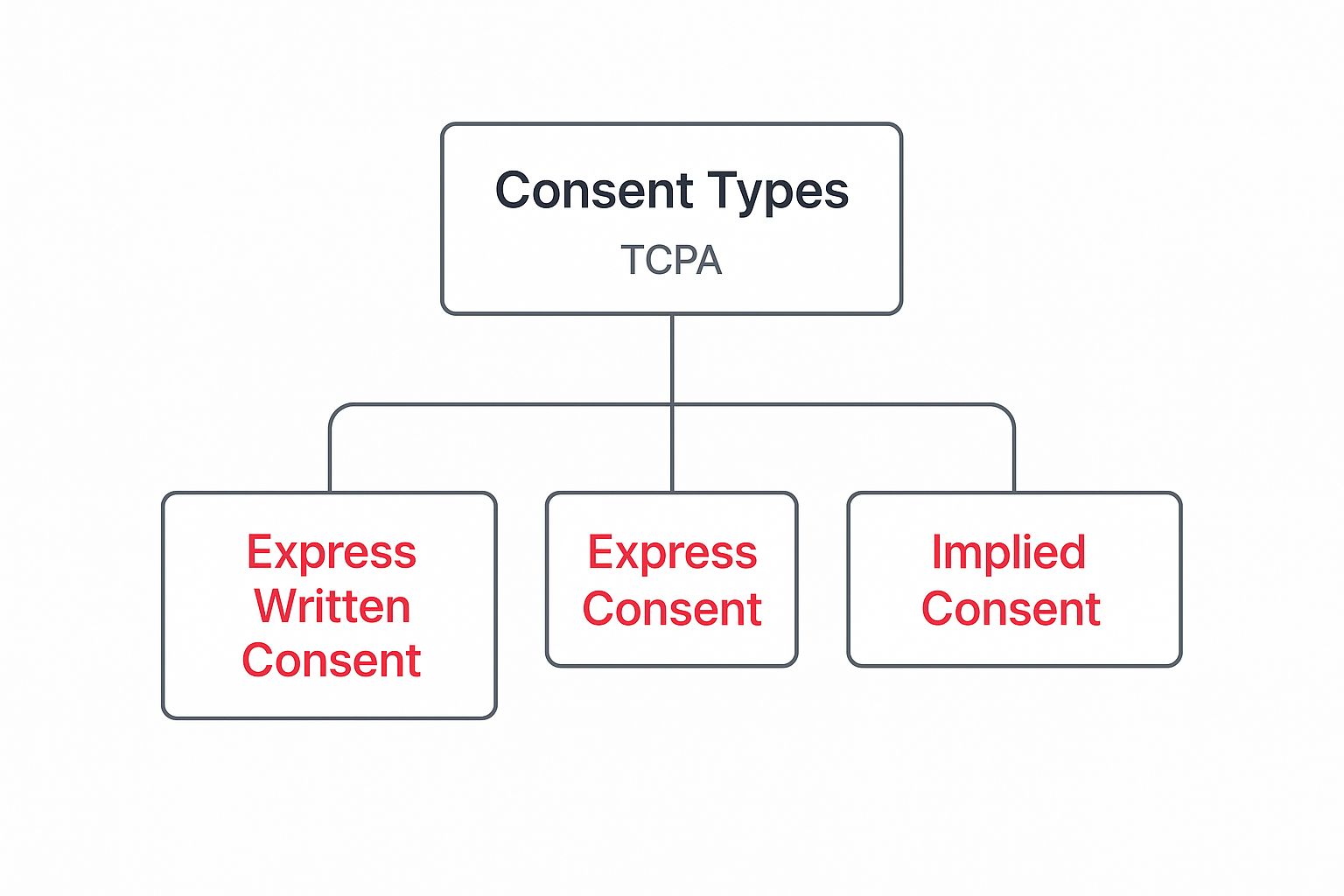
As you can see, Express Written Consent is in its own category for a reason. It sets a much higher bar than other forms of consent, which is exactly why it’s required for any promotional messages.
The second pillar is providing Clear Disclosures. Transparency is everything here. Right at the point of consent, you need to tell people exactly what they’re signing up for. This includes:
- Message Purpose: Be upfront that they will receive marketing or promotional texts.
- Message Frequency: Give them a ballpark idea of how often you’ll be in touch (e.g., “up to 4 messages per month”).
- Data Rates: Always include a disclaimer like “Message and data rates may apply.”
- Opt-Out Instructions: Let them know how they can unsubscribe easily.
These disclosures build trust and make sure your subscribers are fully in the loop, which goes a long way in preventing complaints down the road. For a full rundown, check out our deep-dive guide on SMS marketing compliance.
The Right to Say Stop
Finally, the third pillar is a Seamless Opt-Out Process. This is non-negotiable. Every single text you send must give people a simple, instant way to stop getting messages from you. The standard method is allowing users to reply with a keyword like “STOP,” “END,” or “UNSUBSCRIBE.”
Once a user opts out, you are legally required to honor that request immediately and add them to your suppression list. Sending even one more marketing message after a “STOP” request is a direct TCPA violation.
SMS marketing is an incredibly powerful tool, with open rates that often shoot past 90%. But with great power comes great responsibility. Both federal laws and mobile carriers have strict rules to clamp down on spam. Honoring those opt-outs instantly is just as important as getting consent in the first place.
The High Stakes of a TCPA Lawsuit
Ignoring the rules around TCPA and text messages isn’t just a bad idea; it’s practically asking for legal trouble. TCPA litigation has exploded in recent years, becoming its own thriving cottage industry. Specialized law firms are actively hunting for businesses that slip up on consent and opt-out rules.
These aren’t small claims court disputes. The vast majority are filed as class-action lawsuits, where a simple mistake—like texting a list without proper consent—can snowball into a multi-million-dollar nightmare.
The legal landscape is more active than ever. We’re now seeing hundreds of TCPA lawsuits filed every single month in the U.S., a huge jump from just a few years ago. A big chunk of these are class actions, pushed by firms and professional plaintiffs who aggressively chase down any potential violation. You can dig into the numbers to understand the current state of TCPA lawsuits.
Understanding the Financial Penalties
The financial consequences are severe and unforgiving. The law lays out statutory damages that can easily cripple a small or medium-sized business.
- For each negligent violation, fines start at $500 per text message.
- If a violation is found to be willful or knowing, the court can triple that to $1,500 per text.
Let’s put that into perspective. Imagine you send a single promotional text to a list of just 2,000 people without the right consent. If the court decides it was a willful violation, that one campaign could theoretically cost you $3 million ($1,500 x 2,000). The math is simple, and the numbers add up terrifyingly fast.
And remember, these penalties apply to each individual message. Sending a series of texts to the same person can rack up multiple violations, compounding the financial risk with every single “send.”
This isn’t just a scary thought experiment. Major, well-known brands have settled class-action lawsuits for tens of millions of dollars, all because of simple errors in their SMS marketing programs.
Common Lawsuit Triggers You Must Avoid
While failing to get prior express written consent is the biggest and most common mistake, a few other actions are notorious for triggering lawsuits. Knowing these common traps is the first step in building a solid defense.
- Texting After an Opt-Out Request: This one is a no-brainer. If someone replies with “STOP,” you have to honor it immediately. Sending even one more promotional text after that is a clear-cut violation.
- Lack of Clear Disclosures: You have to be upfront when someone signs up. Failing to clearly state how often you’ll text or that data rates may apply is an easy way to get into hot water.
- Texting Reassigned Numbers: This is a sneaky one. You might have consent from a user, but if they change their phone number and it gets reassigned to someone new, any text you send to that number is now a violation.
Staying compliant isn’t just about following rules. It’s the only way to protect your business from devastating financial penalties and the kind of reputational damage that can be hard to recover from.
Common Ways Businesses Accidentally Violate TCPA
Understanding the rules of TCPA and text messages is one thing, but seeing how easily well-intentioned businesses can trip over them is another. Most violations don’t happen because a company is trying to be sneaky. They happen because of common, everyday business practices that seem totally harmless on the surface. Without a solid grasp of how consent works, it’s surprisingly easy to make a very expensive mistake.
Think about a local boutique that asks for your phone number at the counter to text you a digital receipt. Smart, right? But a few months later, their marketing team gets the bright idea to use that same list to blast out a text about their big summer sale. That’s a classic violation. Just because a customer said yes to a transactional message (like a receipt) doesn’t mean they agreed to get promotional marketing texts.
The Problem with Reused Consent
Another frequent slip-up is mishandling customer data. Imagine an online brand buys a list of phone numbers from another company, thinking the consent those customers gave to the first business just carries over.
Under TCPA, consent is not transferable. You have to get express written consent directly from each person, for your specific brand. Texting a purchased list without getting that direct permission yourself is like buying a fast-pass to a lawsuit.
This isn’t just about bought lists, either. It applies to your own customers, too. A shopper might agree to get texts about their shipping status, but that doesn’t automatically give you the green light to ping them with marketing promos or abandoned cart reminders. Every type of communication needs its own clear, explicit consent. If you’re looking to win back sales with texts, you have to build your strategy on a compliant foundation from the very start, which we break down in our guide to effective abandoned cart SMS practices.
The Reassigned Number Trap
One of the sneakiest and most common ways businesses accidentally break the rules involves reassigned phone numbers. This one can catch even the most careful companies off guard.
Here’s the scenario:
- You get valid, documented consent from a customer to send them marketing texts. You did everything right.
- That customer changes their number, but they don’t tell you.
- The mobile carrier recycles that old number and gives it to someone completely new.
The very next promotional text you send hits the new person’s phone, and—boom—that’s a TCPA violation. The consent you had was with the original person, not the phone number itself. Since the new owner never gave you permission, your message is unsolicited. This exact situation is a massive source of TCPA lawsuits because people who get random marketing texts on their new number are often quick to complain.
The Fine Line in Communication
Businesses also get into trouble when a simple conversation takes a turn into marketing territory. For example, a customer might text your support line asking for help with an order they placed. Your support agent sorts out the problem and then, trying to be helpful, adds, “By the way, we have a 20% off sale this weekend!”
While it seems like friendly customer service, that conversation just crossed the line into promotion. Without prior express written consent for marketing messages, that simple upsell becomes a technical violation. These real-world examples show that TCPA compliance is about more than just checking a box. It means carefully managing every single customer text and having a deep respect for the boundaries of their consent.
Using Technology to Automate TCPA Compliance
Trying to manually track consent, manage opt-outs, and keep perfect records for every single text you send is a huge undertaking. Honestly, it’s a recipe for human error. Under the TCPA, just one small slip-up can lead to massive financial penalties. This is exactly why modern SMS marketing platforms are no longer a “nice-to-have”—they’re essential.
These platforms do a lot more than just send messages. They are designed from the ground up to automate the tricky requirements of TCPA and text messages. They turn compliance from a stressful, manual checklist into a seamless process that just runs in the background.
Built-In Compliance by Design
The biggest win of using a dedicated SMS platform is that compliance features are baked right into its core. Think of it as having a digital compliance officer working for you 24/7. This tech handles the most critical and risk-prone parts of SMS marketing automatically.
Here’s how these platforms act as your first line of defense:
- Automated Consent Management: They create clear, undeniable records of consent. Many use double opt-in flows where a user has to confirm their subscription twice, creating an ironclad audit trail you can rely on.
- Instant Opt-Out Processing: When a customer replies with a keyword like ‘STOP,’ the system immediately adds them to a permanent suppression list. No human has to touch it, which gets rid of the risk of accidentally texting someone who opted out.
- Meticulous Record-Keeping: Every single consent, sent message, and opt-out request is logged with a timestamp. This detailed trail is priceless if you ever need to defend your SMS practices against a legal challenge.
The image below shows a typical dashboard from a compliance-focused platform like CartBoss. You can see how analytics and user data are tracked, giving you a clear view of your activities.

This kind of detailed reporting gives you the proof you need to show that every message was sent with proper consent and that opt-outs were honored instantly.
Advanced Automation for Complex Rules
Beyond the basics, good SMS tools tackle some of the trickiest compliance hurdles businesses run into. One of the most common—and dangerous—traps is texting reassigned numbers. This is a frequent trigger for TCPA lawsuits.
Manually checking every single phone number on your list is impossible. Technology solves this problem by plugging directly into the official Reassigned Numbers Database (RND), automatically scrubbing your lists to remove numbers that have changed owners.
This one feature alone can prevent countless potential violations. By automating this check, you ensure you’re always messaging the person who actually gave you their consent, not some stranger who inherited their old number. To see how these automated workflows fit into a broader strategy, it helps to understand the fundamentals of SMS marketing automation and how it applies to both marketing and compliance.
Ultimately, the right technology removes the guesswork and the liability from the equation. Instead of constantly worrying about legal pitfalls, you can focus on what you do best: building relationships with your customers and growing your business. A solid platform ensures your SMS program isn’t just effective, but also safe, scalable, and fully compliant.
Building a Compliant and Profitable SMS Program
Let’s clear something up: the rules around TCPA and text messages aren’t there to stop you from using SMS marketing. Far from it. The goal is to make sure you’re communicating respectfully and building an audience of people who actually want to hear from you.
When you start looking at compliance as a business strategy instead of just a legal hoop to jump through, everything changes. It transforms SMS from a potential headache into a seriously profitable, long-term channel. Why? Because when customers give you their explicit permission to text them, they’re already bought in. They’re way more likely to open your messages, click your links, and pull out their credit cards. This focus on a permission-based audience is the secret to sky-high conversion rates and a killer return on investment.
Core Best Practices for Success
To keep your SMS program healthy and humming along, you need to weave a few key practices into your daily routine:
- Audit Your Consent Records Regularly: Don’t just get consent and then forget about it. Make it a habit to go back and check your records. You need to be sure every single contact has a clear, documented opt-in that meets TCPA standards.
- Train Your Whole Team: Anyone who talks to customers—from your marketing crew to your support agents—needs to know the basics of TCPA. Make sure they understand the non-negotiables, especially the rules around getting consent and honoring opt-outs.
- Be Radically Transparent: Always be straight with your subscribers. Tell them exactly what kind of messages they can expect and how often they’ll get them. This simple act of honesty builds a ton of trust and keeps complaints at bay.
The single most important step you can take? Partner with a solid SMS platform that has compliance baked right into its DNA. Tools like CartBoss are built for this. They automate how you manage consent, handle opt-out requests the second they come in, and keep detailed records for you, taking all the guesswork out of staying compliant.
At the end of the day, a compliant SMS program doesn’t just keep you out of legal hot water—it flat-out performs better. You’re respecting customer boundaries, which builds genuine brand loyalty and creates a revenue stream you can actually count on. By putting compliance first, you’re not just playing defense; you’re investing in the future health and profitability of your business.
A Few Common Questions About TCPA and Text Messages
Diving into the world of TCPA and text messages can feel a bit like navigating a legal maze. It’s totally normal to have questions. Let’s clear up some of the most common ones that business owners run into.
What Really Counts as Express Written Consent?
Don’t let the word “written” throw you off—you don’t need to chase down customers for an actual pen-and-paper signature. In the eyes of the TCPA, consent is valid as long as it’s crystal clear, unambiguous, and you have a record of it.
Think of it as any action where a customer knowingly and willingly says “yes” to your marketing texts.
Common examples look like this:
- Checking a box on a website form that plainly states they agree to receive marketing texts.
- Texting a keyword like ‘JOIN’ or ‘START’ to your business number.
- Putting their phone number into a form that has clear disclosure language right next to it.
Do Transactional Messages Fall Under TCPA Rules?
This is where things can get a little tricky. On the surface, messages about shipping updates or appointment reminders have different consent rules than your big promotional blasts. But that line between transactional and marketing can blur very quickly.
The absolute safest and most recommended approach? Get express written consent for all your text communications, period. This simple strategy wipes out any gray areas and gives your business the strongest possible legal footing.
How Often Should I Be Scrubbing My SMS List?
While the TCPA doesn’t give a hard-and-fast deadline, keeping your list clean is non-negotiable. Think of it as proactive maintenance. Regular list hygiene is your best defense against texting a reassigned number, which is a surprisingly common—and expensive—violation. For more tips on this, check out our guide to SMS marketing best practices.
As a rule of thumb, make it a habit to clean your lists at least every 30-60 days. This means getting rid of inactive numbers and, just as importantly, cross-checking your contacts against the official Reassigned Numbers Database (RND).
Ready to turn those abandoned carts into revenue without the compliance headaches? CartBoss automates SMS marketing the right way. We’ve built in features to keep you compliant while you focus on boosting your sales. Start recovering lost sales today!
