


A text sign up is simply a way for you to collect a customer’s phone number, along with their permission, so you can send them marketing messages. Think of it as the starting line for any serious SMS marketing strategy. It’s how you build a list of people who actually want to hear from you, creating a direct line of communication that completely sidesteps the chaos of a crowded email inbox.
Why Text Sign Up Is a Non-Negotiable E-Commerce Channel
Let’s cut through the noise and talk about what actually works. For any e-commerce brand trying to grow, SMS marketing has become an absolute necessity, and it all kicks off with that initial text sign up. This isn’t just another channel to manage; it’s your most direct connection to your customer, slicing right through the endless scroll of social media and the mountain of email promos they get every day.
The real magic of SMS is its immediacy. When your phone buzzes with a text, you look. It’s almost a reflex. This simple human behavior is what gives SMS marketing such insane engagement rates. While a good email campaign might see a 20-30% open rate, SMS messages boast an open rate of up to 98%. Even better, most of those texts are read within just a few minutes of landing on someone’s phone, giving you a golden opportunity to drive immediate action.
The Shift to Direct Mobile Outreach
The move toward text-based communication isn’t just a fleeting trend. As businesses hunt for more direct ways to engage with customers on their phones, SMS has exploded. By 2025, it’s projected that 5 to 5.9 billion people across the globe will be sending and receiving texts. That’s a staggering 65–74% of the world’s population.
This massive, engaged audience is why text sign-up programs have become such a core strategy. Recent industry reports show brands are seeing opt-in rates between 50–86% when they ask customers to subscribe. This is a clear signal that people are open to it when it’s done right.
We have to stop thinking about the text sign-up process as just a way to build a list. It’s the groundwork for building a profitable, highly engaged community around your brand.
Building your SMS list is like establishing a VIP club for your best customers. It’s a consent-based relationship where you offer exclusive value in exchange for direct access, creating a powerful loyalty loop.
Building a Foundation for Growth
A smart text sign-up strategy does a lot more than just secure high open rates. It opens up a powerful, two-way street that benefits both you and your customer. For your brand, it’s a direct path to higher conversions and a much better customer lifetime value. For your customers, it’s a super convenient way to get timely updates, exclusive deals, and personalized service without having to dig through their email.
To really nail this, you have to focus on a few key things:
- Legal Compliance: This is non-negotiable. You have to capture subscribers lawfully from day one.
- Valuable Incentives: Give people a genuinely good reason to hand over their number. A weak offer won’t cut it.
- Strategic Nurturing: Once they’re on your list, send them messages they actually want to receive. Don’t just blast promos.
Master these, and you’ll turn a simple phone number into one of your most powerful marketing assets. If you want to dig deeper into the specific advantages, check out our guide on the core benefits of SMS marketing.
Navigating SMS Compliance Without the Headaches
Before you start sending out exclusive deals and timely updates, you have to get your customers’ permission. This isn’t just a friendly suggestion; it’s a legal requirement that protects both your brand and your subscribers. Diving into SMS compliance might sound like a chore, but it’s actually the best way to build a solid foundation of trust right from the start.
Think of compliance less like a roadblock and more like a quality filter. It ensures you’re only messaging people who genuinely want to hear from you. The result? Higher engagement, better conversion rates, and a much healthier subscriber list. On the flip side, ignoring these rules can lead to massive fines and do permanent damage to your brand’s reputation.
The golden rule behind every SMS regulation is express written consent. This simply means you need clear, undeniable permission from someone before you can send them marketing texts. It’s the digital version of a signed contract, and it’s completely non-negotiable.
The Big Three Regulations to Know
While rules can vary by location, three main regulations shape most e-commerce SMS marketing. Getting the gist of these is key to setting up your sign-up forms correctly.
- TCPA (Telephone Consumer Protection Act): This is the big one in the U.S. It demands you get express written consent before sending any automated marketing texts. It also requires you to provide clear opt-out instructions, like texting “STOP.”
- GDPR (General Data Protection Regulation): Selling to customers in the European Union? GDPR is your rulebook. It’s even stricter, requiring consent to be freely given, specific, informed, and unambiguous. Pre-checked boxes are a huge no-no under GDPR.
- CCPA (California Consumer Privacy Act): This law gives California residents more control over their personal data. It means you have to be transparent about what data you collect—including phone numbers for marketing—and why you’re collecting it.
These regulations aren’t set in stone. They’re constantly evolving as carriers and regulators tighten the rules around sender verification and consent. This has meant some increased upfront costs for businesses, but it’s also led to a much better, more secure sign-up experience for everyone.
What Does “Express Written Consent” Actually Look Like?
So, how do you get this all-important consent? It all comes down to using clear, specific language right where you collect the phone number—be it a popup, a checkout checkbox, or a dedicated landing page. Your disclosure language has to be impossible to miss and dead simple to understand.
Here’s exactly what your sign-up form needs to include:
- A clear statement that the user is agreeing to receive recurring automated marketing messages.
- Your brand’s name—who is sending the texts?
- A notification that consent is not a condition of purchase.
- Links to your Privacy Policy and Terms of Service for full transparency.
- Info on message frequency and a heads-up that message and data rates may apply.
Pro Tip: Never, ever use pre-checked boxes for your SMS opt-in. The customer must physically take the action of checking the box themselves. This is a critical detail for both TCPA and GDPR compliance.
Let’s make this practical. Imagine a customer on your checkout page. Here’s the difference between doing it wrong and doing it right.
Non-Compliant Example (Vague and risky):
[ ] Sign up for updates!
Compliant Example (Clear and specific):
[ ] Text me with news, offers, and promotions from [Your Brand Name]. By checking this box, I agree to receive recurring automated marketing text messages at the phone number provided. Consent is not a condition of purchase. Msg & data rates may apply. View Terms & Privacy.
The difference is night and day. The compliant version leaves no room for confusion, protecting your business and respecting your customer. This isn’t just about dodging fines; it’s about building a better, more trustworthy relationship from the very first text.
For a deeper dive into all the nuances, check out our comprehensive guide on SMS marketing compliance.
Choosing The Right Channels To Capture Subscribers
Your customers are everywhere, so your sign-up forms should be too. Building a healthy SMS list isn’t about finding one magical spot for an opt-in form. It’s about creating a web of opportunities that meets customers right where they are, naturally. A multi-channel approach means you’re capturing interest at every single stage of their journey—from curious first-time visitors to your most loyal buyers.
Let’s break down the four most effective channels for growing your SMS list. Each one has a different job, but when you combine them, you get a powerful, always-on machine for bringing in new subscribers. This is all about being present without being pushy, making the sign-up a seamless part of their shopping experience.
Website Popups The Right Way
We all know website popups have a bit of a bad reputation, and honestly, for good reason. An aggressive, poorly timed popup can instantly annoy a potential customer and send them running for the “back” button. The secret is to be strategic, not disruptive. Don’t just blast every visitor the moment they land on your site; use smart triggers instead.
Here are a few tactics I’ve seen work time and time again:
- Exit-Intent Popups: This is my favorite, most respectful approach. The popup only shows up when a user’s cursor zips toward the top of the browser, signaling they’re about to leave. Think of it as a friendly, last-ditch effort to keep them around before they vanish.
- Time-Delayed Popups: Give people a chance to breathe. Set your popup to appear after someone has been on your site for a bit, say 30 or 45 seconds. This lets them browse and actually see what you’re about before you ask for their number.
- Scroll-Based Popups: This one’s smart. Trigger the popup only after a user has scrolled down a good chunk of a page, like 50%. It’s a clear sign they’re engaged with your content and probably more open to hearing from you.
And remember, the design of your popup matters just as much as its timing. Keep it clean, on-brand, and laser-focused on one compelling call-to-action. Be crystal clear about the incentive—whether it’s 15% off, free shipping, or early access—and make sure the compliance text is easy to find and read.
Seamless Checkout Opt-Ins
The checkout page is pure gold for collecting subscribers. Customers who make it this far have serious intent; their cart is full, and they’re ready to pull the trigger. Slipping a simple, unchecked checkbox into your checkout flow on Shopify or WooCommerce is one of the single most effective ways to grow your list with high-quality contacts.
Since they’re already typing in their personal details, asking for a phone number for marketing updates feels natural and low-friction. The absolute key here is explicit consent. Your opt-in box must have clear, compliant language explaining exactly what they’re signing up for. No funny business.
Crucial Insight: Subscribers you gain at checkout are incredibly valuable. They’ve already proven they love your products enough to buy them, making them prime candidates to convert on future SMS campaigns and become repeat customers.
Offline-to-Online Text-to-Join Keywords
Your marketing doesn’t just live on your website. If you have any kind of physical presence—a brick-and-mortar store, a booth at a market, or even just product packaging—you have a killer opportunity to turn those real-world interactions into digital subscribers. This is where text-to-join keywords really shine.
The concept is simple: you promote a unique keyword (like “SAVENOW”) that customers text to a specific phone number (a short code or 10DLC number) to join your list. It’s perfect for:
- In-store signs right by the cash register
- Flyers or little cards tucked into product packaging
- Banners at trade shows or community events
For instance, a local coffee shop could have a sign that says, “Text PERKS to 555-1234 for a free espresso shot on your next order!” It’s immediate, interactive, and gives the customer an instant win.
To get a wider perspective on how different methods can build your audience, it’s worth exploring various effective lead generation strategies.
QR Codes The Modern Keyword
QR codes are back in a big way, essentially acting as a visual, scannable version of a text-to-join keyword. A customer just points their phone’s camera, scans the code, and is whisked away to a pre-filled text message or a sign-up page.
This visual shortcut eliminates the hassle of manually typing a number and keyword. You can stick QR codes on product labels, receipts, direct mailers, or even on a table tent at a cafe. They effortlessly connect the physical and digital worlds. If you want to dive deeper into tactics for list growth, check out our guide on collecting phone numbers for SMS marketing.
Each sign-up channel has its own strengths, but it’s important to understand how they compare at a glance.
Comparing Text Sign Up Channels
| Channel | Best For | Implementation Effort | Typical Conversion Rate |
|---|---|---|---|
| Website Popups | Capturing top-of-funnel visitors and building a broad list. | Low (with the right app) | 1-5% |
| Checkout Opt-In | Acquiring high-intent customers ready to make a purchase. | Low (native in Shopify/Woo) | 10-25%+ |
| Text-to-Join | Converting offline traffic from physical stores or events. | Medium (requires promotion) | Varies by foot traffic |
| QR Codes | Bridging physical products and packaging with digital sign-ups. | Low-to-Medium | Varies by placement |
While each method can stand on its own, their real power is unlocked when they work together. By offering multiple, convenient ways for people to join your SMS list, you build a robust system that continually captures engaged subscribers and fuels your e-commerce growth.
Before you send a single message, though, you need to have consent locked down. This decision tree shows the basic compliance check that has to happen every single time.
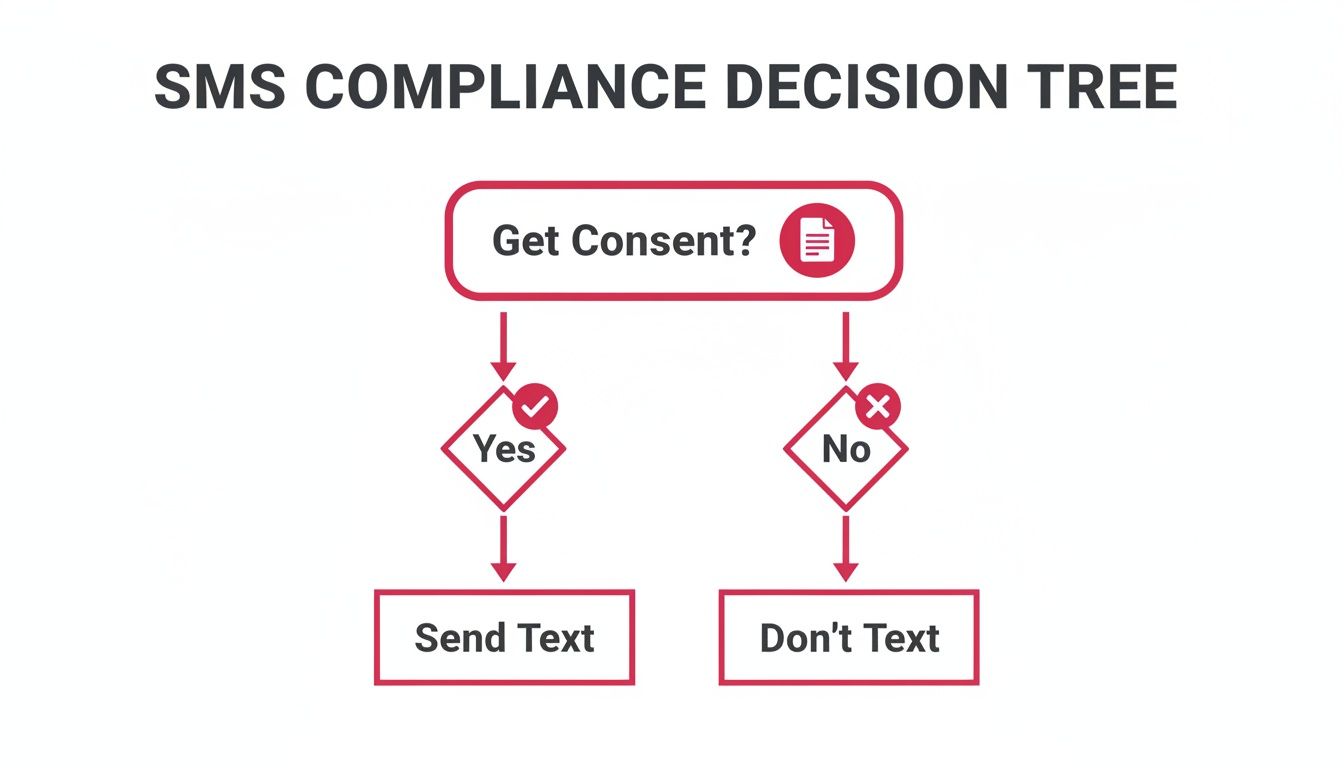
As the visual makes clear, getting and documenting user consent isn’t just a good idea—it’s the non-negotiable first step in any legitimate SMS strategy.
Crafting Offers That Make People Want to Sign Up
Let’s be honest, a customer’s phone number is sacred ground. They guard it way more closely than their email address, which means asking for it is a pretty big deal. If you want someone to actually complete your text sign-up form, you need to make them an offer they can’t refuse—a fair trade for a direct line to their pocket.
The old “10% off your next order” can still get the job done, but it’s feeling a little tired. Shoppers see it everywhere, and frankly, it’s often not compelling enough to get them to act. The real trick is to create an incentive that not only feels valuable but also makes sense for your brand and your profit margins.
Moving Beyond the Standard Discount
While a simple percentage off is easy, other types of offers can feel much more exciting and do a better job of protecting your bottom line. You have to get inside your customer’s head. What do they really want? Is it saving a few bucks on shipping, or is it the feeling of being an insider?
Here are a few powerful incentives that go way beyond the basic discount:
- Free Shipping: This one is a psychological powerhouse. Study after study shows that people will literally spend more money just to avoid paying for shipping. Offering it up as a sign-up bonus can be a massive motivator, especially if shipping costs are a known friction point for your customers.
- A Specific Dollar Amount Off: An offer like “$15 off your first order of $75+” often feels more concrete and substantial than a percentage. It gives the customer a real number to latch onto, making the savings feel more immediate and tangible.
- Exclusive Access: This is all about tapping into the fear of missing out (FOMO). You could offer early access to new product drops, entry into a members-only part of your site, or first dibs on limited-edition items. It makes your subscribers feel like genuine VIPs.
- Free Gift with Purchase: Tossing in a small, high-margin item as a freebie for new SMS subscribers is a fantastic way to boost perceived value. Think of a beauty brand offering a free sample-sized serum—it feels like a treat.
The right offer is going to be different for every business. A brand with tighter margins might find that free shipping is way more sustainable than a steep discount. On the other hand, a hype-driven apparel brand could see a huge response from an “early access” offer.
Your sign-up incentive isn’t just a bribe; it’s the first promise you make to a new subscriber. Make it a good one. It sets the tone for the entire relationship and shows them that being on your list is a genuinely rewarding experience.
Nailing the Welcome Message
So you’ve earned that sign-up. Awesome! But the very next step is just as critical: the welcome message. This first text is your one shot to make a great first impression, deliver on your promise, and set expectations for what’s next. A weak or delayed welcome text can get you an unsubscribe before you’ve even started.
Your welcome message needs to do three things, and it needs to do them fast:
- Confirm the Subscription: Start by welcoming them and confirming they’re officially on your SMS list.
- Deliver the Offer: Immediately give them the discount code or the link they were promised. Don’t ever make them wait for it.
- Set Expectations: Briefly mention what kind of messages they can expect and be sure to include the required compliance info, like how to opt out.
Here are a few proven templates you can tweak for your own brand:
Example 1: The Classic Discount
[Your Brand]: Welcome! ✨ Thanks for signing up. Use code WELCOME15 for 15% off your first order. We'll text you with new drops & exclusive deals. Txt STOP to unsub.
Example 2: The Free Shipping Offer
[Your Brand]: You're in! Free shipping on your next order is officially unlocked. Shop now: [link]. We're excited to have you! Txt STOP to cancel.
Example 3: The VIP Access
[Your Brand]: Welcome to the club! You now have early access to all our new releases. We'll text you before anyone else. Stay tuned! Txt STOP to unsub.
Notice a pattern? Each one is friendly, direct, and provides value right away. This first interaction makes them feel good about their decision to sign up and starts building a positive connection from day one.
For more ideas on how to frame these offers, our guide on text message coupons provides additional templates and strategies you can use. By carefully selecting your offer and perfecting that first message, you create a powerful entry point for a long-lasting and profitable customer connection.
Putting Your SMS Strategy on Autopilot

Getting someone to sign up for texts is just the first step. A healthy subscriber list is great, but the real magic happens when you put your messaging on autopilot. This is how you create smart, responsive flows that engage customers and drive sales 24/7, even while you’re asleep.
This is what turns a simple SMS list into a powerful, revenue-generating machine.
These automated flows, sometimes called “drips” or “journeys,” are just pre-built message sequences triggered by specific customer actions. Instead of manually blasting out texts, you set the rules once, and the system handles the rest. This ensures every single subscriber gets a timely, relevant message at the most critical moments.
The E-commerce Automation Trinity
For any online store, there are three essential automated flows that deliver the biggest results. If you do nothing else, get these three set up and running. They cover the entire customer journey, from that first spark of interest to post-purchase loyalty.
- The Welcome Series: Think of this as your digital handshake. It’s a series of messages that fires off the moment someone subscribes. It confirms their sign-up, delivers their incentive, and gives them a quick introduction to your brand’s story.
- Abandoned Cart Reminders: This is where SMS really flexes its muscles. When a shopper adds items to their cart but bails without buying, this flow sends a few gentle, persuasive reminders to bring them back. Platforms like CartBoss are built specifically for this and make it incredibly easy to recover sales you would have otherwise lost.
- Post-Purchase Follow-Ups: The conversation shouldn’t stop after the purchase. This flow kicks in after a customer buys to thank them, ask for a review, or maybe even offer a discount on their next order. It’s a killer way to build real loyalty and drive repeat business.
By automating these core touchpoints, you ensure no opportunity is missed. You’re consistently engaging customers with the right message at the right time, which is the secret to scaling your SMS revenue effectively.
Getting Started with Simple Segmentation
Once your core automations are humming along, the next step is segmentation. It sounds technical, but it’s really just about sending more relevant messages by grouping subscribers based on what they do. A customer who has bought from you five times shouldn’t get the same message as someone who just signed up yesterday.
It’s just like having a real conversation—you wouldn’t talk to a total stranger the same way you’d talk to a good friend.
Here are a few simple segments you can build right away:
- New Subscribers: People who joined in the last 30 days and haven’t bought anything yet.
- First-Time Buyers: Customers who have made exactly one purchase.
- VIP Customers: Your most loyal shoppers, maybe based on total spend or number of orders.
- Inactive Subscribers: Anyone who hasn’t opened a message or clicked a link in the last 90 days.
When you tailor messages to these groups, your texts feel less like a broadcast and more like a personal tip. You could send a special “thank you” offer just to your VIPs or a re-engagement campaign to your inactive list. This level of personalization is what separates good SMS marketing from great SMS marketing. For a deeper dive, our guide on SMS marketing automation covers these ideas in much more detail.
To really get your entire content and engagement strategy working together, checking out the top Social Media Automation Platform can be a game-changer. By automating these key interactions, from the initial sign-up to long-term loyalty, you build a system that works for you around the clock.
Alright, let’s get down to business. Launching your SMS sign-up system isn’t the final step—it’s just the beginning. If you want to turn that list of phone numbers into a real, consistent source of revenue, you have to know what’s hitting the mark and what’s completely missing it.
You can’t fix what you can’t see. The only way to make smart, profitable decisions for your text marketing is to track the right data. This isn’t about drowning in a sea of numbers; it’s about zeroing in on the handful of metrics that actually tell you if your strategy is working.
Key Metrics That Actually Matter
Your SMS platform’s dashboard is probably overflowing with data, but you only need to focus on a few key performance indicators (KPIs) to get the real story. Keep a close eye on these, because they directly show you how well your sign-up methods and messages are performing.
- Subscriber Growth Rate: This is the heartbeat of your list-building efforts. A steady climb means your popups, keywords, and checkout opt-ins are connecting with customers. If this number starts to flatline, it’s a glaring sign that you need to go back and tweak your acquisition channels.
- Click-Through Rate (CTR): This one’s simple: how many people clicked a link in your message? A healthy CTR, which is typically 5-10% or higher for SMS, tells you the offer and call-to-action were strong enough to get people to act.
- Conversion Rate: Here’s the metric that pays the bills. It tracks the percentage of people who actually bought something after clicking your link. If this number is low, it could mean your offer isn’t compelling enough, or there’s a problem with your landing page experience.
- Unsubscribe Rate: A few people opting out is perfectly normal, but a sudden jump is a major red flag. It’s usually a sign you’re sending too many messages, the content isn’t relevant, or the value you promised at sign-up isn’t matching what you’re delivering.
These numbers are your diagnostic tools. A high unsubscribe rate screams, “dial back the frequency!” while a low CTR is a clear hint that your message copy needs a serious refresh.
Think of your SMS metrics as a direct feedback loop from your customers. They’re telling you exactly what they like and what they don’t with their clicks and purchases. Listen up.
Optimizing with Simple A/B Testing
Once you have a grip on your baseline numbers, you can start making targeted improvements with A/B testing. It sounds technical, but it’s just creating two versions of a message or sign-up form—an “A” version and a “B” version—and showing each to a different group of people to see which one works better.
You don’t need a complicated lab setup for this. Just start with small, focused tests that give you clear answers.
- Test Your Sign-Up Incentive: Is 15% off more tempting than free shipping? Run one popup for a week, then switch to the other. See which one pulls in more subscribers. The winner might not be what you expect.
- Experiment with Message Copy: Pit a direct, benefit-focused headline against one that creates a sense of urgency. For an abandoned cart message, you could test something like “Your cart is waiting!” against “Your items are selling out fast!” and see which one drives more people back to checkout.
- Optimize Send Times: Does a text sent at 10 AM on a Tuesday get more action than one sent at 7 PM on a Thursday? Test different days and times to discover that sweet spot when your audience is most likely to be on their phones and ready to shop.
By testing one thing at a time, you methodically sharpen every part of your SMS program. This data-driven approach takes all the guesswork out of the equation, making sure your text sign-up strategy is always getting better and delivering the best possible results.
Your Top Questions About SMS Sign-Ups, Answered
Getting started with SMS? You’ve probably got a few questions. Let’s tackle two of the most common ones we hear from store owners.
Can I Text Customers Who Gave Me Their Number For Shipping?
This is a big one, and the answer is a hard no. You absolutely cannot use a phone number collected for shipping updates for your marketing messages.
Think of it this way: transactional consent (for shipping, order updates) is completely separate from marketing consent. To stay compliant and build trust, you need to get explicit, separate permission from your customers before you send them a single promotional text.
How Much Does An SMS Program Cost?
The cost really depends on the platform you choose, but it’s more accessible than you might think. Most providers offer tiered plans that scale with your business, usually based on your subscriber count or the number of messages you send per month.
The best part? Many of these platforms have generous free trials or entry-level plans. This makes it a no-brainer for any store to dip their toes in the water, test out the channel, and start seeing a return on their investment right away.