


Good text message wording is the key to unlocking conversions. It needs to be direct, feel personal, and push the customer to take a specific action. Done right, it slices straight through the noise of a packed email inbox, delivering a message that feels both urgent and important.
The Untapped Power of Conversational SMS in E-Commerce
Let’s be real for a second. Your customer’s email inbox is a battlefield, overflowing with promotions they will probably never open. This is exactly where SMS marketing completely changes the game. It moves beyond just hoping for an open and creates a direct line to your customer that feels more like a real conversation than a generic ad blast.
The psychology behind it is straightforward: text messages are personal. They land on the most private device we own, and that closeness creates an immediate sense of importance that email just can’t replicate.
SMS vs Email Engagement: A Quick Comparison
To put it in perspective, let’s look at a side-by-side comparison of how SMS and email stack up in the real world.
| Metric | SMS Marketing | Email Marketing |
|---|---|---|
| Open Rate | Up to 98% | Around 20% |
| Time to Open | 90 seconds on average | 90 minutes on average |
| Click-Through Rate | 25-45% on average | 2-3% on average |
| Customer Preference | Preferred channel for urgent updates & offers | Often seen as cluttered and less immediate |
This table makes it crystal clear why SMS is such a powerhouse for e-commerce brands. It’s not just about reaching people; it’s about reaching them now.
Why SMS Just Hits Different
This isn’t just a hunch; the data backs it up completely. We’re seeing a massive shift in how people want to connect with brands. Effective text message wording isn’t just friendly chatter—it’s a serious business tool.
Consider this: 91% of customers are actually open to receiving texts from brands they like, and a staggering 82% read them within five minutes of getting them. As of this year, 83% of consumers say texting is their number one activity on their phones, a trend that’s been climbing for years.
This kind of instant engagement is a golden opportunity for e-commerce stores. Instead of just pushing out sales announcements, you can start genuine, strategic conversations that build actual loyalty.
- Recover Lost Sales: A friendly nudge to a shopper who abandoned their cart can make all the difference.
- Build Lasting Trust: Proactive shipping updates keep customers in the loop and reduce “where’s my order?” support tickets.
- Drive Repeat Business: Exclusive deals sent via SMS make past buyers feel like VIPs and keep them coming back.
The real magic of SMS is its ability to feel like a one-on-one chat, even when it’s fully automated. It’s all about meeting customers where they already are, on a channel they use every day for personal connections.
The key to making this work at scale is automation. You can’t manually text every single customer. Tools like CartBoss are designed to do the heavy lifting, turning abandoned carts into completed sales while you focus on other things. This is the core of modern conversational text messaging, where the goal is to guide and convert, not just broadcast. The possibilities grow even more when you branch out into strategies like automated SMS marketing for Facebook leads, which can turn a simple click into an immediate, engaging conversation.
Anatomy of an Unforgettable Text Message
Crafting a text message that actually converts isn’t some happy accident. A high-converting SMS is a carefully built tool, with a few key pieces that have to work together perfectly. It’s less about a rigid formula and more about understanding what actually pushes a customer to take action.
This simple flowchart shows just how powerful a well-written text can be, moving a customer from receiving the message to making a sale in just a few steps.
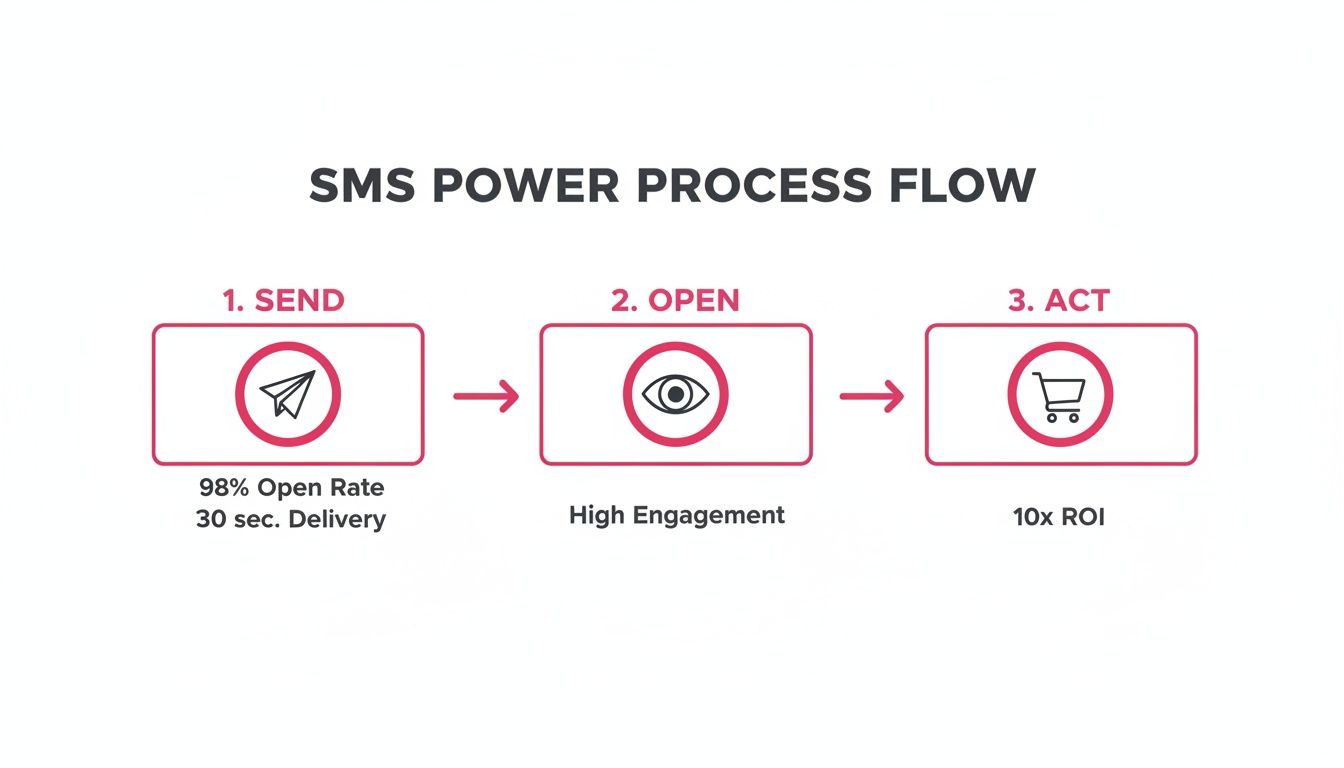
The path from sending the message to getting that conversion is incredibly direct. That’s why every single part of your text matters so much.
A Single, Clear Objective
Every single message you send needs one—and only one—goal. Are you trying to recover an abandoned cart? Announce a flash sale? Or just give a quick shipping update? Trying to cram too much into a single text will just confuse your customer and kill the message’s impact.
Think about a cart recovery text. Its only job is to get that shopper to finish their purchase. That’s it. Every word should be focused on that one goal. A message like “Hey, you forgot something! Complete your order now” is direct, focused, and gets the job done.
The best SMS messages are laser-focused. Before you type a single word, ask yourself: “What is the one thing I want the customer to do?” If you can’t answer that in one sentence, you need to simplify.
Keeping it focused also helps you stay within the ideal character count. If you want to dive deeper into how message length can affect deliverability and cost, check out our guide on decoding the SMS character limit.
The Right Tone and Personalization
Tone is absolutely everything in a text. It has to match your brand’s voice. Are you playful and fun? Helpful and straightforward? High-end and exclusive? An SMS should feel like a quick note from a person, not a corporate broadcast. A casual, friendly tone usually works best to build a real connection.
Personalization is way more than just dropping in the customer’s first name. Real personalization means referencing what they actually did. Mentioning the specific items they left in their cart makes the message feel hyper-relevant and shows you’re paying attention.
This is what strong personalization looks like:
Hi Sarah, still thinking about the Sunset Glow Lamp in your cart? It’s waiting for you! Grab it before it’s gone: [Link]
See how much better that feels than a generic, “You left items in your cart“?
An Irresistible Call to Action
The Call to Action (CTA) is the most critical part of your message. It has to be crystal clear, compelling, and super easy to act on. Vague CTAs like “check it out” are weak and get ignored. You need action-packed language that creates a little urgency or highlights an immediate benefit.
Your CTA should tell the customer exactly what to do next.
- Weak CTA: See our new collection.
- Strong CTA: Shop the new collection now & get 15% off!
The strong CTA gives a clear instruction (“Shop now”) and a powerful incentive (“get 15% off”).
A perfect example is how CartBoss automatically generates a pre-filled checkout link for abandoned carts. The CTA is just a direct link to a page where the customer’s info and their items are already loaded up. This removes all the friction and makes finishing the purchase effortless, which is a huge reason it boosts conversion rates so dramatically.
Winning SMS Wording for Every Customer Scenario
Theory is great, but let’s get down to what actually works. This is where we put everything into practice with proven, effective text message wording for the most critical moments in a customer’s journey. Forget generic placeholders; these are battle-tested examples you can adapt right away.
The right phrasing turns a simple notification into a powerful conversion tool. It’s all about getting into the customer’s mindset for each specific scenario and sending a message that meets them right where they are.
Abandoned Cart Recovery Wording
This is the highest-impact scenario for most e-commerce stores, period. The customer was just moments away from buying, so your message needs to be a gentle but persuasive nudge. The goal here is to remove friction and remind them what they were so excited about.
Simple Reminder:
Hey [Name], still thinking it over? Your cart at [Store Name] is waiting! We saved your items so you can pick up right where you left off: [CartLink]
Incentive + Urgency:
Oops, you left something behind at [Store Name]! Complete your order in the next 3 hours and get 10% OFF with code SAVE10. Your cart expires soon: [CartLink]
Why this works: The second message is a classic for a reason. It combines a clear benefit (10% OFF) with a touch of urgency (“expires soon”). Where a tool like CartBoss shines is by automatically applying that discount and pre-filling the checkout form via the link. It makes saying “yes” ridiculously easy for the customer.
Promotional Campaign Wording
Promotional texts have to feel special. They need to land like an exclusive insider deal, not like random spam that everyone else is getting. Your wording should make your subscribers feel like they’re part of the club.
- Flash Sale: VIP ALERT! Our 24-hour flash sale is LIVE. Get 30% OFF everything, just for our text subscribers. Shop now before it’s gone: [Link]
- New Product Drop: It’s here! The new [Product Name] just dropped at [Store Name]. Be the first to get yours before it sells out: [Link]
These messages create a sense of belonging and urgency—two powerful motivators for immediate action. For more ideas, you can dig into some great examples of high-impact campaign text messages that really get people clicking.
Shipping And Order Update Wording
Don’t sleep on your transactional messages. They’re a massive opportunity to build trust and genuinely delight customers. Proactive, friendly updates turn a moment of anxiety (“Where’s my stuff?”) into a positive brand experience. Keep the tone helpful and reassuring.
Order Confirmed:
Thanks for your order from [Store Name]! We’ve got it and are getting it ready for you. We’ll text you again once it ships. Your order #: [OrderNumber]
Item Shipped:
Good news, [Name]! Your [Store Name] order has officially shipped. You can track its journey to your doorstep here: [TrackingLink]
This level of communication shows you care about the post-purchase experience. That’s how you get people to come back and buy again.
Re-Engagement And Win-Back Wording
Sometimes, customers just go quiet. It happens. A well-timed win-back message can reactivate them without being pushy or desperate. The goal is simple: remind them why they liked your brand in the first place, often with an offer they can’t refuse.
We miss you, [Name]! It’s been a while. Here’s $15 OFF your next order at [Store Name] as a little welcome back gift. Use code COMEBACK15: [Link]
This simple, personal approach is often all it takes to bring someone back into the fold. To see how these examples fit into a broader strategy, you can explore every type of text message you can send to cover the entire customer lifecycle.
Advanced Strategies to Maximize Your SMS ROI
Once you have solid text message wording for your key scenarios, the real fun begins. Now it’s time to fine-tune your approach and squeeze every last drop of value from your SMS campaigns.
Moving from good to great is all about the details. It’s about optimizing the small things that, frankly, have a massive impact on your bottom line. We’re talking about sending the right message to the right person at the perfect time.
This means looking beyond just the copy and thinking strategically about the context. For instance, timing is everything. Blasting out a promo text at 3 AM is a surefire way to get an unsubscribe. You have to respect time zones and your customers’ daily rhythms, especially if you’re selling to a global audience.
The Power of A/B Testing Your Wording
You should never, ever assume your first draft is the best it can be. A/B testing is hands-down the most effective way to improve your results over time. The trick is to change only one variable at a time—that way, you know exactly what caused the shift in performance.
Here are a few simple tests you can run on your text message wording to get started:
- Offer Variation: Pit a percentage discount (like “15% OFF“) against a fixed dollar amount (like “$10 OFF“). You might be surprised which one your audience prefers.
- Urgency Phrasing: See what works better—a time-based deadline (“Ends tonight!”) or a stock-based one (“Low stock!”).
- CTA Wording: Does “Complete Your Order” pull better numbers than something more casual, like “Grab Your Items Now”? Test it and find out.
Even tiny tweaks can lead to significant gains. Keep a running log of your results, and before you know it, you’ll have a playbook of what works best for your specific customers. If you want to get a handle on what to measure, you can find a great breakdown on calculating the ROI of SMS marketing for your eCommerce store.
Simple Segmentation for Maximum Relevance
Sending the exact same message to every single subscriber is a massive missed opportunity. Even the most basic segmentation can dramatically boost relevance and, in turn, your conversion rates.
The goal is to make every customer feel like you’re talking directly to them.
By tailoring your message, you’re not just selling a product; you’re acknowledging the customer’s unique relationship with your brand. This simple act of recognition is what builds long-term loyalty and drives repeat purchases.
Think about it: your text message wording for a brand-new shopper should be completely different from what you send a loyal VIP. A first-time customer might need a welcome discount to get them over the line, while a repeat buyer could be tempted by an exclusive early-access offer.
This personalized approach is especially powerful during peak shopping seasons. During Black Friday, for example, a well-worded SMS packed with urgency can recover up to 50% more sales and drive an average ROAS of a staggering 4,500%. According to SMS marketing statistics on notifyre.com, these kinds of advanced strategies are what turn your SMS list from a simple broadcast channel into a powerful, revenue-generating machine.
Navigating SMS Compliance to Build Customer Trust
Powerful text message wording can drive some incredible results, but it’s all built on a foundation of customer trust. Jumping into SMS without knowing the rules isn’t just risky—it’s a fast way to alienate the very people you’re trying to connect with. Think of compliance not as a barrier, but as your brand’s promise that you respect their privacy.
This all comes down to following regulations like the Telephone Consumer Protection Act (TCPA) in the US and GDPR in Europe. While the legal jargon can get dense, the core principles are refreshingly simple: be transparent and be respectful.
The Non-Negotiables of SMS Compliance
Before you hit ‘send’ on a single message, you absolutely have to get the basics down. These aren’t just friendly suggestions; they’re hard requirements that protect your business and your customers. Getting these right from day one is essential for any sustainable SMS strategy.
- Get Explicit Consent: You must have clear, documented permission before texting a customer for marketing. This is called express written consent, and you can’t just bury it in your terms of service. A simple checkbox at checkout (that’s unchecked by default) is the most common and effective way to handle this.
- Identify Yourself Clearly: Every single message needs to say who it’s from. Don’t make customers play a guessing game. Starting your text with your brand name, like “[Store Name]:”, builds immediate recognition and keeps things clear.
- Provide a Clear Opt-Out: You must include a simple way for people to unsubscribe in every promotional message. The industry standard is “Reply STOP to unsubscribe.” This isn’t just about ticking a legal box—it gives customers control, which makes them trust you more.
Building a compliant SMS program from the start turns a legal necessity into a powerful trust-building tool. When customers know you respect their inbox, they are far more likely to engage with your messages and stick around.
Thankfully, you don’t have to juggle all this on your own. Modern e-commerce platforms like CartBoss are designed with compliance baked right in. They automatically manage opt-out requests, ensure messages follow the rules, and handle consent documentation, taking a huge weight off your shoulders.
For a deeper dive, check out the key pillars of SMS marketing compliance to make sure your strategy is completely airtight.
Your Top SMS Questions, Answered
Jumping into SMS marketing can feel like opening a can of worms. You’ve got questions about how to write the messages, how often to send them, and what actually makes a campaign successful. Getting these details right is what separates a profitable new channel from one that just annoys your customers.
Let’s cut through the noise. Here are the practical, no-fluff answers to the most common hurdles we see e-commerce owners face.
How Often Should I Send Marketing Texts?
This is a balancing act. You need to stay on your customer’s radar without blowing up their phone and getting that dreaded “STOP” reply. There’s no single magic number that works for every store, but a solid starting point is one to four promotional messages per month.
That frequency keeps your brand visible without causing subscriber fatigue. But remember, this rule is strictly for your promotional blasts. Transactional messages are a completely different animal.
- Order Confirmations: Fire these off the second an order is placed.
- Shipping Updates: Send them as soon as the status changes (shipped, out for delivery, etc.).
- Cart Recovery: The sweet spot is 1-3 hours after a cart is abandoned. Any later and you lose the urgency.
These kinds of texts are expected and genuinely helpful, so they don’t count toward your monthly promo limit. The best advice? Listen to your data. If your unsubscribe rate spikes after a campaign, you’re probably pushing too hard.
How Do I Know If My SMS Campaigns Are Actually Working?
Sure, SMS open rates are ridiculously high—often over 95%—but that number doesn’t pay the bills. It’s a vanity metric. Real success is measured by what your customers do after they read your message.
The most important metric isn’t how many people saw your message, but how many people acted on it. You’re aiming for conversions, not just views.
To get a true picture of your ROI, keep a close eye on these key performance indicators (KPIs):
- Conversion Rate: This is the big one. What percentage of people who received the text actually made a purchase?
- Click-Through Rate (CTR): What percentage of people clicked the link in your message? This tells you how compelling your offer and call-to-action really are.
- Revenue Per Recipient (RPR): Take the total revenue from a campaign and divide it by the number of people you sent it to. This shows you the direct cash value of each text.
- Unsubscribe Rate: The percentage of subscribers who opt out. If this number is high, it’s a clear sign that your content or your sending frequency is off the mark.
What Is The Best Way To Get People To Sign Up For Texts?
Nobody gives out their phone number for free. The key to getting opt-ins is to offer a clear, compelling reason for them to subscribe. You need to provide genuine value in exchange for that direct line of communication.
One of the most powerful and seamless methods is a simple checkbox at checkout. This lets shoppers opt-in for marketing messages with a single click while they’re already engaged and buying from you. It’s a low-friction way to build your list with customers who are already fans.
A few other strategies that work like a charm:
- Pop-ups with a killer offer: Think, “Get 15% off your first order when you sign up for texts!”
- Website banners: Promote early access to sales or exclusive drops just for your SMS subscribers.
- Email campaigns: Invite your existing email list to join your “VIP text club” for deals they can’t get anywhere else.
Ready to turn your abandoned carts into your biggest revenue source? CartBoss uses expertly crafted, automated SMS messages to bring customers back and boost your sales by up to 50%.