


Why SMS Marketing Is Transforming Ecommerce Results
In today’s competitive ecommerce environment, grabbing and keeping a customer’s attention is crucial. While email marketing is still a useful tool, the sheer number of emails people receive makes it hard for your message to cut through the clutter. This is where the strength of SMS marketing for ecommerce comes in. It provides a direct link to your customers, skipping overflowing inboxes and unpredictable algorithms. This personal and instant channel creates better engagement and leads to real results.
The Power of Direct and Immediate Communication
Think about how you interact with text messages. Most people check their phones many times an hour, and texts are almost always read within minutes. This is a stark contrast to emails, which can sit unread for days or get lost in spam folders. This immediacy makes SMS marketing extremely effective for time-sensitive promotions, flash sales, and important updates.
For example, sending a text about a limited-time discount code creates a sense of urgency, encouraging customers to act fast. You might be interested in: How to master SMS Marketing Best Practices.
Bypassing the Noise and Reaching Customers Directly
One of the most convincing arguments for SMS marketing in ecommerce is its remarkably high open rate. As of 2025, SMS messages boast an open rate of about 98%. This is much higher than email, which averages around 20%. This high engagement is essential for ecommerce businesses. It ensures promotional messages are seen by most recipients, increasing conversion chances.
For instance, businesses using SMS for promotional offers can expect a far better response than with traditional email marketing. This effectiveness is due to the immediate and personal nature of SMS. It’s a vital channel for reaching customers directly and creating a more interactive experience. Find more detailed statistics here. This direct connection allows you to build a stronger sense of community and develop better relationships with your audience.
Fostering Engagement and Building Relationships
Beyond its impressive open rates, SMS marketing excels at boosting customer engagement. The short message format encourages quick replies and two-way communication. Consider abandoned cart reminders. A personalized text message is often much more effective than an email at reminding customers to finish their purchase.
SMS also offers a simple way for customers to give feedback, ask questions, and interact directly with your brand. This level of engagement builds trust and strengthens customer loyalty.
Building Your Ecommerce SMS Strategy That Outperforms
Effective SMS marketing for ecommerce is more than just blasting out promotions. It’s about creating a strategic approach that transforms SMS from a simple channel into a powerful conversion driver. This means developing SMS programs that work in harmony with your existing marketing initiatives, complementing them rather than competing.
Segmenting Your Audience for Targeted Messaging
One of the most important steps in crafting a successful SMS strategy is segmentation. This involves dividing your customer base into smaller, more manageable groups based on shared characteristics. These characteristics might include past purchases, demographics, or browsing behavior.
For example, imagine you want to promote new accessories. You could segment customers who have previously purchased handbags and send them targeted SMS messages about complementary items like wallets or scarves. This ensures your messages are relevant, boosting engagement and ultimately, conversions.
Determining the Right Message Frequency
SMS boasts high open rates, but there’s a fine line between staying top-of-mind and becoming a nuisance. Finding the optimal message frequency is crucial. Too many messages, and you’ll see customers opting out.
Start by analyzing your customers’ purchase cycles and engagement patterns. This data helps you align your SMS communications strategically within your broader marketing plan. A/B testing different frequencies can further refine your approach and reveal what resonates best with your specific audience.
Crafting Compelling Calls-to-Action
Even the most personalized message won’t convert without a strong call to action (CTA). Your CTA should clearly and concisely tell the customer what you want them to do. Should they visit your website? Use a discount code? Reply to the message?
Instead of a generic “Shop Now” CTA, consider something more specific and action-oriented. For example, “Shop the New Collection & Get 20% Off with code NEW20” provides more value and entices immediate action.
Navigating Compliance and Permission
Prioritizing compliance is essential for long-term SMS marketing success. Obtaining explicit permission from customers before sending marketing messages is non-negotiable. This builds trust and avoids potential legal issues.
Transparency is key. Clearly communicate the benefits customers will receive by subscribing to your SMS list. Just as importantly, always provide a straightforward way for them to opt out if they choose.
Key Components of Your SMS Strategy
The following table summarizes the fundamental elements of a successful SMS marketing strategy specifically tailored for ecommerce:
| Strategy Component | Key Considerations | Implementation Tips |
|---|---|---|
| Segmentation | Customer behavior, demographics, purchase history | Create targeted lists based on shared characteristics |
| Message Frequency | Purchase cycles, engagement patterns | A/B test different frequencies |
| Call to Action (CTA) | Clear, concise, compelling | Use specific and actionable language |
| Compliance & Permission | Legal regulations, customer trust | Obtain explicit consent; provide easy opt-out options |
This table provides a framework for building an SMS strategy that not only drives conversions but also fosters stronger customer relationships. For a deeper dive into maximizing your ROI and engagement with SMS marketing, check out the SMS Marketing Best Practices Playbook from CartBoss.
High-Converting SMS Campaigns That Drive Ecommerce Sales

Let’s dive into some high-converting SMS campaign types that consistently boost ecommerce revenue. These campaigns capitalize on the direct and personal nature of SMS to create truly impactful customer experiences.
Limited-Time Offers and Flash Sales
Creating urgency is a powerful sales driver. SMS is ideal for delivering limited-time offers and announcing flash sales. The instant nature of a text message makes it feel exclusive and encourages immediate action.
- Example: “FLASH SALE! 25% off all dresses for the next 24 hours only! Shop now: [link to dress category]”
Abandoned Cart Recovery
Abandoned cart recovery is one of the most effective uses of SMS in ecommerce. A simple text reminder can be enough to bring customers back to complete their purchase. For more tips, check out this resource: How to master reducing cart abandonment.
- Example: “Hi [customer name], you left something amazing in your cart! Complete your purchase and get free shipping: [link to cart]”
Exclusive Subscriber Promotions
Show your SMS subscribers they’re valued by offering exclusive promotions and early access to sales. This reinforces the benefits of subscribing and keeps them engaged.
- Example: “VIP access just for you! Enjoy 20% off your next order with code VIP20. Shop now: [link to store]”
Welcome Series and Post-Purchase Engagement
A welcome series introduces new subscribers to your brand and sets the stage for future communication. Likewise, post-purchase messages thanking customers and offering product recommendations can build loyalty and drive repeat business.
- Example (Welcome): “Welcome to [Your Brand]! Here’s a special gift: 15% off your first order with code WELCOME15.”
Key Considerations for Campaign Success
Timing is key with SMS. Think about when your audience is most likely to engage with your messages. Personalization is also crucial. Use customer data to create targeted and relevant offers.
Data shows just how impactful SMS marketing can be. 72% of people globally have made a purchase after receiving a brand text message. In Europe, it’s slightly higher at 74%, and in APAC, it’s 69%. This illustrates the power of SMS in influencing buying decisions. For more SMS statistics, visit: SMS Stats. Remember, SMS is just one piece of your overall marketing strategy. Explore other growth strategies in this article on Ecommerce Marketing Strategies. By combining these tactics, you can build a successful SMS program that delivers real results for your ecommerce business.
Automating SMS Success: Beyond Manual Ecommerce Campaigns
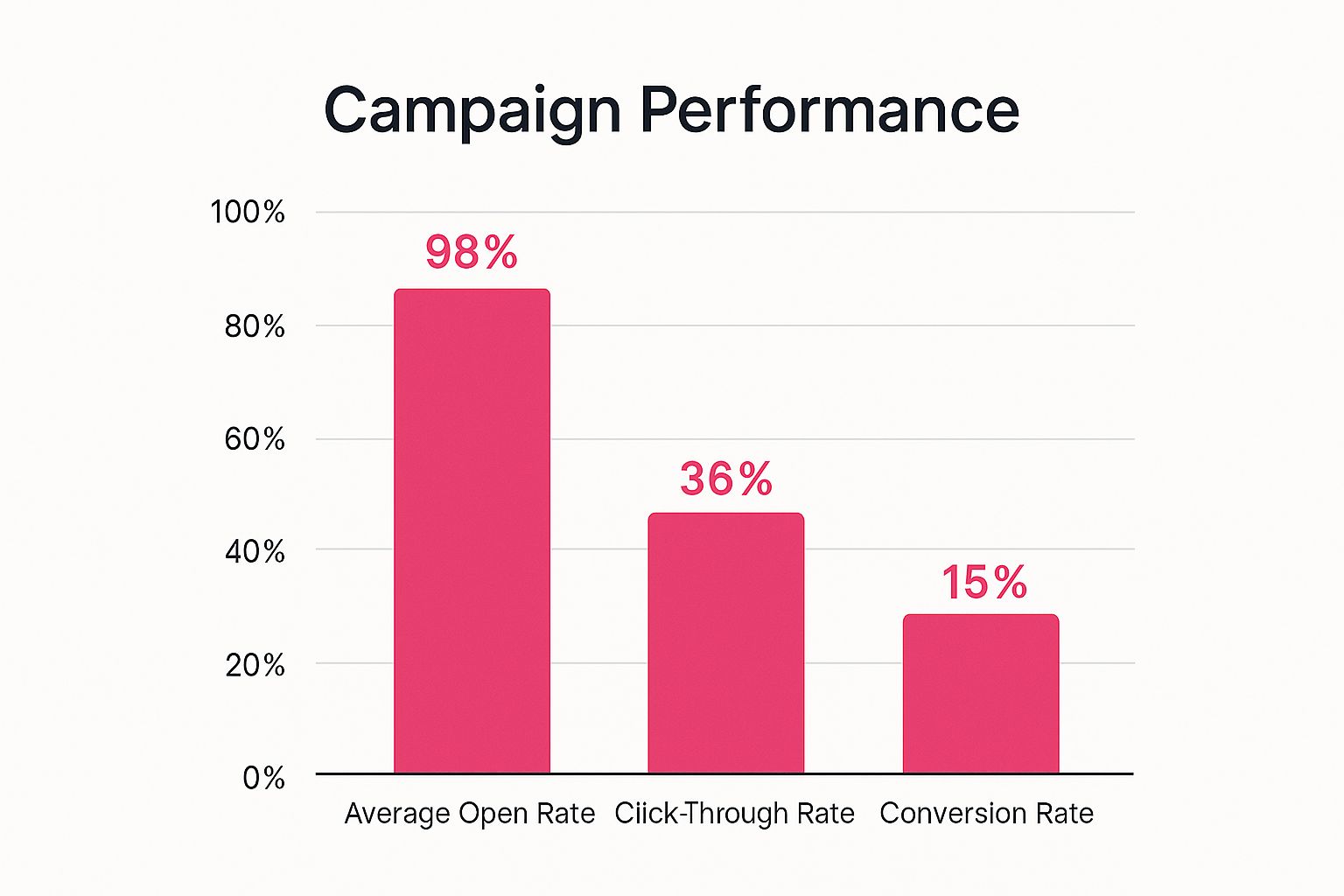
The infographic above highlights some key metrics for SMS campaigns: average open rate, click-through rate, and conversion rate. SMS marketing boasts impressive engagement. Open rates are close to 98%, and click-through rates can reach 36%.
Conversion rates average around 15%. Combined with the high open and click-through rates, this presents a significant opportunity for ecommerce businesses. This data clearly shows how automated SMS can drive real results.
The true power of SMS marketing for ecommerce lies in automation. Going beyond single campaigns to automated messaging lets you deliver the right message at the perfect moment. This maximizes impact and improves efficiency. This is precisely how top ecommerce brands craft personalized customer journeys that boost engagement and sales.
Trigger-Based Messaging for Personalized Experiences
Imagine welcoming a customer the instant they subscribe to your SMS list. Or, picture sending a personalized product recommendation based on recent browsing activity. This is the potential of trigger-based messaging.
Connecting your SMS platform with your current ecommerce platform creates seamless customer experiences. This integrated approach ensures consistent communication across every touchpoint.
Automating Key Ecommerce Workflows
Automation streamlines essential ecommerce workflows. Consider the benefits of an abandoned cart recovery sequence. A well-timed SMS reminding a customer about items left in their cart can recapture lost revenue. Learn more about effective cart abandonment solutions.
This targeted automation not only boosts sales but also improves the customer experience. It demonstrates care and provides a helpful reminder.
Post-purchase sequences can also elevate customer satisfaction and drive repeat purchases. A simple thank you message, along with relevant product recommendations or exclusive offers, builds loyalty and encourages future sales. These automated interactions personalize the customer journey and make every shopper feel valued.
To further illustrate the benefits of SMS automation, let’s look at a comparison of different automated campaign types. The following table summarizes performance metrics for various SMS automation strategies.
SMS Automation Performance Comparison
| Automation Type | Average Conversion Rate | Typical ROI | Customer Satisfaction |
|---|---|---|---|
| Welcome Series | 5-10% | 500% | 90% |
| Abandoned Cart Recovery | 10-15% | 1000% | 85% |
| Post-Purchase Engagement | 2-5% | 200% | 95% |
| Re-engagement Campaigns | 1-3% | 150% | 75% |
As this table shows, different automation types yield different results. While abandoned cart recovery often has the highest ROI, welcome series and post-purchase engagement contribute significantly to overall customer satisfaction. Understanding these nuances allows you to tailor your SMS strategy for optimal performance.
Re-engagement Campaigns and Customer Reactivation
Re-engagement campaigns effectively reactivate inactive customers. A personalized SMS message with a special discount or showcasing new arrivals can reignite interest. This brings lapsed customers back to your store.
This proactive outreach keeps your brand at the forefront of customers’ minds, maximizing customer lifetime value. It’s a valuable way to reconnect with customers who may have simply drifted away.
Testing, Optimizing, and Scaling Your SMS Program
As your subscriber list expands, so should your focus on optimization. Continuously test different message variations, calls to action, and timing to see what resonates best. This data-driven approach lets you refine your campaigns for maximum impact.
This continuous improvement ensures your SMS strategy evolves alongside your business growth. By consistently analyzing and adapting, you can maintain peak performance.
Growing Your SMS Subscriber List That Actually Converts
The foundation of a successful SMS marketing strategy for ecommerce isn’t just about the sheer number of subscribers; it’s about their engagement. A massive list of uninterested subscribers won’t boost your sales. This section explores how to cultivate a highly engaged audience that actively wants to receive your messages, prioritizing quality over quantity.
Creating Compelling Opt-In Offers
Sharing a phone number is a personal choice. Make sure the value proposition is crystal clear. Offer compelling incentives that make subscribing worthwhile.
Some effective motivators include exclusive discounts, early access to sales, and free shipping. For example, a 15% discount on a first purchase is a tried-and-true tactic to entice sign-ups. This immediate reward provides a strong incentive for sharing contact information. Alternatively, offering early access to new product launches creates a sense of exclusivity for SMS subscribers. Tailor your offers to resonate with your specific target audience and their interests.
Designing Streamlined Sign-Up Experiences
Make subscribing as easy and frictionless as possible. Complex forms and unclear instructions can deter potential subscribers. Implement simple opt-in methods like website pop-ups, dedicated landing pages, and checkout checkboxes.
Crucially, ensure your sign-up process is mobile-friendly. Many customers browse and shop on their smartphones. A cumbersome mobile experience can significantly impact your conversion rate.
Implementing Segmentation Strategies for Relevance
As your list grows, segmentation becomes crucial for maintaining high engagement. Divide your subscribers into groups based on their behavior, preferences, and purchase history. This personalization increases the relevance of your messages.
For instance, segment customers who frequently purchase athletic wear and send them targeted messages about new arrivals in that category. This targeted approach ensures your messages are relevant, minimizing opt-outs and maximizing conversions.
Leveraging Cross-Channel Promotion for List Growth
Promote your SMS program across all your marketing channels. Include clear calls to action on your website, social media platforms, and even in your email newsletters.
Highlight the benefits of subscribing, such as exclusive deals and early access to sales. This multi-channel approach broadens your reach and builds brand awareness. For tips on optimizing conversions, check out this guide: How to Master Ecommerce Conversion Rate Optimization.
Focusing on Quality Metrics Beyond List Size
While list size matters, other metrics offer a more accurate picture of your SMS program’s health. Track click-through rates, conversion rates, and revenue generated from SMS campaigns. This data provides valuable insights for improvement.
Also, monitor your opt-out rate. A high opt-out rate suggests a problem with your messaging strategy or frequency. The effectiveness of SMS marketing for ecommerce is impressive: 65% of SMS-driven buyers purchased sooner than planned, and 14% made unplanned purchases due to an SMS message. For more insights, read: Learn More About SMS Statistics. Furthermore, 87% of U.S. shoppers subscribed to brand texts are likely to purchase after signing up. This underscores the power of SMS to drive immediate and future sales. By prioritizing a quality subscriber list and tracking key performance indicators, you can build a profitable and sustainable SMS marketing strategy for your ecommerce business.
Measuring What Matters: SMS Metrics That Drive Growth
Understanding the true impact of your SMS marketing goes beyond basic delivery reports. Successful ecommerce brands delve deeper, analyzing key performance indicators (KPIs) to refine their strategies and boost their return on investment. This data-driven method distinguishes impactful SMS campaigns from those that get lost in the noise.
Key SMS Metrics for Ecommerce Success
Several crucial metrics provide a comprehensive understanding of your SMS campaign performance. These extend beyond simple open rates to offer a more complete picture of how your messages are contributing to your business objectives.
- Click-Through Rate (CTR): This metric tracks how often recipients click on links within your SMS messages. A high CTR suggests compelling content and effective calls to action.
- Conversion Rate: This reveals the percentage of SMS recipients who complete a desired action, such as a purchase or newsletter signup. It directly reflects the effectiveness of your messaging in generating sales.
- Opt-Out Rate: While a certain level of opt-outs is expected, a high rate may indicate issues with your messaging frequency, relevance, or overall value. Monitoring this metric helps identify areas for improvement and maintain subscriber engagement.
- Revenue Generated: This crucial metric tracks the revenue directly attributed to your SMS campaigns. It provides a clear measure of your return on investment (ROI).
Attributing Revenue Across Multiple Touchpoints
Today’s customers interact with brands across various platforms before making a purchase. Accurately attributing revenue across these touchpoints can be a complex task.
However, methods exist to isolate the impact of SMS marketing on overall sales. Using unique discount codes within your SMS campaigns, for example, allows for precise tracking of conversions directly linked to those messages. This helps quantify SMS’s impact on your bottom line.
You might be interested in: Learn more in our article about how to master SMS Marketing ROI.
Calculating the Lifetime Value of SMS Subscribers
Analyzing the lifetime value (LTV) of your SMS subscribers, compared to non-subscribers, unveils the long-term effectiveness of your SMS strategy. If SMS subscribers consistently spend more over their relationship with your brand, it demonstrates SMS’s power in building customer loyalty and driving repeat purchases. This allows you to allocate marketing budget effectively, focusing on high-value channels.
Identifying Opportunities for Improvement
SMS metrics analysis can pinpoint areas for optimization. A/B testing different message variations, calls to action, and sending times can reveal what resonates most with your audience. Continuous testing and iteration based on this data ensure your SMS strategy remains impactful and drives sustained growth. To expand your reach, consider other channels, like organically growing your presence on platforms such as Instagram.
Building a Reporting Routine
Regular reporting keeps your SMS marketing aligned with your business goals. Tracking and presenting key metrics to stakeholders demonstrates the value of SMS and justifies continued investment. This transparent communication strengthens support for your SMS strategy and highlights its contributions to overall business success. Meticulous tracking and analysis can transform your SMS program into a reliable source of revenue growth.
Ready to convert abandoned carts into profits and boost your ecommerce sales? Explore automated SMS marketing with CartBoss and discover how easy it is to recover lost revenue and build lasting customer relationships.